
Quick answer
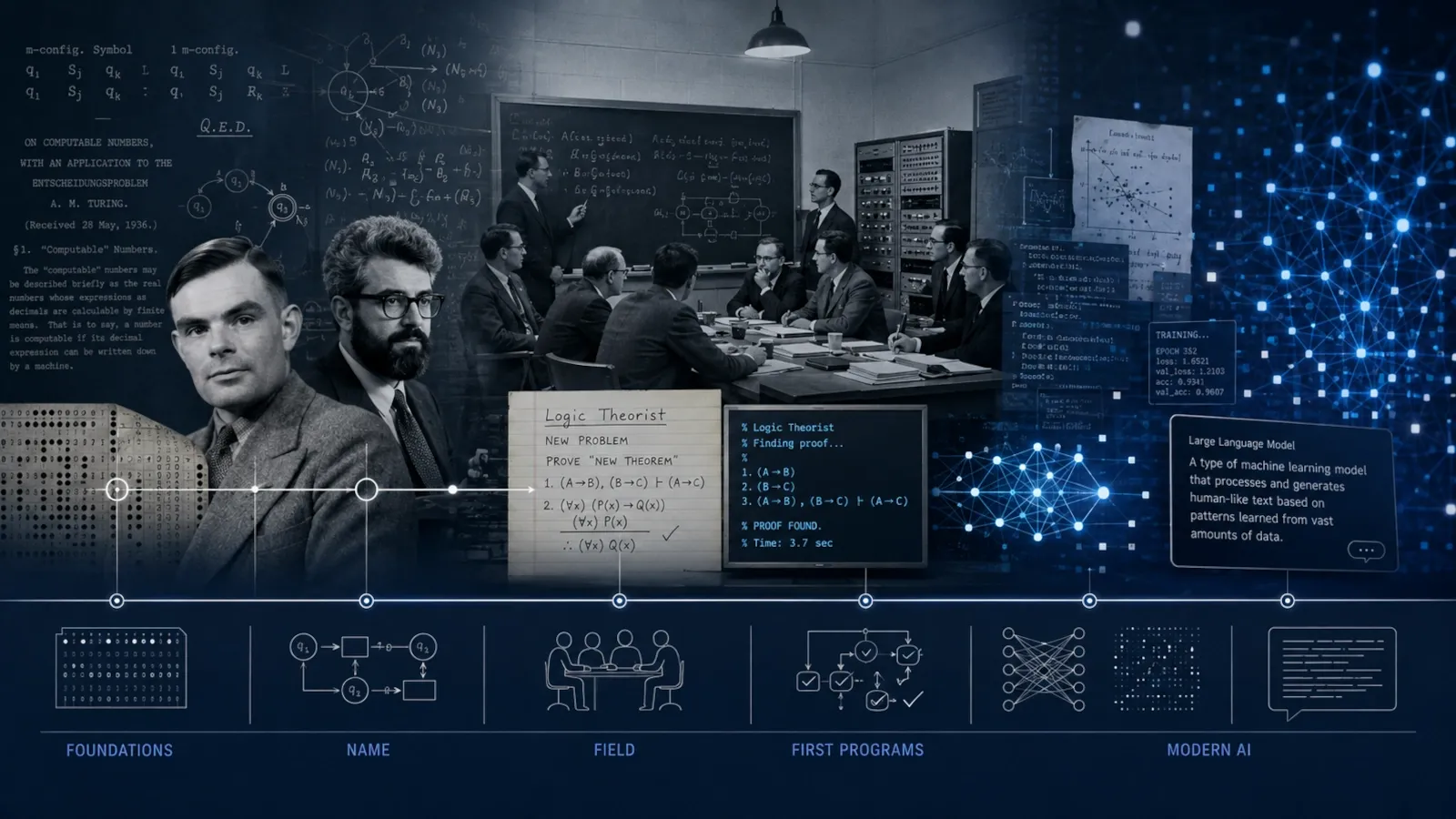
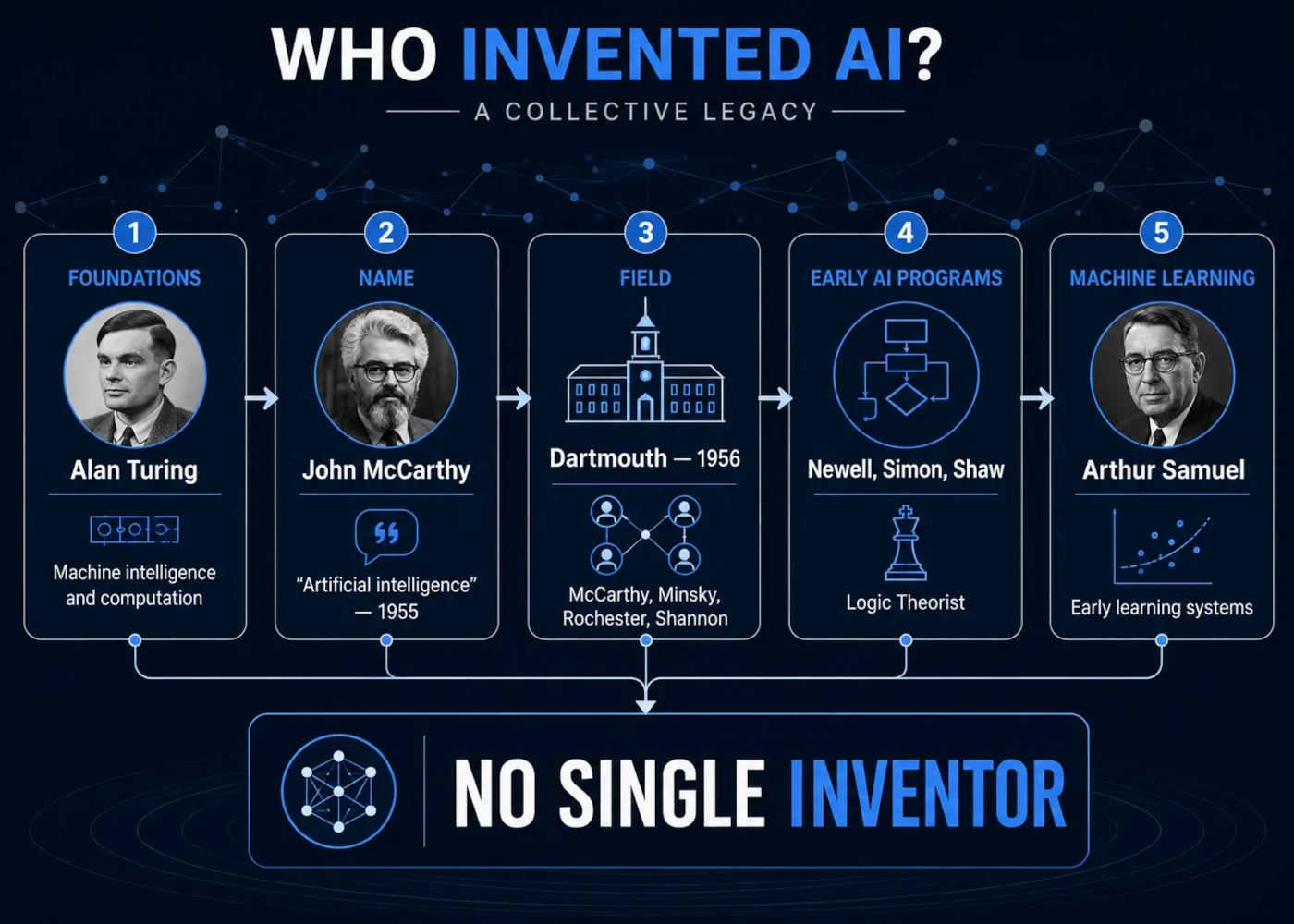
No single person invented artificial intelligence. If you need one name, John McCarthy is the closest answer: he is credited with coining the term artificial intelligence in the 1955 proposal for the Dartmouth Summer Research Project and helped organize the 1956 workshop that established AI as a recognizable research field.
But that answer is incomplete. Alan Turing had already laid crucial foundations for machine intelligence; Warren McCulloch and Walter Pitts modeled artificial neurons; Allen Newell, Herbert A. Simon and J. C. Shaw built Logic Theorist, one of the earliest AI programs; and pioneers including Marvin Minsky, Claude Shannon, Nathaniel Rochester and Arthur Samuel helped shape the field.
The most accurate answer is therefore:
| If by “invented AI” you mean… | Best answer |
|---|---|
| Who laid major conceptual foundations for machine intelligence? | Alan Turing, alongside earlier logic, neuroscience and computing researchers |
| Who coined the term “artificial intelligence”? | John McCarthy, in the 1955 Dartmouth proposal |
| Who helped establish AI as a research field? | John McCarthy, Marvin Minsky, Nathaniel Rochester, Claude Shannon and the wider Dartmouth community |
| When did AI become a formal field? | 1956, at the Dartmouth Summer Research Project |
| Who built one of the first true AI programs? | Allen Newell, Herbert A. Simon and J. C. Shaw, with Logic Theorist |
| Who pioneered early machine learning? | Arthur Samuel, especially through his checkers work |
| Who invented modern AI alone? | No one |
That distinction matters because AI is not one machine, one algorithm or one product. It is a scientific and engineering field built over decades.
When to use this solution
This guide is for you if you are trying to answer any of these questions accurately:
- Who invented AI?
- Who created artificial intelligence?
- Who is the father of AI?
- Did Alan Turing invent AI?
- Did John McCarthy invent AI?
- When was AI invented?
- What was the first AI program?
- Who were the founders of AI?
- Did OpenAI or ChatGPT invent AI?
- Did Elon Musk invent AI?
- Who invented AI as we know it today?
If your real question is how AI works, what machine learning is, or how generative AI produces answers, those are different topics. This article focuses on origins, historical credit and the milestones that turned machine intelligence from an idea into a research field.
Before you start
Three points make the history much easier to understand.
- “AI” is a field, not a single invention. There is no equivalent of one patent, one prototype or one launch date that settles the question.
- “Invented” can mean several different things. The person who asked the foundational question is not necessarily the person who named the field, organized the community or built the first working program.
- Historical “firsts” depend on definitions. A game-playing program, a theorem prover, an artificial neural model and a general problem-solving system can all qualify as early AI under different definitions.
This is why simple statements such as “John McCarthy invented AI in 1956” are useful shortcuts, but not complete history.
Main explanation: why AI has no single inventor
Artificial intelligence emerged where several disciplines met: mathematical logic, computation, neuroscience, information theory, psychology, statistics and programming.
That makes the history of AI closer to the history of a scientific discipline than the history of a consumer product.
A smartphone model can have a launch date. A particular software package can have named developers. AI is different. Researchers spent years answering separate questions:
- Can reasoning be represented mathematically?
- What can a general-purpose computer calculate?
- Can the behavior of neurons be modeled logically?
- Can a machine manipulate symbols to solve a problem?
- Can a program improve through experience?
- Can language, perception and planning be represented computationally?
The field appeared only after enough of those threads came together.
That is why John McCarthy is the best one-name answer, but “no single person” is the best historical answer.
How to understand who invented AI in five steps
1. Separate the foundations from the field itself
Long before researchers used the label artificial intelligence, mathematicians and scientists were developing the ideas that would make AI possible.
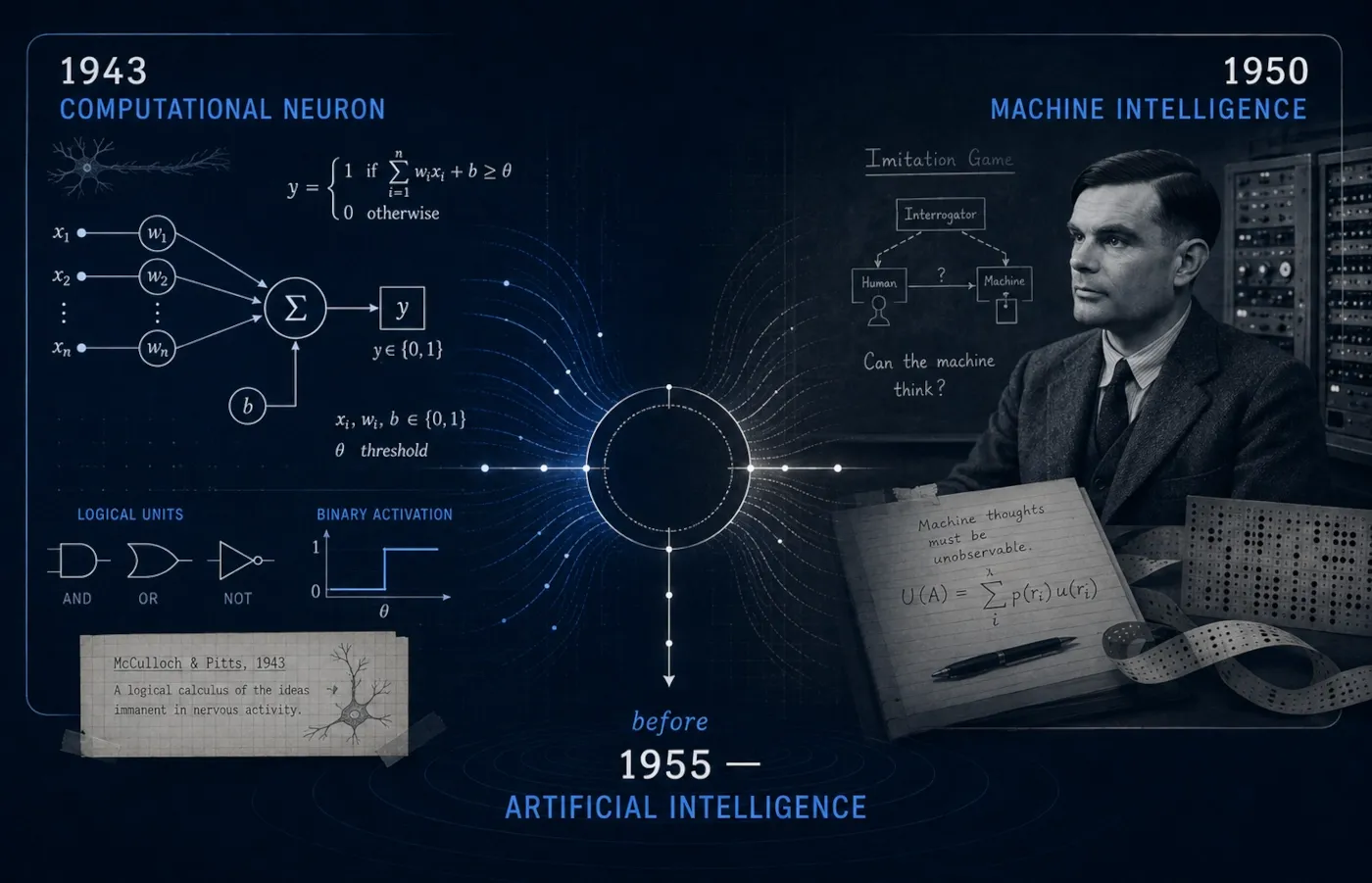
In 1943, neurophysiologist Warren McCulloch and mathematician Walter Pitts published a mathematical model showing how simplified neuron-like units could implement logical operations. Their work did not create modern neural networks, but it became an important intellectual ancestor of computational models of cognition.
In 1950, Alan Turing published Computing Machinery and Intelligence in Mind. Instead of trying to define “thinking” directly, Turing proposed what became known as the imitation game, later associated with the term Turing Test. His paper also discussed learning machines and objections to machine intelligence.
These were foundations of AI, but the field still did not have its modern name or a unified research identity.
2. Identify who gave the field its name
The strongest one-person answer appears in 1955.
While at Dartmouth, John McCarthy took the lead in preparing a proposal for a summer research project. The proposal used the phrase “artificial intelligence”, and Stanford credits McCarthy with creating the term.
This date is worth getting right:
- 1955: the term artificial intelligence appears in the Dartmouth proposal.
- 1956: the Dartmouth Summer Research Project takes place.
The distinction is small, but important. Saying “McCarthy coined AI in 1956” compresses two separate milestones into one.
3. Understand why Dartmouth 1956 matters
The Dartmouth Summer Research Project on Artificial Intelligence brought researchers together around a shared idea: aspects of learning and intelligence might be described precisely enough for machines to simulate them.
The proposal was associated with four principal organizers:
- John McCarthy
- Marvin Minsky
- Nathaniel Rochester
- Claude Shannon
The workshop did not instantly solve intelligence, nor did every major AI technique come from that summer. Its importance was institutional and conceptual: it helped give a scattered set of questions a name, a community and a research agenda.
That is why Dartmouth is widely treated as the birthplace of artificial intelligence as a field.
In 2026, Dartmouth is marking the 70th anniversary of that 1956 workshop, a useful reminder that the formal field of AI is now seven decades old.
4. Look at the first working AI programs
A field is more than a name. Researchers also had to demonstrate that computers could perform tasks associated with reasoning.
Logic Theorist, developed by Allen Newell, Herbert A. Simon and J. C. Shaw in 1955–56, could prove statements in symbolic logic. Carnegie Mellon describes it as the first artificial intelligence program, while other historical accounts use more cautious wording such as “one of the first AI programs.”
That caution is justified. Earlier programs had already explored games and other apparently intelligent behavior. So the answer to “what was the first AI program?” depends on what counts as AI.
Still, Logic Theorist is a major milestone because it demonstrated automated symbolic reasoning rather than merely performing arithmetic.
5. Follow the transition from symbolic AI to learning systems
Early AI was not one approach. Symbolic reasoning, search, game playing, neural models and learning all developed along different paths.
Arthur Samuel became a key figure in machine learning through his checkers program. IBM credits him with coining the term “machine learning” in 1959.
The decades that followed added many more layers: expert systems, probabilistic methods, neural networks, reinforcement learning, deep learning, transformer architectures and generative AI.
Modern systems are therefore descendants of a long research history, not the work of one modern company or one recent inventor.
Did John McCarthy invent AI?
John McCarthy did not invent every idea or technique in artificial intelligence, but he is the person most defensibly named when someone asks for a single “inventor of AI.”
His claim rests on several distinct contributions.
He coined the name
Stanford credits McCarthy with coining the term artificial intelligence in 1955. The phrase appeared in the proposal for the Dartmouth Summer Research Project on Artificial Intelligence.
Naming matters. Researchers had previously discussed cybernetics, automata, neural models, machine intelligence and related ideas. “Artificial intelligence” gave the emerging field a broad label under which different approaches could coexist.
He helped create the Dartmouth project
McCarthy was a principal organizer of the 1956 Dartmouth gathering. That workshop is widely recognized as the event that launched AI as a distinct research field.
He helped build the intellectual infrastructure of early AI
McCarthy later made major contributions to symbolic AI and developed Lisp, a programming language that became deeply associated with AI research.
For these reasons, McCarthy is often called the father of artificial intelligence.
That label is reasonable as long as it is not interpreted to mean that he worked alone or that AI began from nothing with him.
Did Alan Turing invent AI?
No — not in the narrow historical sense of founding the field called artificial intelligence. But Turing is one of the most important intellectual ancestors of AI.
Turing’s influence comes from two major directions.
The mathematical foundations of computation
In the 1930s, Turing helped formalize what it means for a process to be computable. The theoretical machine that now bears his name became foundational to computer science.
Without a rigorous concept of general computation, the later idea of programming machines to perform intelligent tasks would have been much harder to formulate.
The question of machine intelligence
Turing’s 1950 paper Computing Machinery and Intelligence begins from the question of whether machines can think. He reframed the problem through the imitation game and discussed learning, objections to machine intelligence and the capabilities of digital computers.
That was six years before the Dartmouth workshop.
So the clean distinction is:
Turing helped establish the intellectual foundations of machine intelligence. McCarthy named and helped organize artificial intelligence as a field.
This is more accurate than calling either man the sole inventor.
When was AI actually invented?
There is no universally correct single date because different milestones answer different versions of the question.
| Date | What happened | Why it matters |
|---|---|---|
| 1943 | McCulloch and Pitts published a mathematical neuron model | Early bridge between neuroscience, logic and computation |
| 1950 | Turing published Computing Machinery and Intelligence | Major conceptual framework for machine intelligence |
| 1955 | The Dartmouth proposal used the term artificial intelligence | AI received its enduring name |
| 1955–56 | Newell, Simon and Shaw developed Logic Theorist | One of the first working AI reasoning programs |
| 1956 | Dartmouth Summer Research Project took place | AI became a recognizable research field |
| 1958 | McCarthy developed Lisp | A language that became central to symbolic AI research |
| 1959 | Arthur Samuel popularized the term machine learning through his checkers work | Important step toward systems that improve from experience |
If someone asks “What year was AI born?”, 1956 is the conventional answer because it marks the formal emergence of the field.
If someone asks “When did the ideas behind AI begin?”, the answer has to reach further back.
Dartmouth 1956: the moment AI became a field
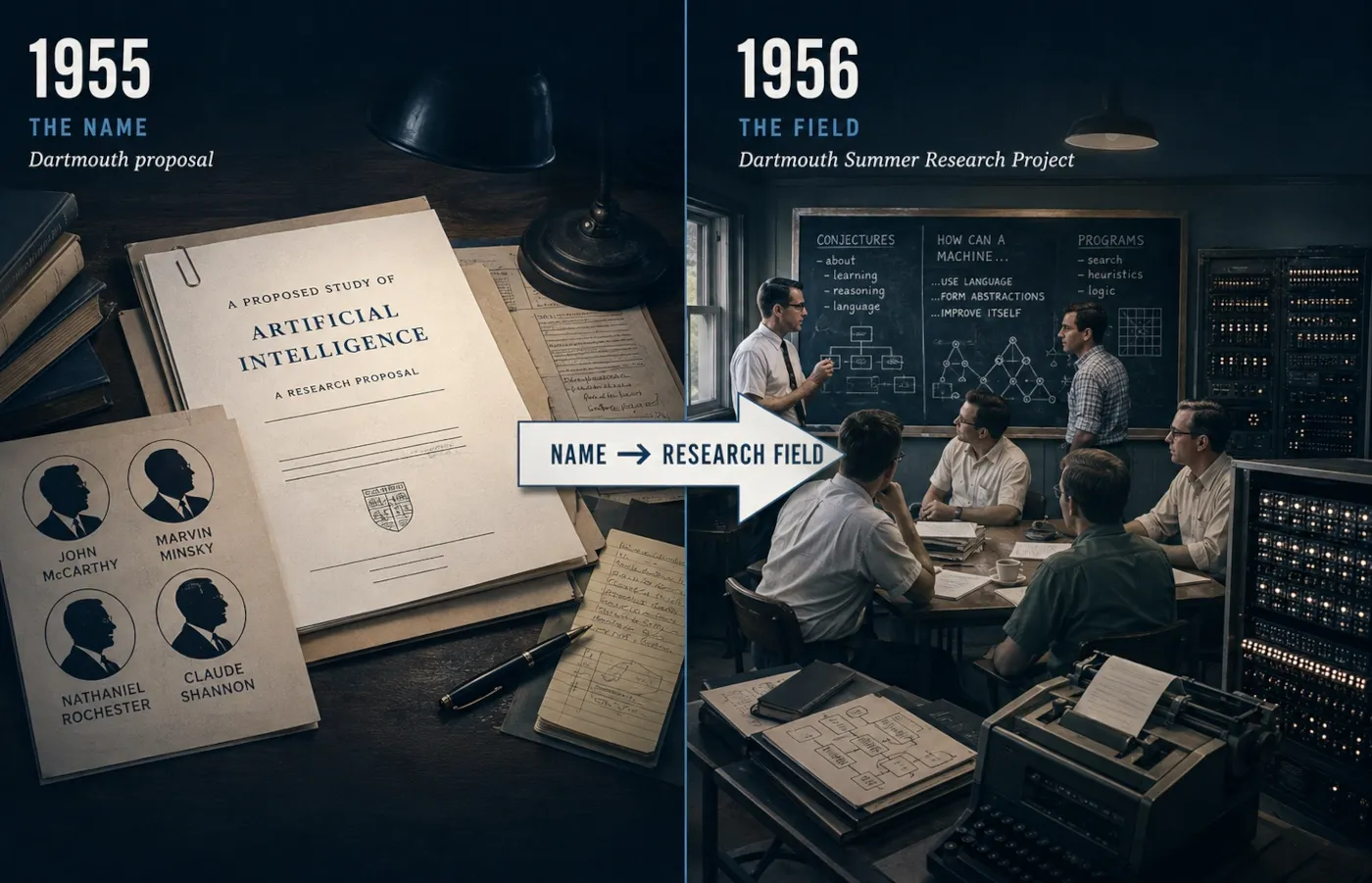
The Dartmouth workshop is sometimes described as AI’s birth because it did something earlier work had not: it assembled a research program around the explicit label “artificial intelligence.”
The organizers were not starting from a blank page. By 1956, there were already ideas about neural computation, game playing, automated reasoning, information theory and digital computers.
What Dartmouth did was bring these ambitions under a common premise.
The original proposal argued that aspects of learning and intelligence might be described with enough precision that a machine could simulate them. This was an extraordinarily ambitious research agenda. Many of its goals remain active research problems today.
Who organized the Dartmouth project?
The proposal was authored by:
- John McCarthy, then at Dartmouth
- Marvin Minsky, then at Harvard
- Nathaniel Rochester, from IBM
- Claude Shannon, from Bell Telephone Laboratories
Other influential researchers participated in or were connected to the broader early-AI community, including Allen Newell, Herbert Simon and Arthur Samuel.
It is more accurate to call these people founders and pioneers of the field than to call every one of them an “inventor of AI.”
Why 1956 is still used as AI’s birthday
Scientific fields rarely begin in one room on one day. Yet historians need useful milestones, and Dartmouth provides an unusually strong one:
- the field had a name;
- researchers gathered under that name;
- a research agenda was stated explicitly;
- the event helped establish an enduring academic community.
Dartmouth itself continues to describe the 1956 project as the event that launched the field.
What was the first AI program?
The most common answer is Logic Theorist.
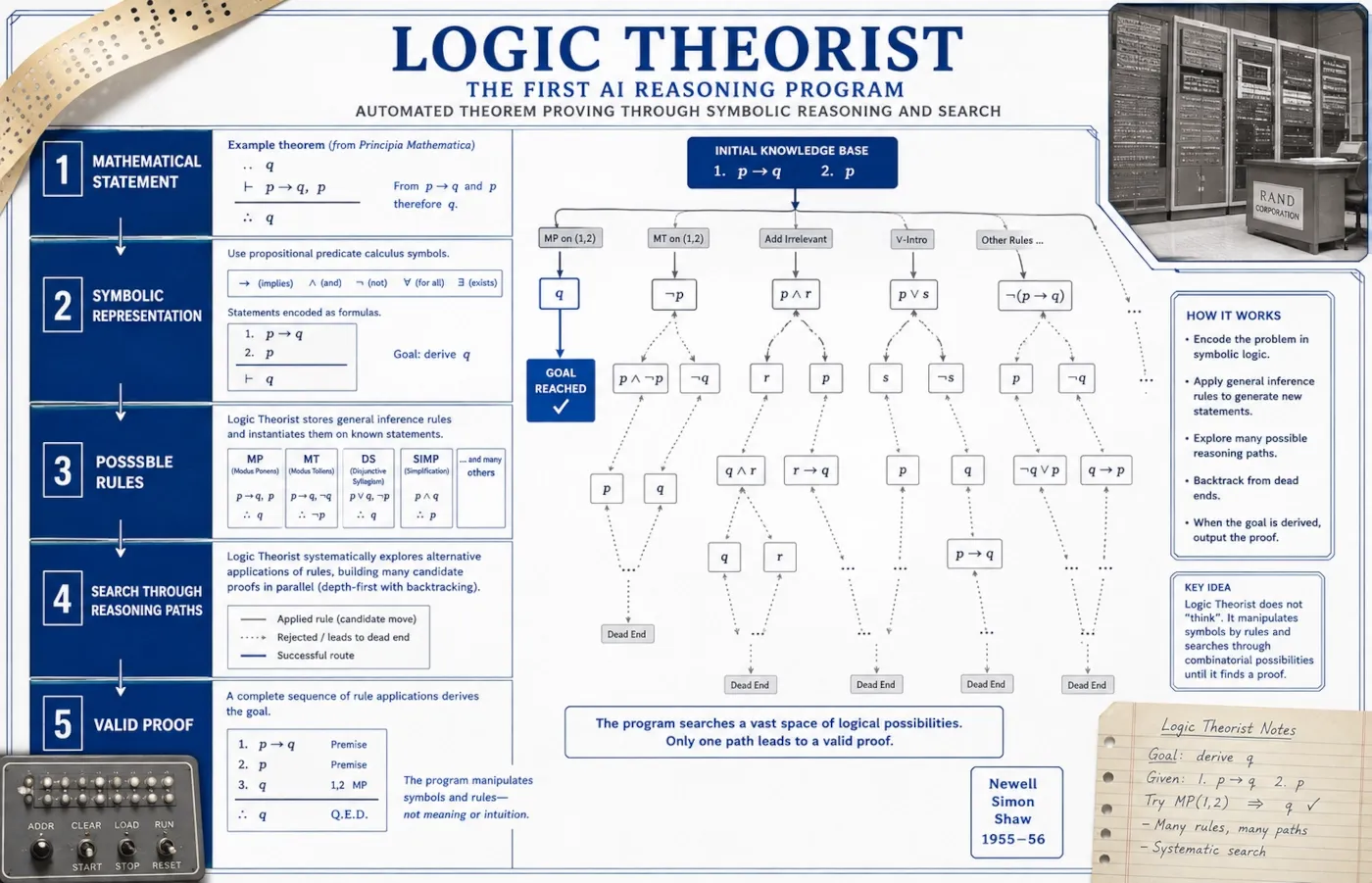
Developed by Allen Newell, Herbert A. Simon and J. C. Shaw, Logic Theorist was designed to prove theorems in symbolic logic. It represented problems as symbolic structures and searched for sequences of operations that could produce proofs.
Carnegie Mellon describes Logic Theorist as the first artificial intelligence program and dates the work to 1955–56.
However, the word first needs a qualification.
Earlier computer programs had already demonstrated game playing and other behaviors that can reasonably be described as intelligent. Depending on whether you define AI as game strategy, symbolic reasoning, learning, neural computation or general problem solving, a different candidate may appear.
For a general reader, the safest formulation is:
Logic Theorist is widely regarded as the first true AI or automated-reasoning program, although the exact “first AI program” depends on how AI is defined.
That is more defensible than presenting the question as historically uncontested.
The people who built early AI
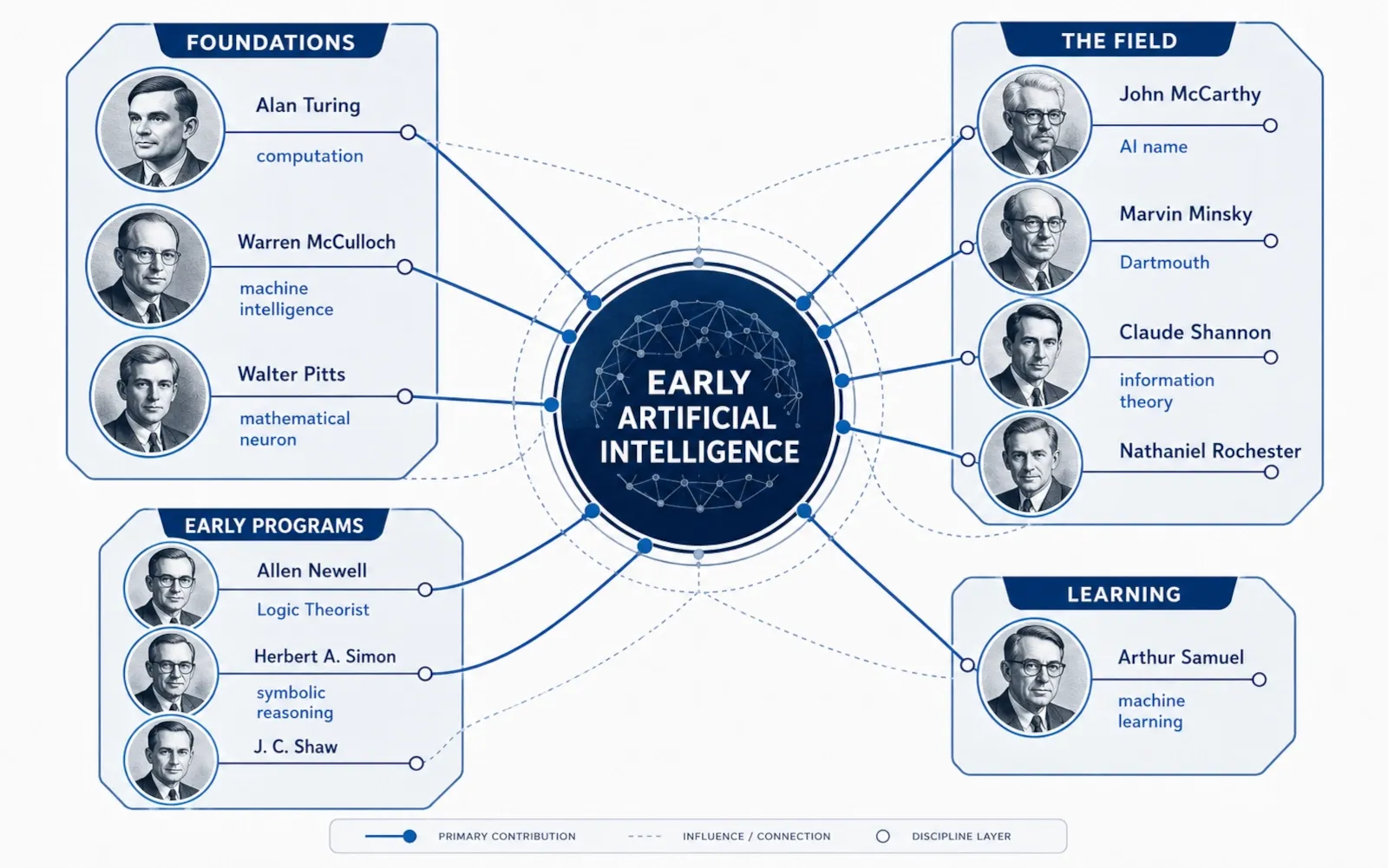
AI’s origin becomes much clearer when each pioneer is credited for a specific contribution instead of being placed in a vague list of “inventors.”
| Pioneer | Why they matter to AI history |
|---|---|
| Alan Turing | Foundations of computation; 1950 treatment of machine intelligence and the imitation game |
| Warren McCulloch | Co-created an early mathematical model of neuron-like computation |
| Walter Pitts | Co-created the McCulloch–Pitts logical neuron model |
| John McCarthy | Coined artificial intelligence; Dartmouth organizer; major symbolic-AI researcher; Lisp |
| Marvin Minsky | Dartmouth co-organizer and influential early AI researcher |
| Claude Shannon | Information-theory pioneer and Dartmouth co-author |
| Nathaniel Rochester | IBM computer pioneer and Dartmouth co-author |
| Allen Newell | Co-created Logic Theorist and later major symbolic problem-solving systems |
| Herbert A. Simon | Co-created Logic Theorist; major work on problem solving and cognition |
| J. C. Shaw | Co-created Logic Theorist and contributed to its programming |
| Arthur Samuel | Early machine-learning pioneer through checkers; associated with the term machine learning |
This table also shows why the phrase “the inventor of AI” is too narrow. Different people deserve credit for different layers of the field.
AI history in one timeline
A useful timeline should show continuity without pretending that every modern AI system descends from one uninterrupted technical approach.
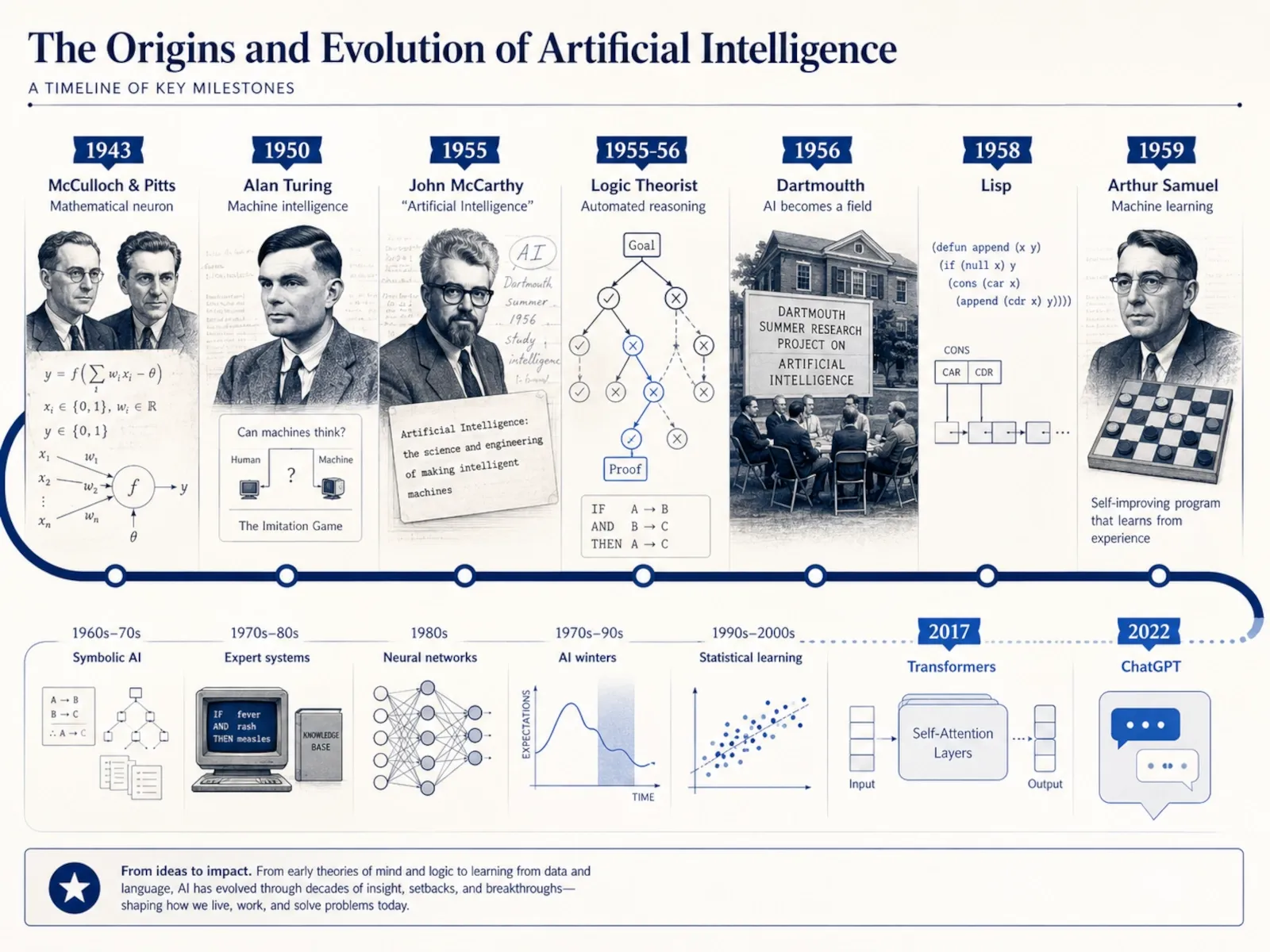
1943 — McCulloch and Pitts model artificial neurons
Their paper connected simplified neural activity with mathematical logic, helping establish the idea that aspects of cognition could be represented computationally.
1950 — Turing reframes machine intelligence
Alan Turing publishes Computing Machinery and Intelligence and proposes the imitation game.
1955 — Artificial intelligence gets its name
John McCarthy uses the phrase artificial intelligence in the Dartmouth research proposal prepared with Marvin Minsky, Nathaniel Rochester and Claude Shannon.
1955–56 — Logic Theorist demonstrates automated reasoning
Newell, Simon and Shaw build a program capable of proving symbolic logic theorems.
1956 — Dartmouth launches AI as a field
Researchers gather for the Dartmouth Summer Research Project on Artificial Intelligence. The event becomes the conventional birth point of AI as an academic discipline.
1958 — Lisp strengthens symbolic AI research
McCarthy develops Lisp, which becomes one of the defining programming languages of early AI.
1959 — Machine learning receives its name
Arthur Samuel’s checkers work demonstrates a program improving through experience, and the term machine learning becomes associated with this line of research.
Later decades — AI repeatedly changes methods
Symbolic AI, expert systems, statistical learning, neural networks and reinforcement learning rise at different times. Periods of high expectations are followed by reduced funding and enthusiasm, often called AI winters.
2017 — Transformers reshape language AI
The paper Attention Is All You Need introduces the Transformer architecture, which becomes foundational to many later large language models.
2022 — ChatGPT makes generative AI mainstream
OpenAI releases ChatGPT publicly on November 30, 2022. Its conversational interface dramatically increases public awareness of generative AI, but it arrives decades after the field of AI was created.
The timeline makes the central point obvious: ChatGPT is part of AI history, not the beginning of AI history.
Did ChatGPT invent AI?
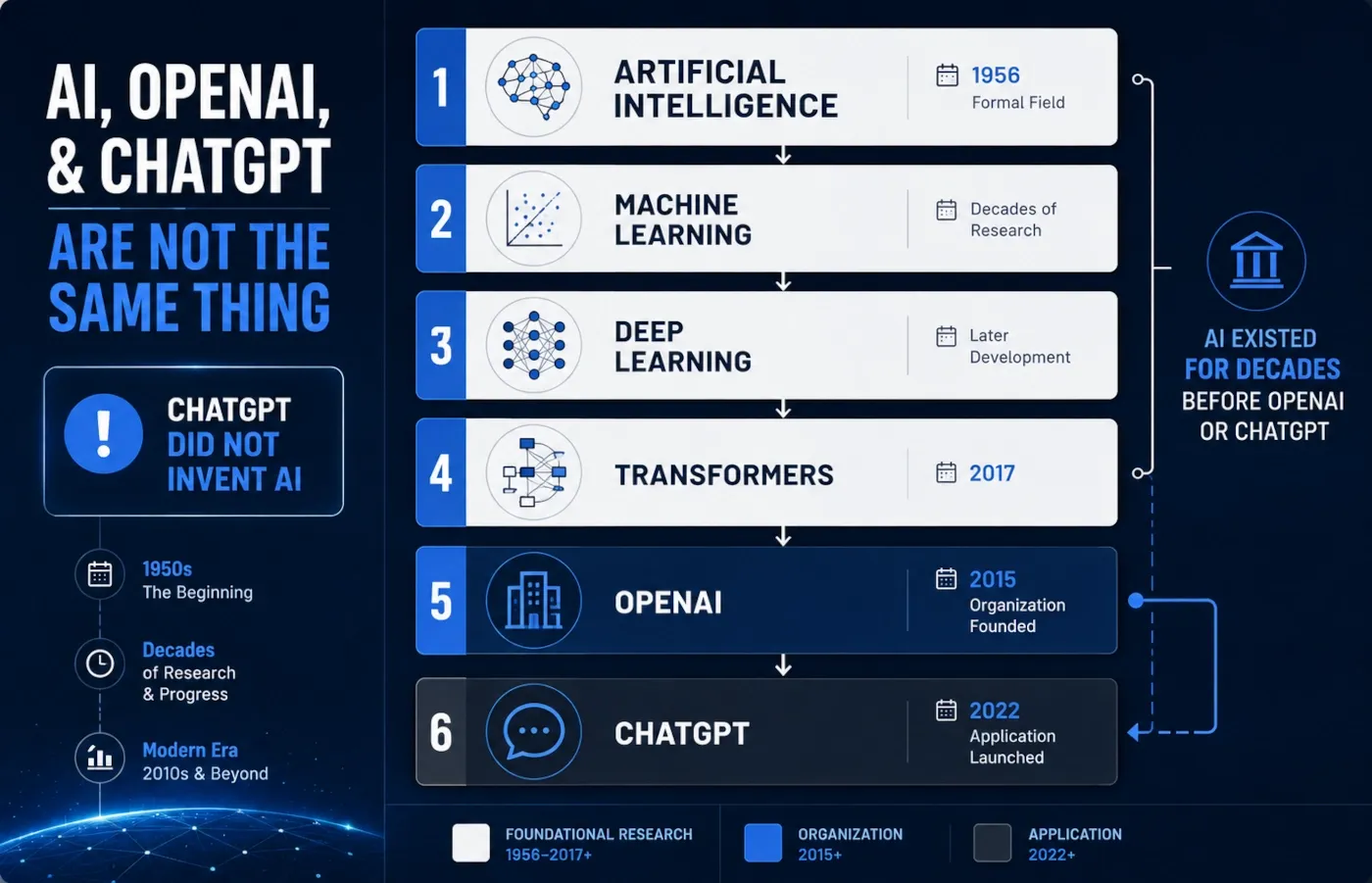
No. ChatGPT did not invent artificial intelligence.
ChatGPT is an AI application developed by OpenAI and publicly introduced in 2022. It belongs to the modern era of generative AI and large language models.
By the time ChatGPT appeared:
- AI had existed as a formal research field for about 66 years;
- machine learning had decades of research behind it;
- neural networks had gone through several generations;
- deep learning had already transformed speech and image recognition;
- the Transformer architecture had been published in 2017.
ChatGPT matters enormously to the popularization and deployment of AI, but not to its original invention.
This distinction explains why searches such as “who invented AI ChatGPT?” combine two different questions:
- Who created the field of AI?
- Who developed ChatGPT?
They do not have the same answer.
Did OpenAI invent artificial intelligence?
No.
OpenAI was founded in 2015, almost six decades after the Dartmouth workshop. Its own original announcement describes it as an artificial-intelligence research organization, which by definition means the field already existed.
OpenAI has contributed influential modern systems and helped bring generative AI to a mass audience. That is historically important, but it is not the same as inventing AI.
A simple date comparison resolves the confusion:
| Event | Date |
|---|---|
| Turing’s machine-intelligence paper | 1950 |
| Term artificial intelligence used in Dartmouth proposal | 1955 |
| Dartmouth AI workshop | 1956 |
| OpenAI founded | 2015 |
| Transformer paper | 2017 |
| ChatGPT launched | 2022 |
Did Elon Musk invent AI?
No.
Elon Musk was involved in the creation of OpenAI in 2015 and was named as a co-chair in OpenAI’s original announcement. That does not make him an inventor of artificial intelligence.
The field was already roughly six decades old.
This is a useful example of a broader mistake: confusing a prominent modern participant in the AI industry with the historical origin of AI as a scientific discipline.
Who invented AI as we know it today?
There is still no single inventor.
What people call “AI today” combines multiple research traditions:
- symbolic reasoning and search;
- probability and statistics;
- machine learning;
- neural networks;
- reinforcement learning;
- large-scale data and computing;
- deep learning;
- Transformer architectures;
- large language models.
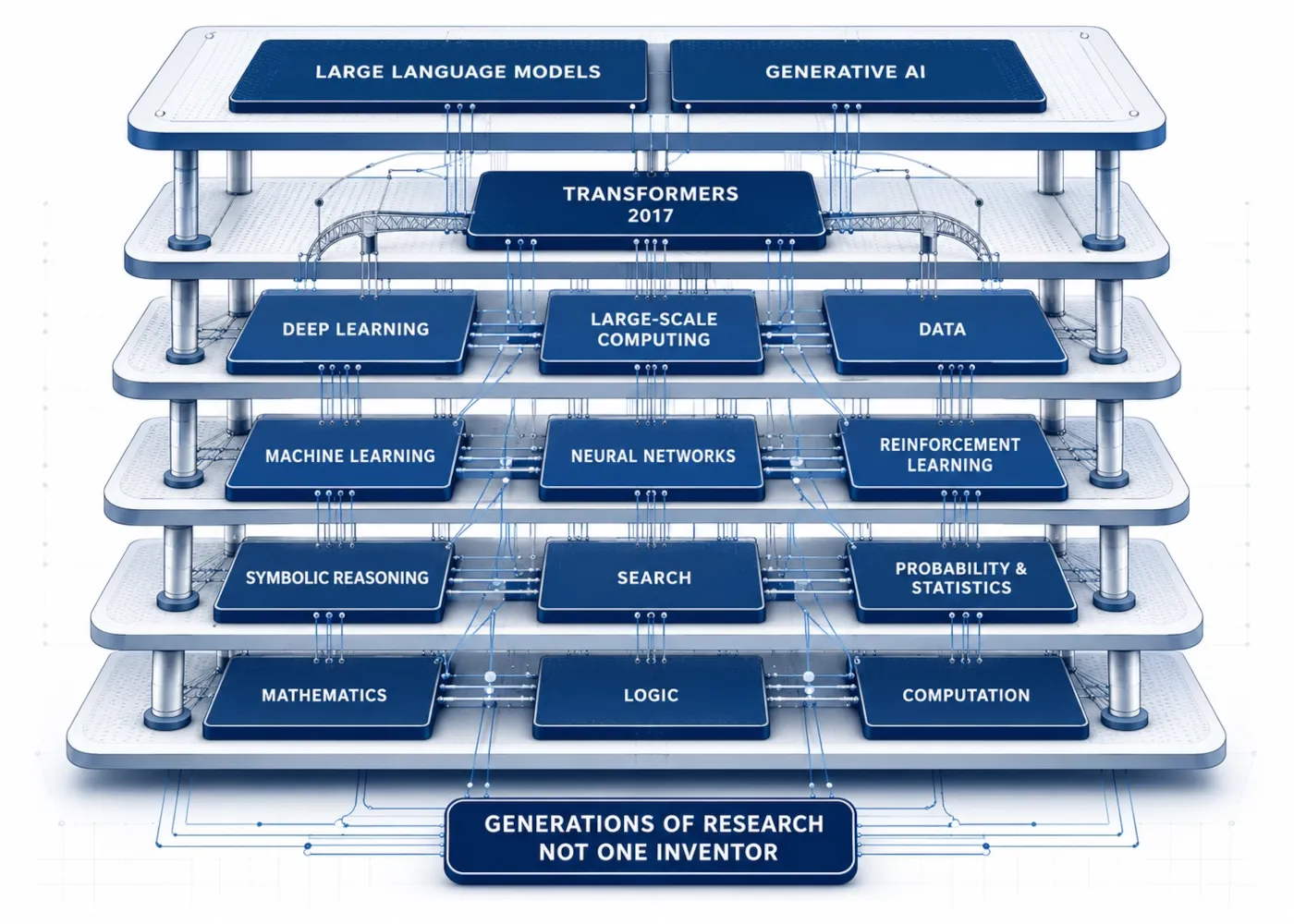
Modern deep learning is itself the result of decades of work. In 2018, the ACM A.M. Turing Award recognized Yoshua Bengio, Geoffrey Hinton and Yann LeCun for conceptual and engineering breakthroughs that made deep neural networks a critical part of computing.
Transformers added another major layer in 2017 through the work of Ashish Vaswani, Noam Shazeer, Niki Parmar, Jakob Uszkoreit, Llion Jones, Aidan N. Gomez, Łukasz Kaiser and Illia Polosukhin.
Large language models then combined architecture, scale, training methods, data, hardware and engineering developed by many teams.
So if the question is “Who invented AI as we know it today?”, the accurate answer is:
Modern AI is a cumulative technological system built by generations of researchers. No individual invented the entire stack.
What about generative AI?
Generative AI also has no single inventor.
The ability to generate text, images, audio or other data emerged from several families of models and decades of work in machine learning. Modern generative AI draws on developments such as neural language modeling, generative adversarial networks, variational methods, diffusion models and Transformers.
For text-based generative AI in particular, the 2017 Transformer paper became a major architectural milestone. But it would still be inaccurate to say that the Transformer authors “invented generative AI” as a whole.
The same credit rule applies:
Name the specific breakthrough, not one person as the inventor of an entire field.
Why AI has founders, not one inventor
The word invention works best when the object has reasonably clear boundaries.
A device can be designed. A program can be written. A protocol can be specified. A patent can identify particular claims.
AI is broader.
It combines:
- mathematics, for formal reasoning and optimization;
- logic, for representing inference;
- computer science, for algorithms and programmable machines;
- neuroscience, which inspired early computational neuron models;
- psychology and cognitive science, for models of problem solving and intelligence;
- statistics, for learning from uncertain data;
- electrical and computer engineering, for the hardware that makes computation possible;
- decades of software engineering, experimentation and research.
That is why “Who invented AI?” is best answered as a credit map, not a single-name trivia question.
Father, godfather and founders: what do these labels mean?
Historical labels can be useful, but they are not formal scientific titles.
John McCarthy: “father of AI”
McCarthy is often called the father of artificial intelligence because he coined the name and played a central role in establishing the field.
This is the strongest conventional one-person answer to the search query.
Alan Turing: foundational thinker, not sole inventor
Turing is sometimes described as a father of AI because his work on computation and machine intelligence was foundational.
A more precise description is that he was one of the essential intellectual precursors of AI and a founding figure of computer science.
Geoffrey Hinton and the “godfather of AI” label
Modern media frequently use labels such as “godfather of AI” for Geoffrey Hinton, while Hinton, Yoshua Bengio and Yann LeCun are strongly associated with the deep-learning revolution.
The ACM recognized all three with the 2018 A.M. Turing Award for breakthroughs that made deep neural networks a critical component of computing.
That does not mean they invented AI in the 1950s. Their work belongs to a later and extremely important chapter.
“Founders of AI”
The plural is often the most historically useful language.
Depending on the scope, a list of early founders and pioneers can include McCarthy, Turing, Minsky, Shannon, Rochester, Newell, Simon, Shaw, Samuel, McCulloch and Pitts.
The list changes because the field has several intellectual lineages. That is not a weakness in the history; it is the reason AI became such a broad discipline.
Final verdict: so, who invented AI?
If a quiz asks for one name, answer:
John McCarthy.
He coined the term artificial intelligence in the 1955 Dartmouth proposal and helped organize the 1956 workshop that established AI as a field.
If the question asks for the historically accurate explanation, answer:
Artificial intelligence had no single inventor.
The credit is better divided like this:
- Alan Turing → foundational ideas about computation and machine intelligence
- McCulloch and Pitts → early mathematical neuron model
- John McCarthy → the name artificial intelligence and a central role in organizing the field
- Dartmouth organizers and participants → establishment of AI as a research discipline
- Newell, Simon and Shaw → Logic Theorist and early automated reasoning
- Arthur Samuel → pioneering machine learning
- later generations of researchers → neural networks, deep learning, Transformers, generative AI and modern systems
That answer preserves the simplicity users want without sacrificing historical accuracy.
Common mistakes
Saying “John McCarthy invented AI in 1956”
This is close, but too compressed.
A more precise version is:
- McCarthy used the term artificial intelligence in the 1955 Dartmouth proposal.
- The influential Dartmouth research workshop took place in 1956.
Saying Alan Turing invented AI
Turing was foundational to computation and machine intelligence, but the research field explicitly called artificial intelligence was organized later.
Credit Turing for the foundation, not for single-handedly creating the discipline.
Saying ChatGPT or OpenAI invented AI
ChatGPT launched in 2022 and OpenAI began in 2015. AI became a formal research field in the 1950s.
Modern prominence is not historical priority.
Treating “first AI program” as completely settled
Logic Theorist is a strong and widely accepted answer, but “first” depends on how AI is defined. Earlier game-playing and computational experiments complicate the boundary.
Use qualified language when historical categories overlap.
Treating “father of AI” as an official title
It is an informal label. It usually points to John McCarthy, but it should not erase the contributions of other pioneers.
Using popularity as proof of historical credit
A famous person may dominate modern search interest for reasons unrelated to the specific historical question.
Alan Turing, for example, is famous for computing theory, wartime cryptanalysis, the Turing machine and the Turing Test. High search interest does not mean one person deserves all credit for inventing AI.
Security, privacy and safety notes
This is a historical explainer, so it does not require you to enter personal information, install software or share data. The main risk is information quality, not account or device security.
For reliable AI history:
- prefer primary papers and institutional archives over unattributed summaries;
- treat exact quotations carefully and verify them against the original source;
- distinguish the date a term was proposed from the date an event took place;
- avoid turning informal labels such as “father” or “godfather” into formal titles;
- do not assume an AI-generated answer is historically correct without checking its sources;
- remember that historical claims such as “first AI program” can change with the definition being used.
The same caution applies to current AI systems: capability claims, model names and company structures can change much faster than the historical facts covered in this article.
Faster alternative
If you only need the shortest reliable answer, use this:
John McCarthy is most often credited as the father of AI because he coined the term “artificial intelligence” in 1955 and helped organize the Dartmouth workshop in 1956. But AI had no single inventor: Alan Turing and many other researchers laid the foundations and built the earliest systems.
Use the full guide when you need to distinguish the idea, the name, the field and the first programs.
FAQ
Who invented AI first?
There is no single inventor. John McCarthy is the closest one-name answer because he coined the term artificial intelligence and helped establish the field. Earlier researchers, especially Alan Turing, had already developed key foundations of machine intelligence.
Who is the father of AI?
John McCarthy is most commonly called the father of artificial intelligence. The label reflects his role in naming the field, organizing the Dartmouth project and advancing AI research. It is an informal historical title, not proof that he worked alone.
Did Alan Turing invent AI?
Not by himself. Turing provided essential foundations for computation and machine intelligence, especially through his 1950 paper Computing Machinery and Intelligence. The field named artificial intelligence was established later.
Who coined the term artificial intelligence?
John McCarthy is credited with coining the term. Stanford records place the phrase in the 1955 proposal for the Dartmouth Summer Research Project on Artificial Intelligence.
When was AI invented?
1956 is the conventional answer for the birth of AI as a research field because that is when the Dartmouth Summer Research Project took place. Important foundations appeared earlier, and the name artificial intelligence was used in the 1955 proposal.
What was the first AI program?
Logic Theorist, developed by Allen Newell, Herbert A. Simon and J. C. Shaw in 1955–56, is widely described as the first AI or automated-reasoning program. The exact answer depends on how broadly “AI program” is defined.
Who were the founders of AI?
There is no universally fixed list. Major early figures include John McCarthy, Alan Turing, Marvin Minsky, Claude Shannon, Nathaniel Rochester, Allen Newell, Herbert Simon, J. C. Shaw, Arthur Samuel, Warren McCulloch and Walter Pitts.
Was AI invented in the United States?
The field called artificial intelligence was formally launched at Dartmouth College in New Hampshire, United States, but its intellectual roots were international. Alan Turing was British, and AI grew from research communities across multiple countries and disciplines.
Was there AI before ChatGPT?
Yes. AI became a formal field in 1956. ChatGPT was released in 2022, so decades of AI research preceded it.
Did OpenAI invent artificial intelligence?
No. OpenAI was founded in 2015, long after artificial intelligence had become an established research field. OpenAI is an important modern AI organization, not the origin of AI itself.
Who invented machine learning?
There is no single inventor of the entire concept, but Arthur Samuel is strongly associated with pioneering machine learning and coining the term in 1959 through his work on a computer checkers program.
How old is artificial intelligence?
Using the 1956 Dartmouth workshop as the conventional birth of the field, artificial intelligence is 70 years old in 2026. The ideas that made AI possible are older.
Did Elon Musk invent AI?
No. Musk was involved in the founding of OpenAI in 2015, but artificial intelligence had existed as a research field for roughly six decades by then.
Who invented generative AI?
No single person invented generative AI. It developed through many lines of machine-learning research, including neural language models, generative models, deep learning and Transformers. The 2017 Transformer paper was a major milestone for modern text-generating systems, but it was not the beginning of generative AI as a whole.
Who invented AI as we know it today?
No individual did. Modern AI combines decades of research in symbolic reasoning, statistics, machine learning, neural networks, deep learning, reinforcement learning, Transformers, large-scale computing and software engineering.
Last tested
Historical claims and dates were reviewed against primary or institutional sources from:
- Stanford University
- Dartmouth
- Oxford Academic / Mind
- Carnegie Mellon University
- MIT Press
- IBM
- Association for Computing Machinery
- the original Transformer paper
- OpenAI release archives
Last tested: 2026-08-28
Related guides
Carefully selected guides to help you understand the topic and complete the next useful step.