Quick answer
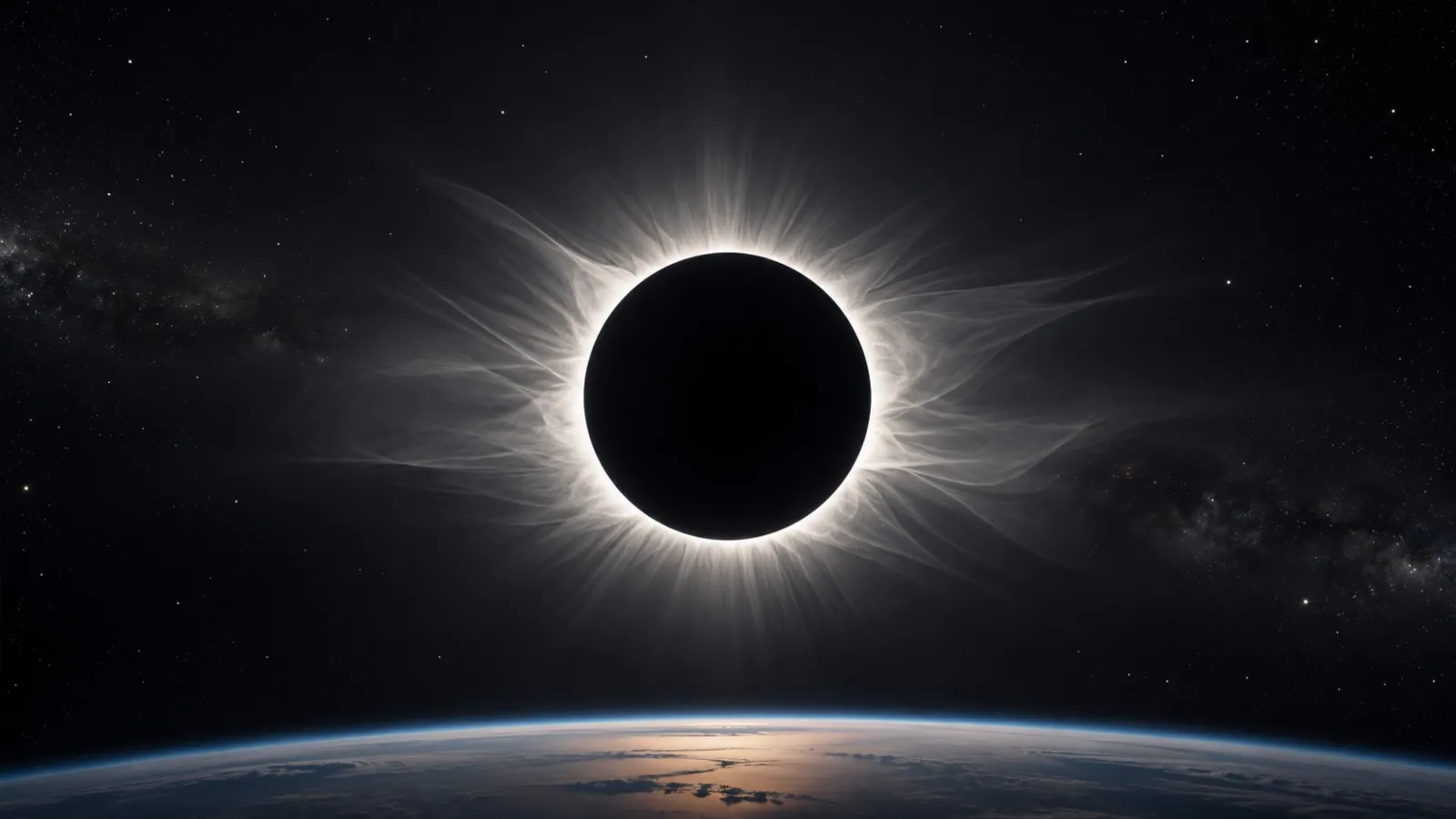
A total solar eclipse happens when the Moon passes directly between Earth and the Sun and appears large enough in our sky to cover the Sun’s bright visible disk completely. The Moon’s darkest central shadow, the umbra, then sweeps across a narrow strip of Earth’s surface called the path of totality.
Inside that path, daylight can fade to twilight, the horizon may glow in every direction, bright planets and stars can appear, and the Sun’s faint outer atmosphere — the corona — becomes visible around the black silhouette of the Moon.
Total solar eclipses happen somewhere on Earth roughly every 18 months, but totality at one particular location is much rarer: about once every 373–375 years on average. The next total solar eclipse is on August 2, 2027.
Next total solar eclipse
Date: August 2, 2027
Totality: Southern Spain, North Africa, Saudi Arabia and Yemen
Maximum totality: about 6 minutes 23 seconds along the central path
Important: exact visibility and timing depend on your precise location.
NASA’s current schedule is available on its Future Eclipses page, while NASA GSFC provides a detailed 2027 eclipse path map.
When to use this solution
Use this guide if you want more than a one-sentence definition of a total solar eclipse.
It is designed to answer the questions people usually have together:
- What exactly makes an eclipse total?
- Why does a total solar eclipse happen only in a narrow path?
- Why is 99% coverage not the same experience as totality?
- What happens in the minutes before, during and after totality?
- Why do solar eclipses not happen every month?
- How rare is totality from one place?
- When and where is the next total solar eclipse?
- What is the difference between total, annular, partial and hybrid eclipses?
- When are eclipse glasses required?
- Why do crescent shadows, unusual lighting and shadow bands appear?
- Why do scientists still travel around the world to study eclipses?
If you only need exact local contact times for a specific city, skip to the Faster alternative section and use an official eclipse map or calculator. Eclipse circumstances can change significantly over relatively short distances.
Before you start
A few concepts make the rest of the article much easier to understand.
- Totality is the short interval when the Moon completely covers the Sun’s bright photosphere for an observer inside the path of totality.
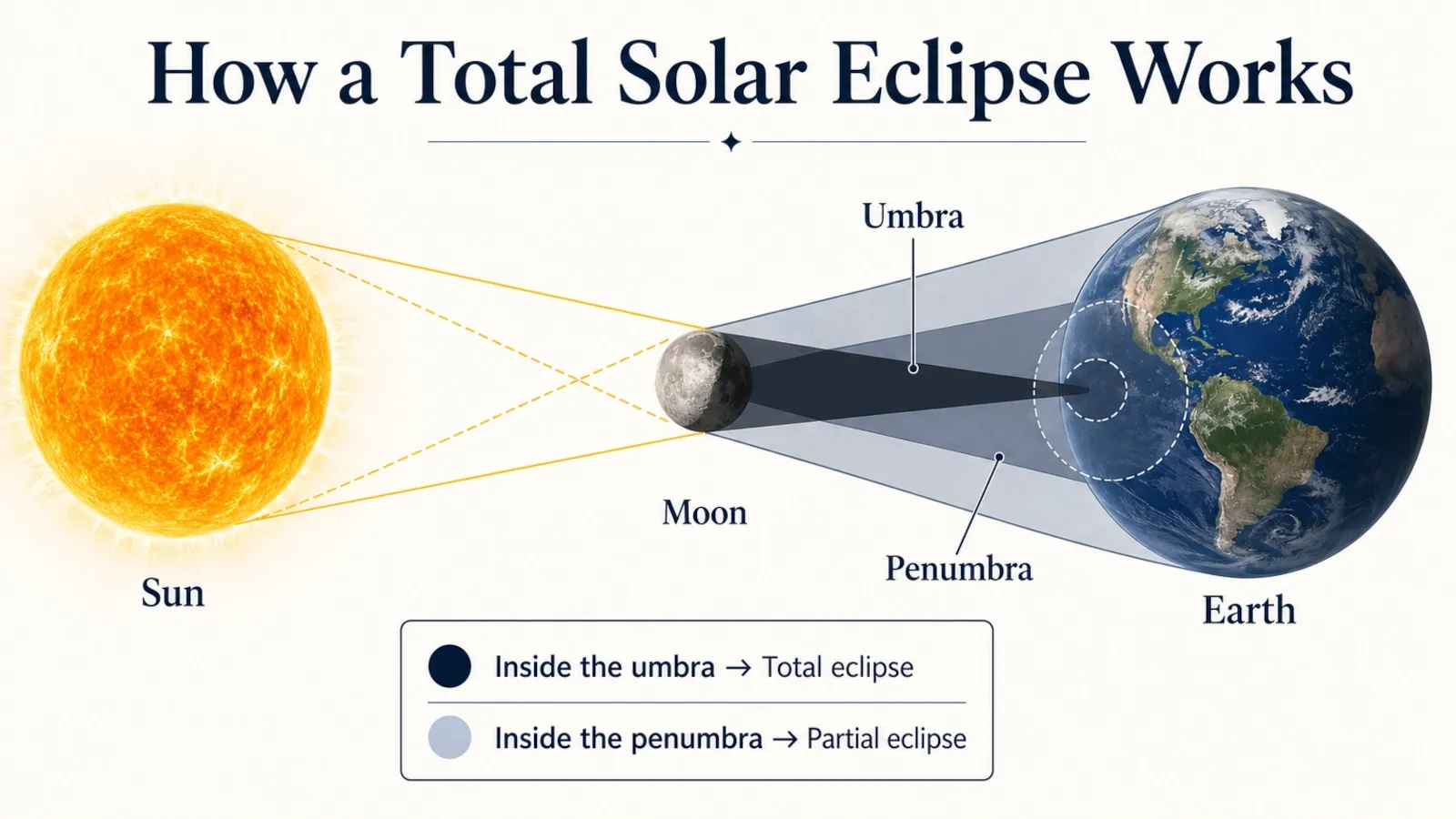
- Umbra is the Moon’s dark inner shadow. If it reaches your location, you can experience totality.
- Penumbra is the broader, lighter shadow where only part of the Sun is covered. Observers there see a partial eclipse.
- Antumbra is the shadow associated with an annular eclipse, when the Moon appears too small to cover the Sun completely.
- Path of totality is the narrow track across Earth swept by the umbra.
- Eclipse magnitude and percentage obscuration are not the same measurement, and neither tells you that a location will experience totality unless it is actually inside the umbral path.
- Future-eclipse dates and path predictions are extremely precise, but local weather is not. A mathematically perfect eclipse can still be hidden by clouds.
- Never improvise solar eye protection. Safe viewing rules are covered in detail below.
Most importantly, remember this distinction:
Inside the umbra  → TOTAL solar eclipse
Inside the penumbra → PARTIAL solar eclipse
A location can have the Sun 99% covered and still be experiencing a partial eclipse, not totality.
Main explanation: how a total solar eclipse works
A total solar eclipse depends on an unusually fortunate piece of geometry.
The Sun is about 400 times wider than the Moon, but it is also roughly 400 times farther from Earth. The result is that the two objects can appear almost the same angular size in our sky. Their apparent sizes are not perfectly constant: the Moon moves in an elliptical orbit around Earth, and Earth follows a slightly elliptical orbit around the Sun.
That variation is crucial.
When the Moon appears large enough and the Sun, Moon and Earth align closely enough, the Moon can hide the Sun’s bright disk completely. When the Moon appears slightly too small, a ring of sunlight remains and the eclipse is annular instead.
A total solar eclipse therefore requires two conditions at the same time:
- The alignment must be close enough for the Moon’s central shadow to reach Earth.
- The Moon must appear large enough to cover the Sun completely from the observer’s location.
NASA explains the changing apparent sizes and eclipse geometry in its eclipse geometry guide.
Why can the Moon cover something as enormous as the Sun?
Physical size is not what determines how large an object looks in the sky. Angular size does.
Hold a small coin close to your eye and it can hide a much larger object in the distance. The Moon does something similar on a planetary scale.
This near-match in apparent size is why Earth can experience total solar eclipses in which the photosphere disappears while the corona remains visible around the Moon.
It is also temporary on astronomical timescales. The Moon is slowly receding from Earth, so hundreds of millions of years from now it will eventually appear too small to produce the kind of total solar eclipses we see today.
What actually happens during a total solar eclipse?
A total solar eclipse is an event with distinct phases, not a sudden switch from daylight to darkness.
The sequence is:
Partial eclipse begins
        ↓
Solar crescent becomes thinner
        ↓
Baily's beads
        ↓
Diamond-ring effect
        ↓
TOTALITY
        ↓
Corona visible
        ↓
Diamond ring returns
        ↓
Partial eclipse continues
        ↓
Eclipse ends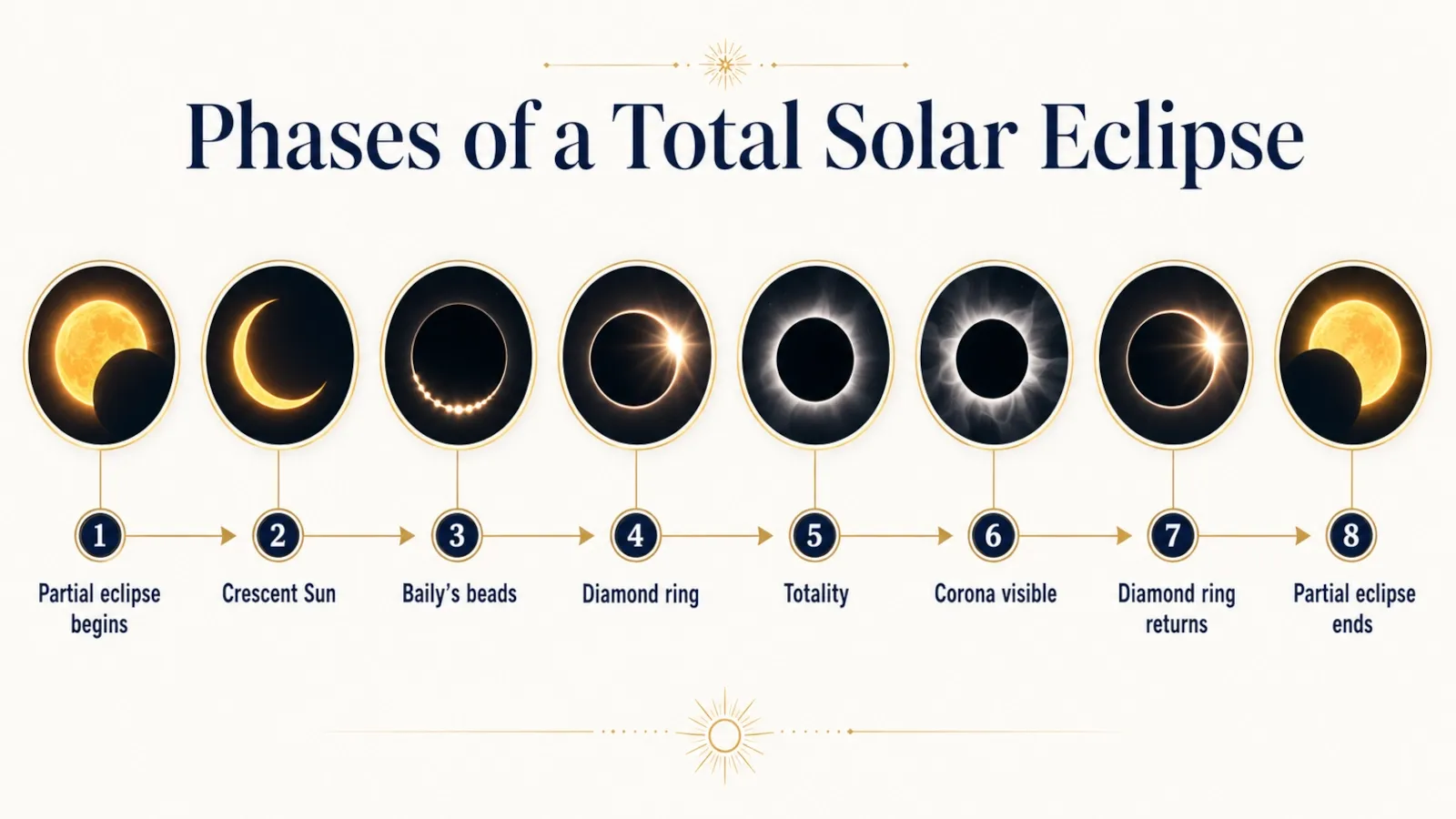
First contact: the partial eclipse begins
The Moon first appears to take a small “bite” out of the Sun.
For most of this phase the environment still looks surprisingly normal. The Sun is so bright that even a substantial reduction in its visible area may not produce the dramatic darkness people expect.
Solar viewers remain on.
The solar crescent becomes thinner
As more of the photosphere is hidden, the remaining part of the Sun narrows to a crescent.
At this stage, several subtle effects can become noticeable:
- daylight takes on an unusual quality;
- shadows may look different;
- temperatures can begin to fall;
- small holes and gaps can project crescent-shaped solar images;
- the horizon and sky can begin to change rapidly near totality.
Baily’s beads
Just before totality, sunlight shines through valleys and low points along the Moon’s irregular edge. The result can look like a string of brilliant points called Baily’s beads.
The lunar surface is not a smooth circle, so the last sunlight does not disappear everywhere at exactly the same instant.
The diamond-ring effect
As the final bright area of photosphere remains visible next to the developing corona, the scene resembles a brilliant diamond attached to a pale ring.
This is one of the most recognizable eclipse effects — and it marks the transition into or out of totality.
Do not anticipate totality by removing eye protection early. Follow the safe-viewing rules in the safety section.
Second contact: totality begins
When the bright photosphere is completely covered, totality starts for that location.
Only now, and only for observers who are actually inside the path of totality, can the Sun be viewed directly without eclipse glasses. NASA emphasizes that this exception applies only during the brief period when the bright solar face is completely hidden.
During totality, you may see:
- the black disk of the Moon;
- the Sun’s white or pearly corona;
- reddish-pink prominences around parts of the solar limb;
- bright stars or planets;
- a twilight-like sky;
- a glow around much or all of the horizon.
The experience is qualitatively different from even a very deep partial eclipse.
Third contact: totality ends
The first point of bright photosphere reappears.
That means the eye-safe naked-eye phase is over immediately.
Eclipse glasses go back on before you continue looking at the Sun.
Fourth contact: the eclipse ends
The Moon finally moves completely away from the Sun’s disk and the partial phase ends.
The entire event can span hours even though totality itself lasts only seconds or minutes.
What is the path of totality?
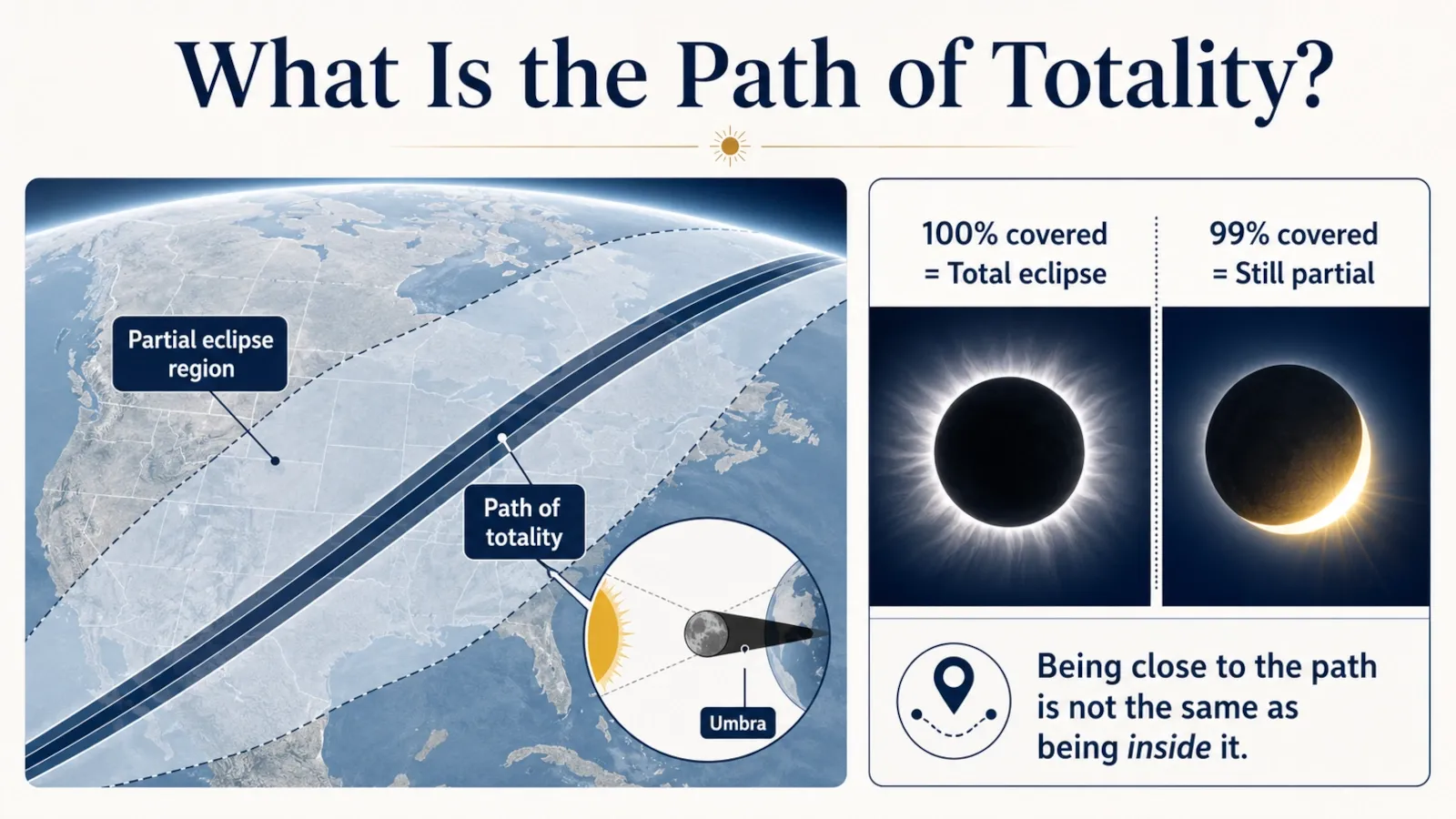
The path of totality is the track made across Earth’s surface by the Moon’s umbra.
The umbra is much smaller than the broad penumbra, which is why a partial eclipse can be visible across a huge region while totality is restricted to a comparatively narrow corridor.
NASA’s 2026 eclipse visualizations, for example, showed a large penumbral region covering much of the Northern Hemisphere while the umbra traced a much smaller path through Greenland, Iceland, the North Atlantic and Spain.
Why 99% is not “almost the same” as 100%
This is one of the most important things to understand about total eclipses.
At 99% obscuration, a thin part of the Sun’s bright photosphere is still exposed. That sliver is intense enough that:
- the full corona is not revealed in the same way;
- direct viewing still requires proper solar protection;
- the landscape does not enter true totality;
- the visual transition that makes totality so striking has not happened.
The difference between 99% and 100% is therefore not merely “one more percent.” It is the difference between a partial eclipse and a total eclipse.
If your goal is to experience totality, being inside the path matters more than being close to it.
Does the centerline matter?
The centerline usually gives longer totality than locations near the edge of the path, but it is not always the only sensible place to observe.
For the August 2, 2027 eclipse, NASA GSFC notes that observers can be far from the theoretical point of greatest duration and still lose only a fraction of a second if they remain reasonably close to the central line.
In real travel planning, cloud probability can matter more than chasing the mathematically longest possible duration.
Why don’t solar eclipses happen every month?
A solar eclipse can happen only around new moon, when the Moon is between Earth and the Sun.
But new moons happen every month, while solar eclipses do not.
The reason is that the Moon’s orbit is tilted by about 5 degrees relative to Earth’s orbital plane around the Sun. Most months, the new Moon passes slightly above or below the apparent Sun from our perspective, so its shadow misses Earth.
The Moon’s orbit crosses the Earth-Sun plane at two points called nodes.
Solar eclipses become possible when a new moon occurs while the Sun is close to one of those nodes. These periods are called eclipse seasons.
NASA describes an eclipse season as lasting roughly 35 days, with eclipse seasons occurring a little less than six months apart.
That is why the logic is:
New moon alone
    ≠
solar eclipse

New moon near an orbital node
    =
solar eclipse possible
The approximately five-degree orbital tilt is small, but across the Earth-Moon distance it is enough for the Moon’s shadow to miss our planet most months.
Why do solar and lunar eclipses often come in pairs?
An eclipse season is longer than the interval between major lunar phases.
If a solar eclipse happens near new moon, the Moon reaches full moon roughly two weeks before or after it. If the geometry remains close enough to the node, Earth can then pass between the Sun and Moon and produce a lunar eclipse.
This is why solar and lunar eclipses often appear in the calendar in closely spaced groups rather than randomly throughout the year.
How rare is a total solar eclipse?
“Rare” depends entirely on whether you mean somewhere on Earth or from one specific location.
Somewhere on Earth
NASA describes a total solar eclipse as occurring somewhere on Earth about once every 18 months on average.
That is not especially rare on a planetary scale.
The reason total eclipses feel rare is that the path of totality covers only a small fraction of Earth’s surface for each event, and much of our planet is ocean or sparsely populated land.
From one particular place
From a fixed location, the story changes dramatically.
NASA GSFC’s long-standing estimate is about 375 years on average between total solar eclipses at the same place.
A 2026 study accepted for publication in the Journal of the British Astronomical Association recalculated the problem over 14,999 years and found a very similar global mean return period: 373 ± 7 years for total eclipses.
That number is a statistical average, not a countdown.
A location can experience two totalities much closer together than 373 years, while another location may wait far longer.
So the useful rule is:
Total solar eclipses are regular global events but rare local events.
When is the next total solar eclipse?
As of August 18, 2026, the total eclipse of August 12, 2026 has passed. The next total solar eclipse will occur on August 2, 2027.
NASA lists totality across:
- southern Spain;
- Morocco;
- Algeria;
- Tunisia;
- Libya;
- Egypt;
- Saudi Arabia;
- Yemen.
A much larger region will see a partial eclipse.
At the point of greatest duration, NASA GSFC predicts approximately 6 minutes 23.2 seconds of totality.
That makes the 2027 event far longer at maximum than the 2026 total eclipse, whose maximum totality was a little over two minutes.
Upcoming total solar eclipses
| Date | Type | Main totality regions | Approx. maximum totality |
|---|---|---|---|
| August 2, 2027 | Total | Southern Spain, North Africa, Saudi Arabia, Yemen | 6m 23s |
| July 22, 2028 | Total | Australia, New Zealand | 5m 10s |
| November 25, 2030 | Total | Southern Africa, southern Indian Ocean, Australia | 3m 44s |
| March 30, 2033 | Total | Alaska and Arctic regions | 2m 37s |
These are global events. Whether an eclipse is total, partial or invisible from your location depends on where you are.
For planning, use NASA’s 2021–2040 eclipse path catalog and verify the exact local circumstances before travel.
What about North America?
The March 30, 2033 total solar eclipse crosses Alaska, so that is the next total eclipse visible from part of the United States.
For the contiguous United States, NASA lists the next total solar eclipse as August 23, 2044.
Total vs annular vs partial vs hybrid solar eclipse
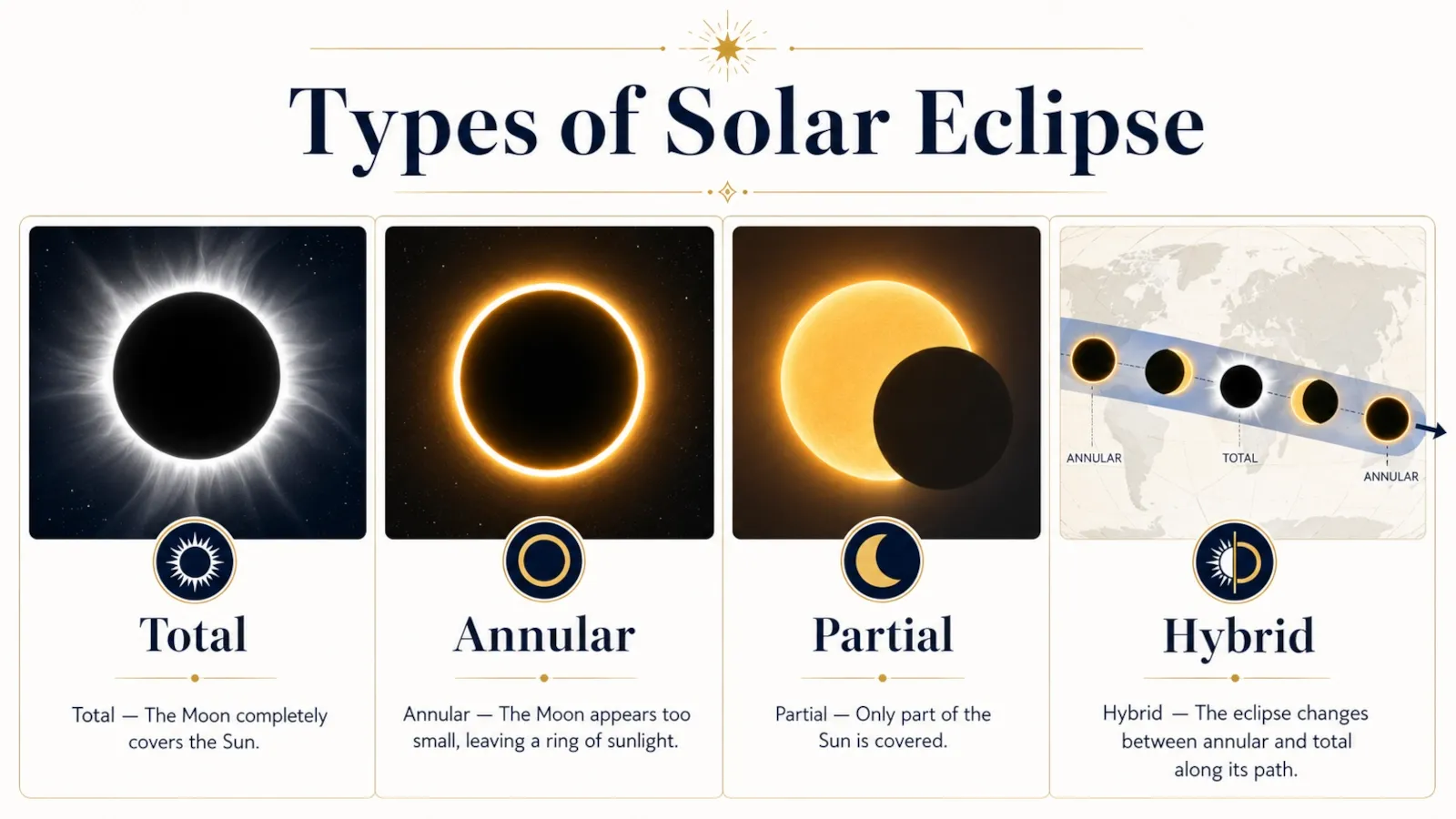
NASA distinguishes four types of solar eclipse.
| Type | What the observer sees | Why it happens |
|---|---|---|
| Total | Moon completely covers the bright Sun; corona becomes visible | Moon’s apparent disk is large enough and alignment brings the umbra to the observer |
| Annular | Bright ring of Sun remains around the Moon | Moon appears slightly smaller, so the antumbra reaches the observer |
| Partial | Only part of the Sun is covered | Observer is in the penumbra or alignment is not central enough |
| Hybrid | Eclipse changes between annular and total along different portions of its path | Earth’s curvature and the geometry of the Moon’s shadow make the umbra reach some locations but not others |
Total vs annular: the crucial difference
In both total and annular eclipses, the Sun, Moon and Earth can be very closely aligned.
The difference is the Moon’s apparent size.
During a total eclipse, it appears large enough to hide the photosphere.
During an annular eclipse, it appears slightly smaller, leaving a brilliant ring of sunlight around it. Because bright photosphere remains visible throughout an annular eclipse, there is no naked-eye totality phase and solar protection remains necessary.
Solar vs lunar eclipse
A solar eclipse and a lunar eclipse reverse the geometry:
SOLAR ECLIPSE
Sun → Moon → Earth

LUNAR ECLIPSE
Sun → Earth → Moon
A solar eclipse happens around new moon and is visible only from part of Earth.
A lunar eclipse happens around full moon and can be seen from the broad night side of Earth.
The eye-safety rules are also completely different: a lunar eclipse is safe to view directly; the exposed Sun during a solar eclipse is not.
How to watch a total solar eclipse safely
Eye safety is not an optional detail in an eclipse guide.
Except during the brief period of complete totality, looking directly at the Sun requires specialized solar viewing protection.
NASA states that ordinary sunglasses are not safe, regardless of how dark they appear.
Safe eclipse glasses and handheld solar viewers should comply with the ISO 12312-2 international standard.
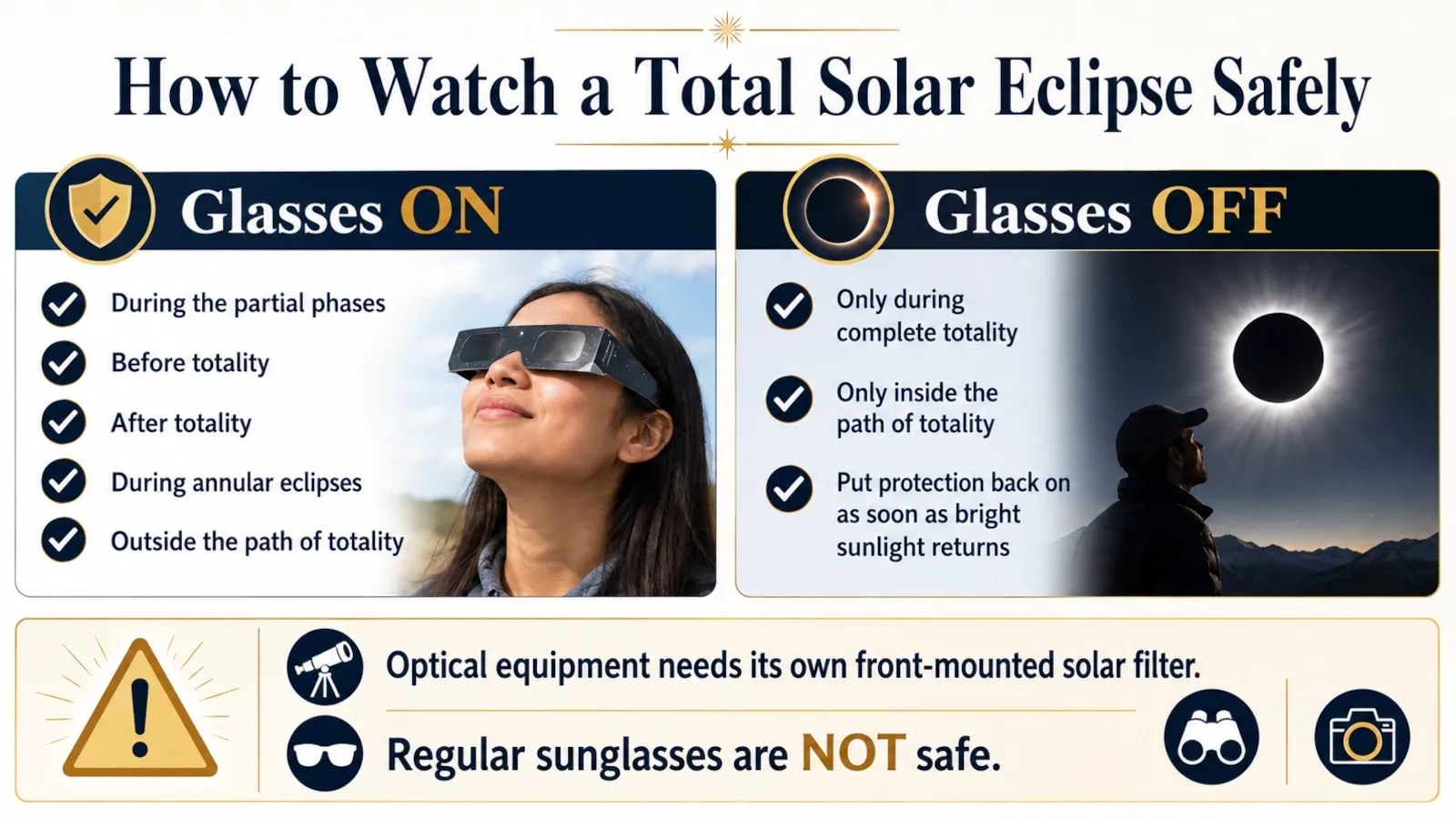
Glasses ON
Use proper solar viewing protection:
- during the entire partial phase before totality;
- whenever any part of the bright solar photosphere is visible;
- immediately after totality ends;
- throughout an annular eclipse;
- throughout a partial eclipse;
- whenever you are outside the path of totality.
Glasses OFF
You may view the Sun directly without eclipse glasses only when all of these conditions are true:
- you are inside the path of totality;
- the Moon is completely covering the Sun’s bright face;
- totality has actually begun.
The moment bright sunlight starts to reappear, protection goes back on.
Cameras, binoculars and telescopes require their own filters
Do not look through an unfiltered camera lens, telescope, binoculars or finder scope while wearing eclipse glasses.
Optical equipment concentrates sunlight.
NASA requires a special-purpose solar filter secured to the front of the optics for safe direct solar observation.
If you are uncertain how to filter an optical instrument properly, do not improvise. Use indirect projection or observe without magnification through certified solar viewers instead.
Steps: how to plan and watch a total solar eclipse safely
1. Confirm that your location is actually inside the path of totality
Do not rely on a country name, city headline or a generic “99% eclipse” forecast.
Open an authoritative eclipse map and check the exact location.
If the umbral path does not cross your observing point, you will see a partial eclipse only.
2. Record the local contact times
For a total eclipse, note:
- start of the partial phase;
- start of totality;
- end of totality;
- end of the partial phase.
Local times can differ significantly across the eclipse region.
If totality lasts only a minute or two where you are, knowing the contact times prevents you from missing it while adjusting equipment or looking at a phone.
3. Obtain proper solar viewers in advance
Use viewers that meet the appropriate solar-viewing standard and follow the manufacturer’s instructions.
Inspect them before use. Do not use damaged viewers.
Keep spare viewers if you are observing with a group.
4. Prepare optical equipment separately
If you plan to use:
- a telescope;
- binoculars;
- a camera with a telephoto lens;
- a spotting scope;
fit the equipment with an appropriate front-mounted solar filter designed for that instrument.
Eclipse glasses are for your eyes; they are not a substitute for an optical filter.
5. Observe the partial phase with protection
Watch how the Sun’s shape changes gradually.
This is also the ideal time to look for indirect eclipse effects on the ground, such as crescent projections through leaves or a pinhole projector.
6. Remove eye protection only after complete totality begins
If — and only if — you are inside the totality path and the bright solar surface is completely hidden, the corona can be viewed directly.
This is the brief visual phase that makes a total eclipse fundamentally different from a partial eclipse.
7. Put protection back on before direct sunlight returns
Do not wait for the returning Sun to become uncomfortable.
As soon as totality ends and the photosphere begins to reappear, stop direct viewing and replace your solar viewers.
Strange things you may notice during a total solar eclipse
Totality is not only a black disk covering the Sun. The changing shape and intensity of the light produce effects across the entire landscape.
Some are easy to explain. Others are still active research questions.
Crescent-shaped shadows under trees
One of the most striking pre-totality effects can appear on sidewalks, walls and the ground under trees.
Tiny gaps between leaves act as pinhole projectors.
Normally each opening projects an image of the round Sun, but those overlapping circles are usually too subtle to notice. During a partial eclipse, each opening instead projects the Sun’s crescent shape.
That means the crescents are not leaf-shaped shadows. They are miniature images of the eclipsed Sun.
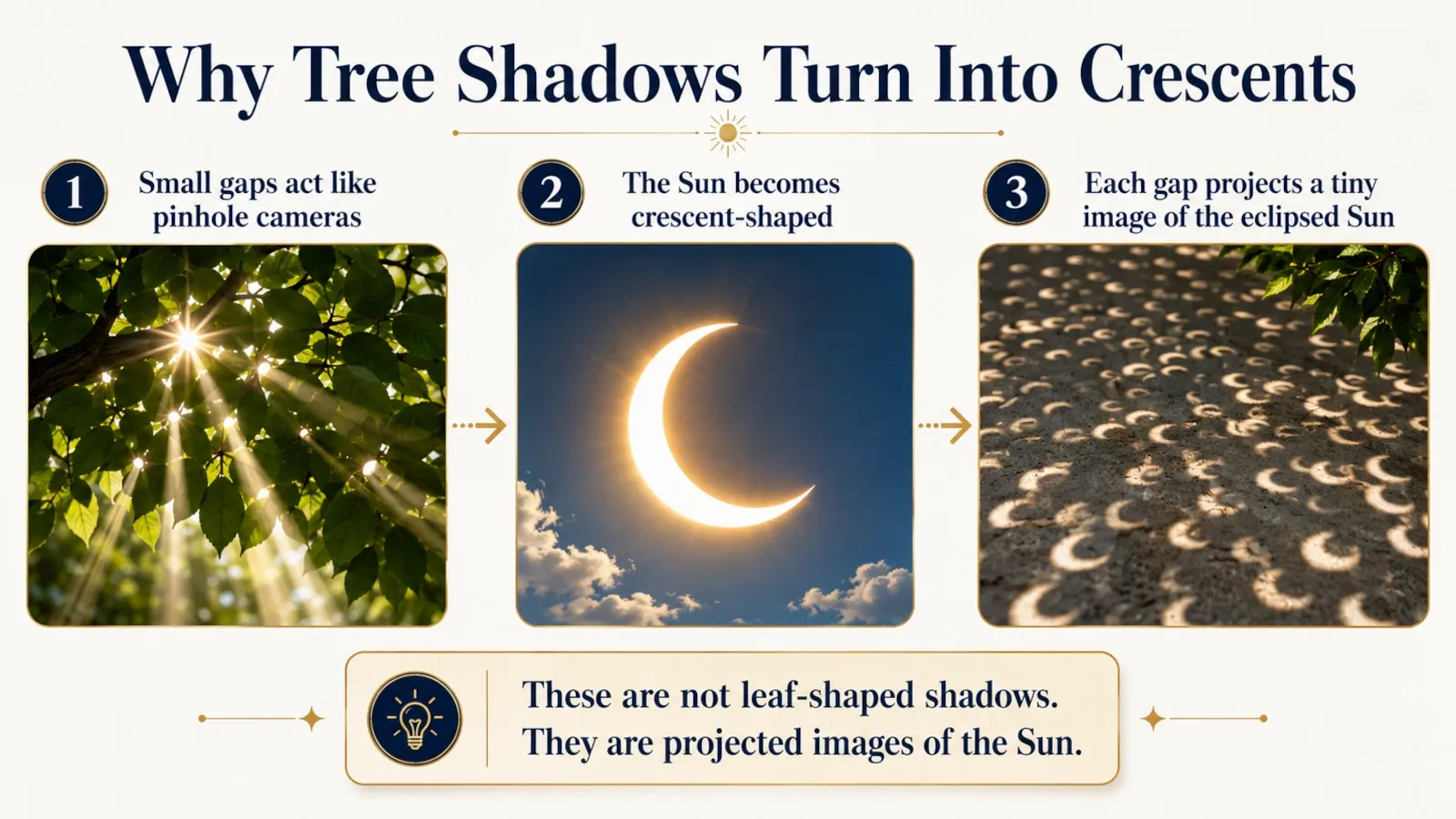
You can reproduce the principle safely with a piece of card containing a small hole. Let sunlight pass through the hole onto a surface rather than looking through the hole at the Sun.
Why shadows can become sharp in one direction
Near totality, the remaining photosphere becomes an extremely thin solar crescent.
Under ordinary sunlight, the Sun is an extended light source. Light arrives from slightly different directions across its disk, which softens shadow edges.
A very thin crescent is still extended in one direction but becomes much narrower in the perpendicular direction. As a result, a shadow can appear unusually sharp along one axis while remaining softer along the other.
It is a subtle demonstration that the shape of a light source affects the geometry of every shadow it produces.
Why the Sun often looks yellow or orange in partial-eclipse photos but white in totality
The Sun itself does not suddenly switch from yellow to white when totality begins.
Many photographs and timelapses of partial phases are made through solar filters. Different filter materials can render the solar disk orange, yellow, red or bluish-white.
During complete totality, the bright photosphere is blocked and photographers can remove the solar filter for the total phase. The corona is then recorded with its natural pale or pearly-white appearance.
Camera processing, atmospheric conditions and filter choice can all influence the final color.
The 360-degree twilight glow
During totality, you are standing inside the Moon’s shadow, but regions beyond the umbra are still illuminated by sunlight.
Light from those surrounding areas can create a twilight-like glow around much of the horizon — often described as a 360-degree sunset or sunrise.
Above you, meanwhile, the sky can become dark enough for bright planets and stars to appear.
Temperature and environmental changes
Blocking direct sunlight can produce a measurable local temperature drop.
Animals and insects may also respond to the rapid change in light as if evening were arriving unexpectedly. The strength of these effects depends on local weather, ecology, eclipse duration and how much sunlight is removed.
Scientists study these temporary changes because an eclipse creates a fast, geographically localized reduction in solar energy that cannot be reproduced by an ordinary sunset.
What are eclipse shadow bands — and do we fully understand them?
Shadow bands are faint, moving bands of light and dark that can sometimes appear on pale surfaces shortly before totality and shortly after it.
They can look like rippling lines or “snakes” moving across the ground.
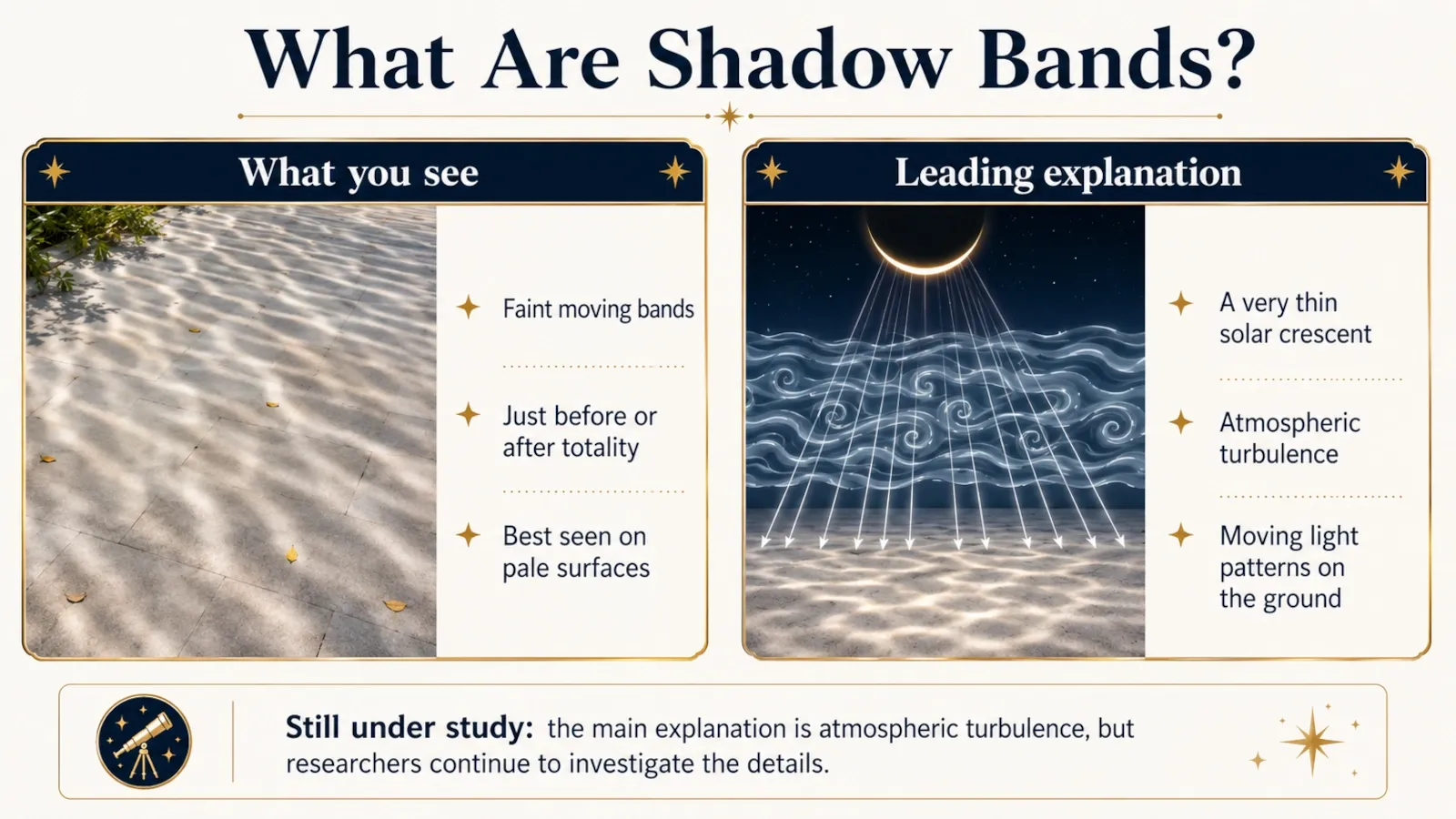
The standard physical explanation involves atmospheric turbulence.
When only a very thin crescent of the Sun remains, its light passes through moving layers of air with different temperatures and densities. Variations in refractive index can make the narrow source scintillate, producing moving intensity patterns at the ground. A 2021 Applied Optics wave-optics model reproduced many observed properties of shadow bands using distributed atmospheric turbulence.
But the story is not completely closed.
A high-altitude balloon experiment during the 2017 eclipse detected a persistent signal both on the ground and well above much of the turbulent lower atmosphere, complicating a simple near-ground-only explanation. A larger 2024 ballooning experiment, published in 2026, did not reproduce that high-altitude detection and concluded that the observations were more consistent with shadow bands being absent on that occasion or primarily associated with atmospheric turbulence.
That combination of results is scientifically valuable:
Atmospheric scintillation is the leading and well-developed explanation for many shadow-band observations, but the details of when the bands form, how strong they become and whether every observed component has the same origin remain subjects for further measurement.
This is one reason future eclipses are more than spectacles: they are repeatable natural experiments.
Why scientists still chase total solar eclipses
Modern spacecraft can observe the Sun continuously, and coronagraphs can create artificial eclipses by blocking the bright solar disk.
So why do researchers still travel into the path of totality?
Because the Moon is an exceptionally effective natural occulter.
NASA notes that the innermost corona is difficult for ordinary coronagraphs to observe as cleanly as it can be seen during a total solar eclipse. That region matters because it is where scientists investigate how energy and heat move through the Sun’s atmosphere and how the solar wind is accelerated.
Eclipses also create an abrupt moving shadow through Earth’s atmosphere, giving researchers a controlled opportunity to investigate:
- the ionosphere;
- atmospheric gravity waves;
- changes in temperature and density;
- radio propagation;
- solar-corona structure;
- the response of Earth’s atmosphere to rapidly changing sunlight.
For the August 12, 2026 eclipse, NASA-funded teams used both scientific balloons and a high-altitude WB-57 research jet to study the corona and atmospheric effects. The jet extended its observing time beyond what was possible from a fixed point on the ground.
Eclipses helped reveal helium — and “coronium”
Eclipse science has a remarkable history.
In 1868, French astronomer Pierre Jules César Janssen detected an unknown spectral line while observing an eclipse. The line was associated with a new element that became known as helium, named from Helios, the Greek name for the Sun. Helium was identified on Earth decades later.
A year later, astronomers observing the 1869 total eclipse found an unexplained green coronal emission line at 530.3 nanometres. Scientists proposed another new element, coronium.
Coronium did not exist.
More than seventy years later, researchers showed that the mysterious lines came from familiar elements in extraordinarily high ionization states. NASA’s historical timeline notes that the famous green line was produced by iron that had lost 13 electrons, evidence of the corona’s extreme temperature.
Total eclipses therefore contributed both to the discovery of a real element and to a scientific mystery whose eventual solution transformed our understanding of the solar corona.
The 1919 eclipse and general relativity
Solar eclipses also became part of one of the most famous tests in modern physics.
During the May 29, 1919 eclipse, teams measured the apparent positions of stars near the darkened Sun. The observations provided evidence that starlight was deflected by the Sun’s gravity, consistent with a key prediction of Einstein’s general theory of relativity.
The experiment is historically complex and later measurements became far more precise, but the eclipse helped turn gravitational light bending from an abstract prediction into an observable phenomenon.
Why does the Northern Hemisphere currently get more total solar eclipses?
This is a deeper question than the basic eclipse geometry, and the answer is not that the Northern Hemisphere has some permanent privilege.
A 2026 long-term eclipse-frequency study confirms a latitude and hemispheric effect: in the present era, total eclipses are more frequent in the Northern Hemisphere, while annular eclipses have a corresponding advantage in the Southern Hemisphere.
One important reason is the relationship between Earth’s seasons and the changing apparent size of the Sun.
Earth reaches aphelion, its farthest point from the Sun, in early July. The Sun therefore appears slightly smaller around northern summer. A slightly smaller apparent Sun makes it easier for the Moon’s disk to cover it completely, all else being equal.
During southern summer, Earth is closer to the Sun, so the solar disk appears slightly larger — conditions that favor annular rather than total geometry more often.
This pattern is not permanent.
The alignment of Earth’s orbital apsides with the seasons changes slowly. The 2026 study finds a cycle of roughly 21,000 years in the north-south eclipse-frequency imbalance. Over very long timescales, the advantage reverses.
That is a good example of an important principle in eclipse science:
The geometry is predictable, but it is not static.
Common mistakes
Mistake 1: assuming 99% coverage is effectively totality
It is not.
If any bright photosphere remains exposed, the eclipse is partial at your location. The corona does not emerge in the same way, direct viewing remains unsafe without proper protection, and the landscape does not undergo true totality.
Do instead: verify that your exact observing location falls inside the path of totality.
Mistake 2: removing eclipse glasses because the sky looks dark
Environmental darkness is not the safety criterion.
The criterion is whether the Sun’s bright face is completely covered.
Do instead: keep viewers on throughout the partial phases and remove them only after complete totality has begun at your location.
Mistake 3: using ordinary sunglasses
Ordinary sunglasses transmit far too much solar radiation for direct solar viewing.
Do instead: use purpose-built solar viewers that meet the appropriate safety standard.
Mistake 4: looking through binoculars or a camera while wearing eclipse glasses
A lens or telescope can concentrate sunlight strongly enough to damage the viewer and your eyes.
Do instead: place the correct solar filter on the front of the optical system.
Mistake 5: confusing an annular eclipse with totality
An annular eclipse can look spectacular, but the bright ring means the photosphere is still exposed.
There is no safe glasses-off phase during an annular eclipse.
Mistake 6: assuming one published time applies to an entire region
Eclipse contact times are location-specific.
Do instead: calculate local circumstances for the exact observing point.
Mistake 7: thinking the yellow-to-white change means the Sun changes color
The apparent yellow or orange color in many partial-eclipse images is often produced by the solar filter and image processing.
Do instead: distinguish the intrinsic light source from the way observation equipment renders it.
Mistake 8: treating the 373–375-year figure as a recurrence cycle
It is a global statistical average for a fixed point, not a periodic schedule.
Do instead: use eclipse catalogs to find the actual past and future eclipses for a location.
Security, privacy and safety notes
This is a science article, but the safety information is potentially more important than any astronomical detail.
- Never look directly at an exposed or partially exposed Sun without proper solar viewing protection.
- Regular sunglasses are not eclipse glasses.
- Outside the path of totality, there is no glasses-off phase.
- During an annular or partial eclipse, solar protection remains necessary throughout.
- Do not use damaged solar viewers.
- Supervise children carefully.
- Do not look through cameras, binoculars, telescopes or finder scopes unless the optical device has an appropriate solar filter mounted correctly over the front aperture.
- Do not rely on clouds, haze, tinted glass, photographic film, exposed X-ray material or improvised filters as eye protection.
- If you are unsure whether totality has begun, keep your solar viewers on.
- Weather, road closures, terrain, crowding and extreme heat can be practical hazards for eclipse travel even when the astronomy is perfectly predictable.
For current official guidance, read NASA’s Eclipse Viewing Safety page before every eclipse.
Scientific limitations to keep in mind
Eclipse predictions are exceptionally accurate, but some details are inherently location-dependent.
The exact edge of the path can shift slightly depending on how the irregular lunar limb is modeled. Atmospheric refraction and Earth’s rotation parameters also matter in high-precision calculations.
Likewise, statements such as “a total eclipse returns every 375 years” describe statistical averages, not fixed cycles.
And for phenomena such as shadow bands, the scientific literature still contains open questions. A strong explanation should distinguish between a leading model and a fully settled result.
Faster alternative
If your only question is:
When is the next total solar eclipse, and will I see totality from my location?
you do not need to read the entire science explanation.
Use this faster process:
- Open NASA’s Future Eclipses page.
- Select the eclipse you are interested in.
- Open the corresponding NASA GSFC path map.
- Check your exact location against the umbral path.
- Record local contact times.
- Read NASA’s safety guidance before observing.
For the next total eclipse, use the NASA GSFC August 2, 2027 map.
The faster method tells you where and when.
The full article explains why the event happens, what makes totality unique, what unusual effects to look for and why scientists study it.
FAQ
What is a total solar eclipse?
A total solar eclipse happens when the Moon passes between the Sun and Earth and completely covers the Sun’s bright visible surface for an observer inside the Moon’s umbra. During totality, the Sun’s faint outer atmosphere — the corona — becomes visible.
When is the next total solar eclipse?
The next total solar eclipse is August 2, 2027. Totality will cross southern Spain, North Africa, Saudi Arabia and Yemen, while a much larger surrounding region will see a partial eclipse.
How often does a total solar eclipse happen?
Somewhere on Earth, a total solar eclipse occurs about once every 18 months on average.
At one fixed location, totality is far rarer. NASA’s traditional estimate is about 375 years on average, while a 2026 long-term study calculated 373 ± 7 years.
Why isn’t there a solar eclipse every month?
Because the Moon’s orbit is tilted by about 5 degrees relative to Earth’s orbital plane. At most new moons, the Moon passes above or below the Sun from our viewpoint and its shadow misses Earth. Eclipses occur when the new moon is close to one of the orbital nodes during an eclipse season.
How long can a total solar eclipse last?
NASA states that totality can last from only seconds to about 7.5 minutes, depending on the geometry.
The August 2, 2027 eclipse is predicted to reach about 6 minutes 23 seconds at maximum. NASA’s long-term calculations identify the July 16, 2186 eclipse as the longest totality in the 4000 BCE–8000 CE interval, at about 7 minutes 29 seconds.
What is the path of totality?
The path of totality is the track across Earth’s surface swept by the Moon’s umbra. Observers inside it can experience a total solar eclipse. Observers outside it see a partial eclipse, even if the Sun is almost completely covered.
Is a 99% eclipse the same as totality?
No.
At 99%, part of the bright photosphere remains visible, so the event is still a partial eclipse. Proper solar eye protection remains necessary, and you do not get the same view of the corona or the same environmental transition as true totality.
Can you look at a total solar eclipse without glasses?
Only during complete totality, when the Moon fully covers the Sun’s bright face, and only if you are inside the path of totality.
Before totality and immediately after it, proper solar viewers are required. Outside the totality path, keep protection on throughout.
What is the difference between a total and an annular solar eclipse?
In a total eclipse, the Moon appears large enough to cover the Sun completely.
In an annular eclipse, the Moon appears slightly smaller, leaving a bright ring of sunlight around it. Because some photosphere remains visible, an annular eclipse has no safe naked-eye totality phase.
What is the rarest type of solar eclipse?
Among the four NASA categories, hybrid eclipses are the least common over long eclipse catalogs. A hybrid eclipse changes between total and annular along different portions of its path because of the geometry of the Moon’s shadow and Earth’s curved surface.
Why can we see the Sun’s corona during totality?
The corona is always present, but it is vastly fainter than the Sun’s bright photosphere.
During totality, the Moon acts like a natural occulting disk and blocks the photosphere, allowing the much fainter corona around it to become visible.
Why do tree shadows turn into crescents during an eclipse?
Small gaps between leaves act like pinhole cameras. Each opening projects an image of the Sun onto the ground. During a partial eclipse, the Sun itself is crescent-shaped, so the projected images become crescents too.
What are shadow bands?
Shadow bands are faint moving light-and-dark patterns sometimes seen immediately before and after totality. Atmospheric turbulence provides a strong physical explanation for many observations, but high-altitude experiments have produced mixed results and researchers continue to investigate the details.
When is the next total solar eclipse in the United States?
The March 30, 2033 total solar eclipse will cross Alaska.
The next total solar eclipse visible from the contiguous United States is August 23, 2044.
Does a solar eclipse have harmful effects on people?
The eclipse itself does not produce a special harmful radiation effect. The major direct hazard is looking at the bright Sun without proper eye protection during partial phases.
The unusual darkness and temperature changes are natural consequences of the Moon temporarily blocking sunlight.
Last tested
Tested on:
- NASA Science — Future Eclipses
- NASA Science — Eclipse Viewing Safety
- NASA Science — Eclipse Geometry
- NASA Science — Types of Solar Eclipses
- NASA GSFC eclipse path predictions for 2027–2033
- NASA eclipse science and solar-science history resources
- 2026 eclipse-frequency research
- Published shadow-band research and 2024 eclipse-ballooning results
Last tested: 2026-08-18
Time-sensitive details — especially the “next eclipse” block, exact path information and future-eclipse table — should be reviewed before each major eclipse season.
Related guides
Carefully selected guides to help you understand the topic and complete the next useful step.