
The stock market can look like a closed world of charts, quarterly reports, IPOs, trading floors and unfamiliar terminology. Underneath that complexity, however, is a relatively simple system: companies divide ownership into shares, investors submit orders to buy or sell those shares, and markets bring those orders together. This stock market for beginners guide focuses on those mechanics rather than predictions or stock picks.
The details matter. A broker does not always send your order directly to the exchange shown beside a stock symbol. A market order does not guarantee the price you saw on screen. An IPO is not the only way a public company can raise new equity capital. An index fund can reduce concentration risk, but it cannot make market risk disappear.
This guide explains the full process in plain international English, while preserving the distinctions beginners need to understand before using a brokerage account.
Educational notice: This article explains financial-market mechanics. It is not personalized investment, legal or tax advice, and it does not recommend any security, broker, strategy or portfolio.
Quick answer
The stock market is a network of regulated exchanges and other trading venues where buyers and sellers trade shares of publicly listed companies, usually through brokers.
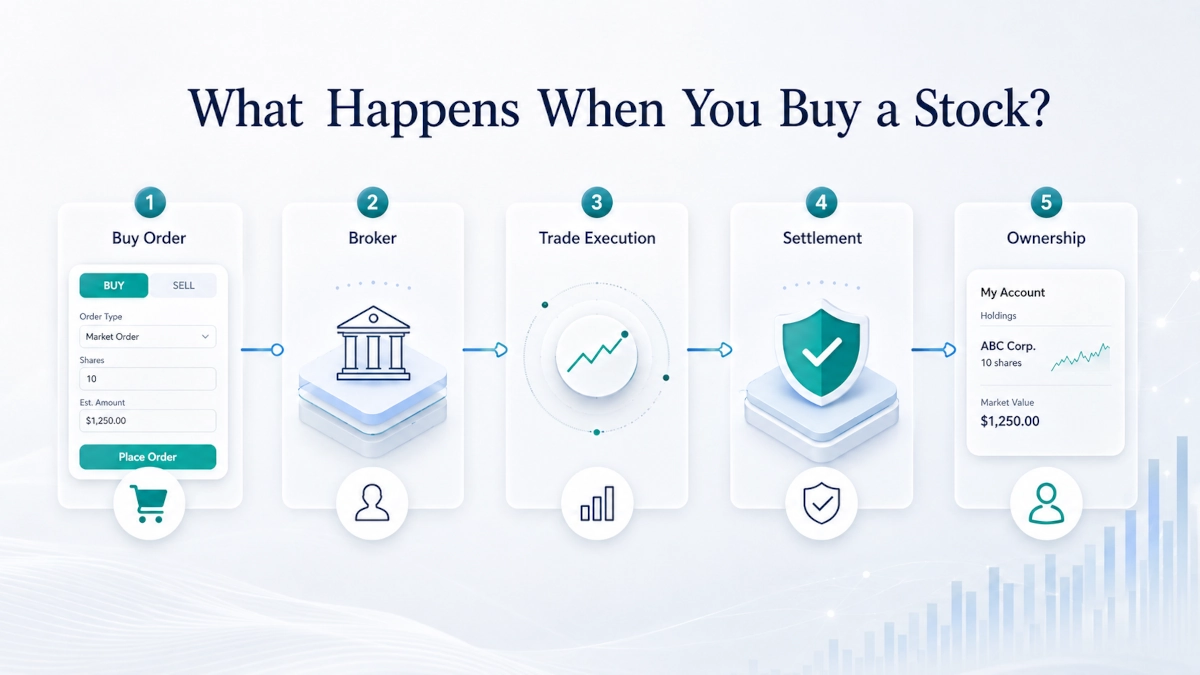
A stock represents an ownership interest in a company. When you press Buy, your broker receives the order, checks it, chooses where to route it and seeks a matching seller. When the trade executes, you receive an execution price and the transaction later settles. In the United States, most stock trades currently settle on the next business day, known as T+1.
Stock prices move because available buy and sell orders change continuously. Company results, expectations about future profits, interest rates, economic conditions, news, liquidity and investor sentiment can all change what buyers are willing to pay and what sellers are willing to accept.
Investors can earn a return through:
- capital appreciation, if the shares are later sold for more than their purchase cost; and
- dividends, if the company chooses to distribute part of its earnings or available capital to shareholders.
Neither source of return is guaranteed. A stock can fall sharply, a company can suspend its dividend, and an investor can lose the entire amount invested in an individual company.
When to use this explanation
This guide is designed for people who:
- have never invested and want to understand the system before opening a brokerage account;
- can read a stock price but do not know what happens after pressing Buy or Sell;
- want to understand IPOs, brokers, exchanges, market orders and limit orders;
- are comparing individual stocks with broad index funds;
- need a foundation before reading company reports or learning portfolio construction.
This is not the right guide for choosing a specific stock, timing the market, calculating your personal risk tolerance or deciding how much money to invest. Those decisions depend on your finances, objectives, tax jurisdiction, time horizon and ability to absorb losses.
Before you start
Keep these points in mind:
- This guide uses the U.S. market as its main example. The core mechanics are widely applicable, but settlement rules, taxes, investor protections and available products vary by country.
- A quoted price is not a promise. Prices can change between the moment you see a quote and the moment your order executes.
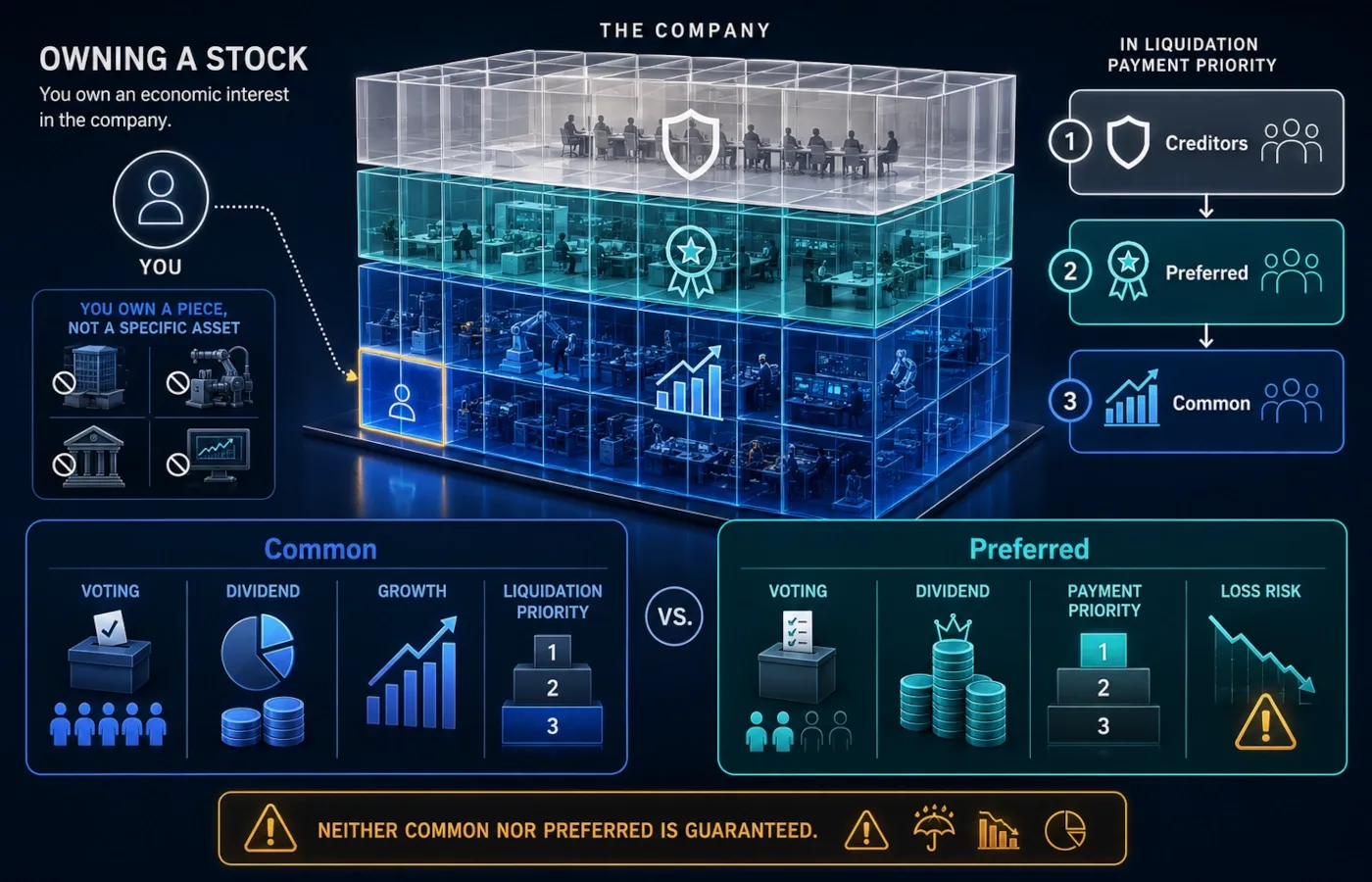
- Owning a share does not give you direct ownership of a particular office, machine or bank account. It gives you an equity interest and the rights attached to that class of stock.
- Returns are uncertain. Historical performance, including the history of major indexes, cannot guarantee future results.
- Costs matter. Commissions may be zero at some brokers, but spreads, currency conversion, taxes, fund expenses and other charges can still reduce returns.
- Leverage changes the risk. Margin, options, short selling, leveraged ETFs and contracts for difference involve mechanics and losses beyond ordinary cash purchases of shares. They are outside the scope of this beginner guide.
The stock market in one simple model
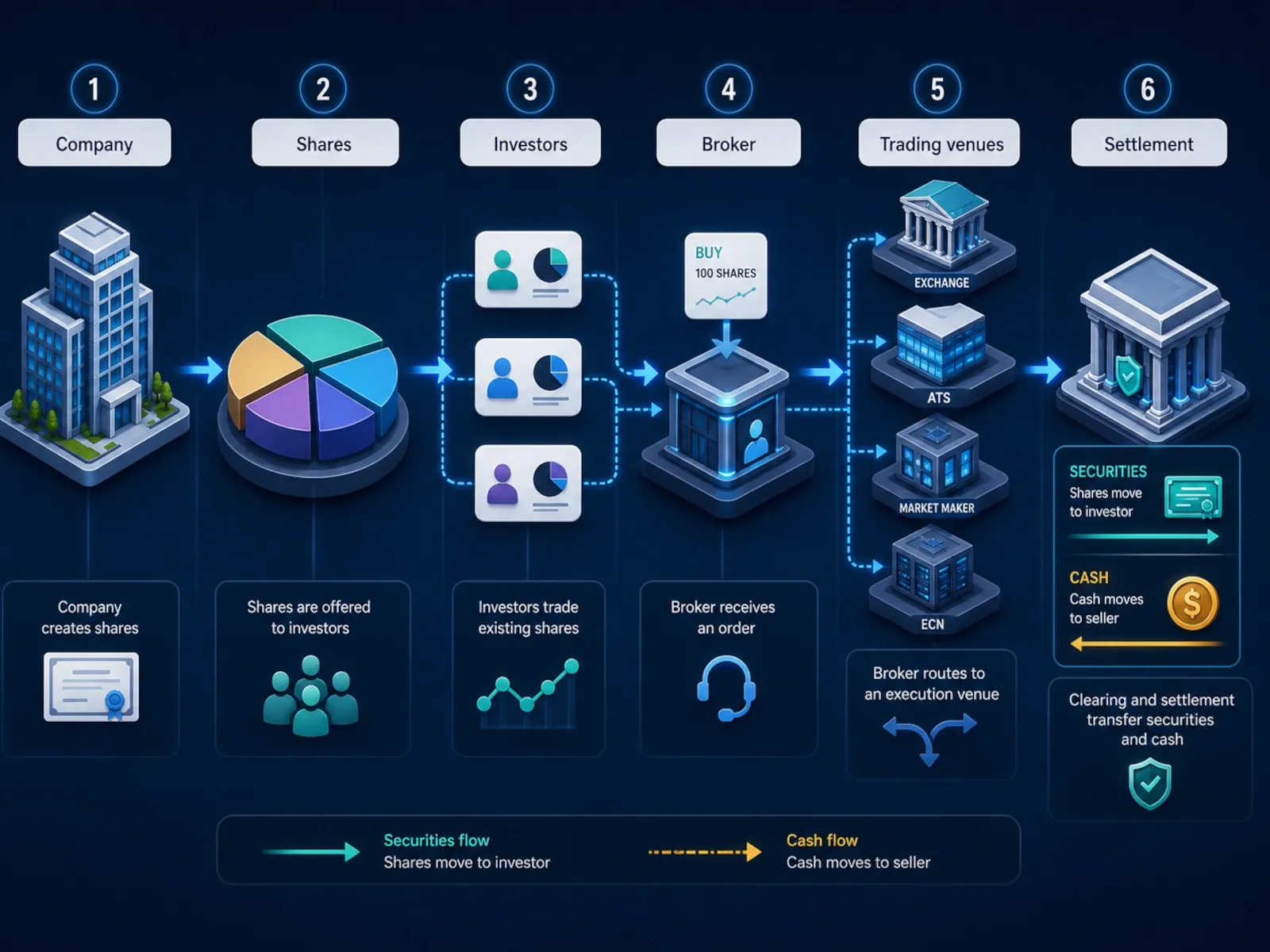
The entire system can be understood as six connected stages:
- A company creates or authorizes shares representing equity ownership.
- The company or existing shareholders may offer shares to investors.
- After listing, investors trade existing shares in the secondary market.
- Brokers receive customer orders and route them to execution venues.
- Buy and sell interest determines the prices at which trades execute.
- The trade is cleared and settled, transferring cash and securities through market infrastructure.
The stock market is therefore not one physical place and not one computer. It is an interconnected system of companies, investors, brokers, exchanges, market makers, alternative trading systems, clearing organizations, custodians and regulators.
What is the stock market?
The stock market is the broader system through which shares are issued, quoted and traded.
People often use stock market and stock exchange as if they mean the same thing, but they are not identical:
- The stock market is the entire ecosystem.
- A stock exchange is one regulated venue within that ecosystem.
- A broker is an intermediary that accepts customer orders.
- A market maker is a firm prepared to buy or sell securities at quoted prices.
- An alternative trading system, electronic communications network or other venue can also match or execute orders.
Traditional exchanges such as the New York Stock Exchange and Nasdaq are highly visible, but not every retail order is executed on the exchange where a stock is listed. According to Investor.gov’s explanation of trade execution, a broker may route an order to an exchange, a market maker, an electronic communications network or another part of the broker’s firm. FINRA also describes exchanges, alternative trading systems, single-dealer platforms and wholesalers as different types of execution venues.
That distinction is important because listing venue and execution venue are not always the same.
What is a stock?
A stock, also called an equity security, represents an ownership interest in a corporation.
If a company has 100 million shares outstanding and you own 100 shares, you own a very small economic interest in that company. Your rights depend on the company’s governing documents, applicable law and the class of shares you hold.
Stock ownership may give you:
- the right to vote on certain corporate matters;
- the possibility of receiving dividends if they are declared;
- the ability to sell the shares, subject to market conditions and applicable restrictions;
- a residual claim on company assets after higher-priority claims are paid if the company is liquidated.
That final point is often misunderstood. Shareholders are residual owners. If a company fails, creditors are generally paid before equity holders. Common shareholders are near the end of the priority order and may receive nothing.
Common stock vs preferred stock
The two broad categories are common and preferred stock.
| Feature | Common stock | Preferred stock |
|---|---|---|
| Voting rights | Commonly includes voting rights | Usually has limited or no voting rights |
| Dividends | May be paid if declared | Often has a stated or preferential dividend structure |
| Payment priority | Behind preferred shareholders | Usually ahead of common shareholders for dividends and liquidation |
| Growth participation | Often has greater exposure to company growth | Often behaves partly like an income-oriented security |
| Guarantee | None | None |
Preferred stock is not a “safe” or guaranteed version of common stock. Its contractual priority can provide a different claim structure, but preferred shares can still lose value, dividends may be deferred or suspended depending on the terms, and investors can still suffer major losses.
A stock price is not the company’s cash balance
A company with a stock price of $200 is not automatically more valuable than a company with a stock price of $20. The number of shares matters.
A basic measure is market capitalization:
Market capitalization = share price × shares outstandingFor example:
- Company A: 1 billion shares × $20 = $20 billion market capitalization
- Company B: 50 million shares × $200 = $10 billion market capitalization
Despite having the higher share price, Company B has the lower market capitalization.
Market capitalization is the market value of a company’s outstanding equity. It is not the same as revenue, profit, cash, book value or enterprise value.
Why do companies issue stocks?
Companies need capital to operate and grow. They may use money to:
- develop products;
- build facilities;
- hire employees;
- enter new markets;
- acquire other businesses;
- strengthen the balance sheet;
- repay debt;
- provide liquidity to early investors or employees.
A company can obtain financing in several ways. It can borrow, retain earnings, sell assets or issue securities. Debt must generally be serviced according to its terms. Equity does not create the same repayment obligation, but issuing new shares can dilute existing shareholders by spreading ownership and future earnings across more shares.
Selling equity is therefore not “free money” for the company. It changes the ownership structure and can reduce the percentage interest represented by each existing share.
What is an IPO?
An initial public offering, or IPO, is the first registered public offering in which a formerly private company offers shares to public investors.
The process normally involves extensive disclosures, financial statements, legal work, underwriters or other intermediaries, regulatory filings and a decision about the offering price. The company typically also seeks to have its shares listed for public trading.
Two distinctions matter:
- Newly issued shares: proceeds from these shares generally go to the company, after offering costs.
- Shares sold by existing holders: proceeds generally go to those selling shareholders, not to the company.
An IPO is also not the last time a public company can raise equity capital. A listed company may later conduct a follow-on registered offering or another permitted securities offering. The SEC specifically describes follow-on offerings as offerings by companies whose securities already trade in the secondary market, including offerings used to raise capital for corporate purposes.
After the offering, the shares can begin trading in the secondary market at prices determined by actual buy and sell orders. The market price may be above or below the IPO price.
Primary market vs secondary market
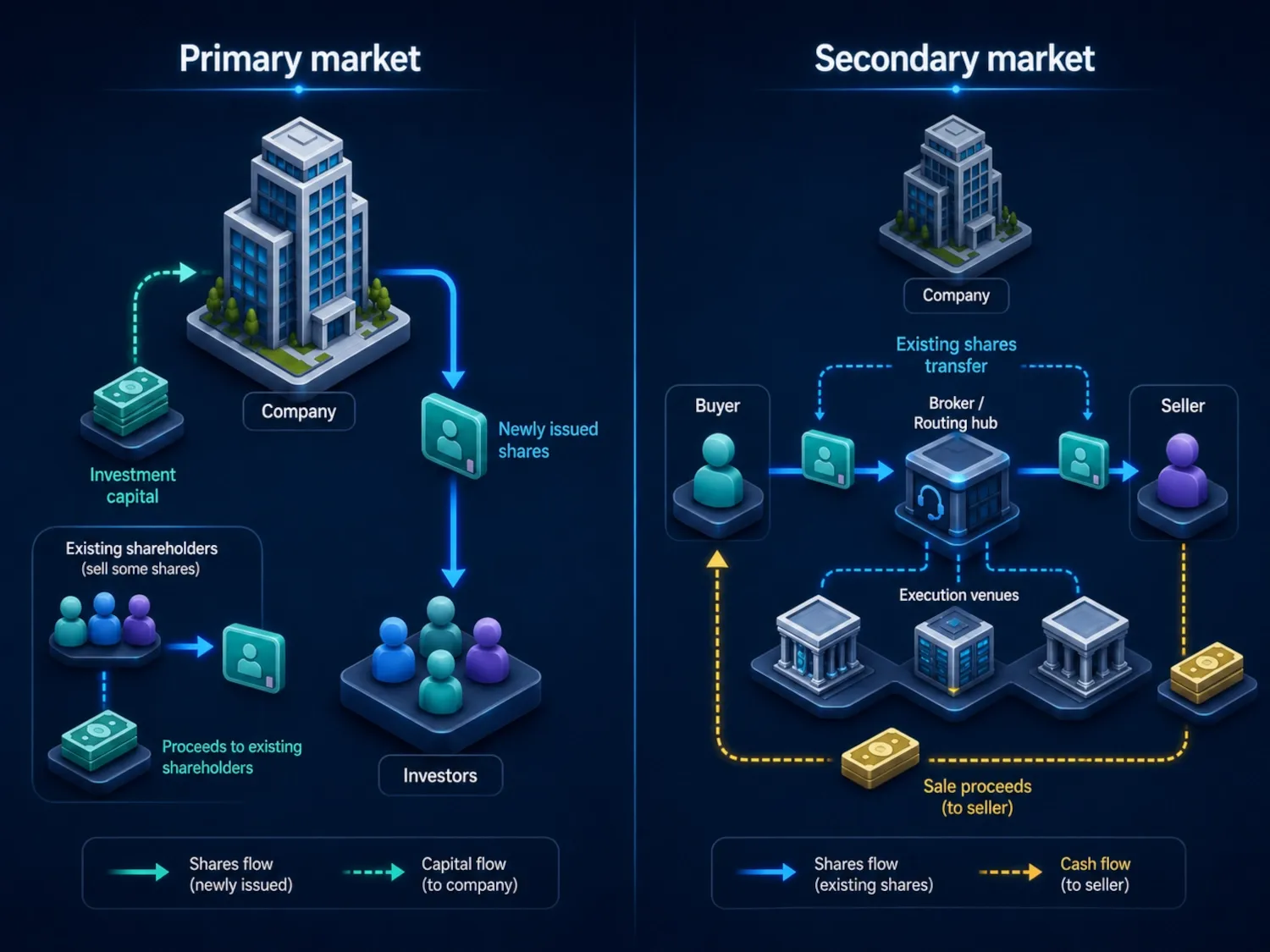
The difference between the primary and secondary market explains where the money goes.
| Market | What is happening? | Who receives the money? |
|---|---|---|
| Primary market | Securities are issued or offered to investors | The issuer receives proceeds from newly issued shares; selling holders receive proceeds from shares they sell |
| Secondary market | Investors trade existing shares with other market participants | The seller receives the sale proceeds, subject to fees, taxes and settlement |
| Follow-on offering | A public company or existing holders offer additional shares | Depends on whether the shares are newly issued or sold by existing holders |
Most everyday stock trading occurs in the secondary market. If you buy 10 shares of a large public company through your broker, you are normally buying existing shares from another market participant—not sending the purchase amount directly to the company.
The company is still affected indirectly by its stock price. A higher or lower valuation can influence future financing, acquisitions, employee compensation, corporate reputation and shareholder pressure. But ordinary secondary-market trades do not automatically add cash to the company’s bank account.
What happens when you buy a stock?
This is the part most beginner explanations skip. Pressing Buy begins a sequence; it does not instantly move money from your account to the company.
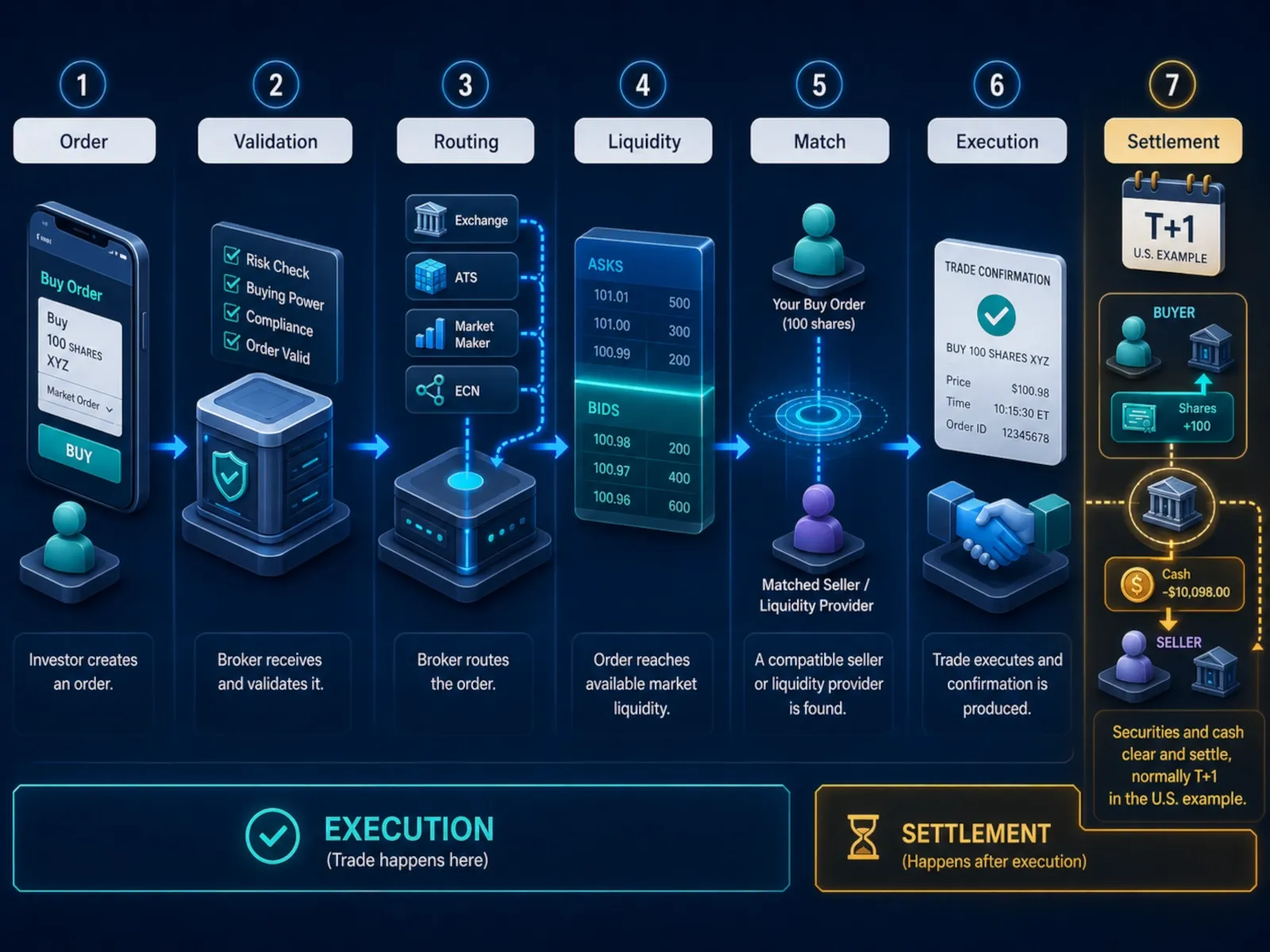
1. You create an order
You select:
- the security;
- the number of shares or monetary amount;
- the order type;
- any price limit;
- the time the order should remain active;
- the account in which the trade will occur.
Some brokers allow fractional shares. Fractional-share programs can work differently from trading whole shares on an exchange, so the broker’s terms matter.
2. Your broker receives and validates the order
The broker checks whether the order is allowed. Depending on the account and transaction, it may verify:
- available cash or buying power;
- whether the market is open;
- whether the security can be traded;
- risk controls and regulatory restrictions;
- the validity of the order instructions.
An app interface can make this stage feel instantaneous, but a regulated intermediary is still processing the instruction.
3. The broker routes the order
The broker decides where to send the order for execution.
Possible destinations include:
- the exchange where the stock is listed;
- another exchange;
- a market maker or wholesaler;
- an alternative trading system;
- an electronic communications network;
- the broker’s own inventory or an affiliated execution operation.
Brokers have best-execution duties under the rules that apply to them, but best execution does not mean every order must receive the single best imaginable outcome in hindsight. Price, speed, likelihood of execution, order size, available liquidity and other factors can matter.
Some venues may pay brokers for order flow. This does not automatically mean the execution is poor, but it creates a potential conflict that investors should understand. In the United States, brokers publish order-routing disclosures that can help customers examine routing practices.
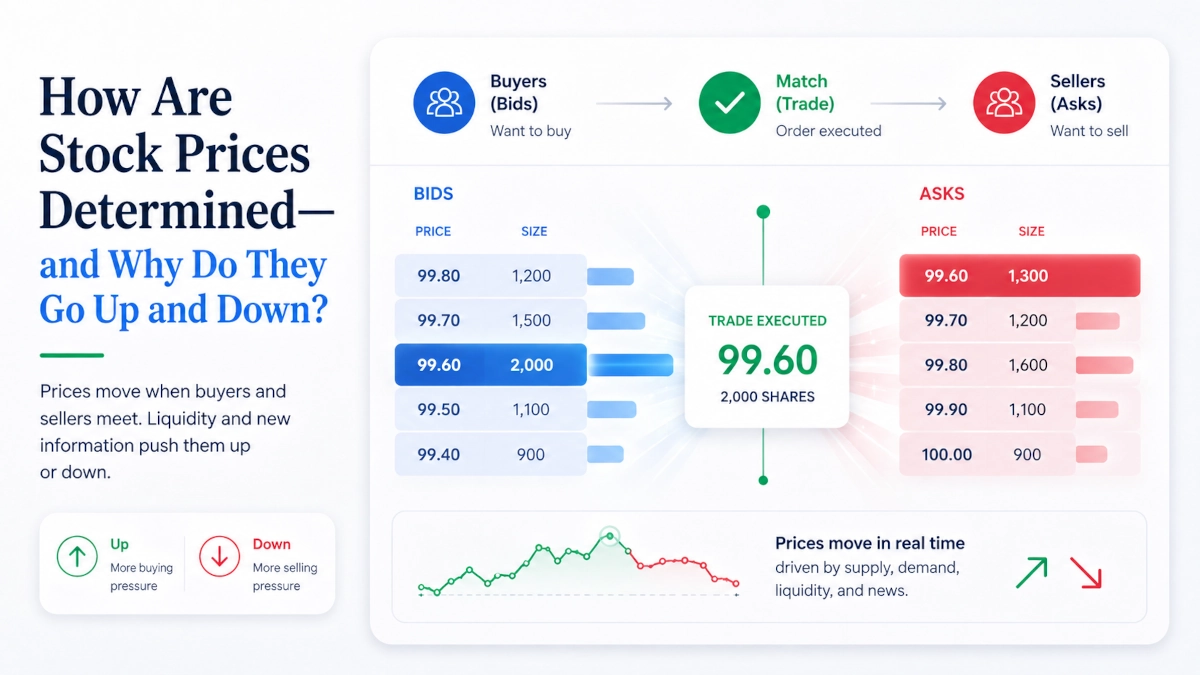
4. The order meets available liquidity
A trade can occur when compatible buy and sell interest is available.
At any moment, the market has:
- bids: prices buyers are willing to pay;
- asks or offers: prices sellers are willing to accept.
The highest displayed bid and the lowest displayed ask form the best visible market quote. The difference between them is the bid–ask spread.
If the highest bid is $49.95 and the lowest ask is $50.05:
Bid–ask spread = $50.05 − $49.95 = $0.10A buyer demanding immediate execution will generally trade against available sell orders. A seller demanding immediate execution will generally trade against available buy orders.
5. The trade executes
When a matching counterparty or liquidity provider is available, the venue executes the trade.
A large order may be filled:
- in one transaction;
- in several partial fills;
- at more than one price;
- across more than one venue.
The last traded price displayed in an app is historical—it is the price of a completed trade. It is not a guarantee that your next order will execute at that exact price.
6. You receive a trade confirmation
The broker updates your account and provides execution details, typically including:
- security and quantity;
- buy or sell;
- execution price or average price;
- execution time;
- fees or commissions, if any;
- settlement date.
The position may appear in your account immediately even though the post-trade settlement process is still continuing behind the scenes.
7. The trade clears and settles
Execution is the agreement to trade. Settlement is the completion of the transfer of securities and money.
In the United States, most transactions in stocks and several other securities currently use a T+1 settlement cycle, meaning settlement normally occurs one business day after the trade date.
Example:
Trade executes on Monday
Normal settlement: Tuesday
Market holidays, weekends, security type and exceptional circumstances can affect the calendar.
This is more precise than saying that the buyer instantly receives final legal delivery at the exact moment the button is pressed. Modern systems update the customer interface quickly, while clearing, netting, custody and settlement continue through market infrastructure.
What happens when you sell a stock?
Selling follows the same core process in reverse:
- You submit a sell order.
- The broker verifies the position and order instructions.
- The broker routes the order.
- The order interacts with available buyers or liquidity providers.
- The trade executes if the order’s conditions are satisfied.
- The broker reports the execution.
- Securities and cash settle through the relevant infrastructure.
Your economic result is not simply the sale price minus the purchase price. A proper calculation can include:
Net result =
sale proceeds
− original cost
− trading costs
− currency-conversion costs
− applicable taxes
Tax treatment varies substantially by country and account type. Realized gains, realized losses, dividends and foreign withholding taxes may all be treated differently.
Selling shares you already own is different from short selling, where shares are borrowed and sold in anticipation of a price decline. Short selling can create losses greater than the original amount received and is not covered in this beginner guide.
How brokers route and execute your order
A common simplified explanation says:
Your broker sends the order to the stock exchange, where it finds another investor.
That can happen, but it is incomplete.
Modern equity markets are fragmented across multiple venues. A broker may route different orders in the same stock to different places. Some retail orders are executed by wholesalers or market makers away from the primary listing exchange. Some orders are internalized. Some limit orders are sent to electronic systems that match prices automatically.
The important principle is not that every order goes to one central order book. It is that the broker must handle the order under applicable rules and seek an execution consistent with its obligations.
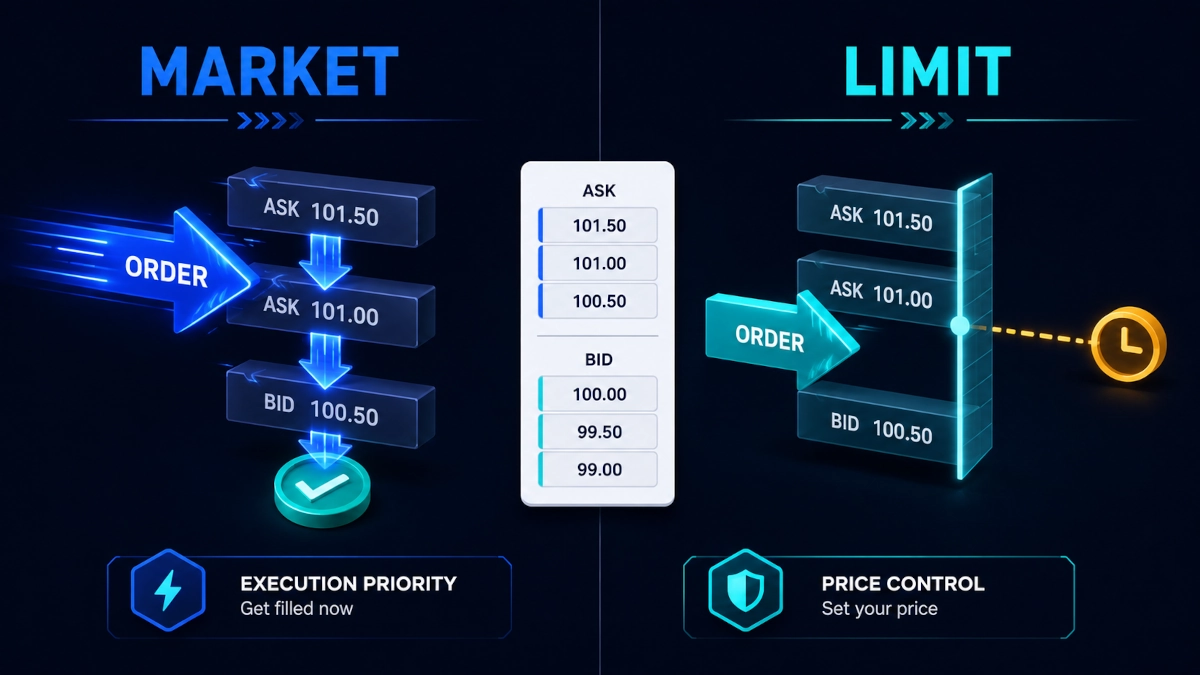
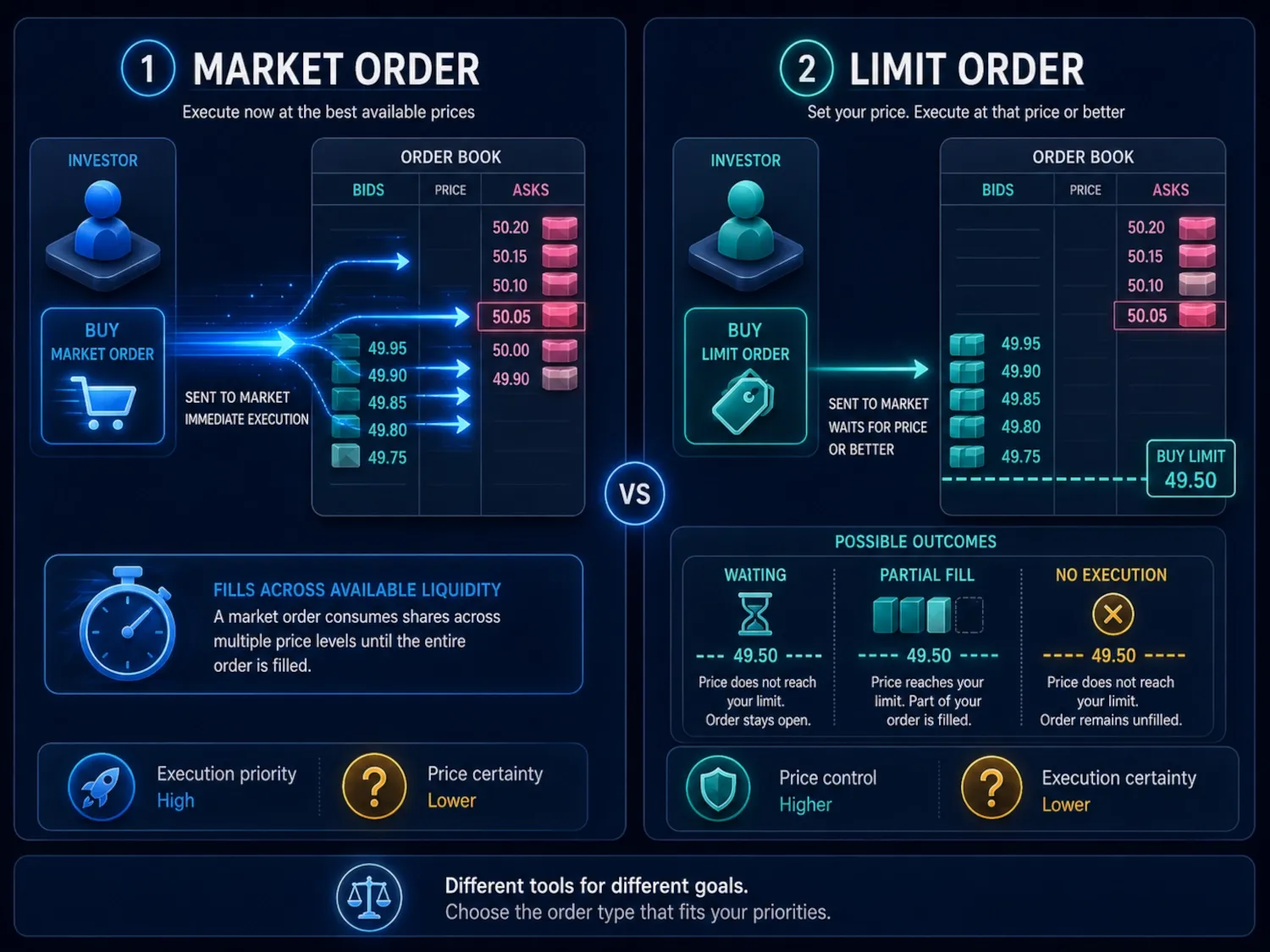
Market orders
A market order instructs the broker to buy or sell promptly at the best price reasonably available when the order reaches the market.
Its main advantage is execution priority. Its main limitation is price uncertainty.
A market order:
- seeks immediate execution;
- does not guarantee the price shown when you clicked;
- may execute at several prices;
- can be especially risky in volatile, illiquid or extended-hours markets.
Investor.gov explains that a market order generally executes at or near the current ask for a purchase or current bid for a sale, but the last-traded price is not necessarily the execution price.
Limit orders
A limit order sets a maximum purchase price or minimum sale price.
- A buy limit order can execute only at the limit price or lower.
- A sell limit order can execute only at the limit price or higher.
Its main advantage is price control. Its main limitation is execution uncertainty.
Suppose a stock is quoted at:
Bid: $49.95
Ask: $50.05
You place a buy limit order at $49.50. The order will not execute above $49.50. It may remain unfilled if no seller becomes willing to trade at $49.50 or less while the order is active.
A limit order protects the price boundary; it does not guarantee that you will buy or sell.
What happens if nobody accepts your price?
The result depends on the order instructions, the venue and the broker.
A limit order may:
- remain active until the end of the trading session;
- remain active for a longer period if marked good-till-canceled;
- be partially filled;
- be canceled by the investor;
- expire without any execution.
It is also too simplistic to say every unfilled retail limit order appears in one public order book. Orders can be routed to different venues, may be subject to display rules, and can receive different handling depending on their terms.
How are stock prices determined?
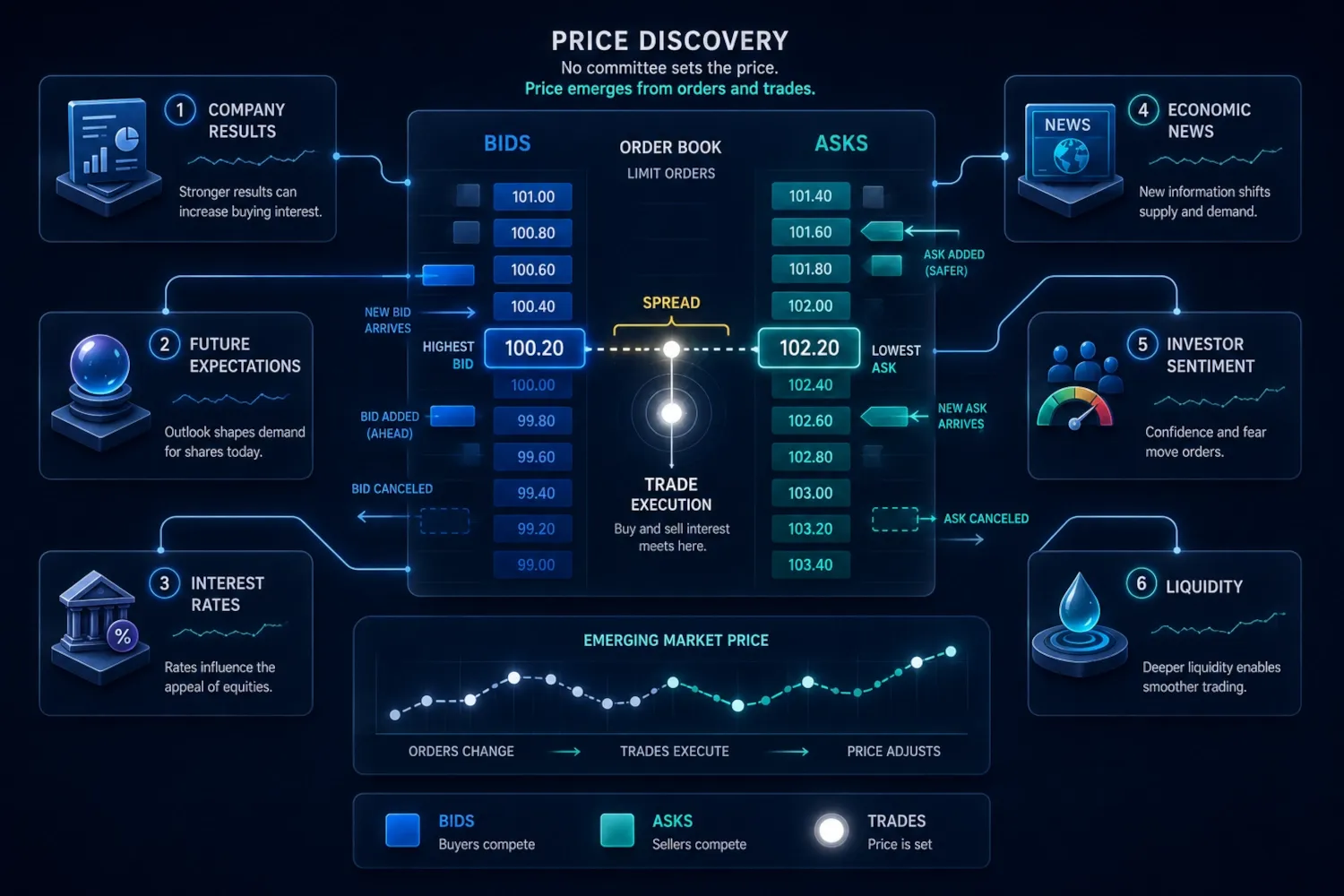
There is no committee continuously deciding the correct price of every stock. The market price emerges from transactions.
A trade price is the price at which a buyer and seller—or their intermediaries—agree to transact. As new orders arrive and existing orders are executed or canceled, the available bids and asks change.
Price discovery depends on:
- the number and size of buy orders;
- the number and size of sell orders;
- the prices attached to those orders;
- liquidity across venues;
- new public information;
- private analysis and expectations;
- the urgency of buyers and sellers.
The quoted market is therefore dynamic. It represents the current state of available trading interest, not an objective guarantee of what the company is worth.
Price vs value
Price is observable: it is what the market currently pays.
Value is an estimate. Investors may estimate value using revenue, profits, cash flow, assets, debt, competitive position, growth prospects, interest rates and many other assumptions.
Two informed investors can study the same company and reach different estimates of value. That disagreement is one reason markets exist.
Why do stock prices go up and down?
At the most basic level, prices rise when buyers become willing to pay more than before and fall when sellers accept less than before. The difficult question is what changes their willingness.
1. Company fundamentals
Investors follow:
- revenue;
- profit margins;
- cash flow;
- debt;
- customer growth;
- product demand;
- competitive position;
- management decisions.
Stronger-than-expected results can improve expectations. Weak results can reduce them. The reaction depends not only on whether the numbers are good or bad, but on how they compare with what the market already expected.
2. Expectations about the future
Stocks are forward-looking assets. Investors are buying claims on uncertain future economic results.
A company can report record profits and still fall if the market expected even better results. Another company can report a loss and rise if investors believe the worst period is ending.
This is why the sentence “the company did well, so the stock must rise” is unreliable.
3. Interest rates and the economy
Interest rates can influence:
- borrowing costs;
- consumer demand;
- company valuations;
- the relative appeal of stocks and bonds;
- currency values;
- expectations about inflation and economic growth.
Economic data, central-bank decisions, recessions and changes in credit conditions can move the entire market, even when nothing company-specific has happened.
4. Industry and geopolitical developments
Commodity prices, regulation, trade policy, wars, supply-chain disruption, elections, natural disasters and technological change can affect industries differently.
An event that benefits one company may harm another.
5. Sentiment, positioning and liquidity
Markets are made of people and institutions operating under uncertainty. Fear, optimism, forced selling, short covering, fund flows and automated strategies can amplify price movements.
Liquidity also matters. A highly traded large-cap stock may absorb orders more easily than a thinly traded small company. In an illiquid market, a relatively modest order can move the price substantially.
6. Corporate actions
Stock splits, share repurchases, new share issuance, mergers, spin-offs and dividend decisions can change the share structure or investor expectations.
A stock split lowers the price per share while increasing the number of shares proportionally; by itself, it does not create additional company value.
How do investors make money from stocks?
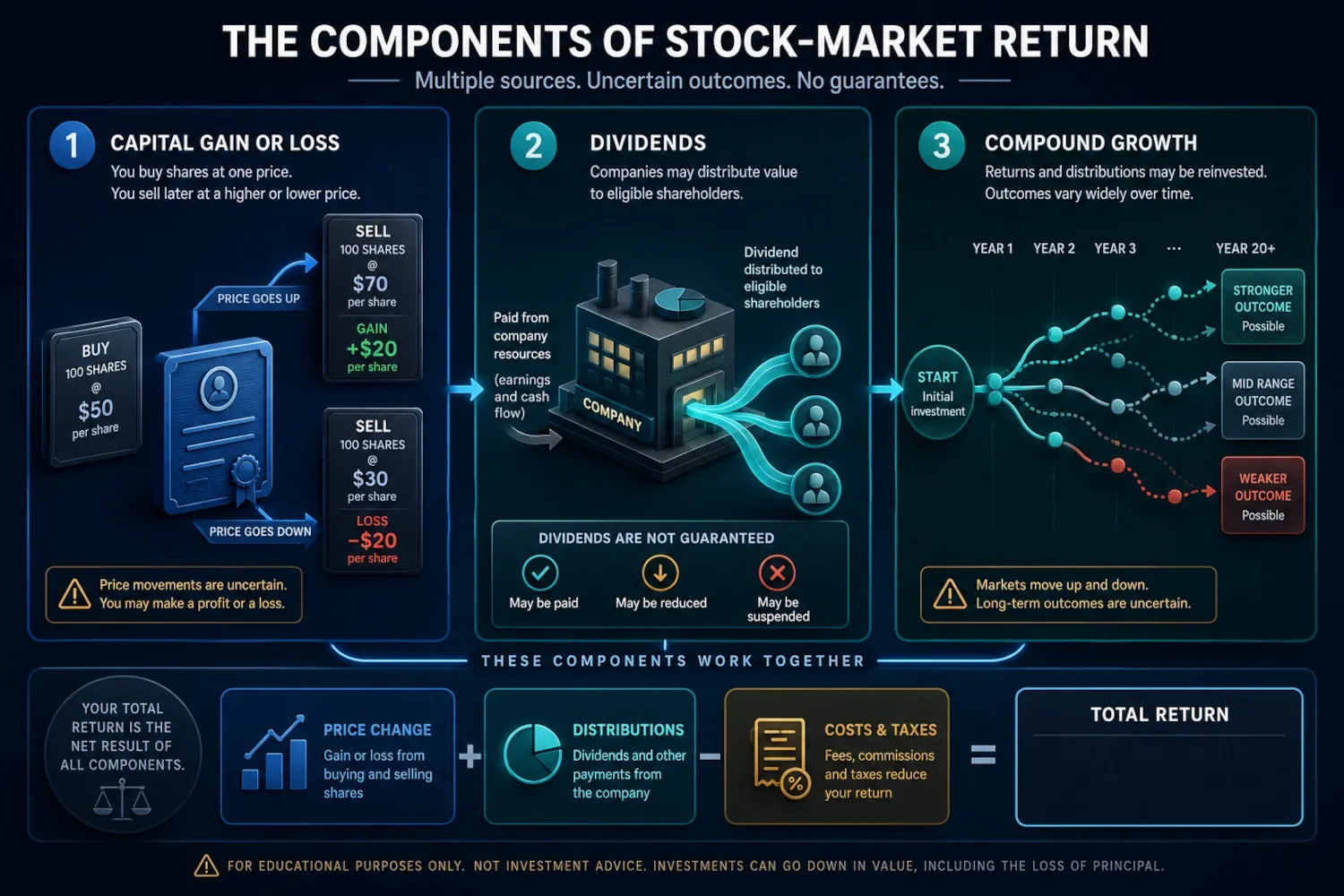
There are two primary components of stock return: price change and distributions.
Capital gains
A capital gain occurs when shares are sold for more than their adjusted purchase cost.
Hypothetical example:
10 shares purchased at $40 = $400
10 shares sold at $50 = $500
Gross capital gain = $100
The actual net result can be lower after fees, taxes and currency effects. If the shares are sold at $30 instead, the investor realizes a gross capital loss of $100.
An unrealized gain is a price increase on a position that has not been sold. It can disappear if the market price later falls.
Dividends
A dividend is a distribution authorized by a company to eligible shareholders.
Important points:
- companies are generally not required to pay regular dividends;
- a board can reduce, suspend or change a dividend;
- the dividend amount does not appear from nowhere;
- eligibility depends on relevant record and ex-dividend dates;
- taxes and withholding may apply;
- a high dividend yield can reflect a falling share price and elevated risk.
Investors should evaluate total return, which combines price change and distributions, rather than treating dividends as free money.
Compound growth
Stock investments do not pay guaranteed “interest” in the way a fixed-rate bank product might. A more accurate term is compound growth: returns may generate additional returns when gains and distributions remain invested.
Hypothetical example only:
$1,000 growing at 7% annually for 30 years
≈ $7,612 before taxes and fees
This calculation demonstrates compounding, not a promised stock-market outcome. Real returns vary, losses occur, inflation reduces purchasing power, and fees and taxes change the result.
Trading vs long-term investing
Trading and investing use the same markets but usually differ in objective, time horizon and decision process.
| Feature | Short-term trading | Long-term investing |
|---|---|---|
| Main objective | Profit from shorter price movements | Participate in long-term business or market growth |
| Typical holding period | Seconds to months | Years or decades |
| Decision focus | Price action, catalysts, positioning, timing | Fundamentals, diversification, valuation, long-term goals |
| Turnover | Usually higher | Usually lower |
| Cost sensitivity | Spreads, execution and taxes can be frequent | Fund fees, taxes and allocation remain important |
| Main challenge | Consistently predicting short-term moves | Remaining disciplined through declines and uncertainty |
Neither label guarantees success. A long holding period cannot turn a poor investment into a good one, and active trading is not automatically reckless. The important issue is whether the strategy is understood, evidence-based, appropriately diversified and compatible with the investor’s finances and risk capacity.
Beginners should be especially cautious about claims that a course, signal group, influencer or automated system can produce reliable profits with little risk.
How index funds work
An index fund is a mutual fund or exchange-traded fund designed to track the returns of a market index before fees and tracking differences.
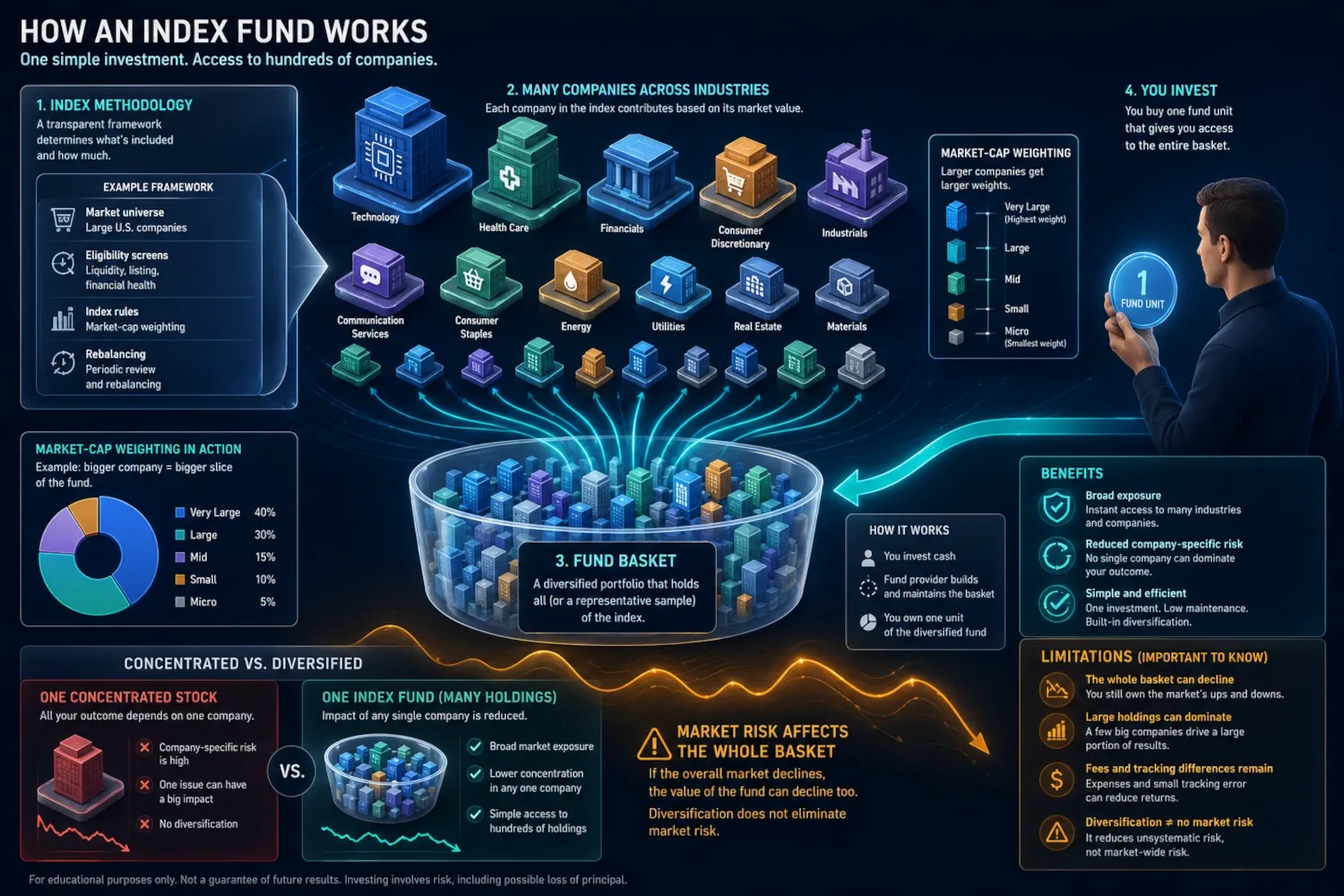
Instead of selecting companies based on a manager’s forecasts, the fund follows a defined index methodology. Depending on the index, the fund may hold:
- large U.S. companies;
- the total U.S. stock market;
- international stocks;
- companies in one sector;
- bonds;
- companies meeting specific size, style or factor criteria.
The S&P 500 example
The S&P 500 includes 500 leading companies and covers approximately 80% of available U.S. market capitalization, according to S&P Dow Jones Indices.
It is an important measure of U.S. large-cap equities, but it is not:
- every U.S. company;
- the entire global stock market;
- equally weighted across all companies;
- guaranteed to rise;
- automatically suitable for every investor.
Most widely used S&P 500 funds are weighted by float-adjusted market capitalization. Larger constituents therefore have a greater effect on performance than smaller constituents.
What diversification can and cannot do
A broad fund can reduce the damage caused by one company failing because the investment is spread across many holdings.
Diversification can reduce company-specific concentration risk. It cannot eliminate:
- market-wide declines;
- inflation risk;
- currency risk;
- valuation risk;
- political or regulatory risk;
- losses caused by selling during a decline.
Two funds can also appear different while holding many of the same companies. Investors need to examine the actual index, holdings and weightings.
Index-fund costs and tracking differences
Index funds are not costless simply because they are passive.
Relevant factors include:
- expense ratio;
- brokerage costs;
- bid–ask spread for ETFs;
- taxes;
- currency conversion;
- tracking error;
- securities-lending and transaction effects;
- platform or account charges.
Investor.gov warns that fees and expenses reduce returns and that even small cost differences can create meaningful long-term differences.
Main risks beginners should understand
Market risk
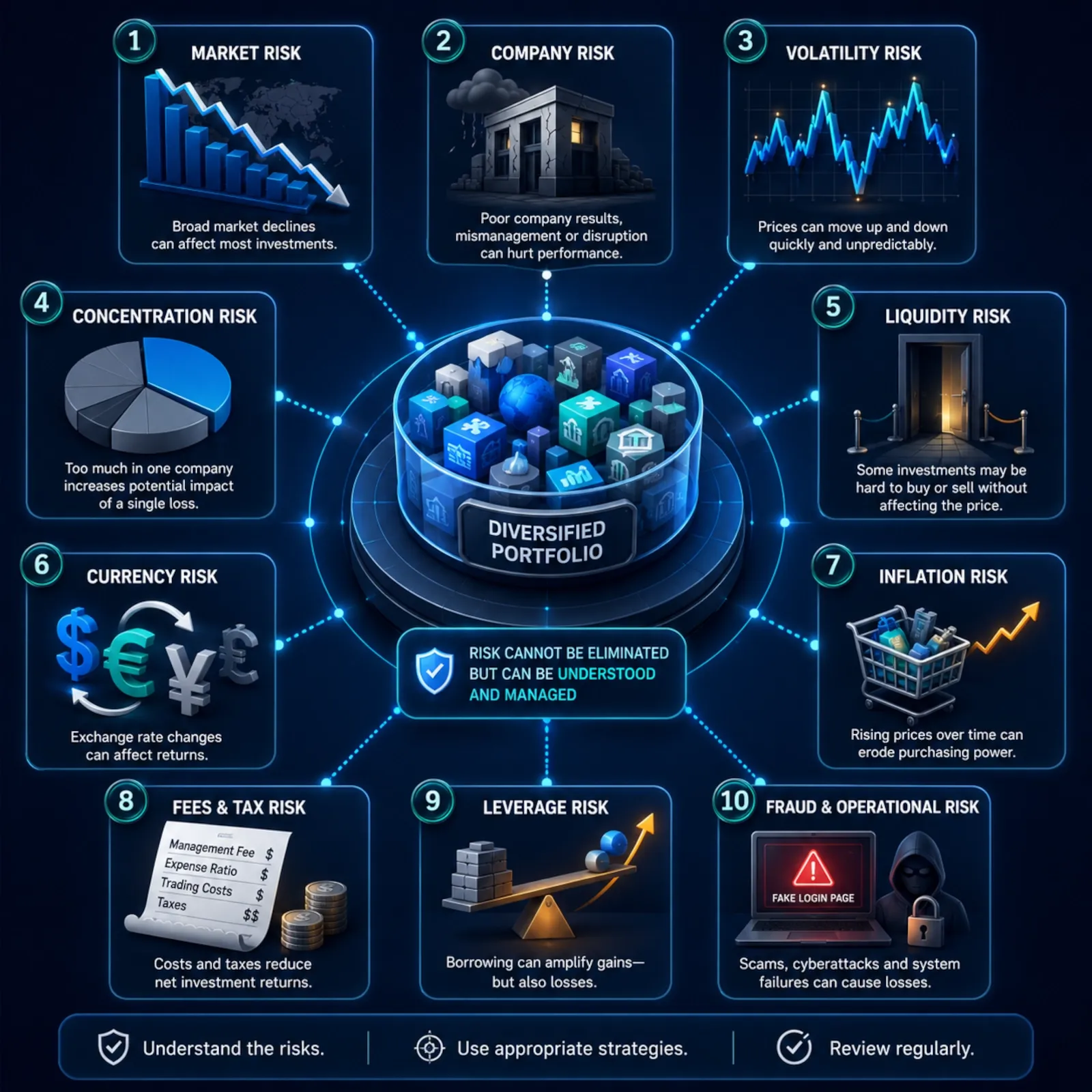
The broad market can decline because of recession, financial stress, war, policy changes or shifts in investor expectations.
Company risk
A company can lose customers, accumulate debt, suffer fraud, face litigation or become obsolete. Common shareholders can lose their entire investment.
Volatility risk
Prices can move sharply. Volatility becomes especially damaging when an investor must sell at an unfavorable time.
Concentration risk
Owning one company, industry or country creates exposure to a limited set of outcomes. A strong recent performer can still be a highly concentrated position.
Liquidity risk
Some securities are difficult to buy or sell without moving the price. Wide spreads and low trading volume can increase execution costs.
Currency risk
An investor purchasing foreign securities or funds can gain or lose because exchange rates change, even if the underlying investment price is unchanged in its home currency.
Inflation risk
An investment can increase in nominal value but still lose purchasing power if its return does not keep pace with inflation.
Fee and tax risk
High costs reduce the capital that remains invested. Tax rules can change the net outcome and vary by jurisdiction.
Leverage risk
Borrowed money magnifies gains and losses. Margin calls can force positions to be sold. Some leveraged or derivative strategies can lose more than the original cash committed.
Fraud and operational risk
Fake brokers, cloned websites, social-media impersonators, account takeovers and unauthorized transfers can cause losses unrelated to market performance.
Common mistakes
Thinking a share price tells you how large a company is
Compare market capitalization, not just price per share. A $10 stock can represent a larger company than a $500 stock.
Believing the company receives your money every time you buy
In ordinary secondary-market trading, the sale proceeds go to the seller. The company receives capital when it issues shares or uses another capital-raising route.
Assuming the broker always sends the order to the named exchange
The broker may route the order to several possible execution venues.
Treating the last traded price as your guaranteed price
Quotes can change, and a market order can execute at a different price—particularly in volatile or illiquid conditions.
Believing a limit order guarantees a trade
It guarantees a price boundary, not execution.
Treating dividends as free money
Dividends are distributions from company resources, are not guaranteed and should be evaluated as part of total return.
Assuming diversification means no losses
A diversified portfolio can still decline when the broad market falls.
Buying because a stock has already risen
Past price momentum does not prove that the future return will be positive or that the current valuation is reasonable.
Confusing investing with a guaranteed savings product
Stocks, mutual funds and ETFs are investments. They can lose value and are not equivalent to insured bank deposits.
Ignoring small recurring costs
Expense ratios, spreads, conversion charges and taxes can compound against the investor over time.
Security, privacy and financial safety notes
Before depositing money with any investment platform:
- Verify the exact legal entity, not only the brand name.
- Check the firm with the securities regulator or official register in your country.
- Type the official website address yourself or use a trusted regulator link.
- Enable strong multifactor authentication.
- Use a unique password stored in a password manager.
- Confirm withdrawal rules, fees, custody arrangements and investor protections.
- Be suspicious of guaranteed returns, urgency, secret strategies and requests to move conversations to private messaging apps.
- Never provide remote access to your device to someone claiming they will invest for you.
- Do not send cryptocurrency or bank transfers to “unlock” profits or recover previous losses.
- Keep trade confirmations, statements and tax records.
For U.S. firms, investors can use official tools such as FINRA BrokerCheck and SEC resources. Other countries have their own registers and compensation arrangements.
Ordinary cash purchases of shares generally limit market loss to the amount invested in that position. Margin, short selling, options, CFDs and other leveraged products can create larger or differently structured losses.
Faster alternative
Use this 60-second mental model:
A company divides ownership into shares
        ↓
Shares may be offered to investors
        ↓
Existing shares trade in the secondary market
        ↓
You send an order through a broker
        ↓
The broker routes it to an execution venue
        ↓
Compatible buy and sell interest produces a trade
        ↓
The trade settles and your account records the position
Then remember four rules:
- A share is ownership, not a guaranteed return.
- A broker routes the order; the company usually is not your counterparty.
- A market order prioritizes execution; a limit order prioritizes price control.
- Diversification can reduce concentration risk, but it cannot remove market risk.
This shortcut is enough to understand the basic system. It is not enough to evaluate a company, fund or personal investment plan.
Frequently asked questions
How do stocks work in simple terms?
A company divides its equity into shares. Investors can buy and sell those shares through brokers, and the market price changes as available bids, asks and expectations change. Shareholders may benefit from price appreciation or dividends, but both are uncertain.
Is the stock market the same as a stock exchange?
No. The stock market is the broader network of issuers, investors, brokers, exchanges and other venues. A stock exchange is one type of regulated trading venue within that network.
What exactly do I own when I buy a stock?
You own an equity interest with the rights attached to that class of shares. You do not directly own a specific company building, machine or bank account.
Where does my money go when I buy a stock?
In a normal secondary-market trade, the proceeds ultimately belong to the seller, subject to the roles of brokers, clearing organizations, custodians, fees and settlement. If you buy newly issued shares in an offering, some or all proceeds may go to the issuing company.
Does the company benefit when its stock price rises?
A rising price does not automatically deposit cash into the company’s account. It can nevertheless improve the company’s ability to raise capital, use shares in acquisitions, compensate employees and negotiate from a stronger market position.
Why did my market order execute above the price I saw?
The quote may have changed, available shares at the displayed price may have been limited, or the order may have been filled across several prices. A market order seeks prompt execution, not a guaranteed price.
What happens if no one wants to sell at my limit price?
The order may remain unfilled, receive a partial fill, expire or be canceled. Reaching the quoted price also does not always guarantee execution because other orders may have priority and liquidity may be limited.
Can I lose more than I invest in a stock?
With a fully paid cash purchase of ordinary shares, the position can generally fall to zero, limiting the market loss on that position to the amount invested. Borrowing on margin, short selling and derivatives can create losses beyond that amount.
Are dividends guaranteed?
No. A company’s board generally decides whether to declare a dividend, subject to law and the security’s terms. Dividends can be reduced, suspended or eliminated.
Are index funds risk-free?
No. They hold securities whose prices can fall. An index fund may also have fees, tracking error, concentration and liquidity risks.
Does the S&P 500 represent the entire stock market?
No. It is a leading benchmark for large-cap U.S. equities and covers a substantial share of U.S. market capitalization, but it does not include every U.S. company or international market.
What is the difference between execution and settlement?
Execution occurs when the trade is agreed at a price. Settlement is the later completion of the securities and cash transfer. Most U.S. stock transactions currently settle on T+1.
Is long-term investing guaranteed to make money?
No. A longer time horizon can provide more opportunity to recover from temporary declines, but there is no guaranteed holding period, stock or index return.
Editorial sources
This guide was reviewed against investor-education and market-structure material from official or primary sources:
- Investor.gov — Introduction to Investing
- Investor.gov — Stocks: Frequently Asked Questions
- U.S. Securities and Exchange Commission — Initial Public Offerings
- U.S. Securities and Exchange Commission — Follow-on Registered Offerings
- Investor.gov — Executing an Order
- Investor.gov — Types of Orders
- FINRA — Where Do Stocks Trade?
- FINRA — Understanding Settlement Cycles
- Investor.gov — Index Funds
- Investor.gov — Diversify Your Investments
- Investor.gov — Mutual Fund and ETF Fees and Expenses
- Investor.gov — What Is Risk?
- S&P Dow Jones Indices — S&P 500
Interface labels, settlement rules, tax treatment and investment products can change. Verify current information with the relevant broker, exchange and regulator before acting.
Last tested
Tested on:
- U.S. stock-market structure
- SEC and Investor.gov investor-education materials
- FINRA order-routing, execution-venue and settlement guidance
- S&P Dow Jones Indices’ official S&P 500 description
Last tested: 2026-07-23
Related guides
Carefully selected guides to help you understand the topic and complete the next useful step.