The PDF is so common that it is easy to forget it had to be invented.
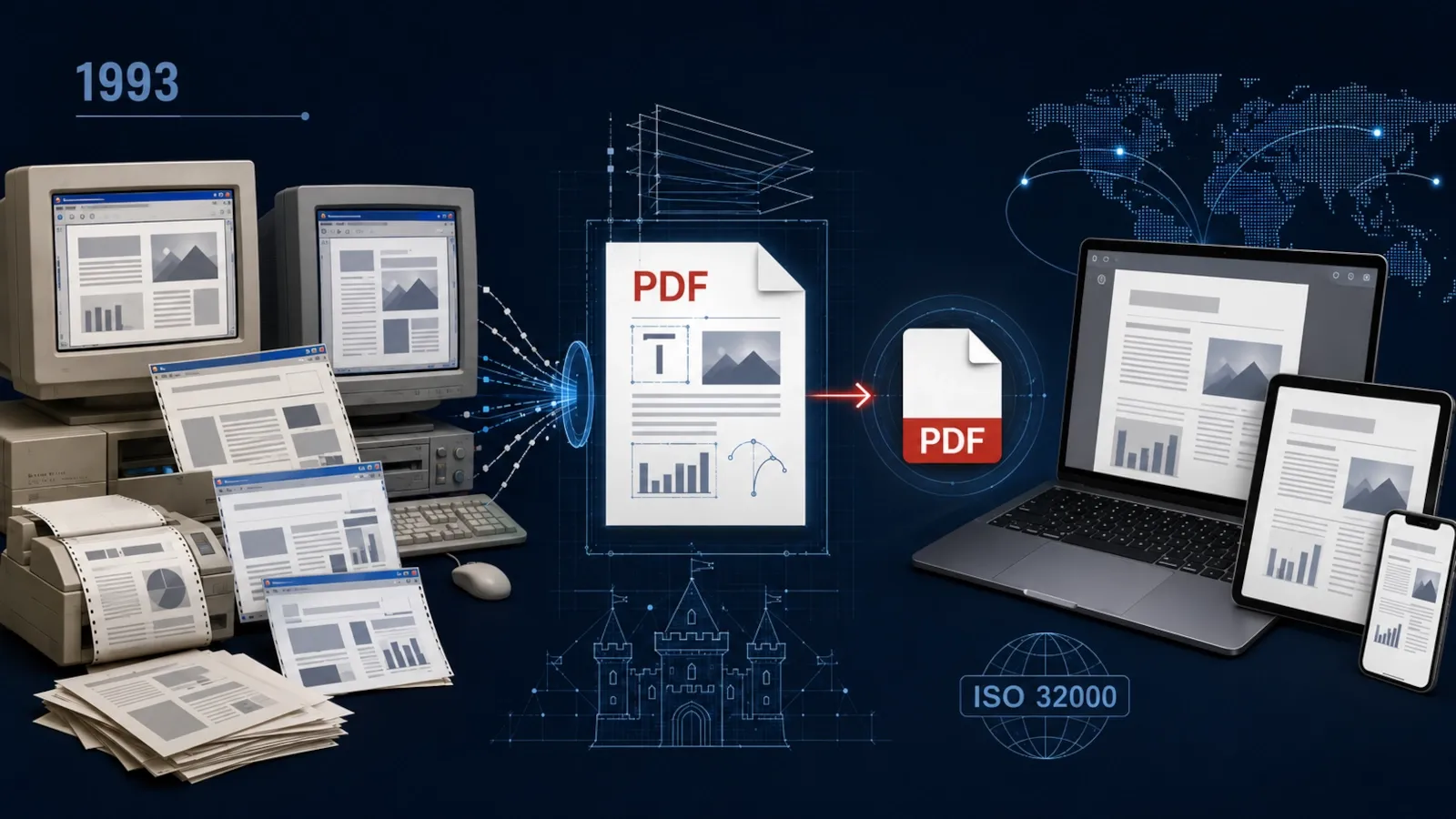
Before the Portable Document Format existed, sending an electronic document to someone else could change the very thing the document was supposed to preserve. Fonts could disappear, lines could wrap differently, pages could repaginate, graphics could move, and the recipient might need the same application — sometimes even the same version — just to open the file correctly.
PDF was created to solve that problem.
Its history is often reduced to one sentence: “John Warnock invented the PDF.” That is useful as a shortcut, but it is not the complete story. The more accurate answer involves John Warnock, Adobe, an engineering team, the earlier PostScript technology, the Camelot Project, Adobe Acrobat, the rise of the web, and eventually the international ISO standards process.
This guide explains that full story.
Quick answer
Adobe created the PDF, with Adobe co-founder Dr. John Warnock as the central driving force behind the idea that became the format.
Warnock began exploring a universal electronic-document system around 1990. His Camelot Project described a way to capture documents from different applications, send them electronically, and preserve their appearance when viewed or printed on different computers. Adobe developed that vision into Portable Document Format (PDF) and the Acrobat product family, formally launching Acrobat and PDF on June 15, 1993.
Charles Geschke, Adobe’s other co-founder, was a major figure in the company and its document-technology strategy, but the surviving historical record ties the specific Camelot concept most directly to Warnock. PDF itself was not the work of one person: Adobe engineers had to turn the concept into a robust file format and shipping product.
Adobe published the PDF specification openly from the beginning. In 2008, PDF 1.7 became ISO 32000-1, moving the core specification into an international standards process. The current core specification is PDF 2.0, ISO 32000-2:2020.
So the shortest accurate answer is:
John Warnock originated the vision that became PDF; Adobe and its engineering team created and launched the format.
When this explanation is useful
This article is for you if you are trying to answer any of these questions:
- Who invented PDF?
- Who created the PDF format?
- Was PDF invented by John Warnock or by Adobe?
- Did Charles Geschke invent PDF?
- When was PDF invented?
- Why was PDF created?
- What does PDF stand for?
- When did PDF become popular?
- Is PDF still owned by Adobe?
- When did PDF become an open international standard?
- What is the difference between PDF and Adobe Acrobat?
- Why is PDF still used more than 30 years after its launch?
It is a history and technology explainer, not a guide to editing, converting or compressing PDF files.
Before you start
Three distinctions make the history much easier to understand.
PDF is a format, not an application
A PDF is a document file format. Adobe Acrobat is software for creating, viewing, editing and managing PDF files. They are closely connected historically, but they are not the same thing.
“Invented” does not point to one single moment
There was an idea, an early prototype, the Camelot Project, product development, a public specification and finally a commercial launch. Asking “When was PDF invented?” therefore has more than one defensible milestone.
“John Warnock invented PDF” is shorthand
Warnock’s role was foundational, but a production file format and cross-platform software system required an engineering team and a company willing to develop, publish and support it. The strongest historical answer separates the originator of the vision from the organization and team that built the standard and product.
Who really invented the PDF?
If a quiz asks for one person, John Warnock is the best-known answer.
If the question is historical and technical, the answer should be more precise.
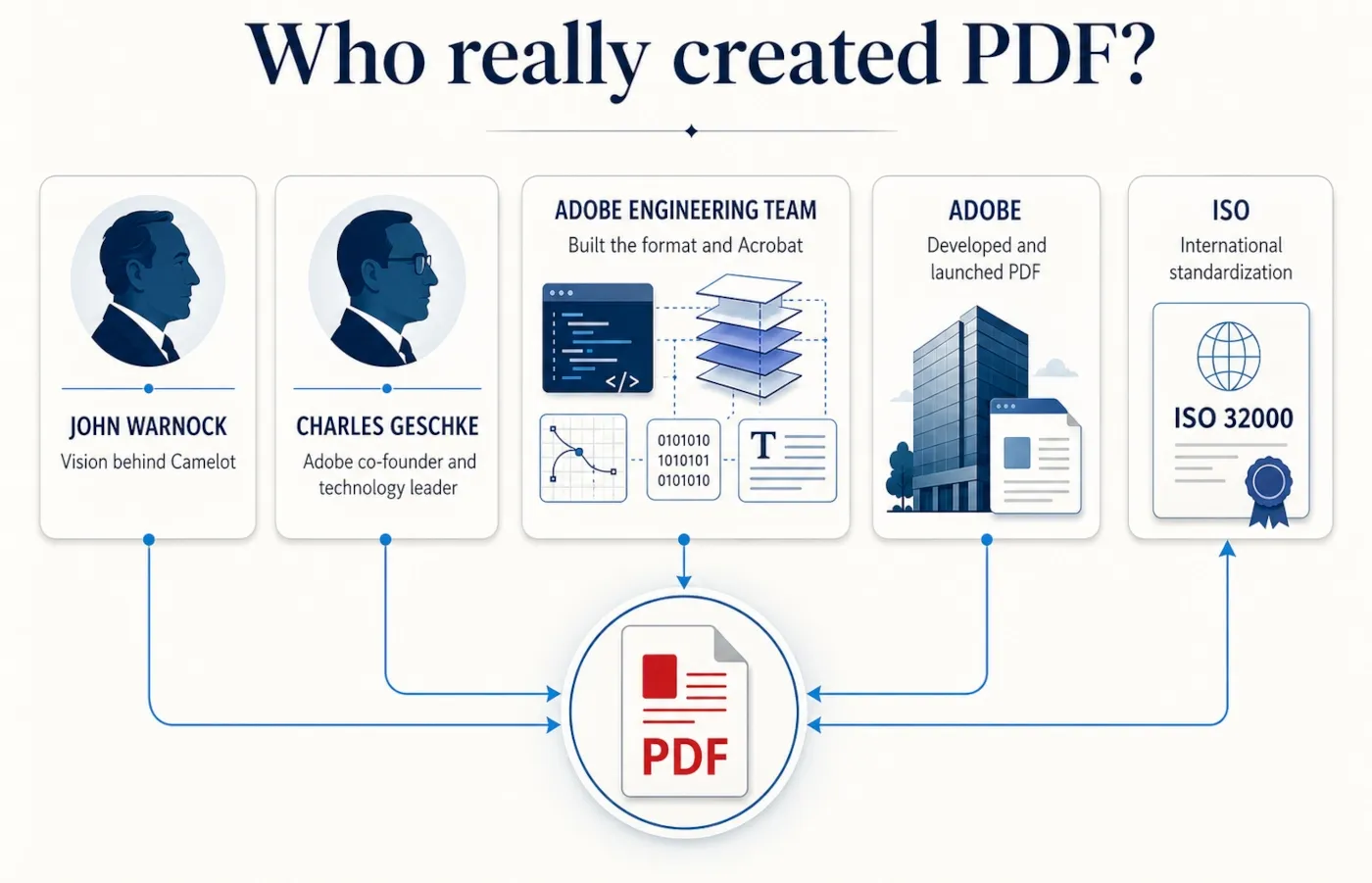
Adobe states directly that Adobe created the PDF and identifies Warnock’s Camelot Project as the idea from which PDF emerged. The PDF Association’s copy of the Camelot Project likewise describes Warnock’s document as the vision that became PDF.
The most accurate attribution is therefore:
| Person or organization | Role in the story |
|---|---|
| John Warnock | Originated and championed the universal electronic-document vision that became the Camelot Project and PDF |
| Charles Geschke | Adobe co-founder and key leader in the company’s document and publishing technology strategy |
| Adobe engineering team | Turned the concept into a robust file format, cross-platform software and commercial product |
| Adobe | Developed, launched, documented and initially governed PDF and Acrobat |
| ISO community | Later standardized and now maintains the core PDF specification through the international standards process |
Calling Warnock “the inventor of PDF” is reasonable in ordinary conversation. Saying he created the entire production format alone is not.
The problem PDF was created to solve
To understand why PDF mattered, imagine sending an important document in 1990.
You create a carefully formatted report on one computer. It contains:
- several fonts;
- charts;
- images;
- precise page breaks;
- headers and footers;
- tables;
- a specific printed layout.
Then you send the source file to another person.
The recipient might use a different operating system, a different application, a different software version, different installed fonts and a different printer. The result could be a document that looked noticeably different from the one you created.
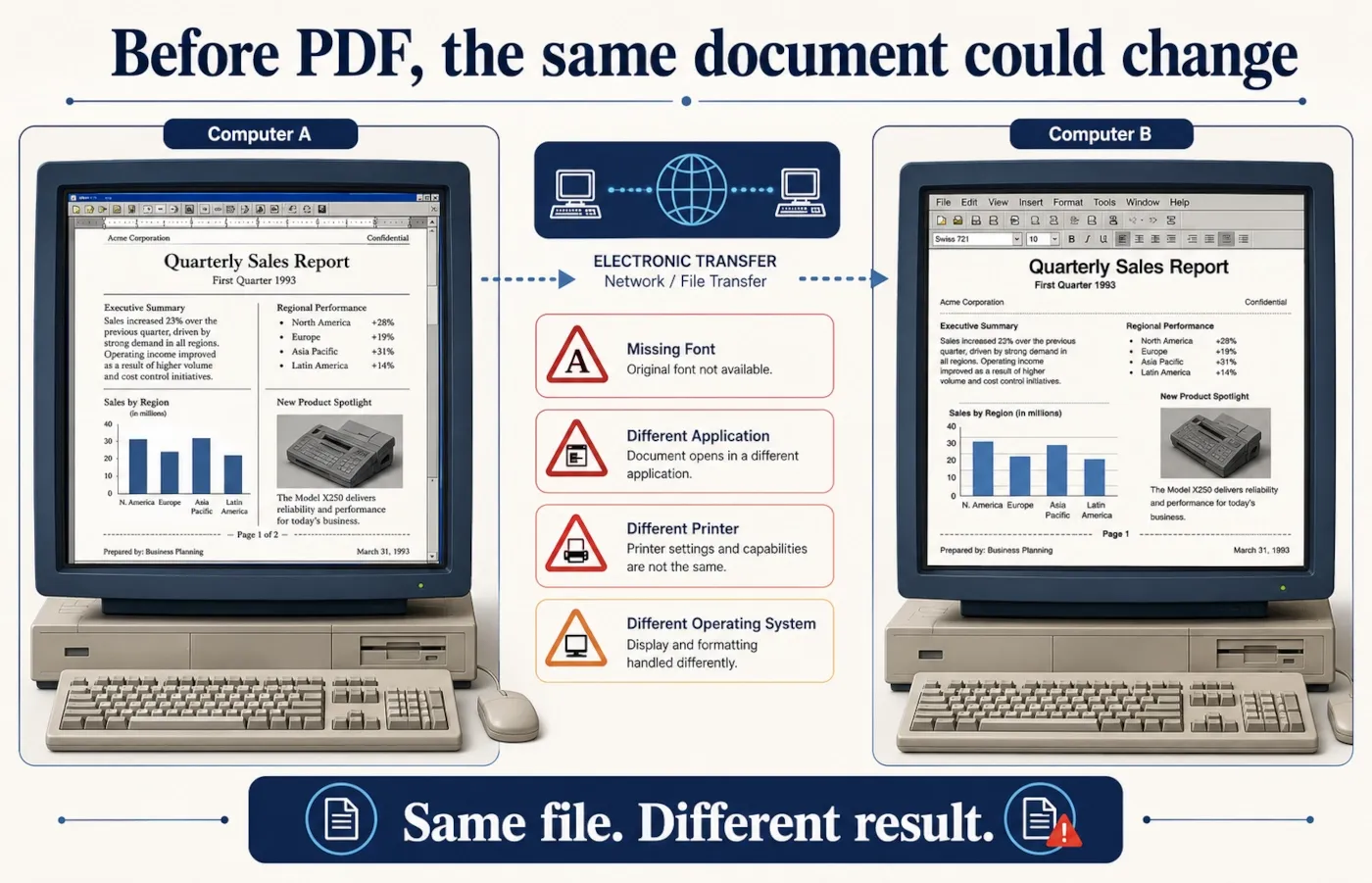
In a retrospective interview with John Warnock and Acrobat engineering leader Bob Wulff, Knowledge at Wharton described the problem plainly: even when both people had compatible software, fonts could change, text could reflow and pages could repaginate.
Plain text was portable, but it did not preserve sophisticated layout.
Application-native files preserved editability, but depended on the original software environment.
Fax could reproduce a visual page remotely, but at the cost of quality, searchability and efficient digital reuse.
The computing industry needed something different:
a way to preserve the visual identity of a document while making it independent of the computer, operating system, application and printer that created it.
That is the problem PDF was designed to solve.
PostScript: the technology that made PDF possible
PDF did not appear from nowhere.
Its most important technical ancestor was PostScript, the page-description language that helped make Adobe a major technology company in the 1980s.
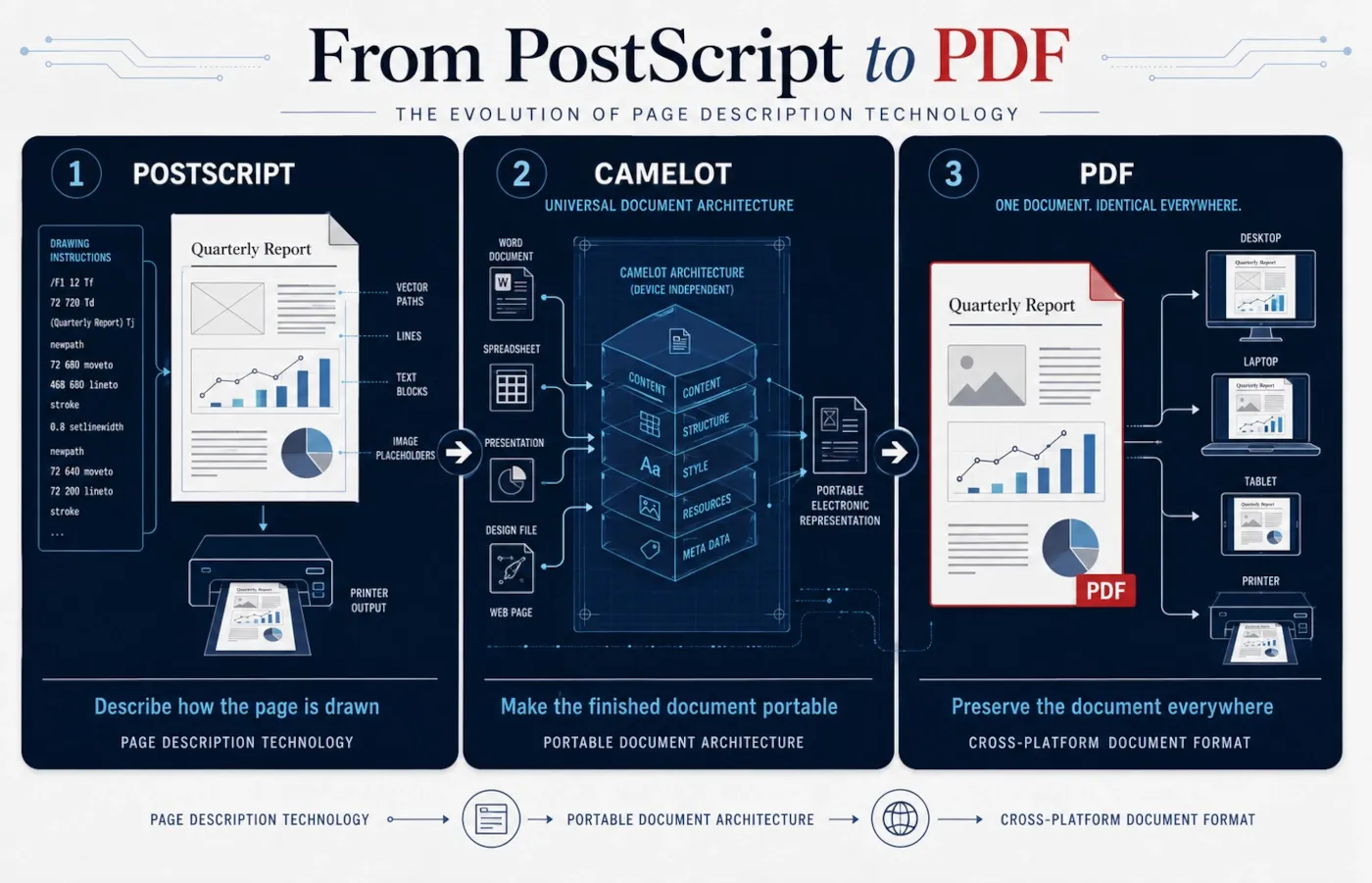
PostScript described how a page should be drawn: text, lines, shapes, images and other graphical elements could be expressed as instructions and rendered by a PostScript-capable printer.
That was revolutionary for desktop publishing because it separated document design from a specific printer model.
But PostScript was fundamentally a programming language for describing and producing pages. A PostScript file could contain executable logic and was not designed primarily as a lightweight, interactive document that ordinary users would open, navigate and exchange.
Warnock saw that Adobe could take the powerful imaging model behind PostScript and transform it into something more suitable for electronic documents.
In a Knowledge at Wharton interview, Warnock described the key idea as turning the results of PostScript’s graphical operations into a static data structure. Instead of shipping a program that still needed to be executed to construct the page, the system could preserve the resulting page description.
That distinction was central to the technology that became Acrobat Distiller and PDF.
John Warnock and the Camelot Project
The clearest primary historical source is Warnock’s own document, The Camelot Project.
The PDF Association preserves the paper and identifies it as the document describing the base technology and ideas behind Camelot.
Warnock began by identifying what he considered a fundamental business problem: companies could print information through many different applications and printers, but lacked a universal way to communicate that visual information electronically across different computer systems.
His goal was ambitious.
A useful universal document system needed to allow documents to:
- originate in many different applications;
- travel across networks;
- remain independent of a particular operating system;
- be viewed on different displays;
- print correctly on different printers;
- preserve the information needed to reproduce the page.
This was not simply a proposal for a new file extension.
It was a proposal for a portable document architecture.
A note about the 1990 versus 1991 Camelot date
Historical sources are not perfectly consistent about the exact date attached to “the Camelot Project.”
Adobe’s current PDF history timeline dates the Camelot Project to 1990. The PDF Association also describes Warnock’s Camelot paper as written in 1990.
Another current Adobe page, What is a PDF?, dates the launch of the Camelot idea to 1991.
There is even more useful context in the 2013 Wharton interview: Bob Wulff recalled that the first prototype was built in June 1990, while Warnock said he wrote the Camelot paper in 1991.
Rather than forcing these sources into a false single date, the safest historical chronology is:
- 1990: early Acrobat/Camelot prototypes and active experimentation;
- 1990–1991: Camelot concept and paper take shape;
- 1992: Camelot develops into the technology Adobe calls PDF;
- 1993: Acrobat and PDF are formally launched.
This is more accurate than simply saying “PDF was invented in 1991.”
What did the Camelot Project actually propose?
The central idea can be expressed as a simple pipeline:
Any application → electronic document → any computer → consistent viewing and printing
That sounds ordinary today. In the early 1990s, it was not.
The Camelot concept tried to make the electronic document itself portable. The recipient would not need to reconstruct the original author’s exact combination of software, fonts, hardware and printer environment just to see the intended page.
This also explains the word portable in Portable Document Format.
The core promise was not “a small file you can carry around.”
It was a document that could move between computing environments without losing its intended representation.
That same idea remains visible in the modern ISO definition of PDF. ISO 32000-2:2020 defines PDF as a digital representation that enables electronic documents to be exchanged and viewed independently of the environment in which they were created or the environment in which they are viewed or printed.
More than three decades later, the problem statement is recognizably the same.
When was PDF actually invented?
There is no single date that captures every stage.
A better answer separates four milestones.
| Milestone | Date | What happened |
|---|---|---|
| Early prototype | June 1990 | Adobe built an early prototype of the concept that would become Acrobat/PDF |
| Camelot vision | 1990–1991 | Warnock formalized the universal electronic-document idea |
| PDF takes shape | 1992 | Adobe says the Camelot Project had developed into PDF |
| Official launch | June 15, 1993 | Adobe formally introduced Acrobat and the underlying Portable Document Format |
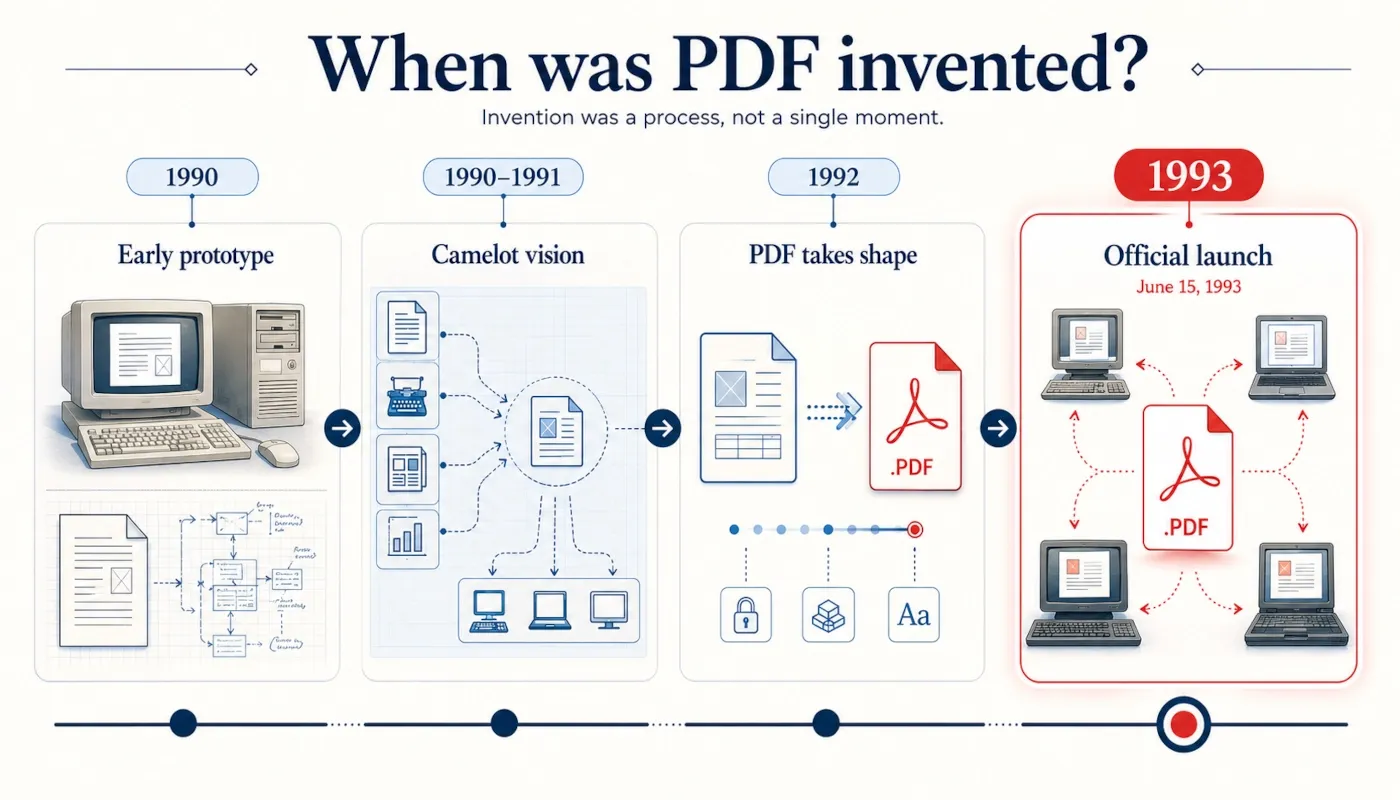
If someone asks “When was PDF created?”, the clearest public-launch answer is:
PDF was officially launched in 1993.
If they ask when its invention began, the answer reaches back to 1990.
What roles did John Warnock, Charles Geschke and Adobe play?
The three names are related, but their roles should not be blurred together.
John Warnock
Warnock co-founded Adobe with Charles Geschke in 1982. He was the central technical visionary behind the Camelot idea and repeatedly championed the need for a universal document format.
His earlier work on PostScript gave Adobe both the imaging technology and the conceptual foundation needed to attempt the problem.
Warnock did not merely suggest “make a document file.” He pushed the more difficult idea of a format with enough structural strength to survive future expansion and cross-platform use.
Charles Geschke
Charles “Chuck” Geschke co-founded Adobe with Warnock and helped build the company that created PostScript, Acrobat and PDF.
Adobe’s own founders history credits Warnock and Geschke together with building Adobe around ambitious technical innovation.
The specific historical trail for the Camelot Project, however, points most directly to Warnock. That is why Warnock is usually named when people ask who invented PDF.
Geschke’s importance should therefore be described accurately: he was a co-founder, technical leader and major figure in the organization that made PDF possible, not a substitute attribution for the Camelot idea.
The Adobe engineering team
An idea is not a file format.
Warnock and Wulff’s Wharton interview makes clear that Adobe needed engineers capable of designing a robust architecture that could grow far beyond an early prototype.
The production system had to solve:
- file structure;
- font handling;
- page representation;
- cross-platform rendering;
- printing;
- extensibility;
- performance;
- later security and interactive requirements.
That is why “Adobe created PDF” is more complete than attributing every part of the final format to a single inventor.
What does PDF stand for — and why “Portable”?
PDF stands for Portable Document Format.
Each word matters.
Portable means the document is designed to travel across environments.
Document means the format represents a document rather than merely an image or raw text stream.
Format means PDF defines a structured way to encode the document’s contents and the information needed to interpret them.
A typical PDF can preserve or contain information such as:
- text;
- fonts;
- vector graphics;
- raster images;
- page geometry;
- color information;
- annotations;
- links;
- forms;
- metadata;
- logical document structure;
- attachments and other optional content.
Not every PDF contains all of these things, and the format has gained capabilities over time.
The enduring principle is that a PDF carries enough information for a conforming processor to reproduce the document in a predictable way.
PDF vs Adobe Acrobat: what is the difference?
The names are often used as if they mean the same thing, but they do not.
| Term | What it is |
|---|---|
| The Portable Document Format — a document file format and international standard | |
| Adobe Acrobat | Adobe’s software family for creating, editing, signing, converting and managing PDFs |
| Acrobat Reader | Adobe’s reader for viewing, printing, commenting on and interacting with PDFs |
| Adobe | The company that created PDF and Acrobat |
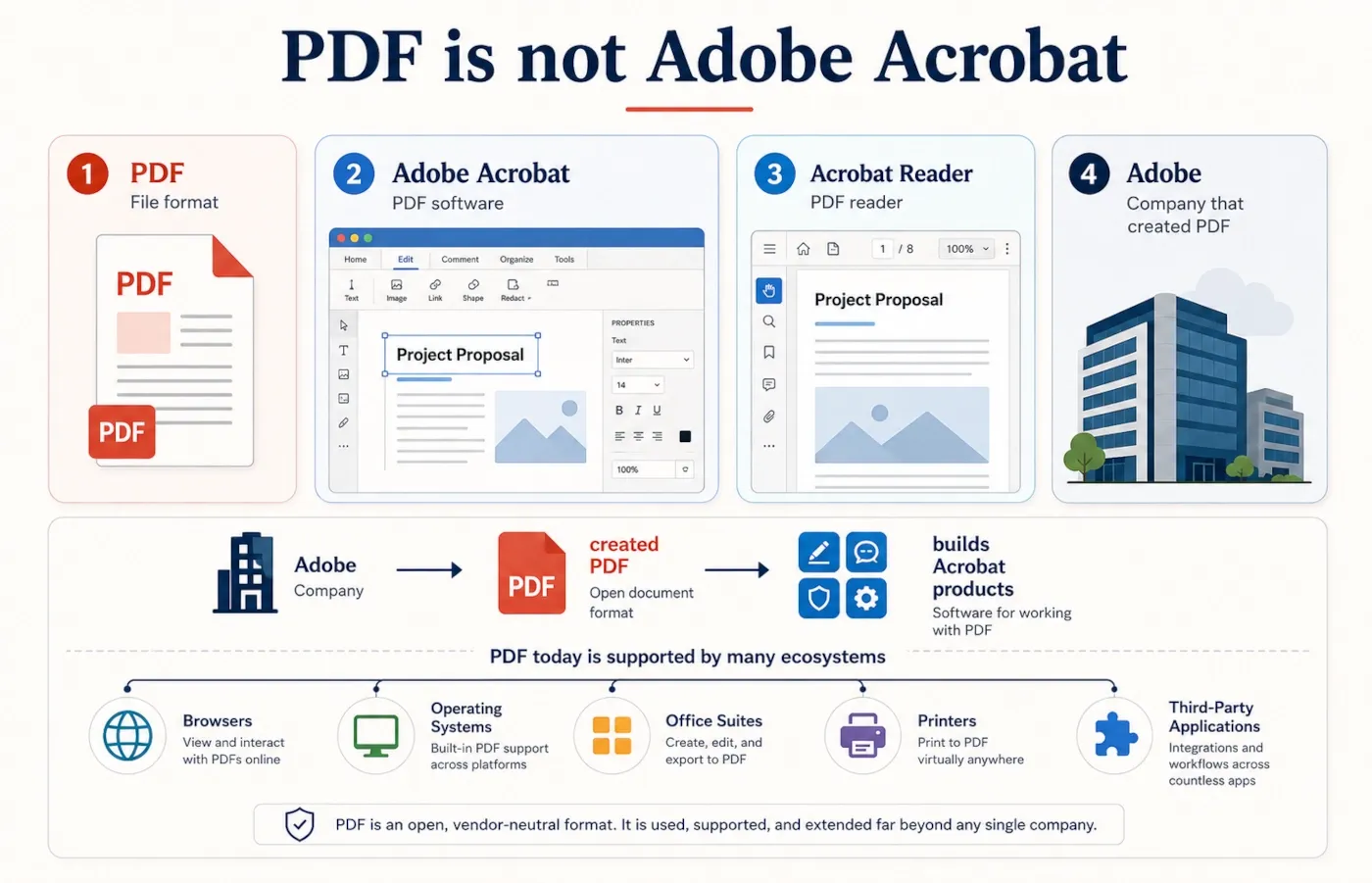
This distinction matters because PDF has grown far beyond Adobe software.
Many operating systems, browsers, office suites, libraries, printers, scanners, document-management systems and third-party applications can create or process PDF files.
You do not need Adobe Acrobat to create or read every PDF.
What was PDF 1.0 like?
PDF 1.0 was the first published version of the format in 1993.
Its importance was not that it already contained every feature associated with a modern PDF. It established the core architecture for portable, fixed-page electronic documents.
The earliest format already addressed the essential problem:
preserve a page-oriented document so that it can be exchanged and reproduced independently of the application and platform that originally created it.
Many capabilities people now associate with sophisticated PDFs arrived later.
For example, Adobe’s accessibility history notes that later PDF versions introduced the logical structures and tagged-PDF mechanisms needed for much stronger assistive-technology support. Other later versions expanded areas such as compression, transparency, security, metadata, interactive features and document structure.
PDF succeeded partly because Adobe did not try to freeze the format in 1993. It was designed to evolve.
Why PDF almost failed
In hindsight, PDF looks inevitable.
It was not.
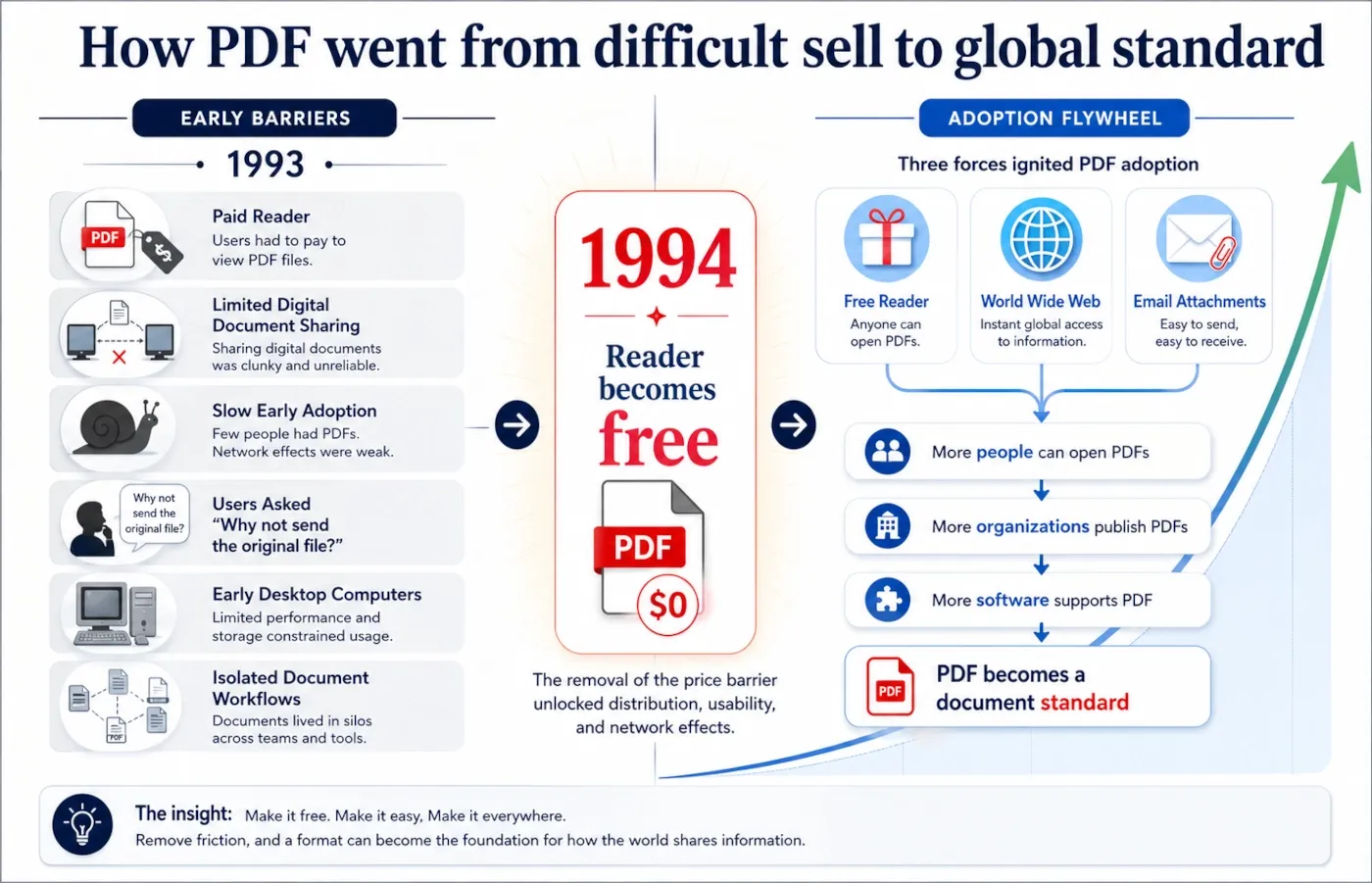
When Acrobat launched, many people did not understand why they needed it.
Warnock recalled that prospective customers and industry analysts questioned the value of a format that preserved a document but was not primarily designed for editing. The logic of the time was understandable: why not simply send the original application file?
There were also practical barriers.
The Reader was not originally free
With Acrobat 1.0, the Reader cost money — Wharton reports roughly $35 to $50 per seat.
That created a serious adoption problem. A universal document format becomes far less universal if the recipient has to buy software before opening the document.
With Acrobat 2.0 in 1994, Adobe made the Reader free.
That decision was controversial internally, but strategically crucial.
Acrobat lost money for years
Warnock said Acrobat lost money for Adobe for about four years.
Adobe kept investing because Warnock believed the product solved a fundamental, longstanding computing problem.
The market had not yet caught up
In 1993, consumer email, file attachments and the World Wide Web were not yet everyday infrastructure for most people.
PDF solved a future problem before the future had fully arrived.
That made the product difficult to explain — but it also meant Adobe was positioned when electronic document exchange suddenly became normal.
When did PDF become popular?
There is no single day when PDF “became popular.” Its rise was driven by several reinforcing changes.
1. The Reader became free
Removing the price barrier made it much easier to distribute documents to people who did not own Acrobat.
2. The World Wide Web expanded
Warnock and Wulff recalled that the web changed how people understood Acrobat’s value. Websites created a global distribution channel, while PDF provided something early HTML was not designed to guarantee: precise page presentation.
3. Email attachments became normal
By the mid-1990s, more people were exchanging files by email.
That exposed the original problem PDF had been built to solve. Sending an editable application file could produce compatibility problems; sending a PDF gave the recipient a much better chance of seeing the intended document.
4. Organizations needed dependable digital documents
Government agencies, publishers, businesses, lawyers, engineers and other document-heavy industries found value in a format that could preserve forms, manuals, reports and finished layouts.
Wharton identifies organizations such as the U.S. Centers for Disease Control, the IRS and The New York Times among early adopters.
5. Anyone could implement the specification
Adobe publicly documented the PDF format and allowed third parties to build software around it.
Wulff later described publishing the file format from the beginning without patent barriers to implementation as a major factor in PDF’s success.
The result was a positive network effect:
more readers → more reasons to publish PDFs → more PDF software → more reasons to rely on the format.
How PDF evolved from 1.0 to 1.7
The format did not jump directly from the 1993 version to today’s PDF 2.0.
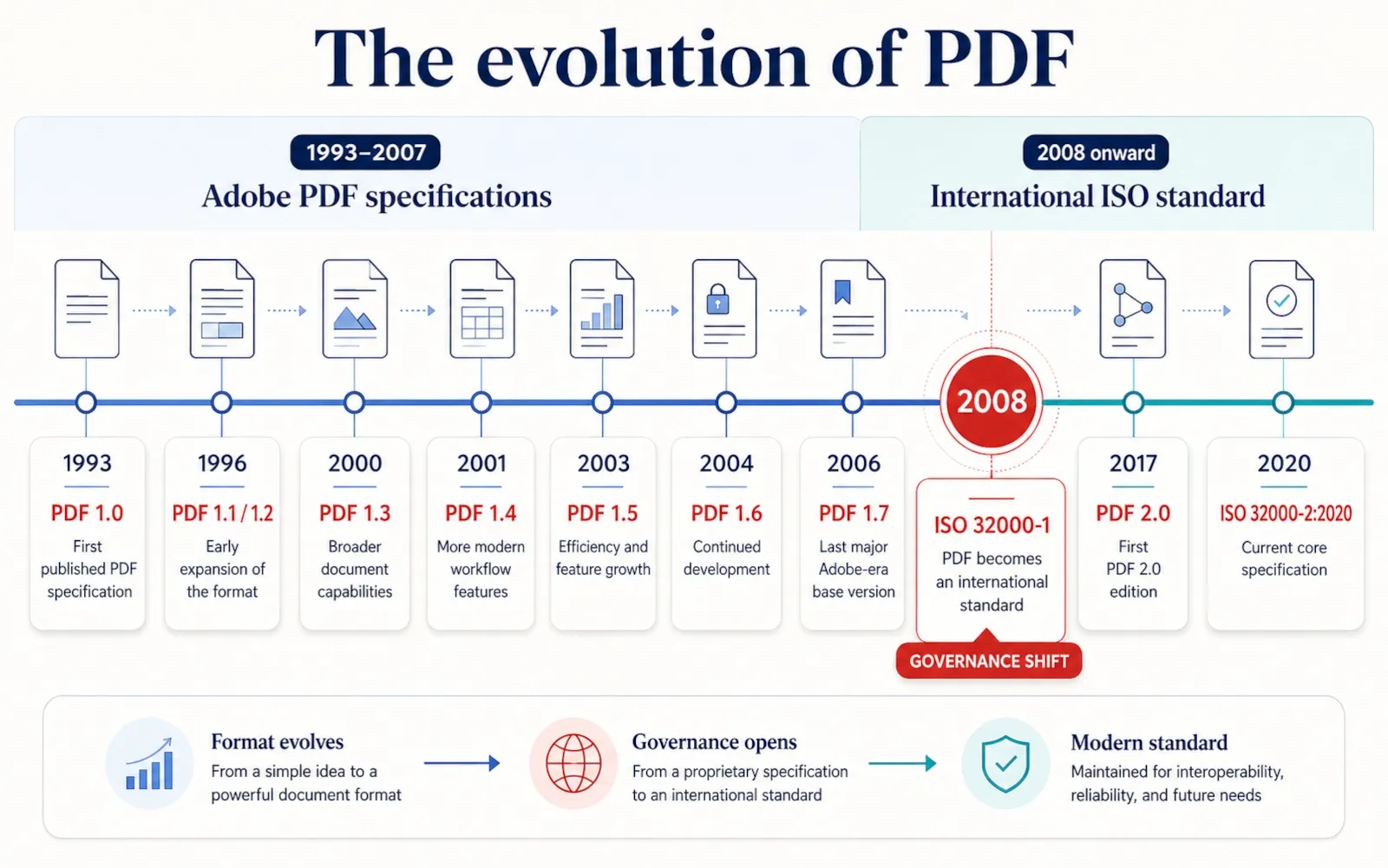
The PDF Association specification archive records the major published versions:
| Version | Year | Historical significance |
|---|---|---|
| PDF 1.0 | 1993 | First published PDF specification |
| PDF 1.1 | 1996 | Early expansion of the format |
| PDF 1.2 | 1996 | Continued extension of the original architecture |
| PDF 1.3 | 2000 | Major late-1990s/early-2000s evolution |
| PDF 1.4 | 2001 | Added important capabilities used by more modern document workflows |
| PDF 1.5 | 2003 | Further expansion and efficiency improvements |
| PDF 1.6 | 2004 | Continued development of document features |
| PDF 1.7 | 2006 | Last major Adobe-controlled base version before ISO standardization |
| ISO 32000-1 / PDF 1.7 | 2008 | PDF becomes an international ISO standard |
| PDF 2.0 / ISO 32000-2 | 2017 | First PDF specification developed in the ISO process as PDF 2.0 |
| ISO 32000-2:2020 | 2020 | Second edition of PDF 2.0 and the current core specification |
This table is deliberately selective about features.
The important historical pattern is that Adobe evolved PDF through a series of openly documented specifications for roughly 15 years before the core format moved into the ISO standards system.
When did PDF become an ISO standard?
The decisive milestone came in 2008.
From 1993 through 2007, Adobe published the PDF Reference. The PDF Association states that the specification went through eight Adobe editions from PDF 1.0 to 1.7.
Adobe then submitted PDF 1.7 for international standardization.
In 2008, it became:
ISO 32000-1:2008 — Document management — Portable document format — Part 1: PDF 1.7
This changed the governance of the core format.
Adobe remained an important participant in the PDF ecosystem, but PDF was no longer simply a specification whose core evolution was controlled only by Adobe.
Does Adobe still own PDF?
The best answer depends on what “own” means.
Adobe created PDF and still owns and develops Adobe Acrobat and other Adobe products.
But the core PDF specification is now an ISO international standard. Its technical development takes place through the ISO standards process rather than being defined unilaterally by Adobe.
That means it is misleading to describe modern PDF simply as “Adobe’s proprietary file format.”
It is more accurate to say:
PDF originated at Adobe, but its core specification is now maintained as the ISO 32000 international standard.
This distinction also explains why there are so many non-Adobe PDF readers, writers, libraries and document systems.
What is PDF 2.0?
PDF 2.0 is the modern generation of the core PDF specification.
The first ISO edition defining PDF 2.0 was ISO 32000-2:2017. That edition was later withdrawn and replaced by the second edition:
ISO 32000-2:2020
As of this article’s last review in 2026, ISO lists ISO 32000-2:2020 as published, current and confirmed.
The standard is intended for developers of software that creates, reads, displays, modifies or otherwise processes PDF documents.
Its abstract preserves the original goal that motivated Camelot: electronic documents should be exchangeable and viewable independently of the environment in which they were created, viewed or printed.
The technology has changed dramatically.
The fundamental promise has not.
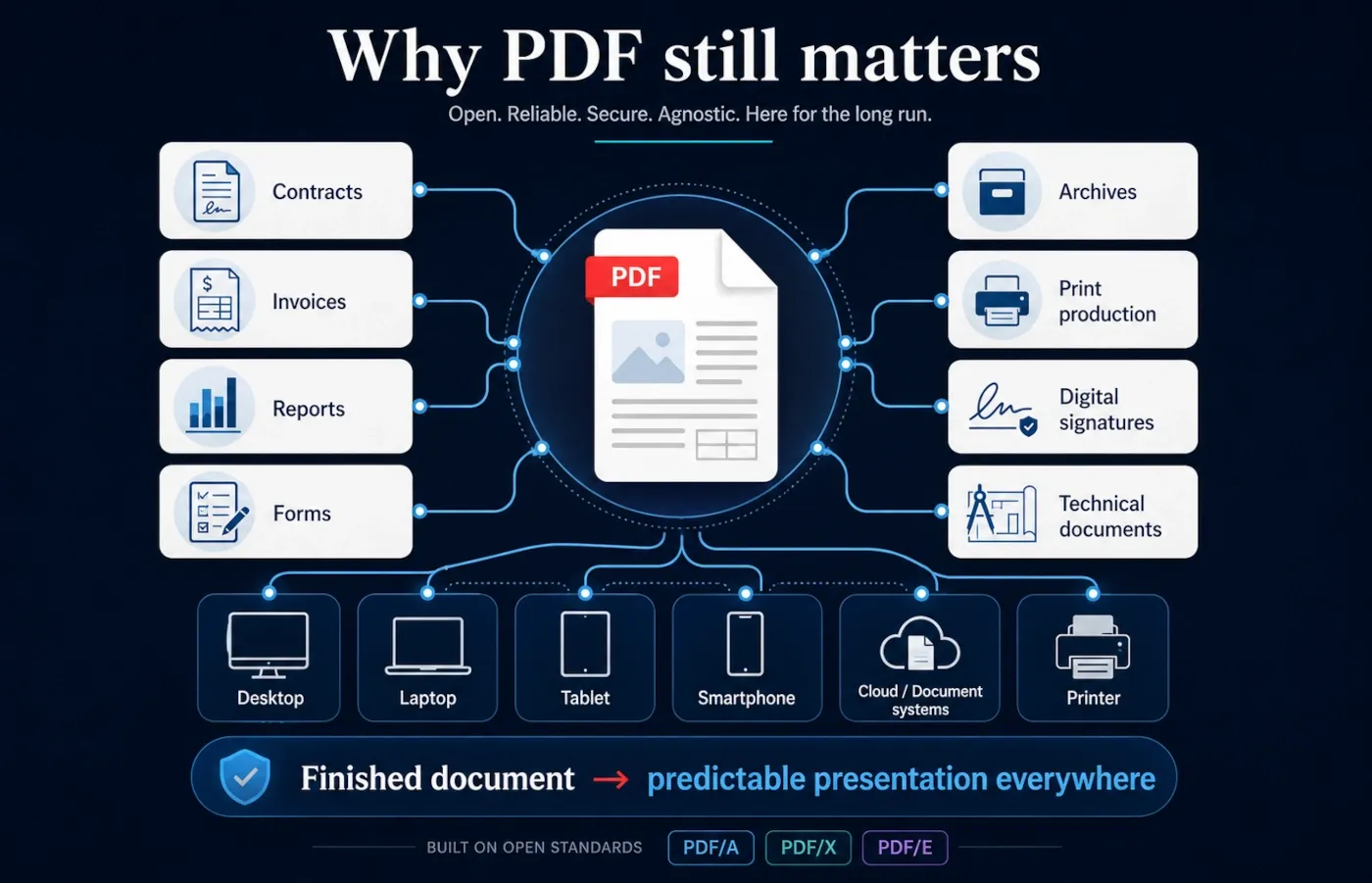
Why is PDF still used more than 30 years later?
PDF survived because the original problem never disappeared.
People still need documents that can move between systems without being casually reformatted.
That matters for:
- contracts;
- invoices;
- reports;
- manuals;
- academic papers;
- forms;
- government documents;
- print production;
- engineering documents;
- archives;
- signed records;
- accessibility workflows;
- regulated business processes.
Modern PDF has also accumulated an enormous ecosystem of standards, software and specialized profiles.
Examples include PDF/A for long-term preservation, PDF/X for print workflows and PDF/E for engineering-oriented use.
But the deeper reason for PDF’s longevity is simpler:
it separates the finished document from the application that authored it.
A Word document is primarily an editable working document.
A PDF is primarily a portable representation of a document that another person, system or printer should be able to reproduce consistently.
That distinction remains useful.
How PDF became a global standard: the story in 10 steps
1. Adobe builds its printing foundation
John Warnock and Charles Geschke founded Adobe in 1982.
Adobe’s PostScript technology, introduced commercially in the 1980s, provided a powerful device-independent model for describing printed pages.
2. Electronic document exchange becomes an obvious problem
As networks and desktop applications spread, companies increasingly needed to send complex documents between different systems.
Source files were often fragile outside their original environment.
3. Warnock begins experimenting with a portable document system
Adobe’s recollections place early prototypes in 1990.
The idea was to use Adobe’s page-imaging knowledge to capture a finished document in a form that could be transported and reproduced reliably.
4. The Camelot Project defines the vision
Warnock’s Camelot concept described a universal way to communicate visual documents electronically across diverse systems and networks.
5. Adobe turns the concept into a product architecture
A small prototype was not enough.
Adobe engineers developed a robust, extensible format and the Acrobat software required to create and view it.
6. Adobe launches Acrobat and PDF
On June 15, 1993, Adobe formally introduced the Acrobat product family and the Portable Document Format.
PDF 1.0 became publicly documented.
7. Adobe removes the Reader price barrier
Acrobat initially struggled.
With Acrobat 2.0 in 1994, Adobe made Reader free, helping the format spread.
8. The web and email make portable documents valuable
As the web, email and file attachments became mainstream, more users encountered exactly the cross-platform document problem PDF had been designed to solve.
9. PDF becomes a broad industry format
Adobe continued publishing the specification, third-party developers implemented it, and PDF became embedded in business, government, publishing and software workflows worldwide.
10. PDF moves into international standardization
PDF 1.7 became ISO 32000-1 in 2008.
PDF 2.0 later became ISO 32000-2, placing the modern core format within a vendor-neutral international standards process.
Common mistakes when telling the history of PDF
Mistake 1: “John Warnock single-handedly invented PDF”
Warnock was the central visionary behind Camelot and deserves the strongest individual attribution.
But PDF as a shipping format and Acrobat as a product required an Adobe engineering team.
Better wording: John Warnock originated and championed the idea; Adobe and its engineers created and launched PDF.
Mistake 2: “Charles Geschke invented PDF”
Geschke was an essential Adobe co-founder and technology leader, but the surviving Camelot history specifically centers on Warnock.
Better wording: Geschke helped build the company and technical environment in which PDF was created; Warnock is the person most directly linked to the Camelot concept.
Mistake 3: “PDF was invented in 1991”
That compresses several historical stages into one date.
Better wording: prototypes existed in 1990, Camelot developed around 1990–1991, PDF took shape by 1992, and Acrobat/PDF formally launched in 1993.
Mistake 4: “PDF and Acrobat are the same thing”
They are not.
PDF is the format. Acrobat is Adobe software built around the format.
Mistake 5: “Adobe still completely controls PDF”
Adobe remains deeply connected to PDF and owns Acrobat, but the core specification is now maintained through ISO 32000.
Mistake 6: “PDF succeeded immediately”
The opposite is more instructive.
Acrobat initially confused the market, Reader originally cost money, and the product lost money for years before the web, email and free Reader helped the idea become obvious.
Mistake 7: “Portable means small”
A PDF can be small or enormous.
“Portable” refers primarily to the ability to exchange and reproduce a document across different computing environments.
Security, privacy and safety notes
PDF becoming an international standard does not mean every PDF file is automatically safe.
Modern PDF is a rich document format. Depending on the file and viewer, PDFs can contain or reference features such as:
- hyperlinks;
- attachments;
- forms;
- embedded files;
- scripts or interactive actions;
- external resources.
A malicious PDF can therefore be used as part of an attack, just as other complex document formats can.
For everyday safety:
- keep your PDF reader, browser and operating system updated;
- be cautious with PDFs from unknown senders;
- do not open unexpected attachments simply because they end in
.pdf; - treat suspicious links inside PDFs the same way you would treat suspicious links in email;
- use security scanning and sandboxing where appropriate in professional environments.
This article explains the history of the format, not the trustworthiness of a particular PDF file.
Faster alternative: the 30-second history of PDF
If you only need the essential timeline, remember these five points:
- John Warnock began developing the vision for a universal electronic-document system at Adobe around 1990.
- His Camelot Project aimed to preserve documents across applications, operating systems and printers.
- Adobe developed the idea into PDF and Acrobat, officially launched on June 15, 1993.
- Free Reader software, the web and email helped PDF become a global document format during the 1990s and 2000s.
- PDF 1.7 became ISO 32000-1 in 2008, and today’s core specification is PDF 2.0 / ISO 32000-2:2020.
PDF history timeline
| Year | Milestone |
|---|---|
| 1982 | John Warnock and Charles Geschke found Adobe |
| 1985 | PostScript becomes a major foundation for desktop publishing and digital printing |
| 1990 | Early Acrobat/Camelot prototype work is underway |
| 1990–1991 | Warnock develops and documents the Camelot vision |
| 1992 | Adobe says Camelot has developed into PDF |
| 1993 | Acrobat and PDF officially launch on June 15; PDF 1.0 is published |
| 1994 | Acrobat 2.0 era; Reader becomes free, reducing a major adoption barrier |
| 1996 | PDF 1.1 and 1.2 specifications appear |
| 2000 | PDF 1.3 |
| 2001 | PDF 1.4 |
| 2003 | PDF 1.5 |
| 2004 | PDF 1.6 |
| 2006 | PDF 1.7 |
| 2008 | PDF 1.7 becomes ISO 32000-1:2008 |
| 2017 | ISO publishes the first PDF 2.0 edition, ISO 32000-2:2017 |
| 2020 | ISO publishes the second edition, ISO 32000-2:2020 |
| 2026 | ISO 32000-2:2020 remains the current confirmed core PDF specification |
FAQ
Who is the creator of PDF?
Adobe created PDF. John Warnock, Adobe’s co-founder, is the individual most closely associated with originating the Camelot Project and the vision that became PDF.
Did John Warnock invent PDF?
Yes, it is reasonable to call John Warnock the inventor or principal originator of PDF because he conceived and championed the Camelot approach. A more complete historical description is that Warnock originated the vision and Adobe’s team engineered it into PDF and Acrobat.
Did Charles Geschke invent PDF?
Charles Geschke co-founded Adobe with Warnock and was a major technical and business leader, but the specific Camelot concept that led to PDF is most directly attributed to John Warnock. Geschke was important to the company and technology environment that made the project possible, but he is not usually identified as the sole inventor of PDF.
Did Adobe invent PDF?
Yes. Adobe explicitly states that it created PDF. The format was developed inside Adobe and launched with the Acrobat product family in 1993.
When was PDF invented?
Work on the concept was underway by 1990, and early prototypes existed that year. The Camelot vision developed around 1990–1991, Adobe says the project had evolved into PDF by 1992, and PDF was officially launched in 1993.
If you need one date, use 1993 for the public launch of PDF.
What was the first version of PDF?
The first published version was PDF 1.0, released in 1993.
What was the first PDF file?
The historical sources reviewed here establish early prototypes before the 1993 launch, but they do not identify one universally recognized document as the first PDF file ever created.
It is safer to say that PDF 1.0 was the first public version of the format than to claim a specific surviving document was the first PDF.
What does PDF stand for?
PDF stands for Portable Document Format.
“Portable” refers to the goal of making documents exchangeable across different applications, computers, operating systems and output devices while preserving their intended representation.
Why was PDF invented?
PDF was invented because electronic documents did not reliably preserve their appearance when moved between different applications and computer systems.
The goal was to create a universal document format that could be viewed and printed consistently without requiring the recipient to recreate the author’s original software environment.
When did PDF become popular?
PDF’s adoption accelerated during the mid-to-late 1990s as Adobe made Reader free and the web, email and electronic file exchange became widespread.
There was no single “popularity date”; adoption grew as digital document distribution became normal.
Is PDF still owned by Adobe?
Adobe created PDF and still owns Adobe Acrobat, but the core PDF specification is now maintained as the ISO 32000 international standard.
So it is misleading to describe the modern PDF specification as a purely proprietary Adobe format.
Who controls the PDF standard today?
The core PDF specification is developed through the International Organization for Standardization (ISO) standards process, specifically within the committee structure responsible for document file formats.
Adobe remains part of the broader PDF industry, but it does not unilaterally define the modern ISO PDF specification.
What is PDF 2.0?
PDF 2.0 is the modern generation of the PDF specification.
The current core edition is ISO 32000-2:2020, which ISO lists as the published and confirmed standard as of this article’s 2026 review.
What is the difference between PDF and Adobe Acrobat?
PDF is the file format.
Adobe Acrobat is software for creating, editing, signing, converting and managing PDF documents.
A PDF can be opened or created with many applications that are not Adobe Acrobat.
Why do people use PDF instead of Word?
The two formats are designed for different priorities.
A Word document is primarily an editable authoring document. Its layout can change depending on fonts, application versions, page settings and other environmental factors.
A PDF is designed primarily to preserve a document’s presentation for exchange, viewing and printing.
Use an editable word-processing format when collaboration and rewriting are the priority. Use PDF when you want to distribute a finished document with predictable presentation.
Why is PDF called PDF?
The name is an abbreviation of Portable Document Format.
The name reflects the original design goal: make a finished electronic document portable across different computing environments.
Final verdict
So, who invented PDF?
John Warnock is the person most closely associated with inventing the concept that became PDF, but Adobe created the actual format and Acrobat product with the work of an engineering team.
That distinction matters because the history of PDF is not really the story of one person inventing a file extension.
It is the story of a much larger computing problem.
In the early 1990s, electronic documents did not travel reliably. A document could leave one computer and arrive on another looking different because the receiving system lacked the same software, fonts, printer assumptions or page-layout environment.
Warnock’s Camelot vision proposed a different model: capture the document itself in a form that could move independently of the system that created it.
Adobe turned that idea into PDF.
The web and email gave the format a global distribution system.
Openly published specifications allowed a broad software ecosystem to grow around it.
ISO standardization gave the core format vendor-neutral international governance.
And the same promise that mattered in 1990 still explains why PDF exists today:
a document should be able to move from one system to another without losing what makes it the same document.
That is the real invention behind PDF.
Last tested
Sources and standards reviewed:
- Adobe official PDF history and Acrobat documentation
- John Warnock’s The Camelot Project
- PDF Association historical and specification resources
- Knowledge at Wharton interviews with John Warnock and Acrobat engineering leadership
- ISO 32000-2:2020 status and specification information
Last tested: 2026-08-27
Related guides
Carefully selected guides to help you understand the topic and complete the next useful step.