
An initial public offering can transform a privately owned business into a company whose shares trade on a public stock exchange. The change affects how the company raises money, who can own its shares, what information it must disclose, and how its value is judged by the market.
The headlines usually focus on the first-day price. The complete process is more important. An IPO can involve new shares that raise capital for the company, existing shares sold by early owners, an underwritten offering to selected investors, and a later opening auction where public trading begins. Those are related events, but they are not the same transaction.
This guide explains the IPO from both sides: what it means for the company and what it means for an ordinary investor.
New to investing? Start with How Does the Stock Market Work? for the broader system of companies, exchanges, brokers, buyers, sellers and market prices.
Educational information only: ClearHowGuide provides general educational information, not personalized investment, legal, accounting or tax advice. This guide explains the general IPO process and uses the United States as its main regulatory example. Regulators, filings, allocation rules, investor protections and listing procedures differ across countries and markets.
Quick answer
An IPO, or initial public offering, is the process through which a private company first offers shares to public investors and normally begins trading on a stock exchange. The company may issue new shares to raise capital, while existing shareholders may also sell some of their shares. Investment banks usually help prepare, market, price and distribute a traditional IPO. After public trading begins, buyers and sellers determine the market price, which may be substantially above or below the original IPO offer price.
The basic flow is:
Private company
→ prepares public disclosures
→ markets the offering
→ sets the offer price
→ allocates shares
→ begins public trading
→ continues as a reporting public company
When to use this guide
Use this guide when you want to understand:
- what IPO stands for and what it means in simple terms;
- how a private company becomes publicly traded;
- why a company chooses to go public;
- who underwriters, regulators and stock exchanges are;
- how the offer price is determined;
- who receives the money raised in an IPO;
- why the opening price can differ from the IPO price;
- whether ordinary investors can buy at the offer price;
- what you own after buying an IPO stock;
- what risks to examine before investing;
- how an IPO differs from a direct listing or a SPAC transaction.
This article does not identify the “best IPO,” predict first-day performance or recommend a particular security. Those questions depend on current facts, valuation, personal circumstances and risks that cannot be answered by a general explainer.
Before you start
Keep these distinctions in mind:
- An IPO is a process, not a separate type of asset. After listing, the IPO shares normally trade as publicly listed stock.
- The IPO offer and secondary-market trading are different transactions. The company may receive money when it sells new shares in the offering. It does not receive money every time those shares later change hands between investors.
- The offer price is not the opening price. The offer price is set before public trading. The opening price is established when trading begins.
- Registration is not regulatory approval of the investment. A regulator reviews disclosure compliance; it does not guarantee the company, the price or the future return.
- Access to shares at the offer price may be limited. Many retail investors buy only after the stock begins trading.
- IPO procedures vary internationally. References to the SEC, Form S-1, EDGAR, 10-Q and 10-K describe the U.S. framework.
What does IPO stand for?
IPO stands for Initial Public Offering.
Each word describes part of the event:
- Initial: it is the company’s first public offering of that class of shares in this form.
- Public: the offering opens ownership to public-market investors rather than only founders, employees and private investors.
- Offering: a specified number of shares is offered for sale under defined terms.
Investor.gov describes an IPO generally as the first time a company sells its shares to the public. In the United States, the securities must normally be registered with the SEC unless an exemption applies. The registration statement includes a prospectus describing the company and the offering terms. See the SEC’s updated IPO investor bulletin.
What is an IPO in simple terms?
Imagine a private company as a business divided into ownership units called shares.
Before the IPO, those shares are held mainly by a limited group:
- founders;
- employees;
- venture-capital or private-equity investors;
- angel investors;
- other private shareholders.
During the IPO, the company and its advisers arrange for some shares to be sold to public investors. The offering may contain:
- new shares, created and sold by the company to raise capital;
- existing shares, sold by current shareholders who want liquidity;
- or a combination of both.
After the listing, the publicly tradable shares can normally be bought and sold through brokerage accounts on the stock market.
The important limitation is that public investors do not all receive equal access to the IPO itself. In a traditional U.S. IPO, underwriters often allocate most offer-price shares to institutional and high-net-worth clients. Many individual investors enter only after public trading starts, at the price then available in the market.
Private company vs public company
| Before the IPO | After the IPO |
|---|---|
| Ownership is privately held | Public investors can trade listed shares |
| Shareholders are usually a limited group | The shareholder base can become much broader |
| Shares may be difficult to sell | Public trading can provide greater liquidity |
| No continuous public market price | The market continually reprices the stock |
| Public disclosure is more limited | Ongoing financial and corporate reporting applies |
| Private funding negotiations dominate | The company can access public capital markets |
| Founders and private investors may control ownership directly | Control depends on share ownership, voting classes and governance rules |
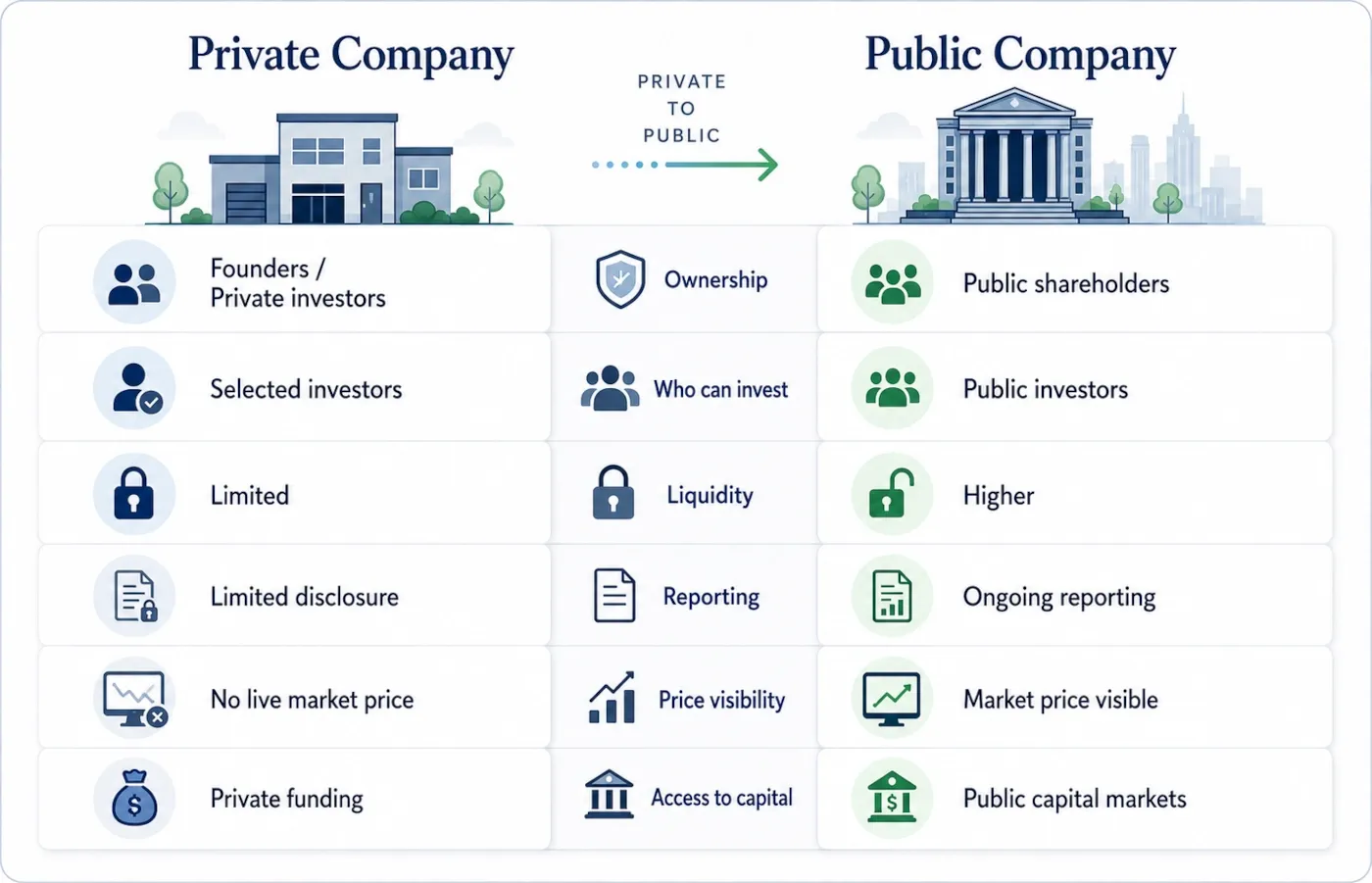
In the United States, a newly public company generally enters an ongoing reporting system that includes quarterly and annual financial statements on Forms 10-Q and 10-K, as explained in the Investor.gov IPO bulletin.
Becoming public does not mean every share can immediately trade. Shares held by founders, employees and early investors may be restricted or subject to contractual lock-up agreements.
Why do companies go public?
A company may pursue an IPO for several reasons.
Raise capital
Selling new shares can provide money for:
- expansion;
- research and development;
- new products;
- acquisitions;
- equipment and infrastructure;
- working capital;
- repayment of debt.
The NYSE explains that primary IPO proceeds can fund growth, investments or debt repayment. Public status can also make future equity or debt financing easier to access. See the NYSE IPO Guide.
Give existing owners liquidity
Private shares can be difficult to sell. An IPO can allow founders, employees and early investors to sell registered shares in the offering or gain a clearer future path to liquidity after restrictions and lock-ups expire.
Create a publicly valued acquisition currency
A listed company may use its shares in acquisitions, strategic transactions and employee compensation. A public market price gives the equity a visible reference value, although that price can be volatile.
Increase visibility and credibility
Public-company status can raise awareness among customers, suppliers, employees and potential partners. That visibility is not automatically positive: performance, governance and management decisions also receive greater scrutiny.
Broaden future access to capital
The IPO is not necessarily the company’s last share sale. A public company may later conduct follow-on offerings or use other financing methods.
The disadvantages of going public
The benefits come with material costs and obligations:
- underwriting, legal, accounting, audit and listing expenses;
- extensive preparation and management time;
- recurring public reporting;
- disclosure of business, financial and risk information;
- pressure from investors and analysts;
- exposure to market volatility;
- possible dilution of existing ownership;
- governance requirements;
- potential loss of control, unless voting structures preserve it;
- litigation, compliance and reputational risks.
An IPO can raise money and create liquidity, but it does not make the company more profitable or less risky by itself.
Who is involved in an IPO?
| Participant | Main role |
|---|---|
| Company | Decides to go public, prepares disclosures and offers shares |
| Board and management | Approve the transaction, present the business and accept major deal terms |
| Existing shareholders | Keep their holdings, sell registered shares, or do both |
| Underwriters | Investment banks that help manage, market and sell a traditional IPO |
| Lawyers | Prepare and review offering documents, contracts and regulatory disclosures |
| Auditors and accountants | Audit financial statements and support financial reporting |
| Regulator | Reviews the filing for compliance with disclosure requirements |
| Stock exchange | Evaluates the listing application and operates the market where trading begins |
| Institutional investors | Often provide indications of interest and may receive substantial allocations |
| Retail investors | May receive offer-price shares through participating brokers or buy after listing |
| Brokers | Provide account access, accept orders and apply eligibility rules |
| Transfer agent and market infrastructure | Support ownership records, clearing, settlement and corporate actions |
In the traditional U.S. process, underwriters are investment banks that manage and sell the offering. They collect indications of interest from potential investors and recommend pricing, while the issuer ultimately determines the IPO price. The SEC’s investor bulletin explains these roles in greater detail.
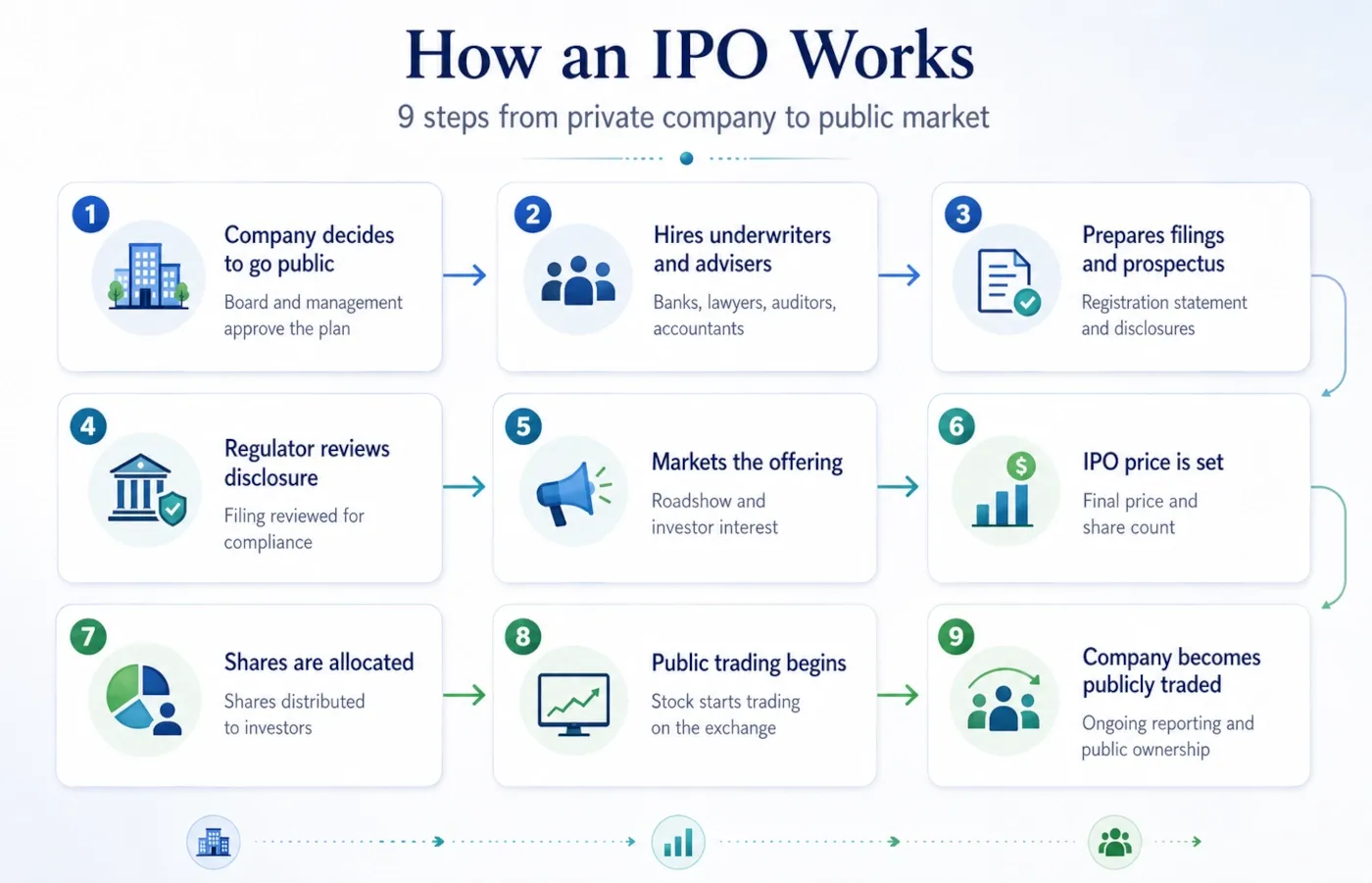
How does an IPO work? Step by step
A company may spend many months or longer preparing to operate as a public company. The sequence below focuses on the transaction itself, but readiness work can begin well before the formal offering.
1. The company decides whether going public fits its goals
Management and the board examine:
- why the company needs capital;
- how much it may seek to raise;
- whether existing shareholders want to sell;
- readiness of financial systems and governance;
- likely valuation;
- market conditions;
- disclosure and compliance obligations;
- alternatives such as private financing, a sale, a direct listing or another transaction.
What it means for the company: public ownership may provide capital and liquidity but adds cost, scrutiny and ongoing obligations.
What it means for the investor: the reason for the IPO matters. Raising money for productive expansion is economically different from an offering dominated by insiders selling existing shares.
2. The company selects underwriters and professional advisers
A traditional IPO normally involves:
- one or more lead investment banks;
- additional banks in the underwriting syndicate;
- securities lawyers;
- auditors;
- accountants;
- investor-relations and communications advisers;
- exchange and transfer-agent specialists.
The underwriters help structure the deal, assess investor demand, market the offering and distribute shares. The underwriting agreement describes responsibilities, compensation and sale arrangements.
What it means for the company: advisers can provide execution expertise and investor access, but their fees reduce net proceeds.
What it means for the investor: underwriters help build the order book and distribute shares, but their involvement does not guarantee an appropriate valuation or future performance.
3. The company prepares the registration statement and prospectus
In the United States, a company commonly uses Form S-1 for an IPO registration statement. The filing is available through the SEC’s EDGAR system and can be amended through documents labelled S-1/A.
The prospectus generally describes:
- the company’s business;
- products and markets;
- financial condition and results;
- management;
- material risks;
- intended use of proceeds;
- capitalization and dilution;
- classes of stock and voting rights;
- major shareholders;
- selling shareholders;
- underwriting arrangements;
- shares that may become eligible for future sale.
The SEC explains that Part I of a registration statement is the prospectus and must include important information about operations, financial condition, results, risk factors, management and audited financial statements. See What Is a Registration Statement?.
International context: Form S-1 and EDGAR are U.S. mechanisms. Other jurisdictions use different regulators, filing names and disclosure systems.
4. The regulator reviews the disclosure
SEC staff reviews the registration statement for compliance with disclosure requirements. The review can lead to comment letters, revisions and amended filings.
This is one of the most important concepts in the entire IPO process:
The SEC does not approve the merits of an IPO, certify the company’s quality or guarantee that the investment is suitable.
A declaration of effectiveness allows the offering to proceed. It is not a recommendation and does not guarantee that every disclosure is complete or accurate. Responsibility for disclosure remains with the company and others involved in preparing the filing.
What it means for the company: it must respond to comments and provide disclosure that complies with the applicable rules.
What it means for the investor: “registered with the SEC” must never be interpreted as “approved by the SEC.”
5. The company markets the offering
Management and underwriters present the company to potential investors, traditionally through a roadshow and related meetings. They explain the business, strategy, financial history, growth plans and risks.
Potential investors may communicate indications of interest:
- whether they might buy;
- how many shares they may want;
- at what price or within what range.
These indications are not the same as completed public trades. They help the underwriters assess demand and build an order book.
6. The company and underwriters determine the offer price
The final IPO price reflects a mix of:
- valuation analysis;
- revenue, growth and profitability;
- comparable public companies;
- financial condition;
- business and sector risk;
- investor demand;
- the size of the offering;
- market conditions;
- negotiation between the issuer and underwriters.
The preliminary prospectus may show a price range. The final prospectus, often filed after effectiveness as a 424B4 in a U.S. IPO, normally includes the final offer price.
The offer price is not produced by unrestricted exchange trading. It is a negotiated deal price set before public trading begins.
7. Shares are allocated to participating investors
Underwriters decide how offered shares are distributed among eligible clients, subject to the issuer’s involvement, applicable rules and the underwriting process.
A request for IPO shares is not a guarantee of allocation. In a heavily demanded offering, an investor may receive:
- the full requested quantity;
- a reduced quantity;
- or no shares.
Many popular U.S. IPOs allocate a large proportion of shares to institutions and high-net-worth clients. Retail access depends on whether the investor’s broker participates and what eligibility rules it applies.
8. The offering closes and public trading begins
Once the offer-price sale is completed, the stock is admitted to trading and the exchange conducts its opening process.
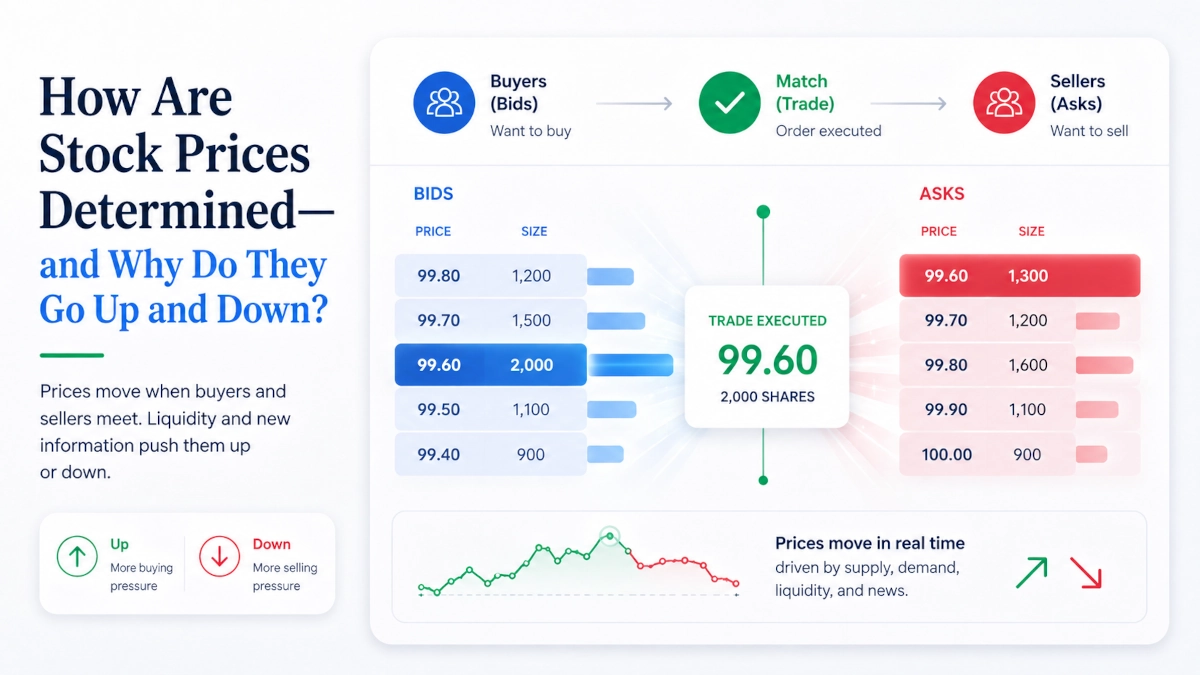
Public buy and sell orders then interact. Supply and demand establish the opening trade.
The opening price may differ from the IPO offer price because:
- many investors did not receive offer-price allocations;
- new orders arrive before the opening;
- the tradable supply may be limited;
- market conditions may change;
- demand may be stronger or weaker than expected.
A first-day jump is often called an IPO pop. A decline is equally possible.
9. The company operates as a reporting public company
After listing, the company enters an ongoing cycle of:
- financial reporting;
- earnings announcements;
- material-event disclosures;
- shareholder meetings and proxy materials;
- governance and exchange requirements;
- analyst and investor scrutiny.
The stock price now responds continuously to new information, expectations, liquidity and market conditions.
A simple IPO example with numbers
Assume a private company has 40 million existing shares.
The company and underwriters set an IPO offer price of $20 per share and the company issues 10 million new shares.
Before the new shares are issued:
40 million existing shares × $20
= $800 million implied pre-money equity value
The company sells:
10 million new shares × $20
= $200 million gross primary proceeds
After the issuance:
40 million existing shares
+ 10 million new shares
= 50 million shares outstanding
At the $20 offer price:
50 million shares × $20
= $1 billion implied post-IPO market capitalization
The company does not keep the full $200 million. Underwriting discounts, legal fees, accounting costs and other offering expenses reduce the net amount.
Now suppose the stock opens at $26:
50 million shares × $26
= $1.3 billion market capitalization at the opening price
The company does not automatically receive the additional $6 per share when investors trade in the public market. That price change affects the market value of the outstanding shares. Normal post-listing purchases are generally transactions between investors or liquidity providers.
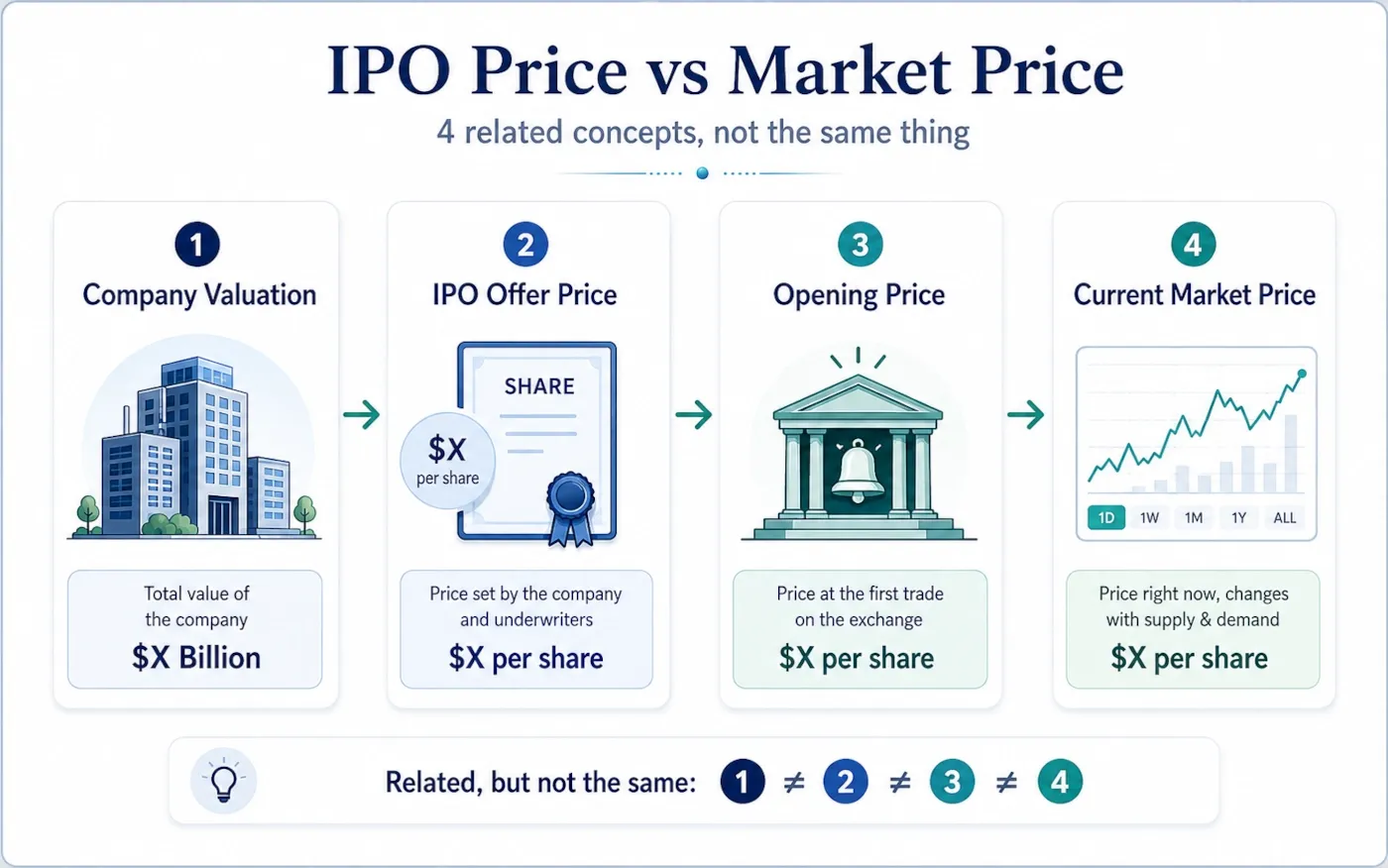
This example also shows why four concepts must remain separate:
- company valuation;
- offer price;
- opening price;
- current market price.
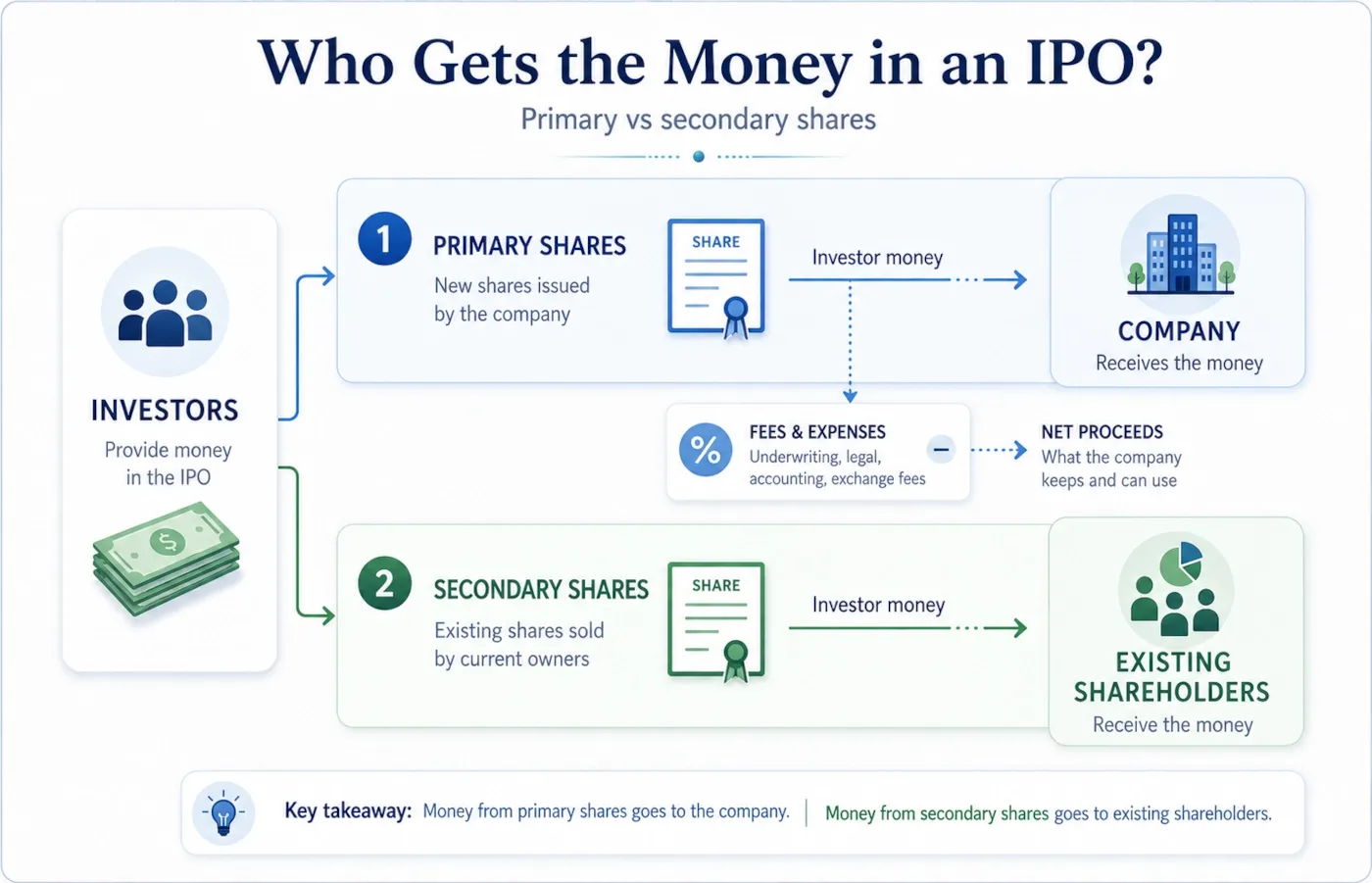
Who gets the money from an IPO?
The answer depends on what type of shares are sold.
Primary shares
Primary shares are newly issued by the company.
Investor payment
→ offering process
→ company receives gross proceeds
→ fees and expenses are deducted
→ company retains net proceeds
The company may use the money for the purposes described in the Use of Proceeds section of the prospectus.
Secondary shares
Secondary shares already belong to existing shareholders.
Investor payment
→ offering process
→ selling shareholder receives sale proceeds
The company does not receive the proceeds from shares sold by founders, employees, private-equity funds or other selling shareholders, except for any separate arrangements disclosed in the prospectus.
The Investor.gov IPO bulletin explains that proceeds from registered selling-shareholder sales go to those shareholders rather than the company.
Mixed offerings
An IPO can combine primary and secondary shares. The prospectus cover and offering section should identify:
- how many shares the company is selling;
- how many shares existing shareholders are selling;
- expected gross proceeds;
- underwriting compensation;
- estimated net proceeds to the company.
Company valuation vs IPO price vs opening price vs market price
| Concept | What it means |
|---|---|
| Company valuation | An estimate of the equity value of the entire company, often expressed through market capitalization |
| IPO offer price | The per-share price paid by investors who receive shares in the offering |
| Opening price | The price of the first completed public-market trade |
| Current market price | The price produced by ongoing trading after the opening |
Company valuation
A simple market-capitalization calculation is:
Share price × total shares outstandingThe calculation must use the correct share count. Pre-money and post-money values differ when the company issues new shares.
A company may also have debt, cash, preferred securities, options and other claims. Market capitalization is therefore not the same as enterprise value and does not describe the entire capital structure.
IPO offer price
The offer price is negotiated before public trading. It determines:
- what allocated investors pay;
- gross proceeds from newly issued shares;
- the implied equity valuation at the offering;
- underwriting compensation when it is calculated as a percentage of proceeds.
Opening price
The opening price is established through the exchange’s opening mechanism using public-market supply and demand.
It can be higher or lower than the offer price. It is not a revision of the price paid by the company’s IPO allottees.
Current market price
After the opening, every trade contributes to price discovery. The market price changes as orders, news, earnings expectations, interest rates, sector conditions and market sentiment change.
The SEC cautions that the offer price is a negotiated estimate and may bear little relationship to later trading prices. The stock may trade well above or below the offer price shortly after listing.
Can ordinary investors buy shares at the IPO price?
Sometimes, but access is not universal.
Three common outcomes are possible.
1. Your broker offers direct IPO participation
A participating brokerage may let eligible clients request shares before listing. Requirements can include:
- account status;
- investor eligibility;
- minimum assets or activity;
- agreement to special terms;
- availability of the offering in the investor’s jurisdiction.
A request is not a guaranteed allocation.
2. You request shares but receive fewer or none
Oversubscribed IPOs can attract requests for more shares than are available. Underwriters may reduce allocations or exclude some requests.
3. You buy after public trading starts
This is the most common route for many individual investors. You place a stock order after the exchange opens the shares for public trading.
At that point, you are not buying from the company at the offer price. You are buying in the secondary market at available market prices.
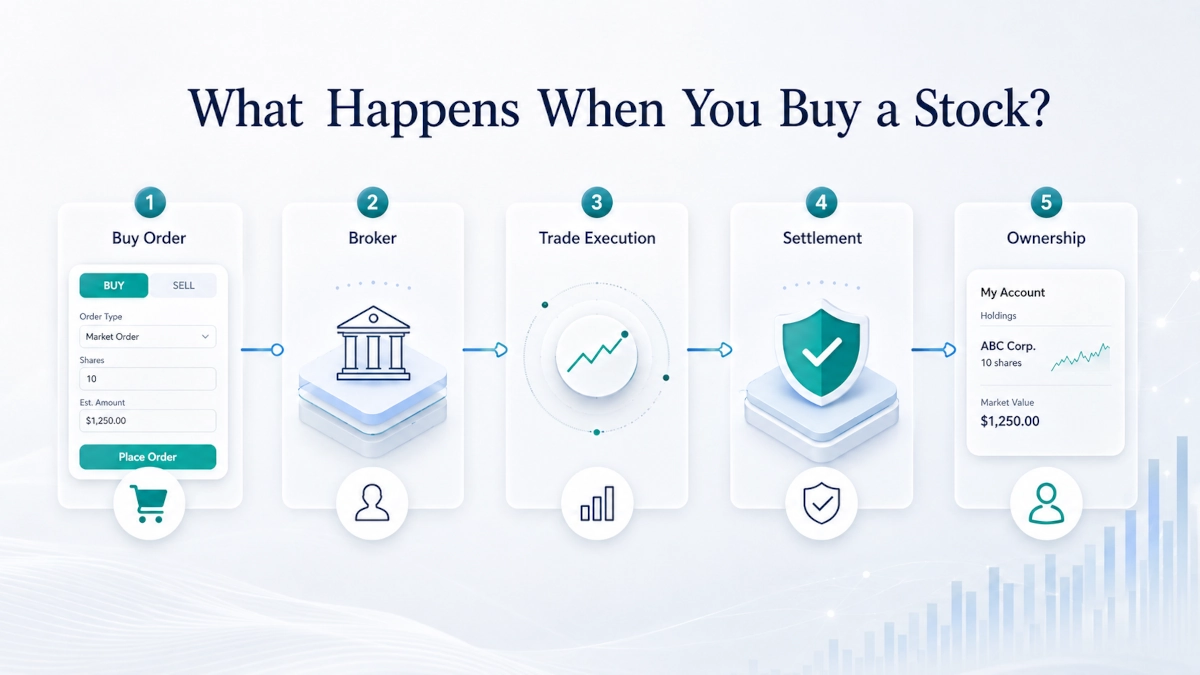
For the mechanics of that purchase, see What Happens When You Buy a Stock?.
What do you own after buying an IPO stock?
After you buy an actual listed share, you own the rights attached to that class of stock.
Those rights may include:
- an economic interest in the company;
- the ability to benefit if the share price rises;
- the possibility of dividends if the board declares them;
- voting rights, if that share class carries votes;
- participation in certain corporate actions;
- a residual claim after creditors and senior claims in a liquidation.
You do not directly own the company’s:
- buildings;
- bank accounts;
- patents;
- inventory;
- equipment;
- individual business units.
The corporation owns those assets. Your share is an ownership interest in the legal entity.
Rights can vary materially by share class. A dual-class company may sell lower-voting shares to the public while founders retain shares with much greater voting power. FINRA notes that dual-class structures can allow leaders to retain control while owning a smaller economic percentage. Review the prospectus sections titled Description of Capital Stock, Principal Shareholders and similar headings.
Do IPO stocks always go up?
No.
An IPO can:
- rise sharply;
- open close to the offer price;
- fall on the first day;
- rise initially and later decline;
- remain volatile for an extended period.
A strong opening can reflect high demand combined with limited tradable supply. It does not prove that the company is fairly valued or likely to produce long-term returns.
A weak opening can reflect:
- reduced investor demand;
- changed market conditions;
- valuation concerns;
- sector weakness;
- new information;
- more selling interest than expected.
The Investor.gov IPO bulletin warns that IPOs can be risky and speculative. It also explains that the trading price can move well above or below the offer price and that temporary underwriter support can affect early trading.
Main IPO risks
Limited public history
A newly public company may have no long record of SEC reporting. The prospectus may be the primary source of standardized public information.
Uncertain valuation
IPO pricing combines analysis, demand and negotiation. Forecasts can be optimistic, comparable companies imperfect and business conditions subject to change.
First-day volatility
A limited public float and intense demand can produce rapid moves. An order entered without understanding the available price may execute at an unexpected level.
Limited tradable supply
Only a portion of total shares may be freely tradable after the IPO. Restricted shares and lock-ups can constrain supply at first.
Lock-up expiration
Insiders and large shareholders often agree not to sell for a defined period. Investor.gov notes that many lock-ups last about 180 days, although terms vary. When a lock-up expires, more shares may become eligible for sale and the price can react. Check the prospectus rather than assuming a standard date.
Market overhang
Shares that are outstanding but not yet freely tradable can become future supply. The prospectus section Shares Eligible for Future Sale helps investors assess this overhang.
Dilution
New share issuance increases the number of shares outstanding. Options, warrants, convertible securities and future offerings can create additional dilution.
Selling-shareholder incentives
A large secondary component may provide liquidity to insiders without raising as much capital for the business. That is not automatically negative, but investors should understand who is selling and how much each seller retains.
Dual-class voting
Public investors may have less voting power than founders or controlling shareholders, even when the public owns substantial economic value.
Hype and fear of missing out
Media attention, scarcity and first-day price moves can encourage rushed decisions. Popularity is not a substitute for valuation and risk analysis.
Allocation risk
You may receive no offer-price shares or a smaller allocation than requested. If you buy after trading begins, the price may already be substantially different.
Business and market risk
The company can underperform, lose customers, face competition, need more capital or fail. Broader market conditions can also reduce the stock price regardless of the company’s IPO story.
Important: An IPO is not a regulatory endorsement, a guaranteed discount or a promise of future profit.
How to research an IPO
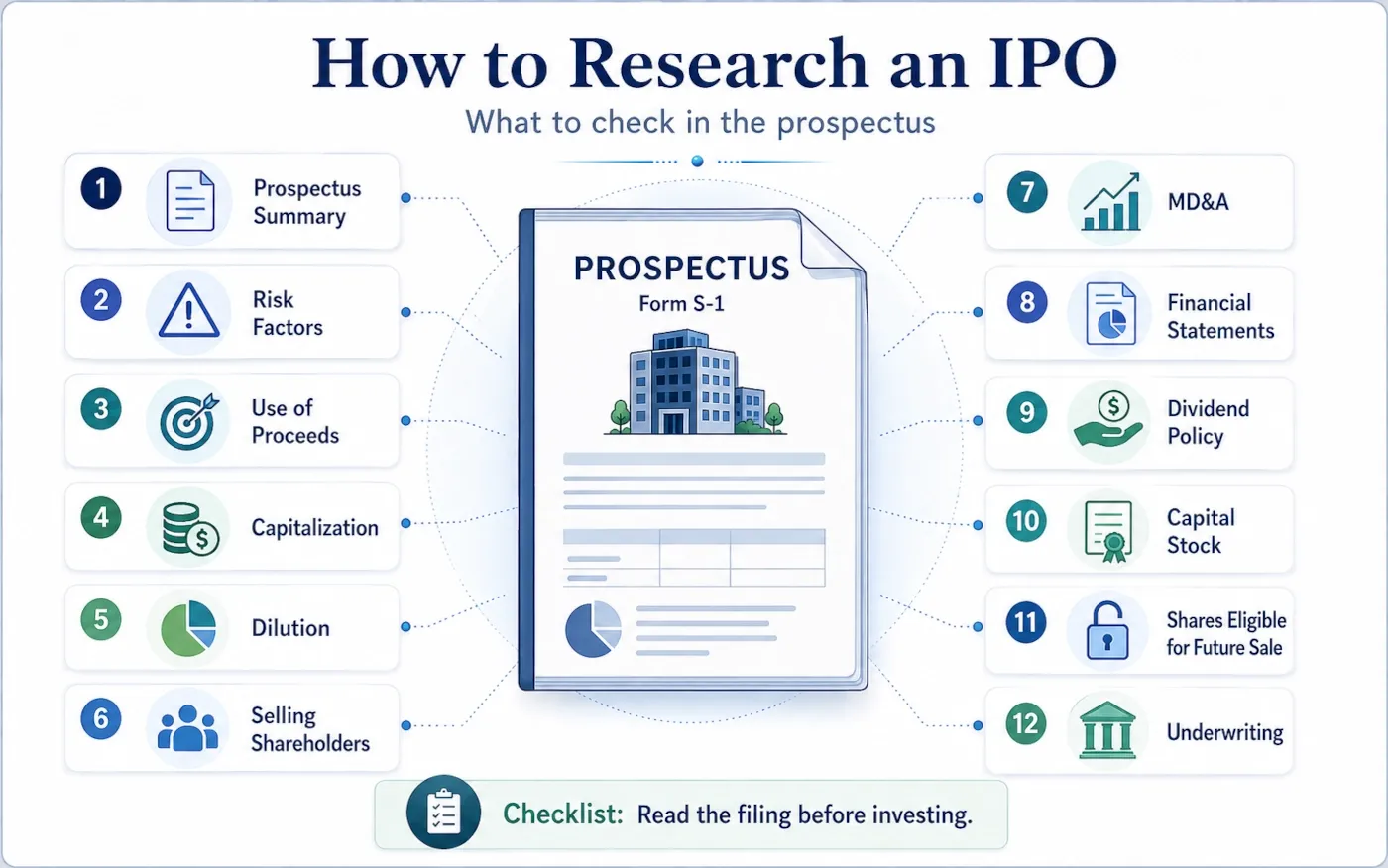
For a U.S. IPO, start with the company’s most recent filing in the SEC’s EDGAR system. Preliminary documents can change, so verify that you are reading the latest amendment and then the final prospectus.
Prospectus checklist
| Prospectus section | What to look for |
|---|---|
| Prospectus Summary | Business model, strategy, offering terms and financial overview |
| Risk Factors | Company-specific, industry, financial, legal and offering risks |
| Use of Proceeds | How the company expects to use primary capital |
| Capitalization | Debt, cash and equity before and after the offering |
| Dilution | Difference between the public price, book value and earlier investor costs |
| Principal and Selling Shareholders | Who owns the company, who is selling and what they retain |
| MD&A | Management’s explanation of performance, liquidity and trends |
| Business | Products, customers, suppliers, competition and operations |
| Financial Statements and Notes | Revenue, losses, cash flow, balance sheet and accounting details |
| Dividend Policy | Whether dividends have been paid or are expected |
| Description of Capital Stock | Voting rights, share classes and governance terms |
| Shares Eligible for Future Sale | Restricted shares, lock-ups and future market supply |
| Underwriting | Offer mechanics, fees, allocations and stabilizing arrangements |
| Legal Proceedings | Material litigation and regulatory matters |
Questions to ask
- Is the company profitable? If not, what is the path to sustainable cash generation?
- How dependent is the company on one product, customer, supplier or market?
- Why is it raising money?
- How much of the offering is primary versus secondary?
- Are insiders selling a small portion or most of their holdings?
- What valuation does the offer price imply?
- What voting rights do public shares carry?
- What options, warrants or convertible securities could dilute shareholders?
- When do lock-ups expire?
- What could cause the company to need more capital?
- Are the risk factors specific and material, or mainly generic?
- Do independent sources support the company’s market claims?
The SEC’s IPO bulletin recommends reading the prospectus, checking the latest filing and verifying information against independent sources where possible.
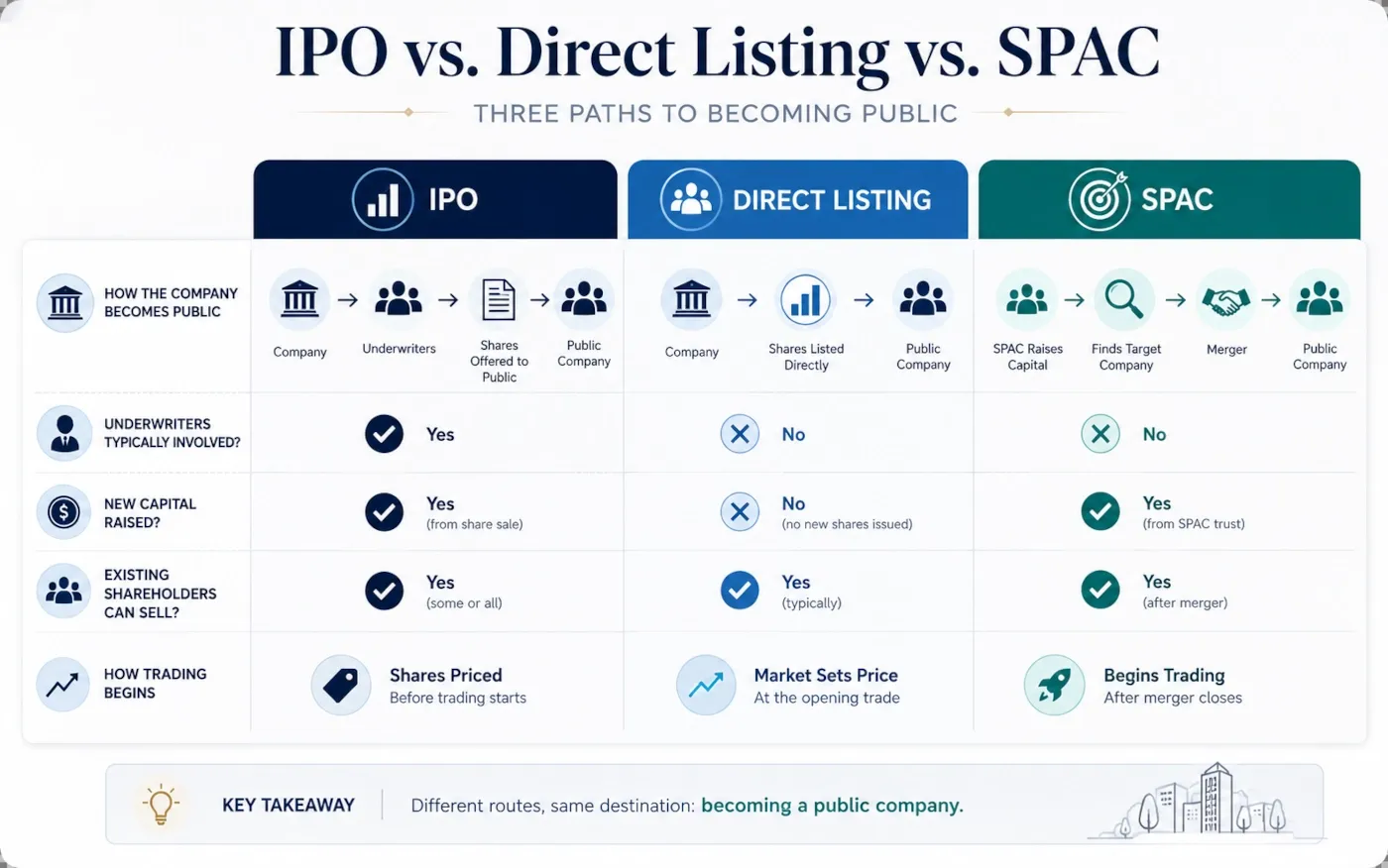
IPO vs direct listing vs SPAC
These routes can all result in publicly traded shares, but they are not interchangeable.
| Route | How public trading begins | Traditional underwriters | Capital raising | Main distinction |
|---|---|---|---|---|
| Traditional IPO | Offered shares are priced and sold before exchange trading begins | Usually yes | Often primary, secondary or both | Underwriter-led offering and allocation |
| Direct listing | Shares begin through an exchange opening auction | No traditional underwriting syndicate | May involve existing shares and, under permitted structures, newly issued shares | Market-based opening without a traditional pre-opening allocation |
| SPAC transaction | An operating company combines with an already public SPAC | Different transaction structure | Capital can come from the SPAC, PIPE financing or other sources | The operating business becomes public through a de-SPAC combination |
Direct listing
A direct listing historically focused on allowing existing shareholders to sell when trading opened. Exchange rules now permit certain direct listings to include a primary capital raise. The NYSE explains that pricing occurs through its opening auction rather than through a traditional underwritten sale before trading. See NYSE Direct Listings.
A direct listing still requires public-company disclosures and compliance with listing standards.
SPAC transaction
A SPAC, or special purpose acquisition company, first raises money through its own IPO. It later seeks an operating company for a business combination known as a de-SPAC transaction.
The operating company becomes part of a publicly traded combined company through that transaction. SPAC securities, sponsor incentives, redemption rights, warrants and dilution create a different risk structure from a traditional operating-company IPO. See the Investor.gov SPAC bulletin.
What happens after the IPO?
Public trading continues
Investors buy and sell shares through the secondary market. The company does not receive money from each ordinary trade.
The company reports results
U.S. public companies generally file periodic reports, including quarterly and annual financial statements. Material events may require additional disclosure.
Analysts and investors evaluate performance
The market begins comparing actual results with the expectations reflected in the valuation.
Lock-ups eventually expire
Shares held by insiders may become eligible for sale, subject to securities laws, contractual terms and company trading policies.
The company may raise more capital
A public company can later issue additional shares or securities. Additional issuance can fund the business but may dilute existing shareholders.
Corporate actions affect shareholders
Public investors may experience:
- dividends;
- stock splits;
- mergers;
- tender offers;
- rights offerings;
- proxy votes;
- share repurchases;
- delistings or bankruptcies.
The IPO is the beginning of public-market life, not the end of the company’s financing story.
The IPO from the company and investor perspectives
| Event | What it means for the company | What it means for the investor |
|---|---|---|
| New shares are issued | The company raises gross primary capital | The investor buys an ownership interest |
| Offer price is set | Determines gross proceeds and implied valuation | Determines the cost for allocated shares |
| Existing shares are sold | No primary capital from those shares | Early owners receive liquidity |
| Public trading opens | The company becomes continuously market-valued | The investor buys or sells at market prices |
| The price moves | Market capitalization changes | Position value rises or falls |
| Lock-up expires | More insider shares may become tradable | Future supply may affect price |
| Follow-on offering occurs | The company raises more capital | Existing ownership may be diluted |
| Earnings are reported | Management becomes accountable to public markets | Investors reassess value and risk |
Common mistakes
Confusing the offer price with the first public price
The offer price applies to allocated IPO shares. The opening price is produced by public-market supply and demand. One does not guarantee the other.
Assuming every IPO dollar goes to the company
Secondary-share proceeds go to selling shareholders. Review the offer breakdown.
Believing SEC effectiveness means SEC approval
The SEC reviews disclosure compliance. It does not endorse the company, verify future performance or decide whether the IPO suits an investor.
Treating a first-day pop as proof of quality
A sharp increase can reflect limited supply, strong demand or underpricing. It does not establish long-term value.
Ignoring the total post-IPO share count
Valuation requires total shares outstanding, not only the number offered. Options, warrants and convertible securities may add potential dilution.
Reading an outdated preliminary prospectus
IPO terms can change through amendments. Check the latest filing and the final prospectus.
Assuming all public shares have equal voting rights
Dual-class structures can give founders much more voting power than public investors.
Ignoring lock-ups and future share supply
Restricted shares and lock-up expirations can materially change the tradable float.
Using social media as the main research source
Promotional claims and price predictions cannot replace the prospectus, audited financial statements and independent verification.
Security, privacy and financial-safety notes
- Use official regulatory filing systems and the company’s verified investor-relations site.
- Confirm that a brokerage firm and financial professional are properly registered in the relevant jurisdiction.
- Do not transfer money to an individual, messaging-app contact or unverified website claiming to provide “guaranteed IPO access.”
- Be cautious with “pre-IPO” offers. A private-company investment is not the same as a registered public IPO and may be illiquid, speculative or fraudulent.
- Never treat an SEC filing number, registration statement or exchange application as an investment guarantee.
- Verify the ticker, share class and exchange before placing an order.
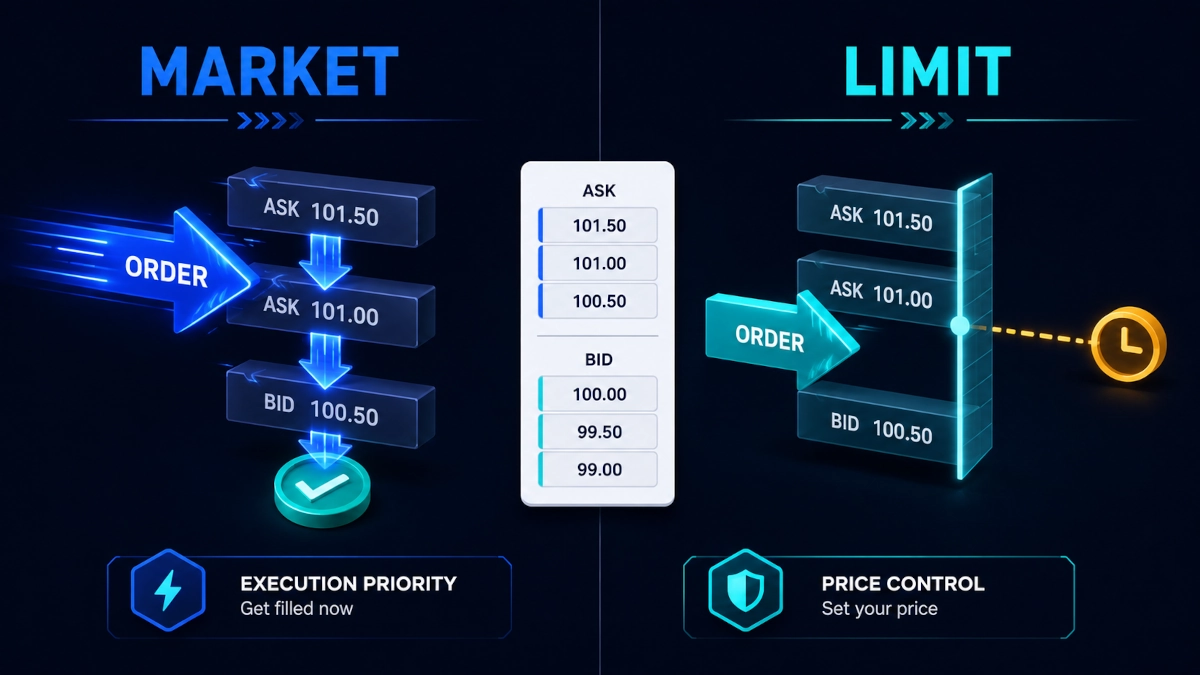
- Understand the selected order type. Newly listed shares can be volatile, and the available price may change quickly.
- Review fees, foreign-exchange costs, tax treatment and investor protections for your country and broker.
- Avoid making a decision solely because an IPO is popular, oversubscribed or expected to rise.
- Do not invest money you cannot afford to lose.
Faster alternative: a five-minute IPO check
A complete review takes time. For an initial screen, check these five items:
- Use of Proceeds: Is the company funding growth, repaying debt or mainly facilitating insider liquidity?
- Primary vs secondary shares: How much money goes to the company?
- Financial statements: Are revenue, margins, cash flow and losses improving or deteriorating?
- Valuation and dilution: What market capitalization does the offer price imply, and what additional securities could dilute holders?
- Risk and control: What are the most important risk factors, share-class rights and lock-up terms?
This shortcut can help identify major questions. It cannot replace reading the latest prospectus, understanding the business or assessing whether the risk fits an investor’s circumstances.
Key takeaways
- An IPO is the first public offering of a company’s shares.
- New primary shares can raise capital for the company.
- Existing shareholders may sell secondary shares and receive those proceeds.
- The offer price, company valuation, opening price and current market price are separate concepts.
- Retail investors may not receive shares at the offer price.
- The SEC reviews disclosure compliance but does not approve the investment.
- IPO stocks can rise or fall and may be highly volatile.
- The prospectus is the central research document.
- Share classes, dilution, lock-ups and future supply can materially affect investors.
- An IPO creates opportunity for public ownership, not a guarantee of profit.
FAQ
What is an IPO in simple terms?
An IPO is the process through which a private company first offers shares to public investors and normally begins trading on a stock exchange. The company may issue new shares to raise money, and existing owners may also sell some shares.
Who gets the money from an IPO?
The company receives proceeds from newly issued primary shares, after fees and expenses. Existing shareholders receive proceeds from secondary shares they sell. A mixed IPO can contain both.
Can anyone buy IPO shares?
Anyone with an eligible brokerage account may be able to buy the stock after public trading begins. Buying at the IPO offer price is more limited and depends on broker participation, client eligibility, demand and allocation.
Is an IPO the same as buying a stock?
No. An IPO is the process of bringing shares to the public market. Buying an IPO allocation is one way to acquire stock. Buying the shares after listing is an ordinary secondary-market stock purchase.
Which is better, an IPO or a stock?
The comparison is misleading because an IPO share is a stock. The meaningful comparison is between participating in the offer, buying after listing, or investing in a company with a longer public history. None is automatically better.
How long does an IPO take?
There is no universal timetable. Readiness work can take many months or longer, and the formal transaction depends on company preparation, audits, regulator review, market conditions and investor demand. The NYSE notes that companies may spend 6, 12, 18, 24 or more months preparing before formally launching the transaction.
Do IPO stocks always rise?
No. They can open above or below the offer price and can later rise, fall or become highly volatile. Demand, supply, valuation, company performance and market conditions all matter.
Is investing in an IPO safe?
An IPO is not risk-free. The company may have a limited public history, the valuation may be uncertain, trading can be volatile and the investment can lose substantial value. Registration and exchange listing do not guarantee a return.
Can beginners invest in IPOs?
A beginner may be permitted to invest, but IPOs can be difficult to evaluate and highly volatile. A beginner should understand ordinary stock ownership, order types, valuation, diversification and the prospectus before considering the risks.
What happens to existing shareholders during an IPO?
They may keep their shares, sell registered shares in the offering, or do both. Unsold holdings may be restricted or locked up temporarily. Their ownership percentage may be diluted when the company issues new shares.
What is the difference between an IPO and a direct listing?
A traditional IPO normally uses underwriters to price and distribute shares before trading begins. A direct listing begins through an exchange opening auction without a traditional underwritten allocation. Depending on the structure and exchange rules, a direct listing may involve existing shares, new primary shares, or both.
Is an IPO good or bad?
An IPO is neither inherently good nor bad. It can provide capital, liquidity and public access, but it can also involve high costs, dilution, uncertain valuation and substantial investor risk. The quality of the company and the price paid matter more than the label “IPO.”
Can you make money from an IPO?
Yes, but profit is not guaranteed. An investor may benefit from share-price appreciation or future dividends, if any. The price can also fall below the offer price or the investor’s purchase price.
Is your money protected in an IPO?
Not against market losses. Securities-account protections may apply if a regulated brokerage fails, depending on the jurisdiction, but they do not reimburse losses caused by a falling stock price or a failed company.
What is an IPO lock-up period?
A lock-up is a contractual restriction that prevents certain insiders and large shareholders from selling for a specified period after the IPO. Terms vary, although many U.S. lock-ups have historically lasted around 180 days. The prospectus discloses the applicable terms.
Last tested
Reviewed against:
- SEC and Investor.gov IPO guidance;
- SEC registration-statement guidance and EDGAR filing structure;
- NYSE IPO and Direct Listing materials;
- Investor.gov lock-up and SPAC guidance;
- FINRA investor education on dual-class voting.
Last reviewed: 2026-08-05
Related guides
Carefully selected guides to help you understand the topic and complete the next useful step.