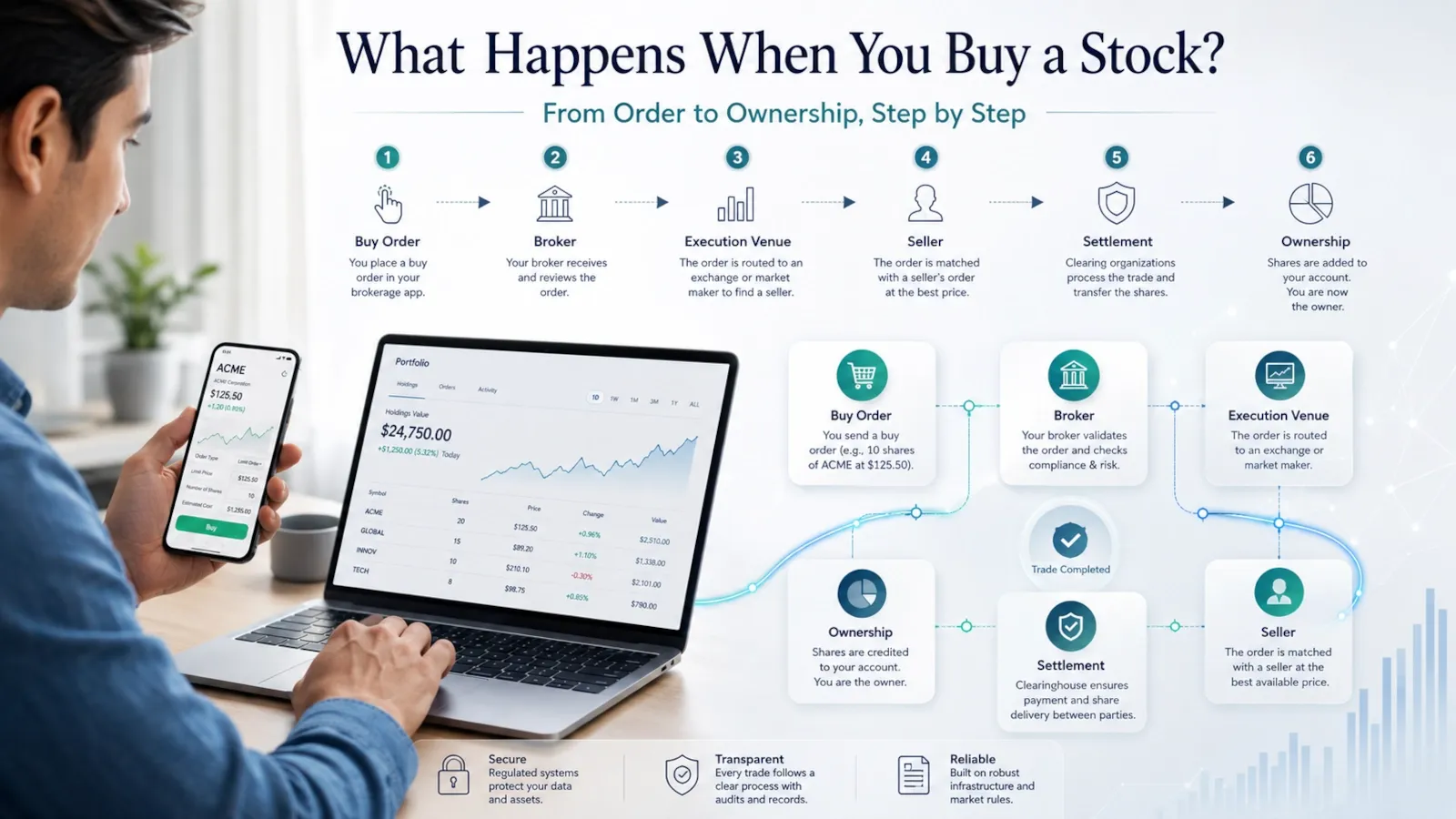
Buying a stock can look almost instantaneous. You choose a company, enter an amount, tap Buy, and a position appears in your brokerage app. Behind that simple action, however, several separate processes take place: the broker validates the order, chooses where to send it, finds an available seller, executes the trade, confirms the transaction, and arranges the transfer of cash and securities.
This guide follows one stock purchase from the moment the order is entered until the shares are settled and recorded in the brokerage account. It also explains who receives the money, why the execution price can differ from the price shown on screen, what “street name” means, and what you actually own after the purchase.
New to investing? Start with How the Stock Market Works for Beginners for the broader picture of companies, exchanges, brokers, prices, dividends, index funds and market risk.
Educational information only: ClearHowGuide provides general educational information, not personalized investment, legal or tax advice. This guide uses the U.S. stock-market structure as its main example. Order handling, settlement, investor protection, ownership records and tax treatment can differ by country, market, broker and account type.
Quick answer
When you buy a stock through a broker, the broker checks your order and routes it to an exchange, market maker, electronic communications network or another execution venue. The order is matched with an available seller and executed at an available price. In a normal secondary-market purchase, the purchase money ultimately goes to the seller rather than directly to the company. The trade then enters clearing and settlement.
In the United States, most stock transactions settle on the next business day, known as T+1. Your shares will usually be held in street name: the broker or its nominee appears as the registered holder, while the broker’s records identify you as the beneficial owner.
The complete flow is:
You place the order
→ the broker checks it
→ the order is routed
→ it meets an available seller
→ the trade executes
→ cash and securities settle
→ the position remains in your brokerage account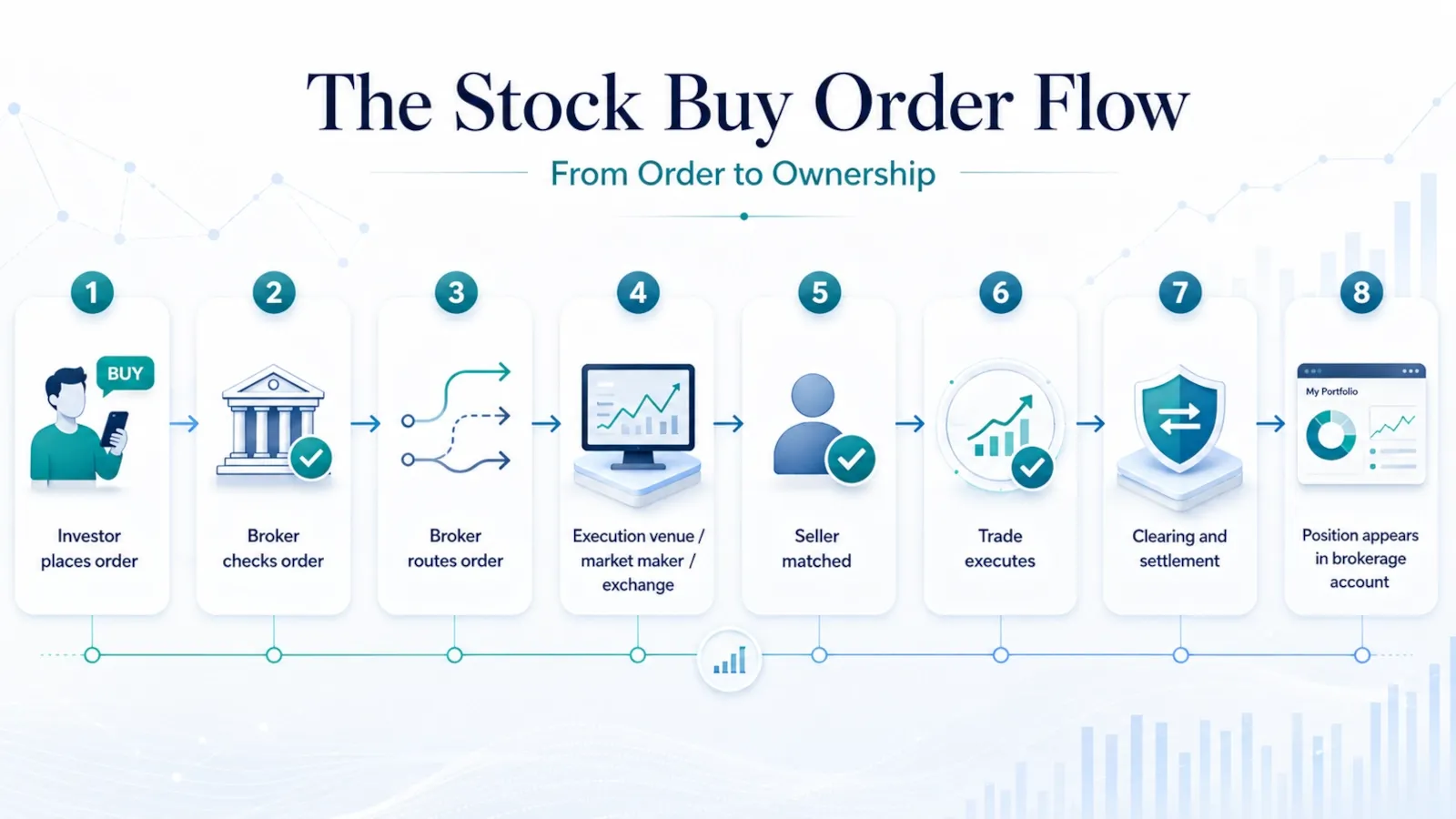
When to use this guide
Use this explanation when you want to understand:
- what happens after you press Buy in a brokerage app;
- how buying a stock works behind the screen;
- why the displayed price and execution price may differ;
- whether your money goes to the company or another investor;
- when the trade becomes settled;
- whether you actually own the shares;
- what changes inside your brokerage account after execution;
- how whole shares, fractional shares, ADRs, ETFs and derivatives differ.
This article does not tell you which stock to buy, predict future returns, recommend a portfolio, or provide a personalized investment strategy. Those are different questions and require information about goals, financial circumstances, time horizon and risk tolerance.
Before you start
A few distinctions make the rest of the process much easier to understand.
- Trade date is the day the order is executed.
- Settlement date is the day cash and securities are officially delivered.
- Execution and settlement are not the same event.
- The price shown on screen is normally a current or recent quote, not a guaranteed purchase price.
- A button labeled Buy does not always mean you are purchasing an ordinary share. The product could be a fractional share, ETF, ADR, CFD, token or another instrument.
- Brokerage rules vary. Read the broker’s order-handling, fractional-share, fee, custody and investor-protection disclosures.
- In a cash account, make sure the purchase is fully funded and understand the rules on using unsettled proceeds.
The examples below assume a straightforward purchase of a publicly traded U.S. common stock in a brokerage account, unless stated otherwise.
What does it mean to buy a stock?
A share of stock represents an ownership interest—also called equity—in a corporation. When you buy an actual share, you acquire the economic and legal rights attached to that class of stock, subject to company law, securities rules, the issuer’s governing documents and the way the security is held.
That does not mean you personally own or may use a physical slice of the company’s offices, factories, bank balance or equipment. The corporation is a separate legal entity that owns its assets. Your share represents an interest in the corporation as a whole.
There are two broad categories of stock:
- Common stock commonly carries voting rights and may receive dividends if the board declares them.
- Preferred stock usually has different economic terms, often including priority over common stock for dividends or liquidation proceeds, but it may have limited or no voting rights.
The exact rights can vary significantly. Some companies have multiple common-stock classes with different voting power. Some shares are non-voting. Dividends are never automatic merely because you own stock.
Owning shares also does not guarantee a profit. The market value can rise, fall or become worthless. A shareholder’s potential return usually comes from price appreciation, dividends, or both—but neither is assured.
How Buying a Stock Works: The Complete Process
The purchase can be divided into nine practical stages.
1. You choose what to buy
Before the order exists, you choose the instrument and the amount.
A brokerage platform may let you enter:
- a number of whole shares, such as
10 shares; - a monetary amount, such as
$500; - a fractional quantity, such as
0.25 shares; - a recurring investment amount;
- an order for a related product rather than the ordinary share itself.
This first stage matters because similar-looking products can create different rights.
For example:
- buying one ordinary share normally creates an ownership interest in the issuer;
- buying a fractional share creates an interest of less than one full share, but voting, transfer and execution arrangements may depend on the broker;
- buying an ETF gives you a share in a fund, not direct ownership of every company held by the fund;
- buying a CFD generally gives you a contract linked to price movements, not ownership of the underlying share.
Before continuing, confirm the instrument name, ticker, exchange, currency and product type.
2. You create the order
The order tells the broker what you want to buy and under what conditions.
The most important choices are:
Quantity or cash amount
A whole-share order specifies the number of shares. A cash-based order asks the broker to convert a monetary amount into a whole or fractional quantity.
Market or limit order
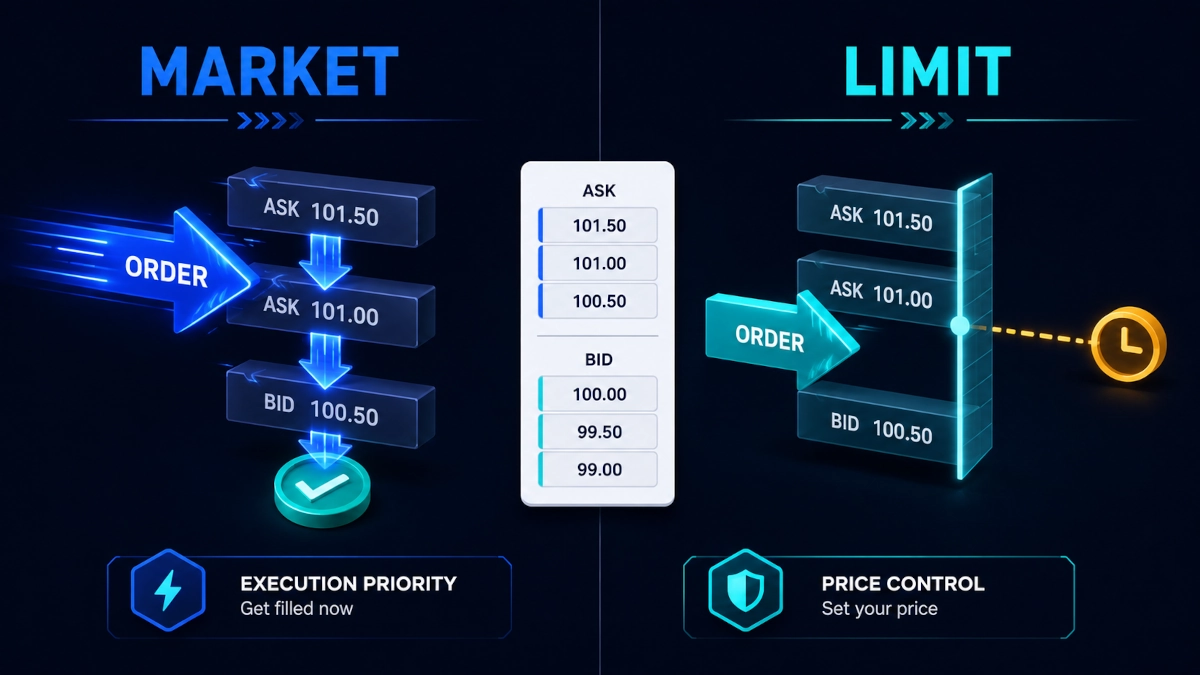
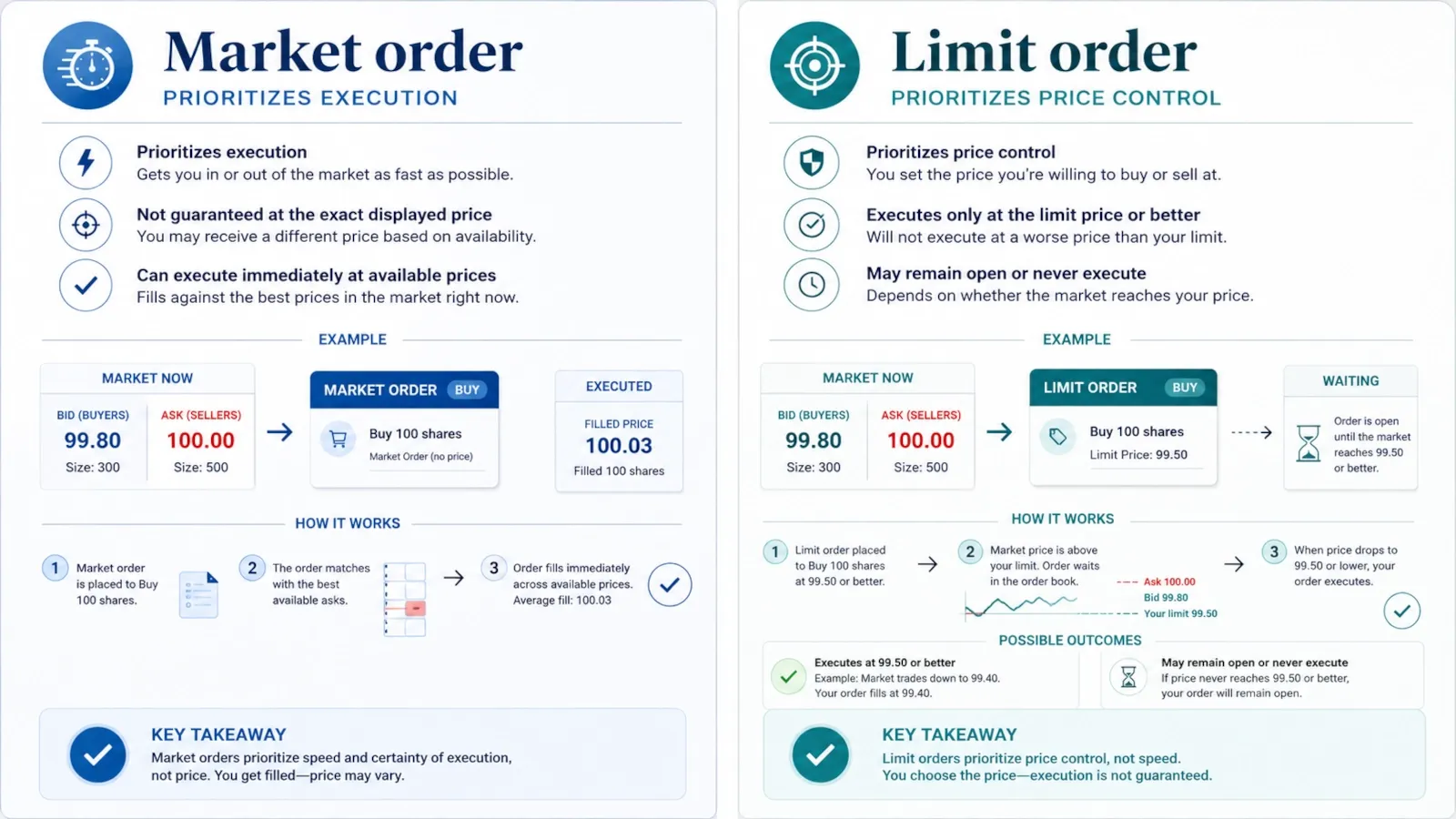
A market order asks the broker to buy promptly at the best available price. It prioritizes execution, but it does not guarantee the price displayed when you submit it.
A limit order specifies the highest price you are willing to pay. A buy limit order can execute only at the limit price or lower. It gives you price control, but the order may remain open or never execute.
Time in force
Common instructions include:
- Day: the order expires if it is not executed during that trading day;
- Good-’til-canceled: the order remains active until filled, canceled or automatically expired under the broker’s policy;
- Immediate-or-cancel: available portions execute immediately and the remainder is canceled;
- Fill-or-kill: the entire order must execute immediately or be canceled.
Not every broker offers every instruction, and definitions can vary by venue.
Regular or extended hours
Trading outside the main market session may involve lower liquidity, wider bid-ask spreads, fewer available venues and greater price volatility. Some brokers restrict order types during pre-market or after-hours sessions.
3. The broker checks the order
Before routing the order, the broker’s systems perform validation and risk checks. These can include:
- whether the account has enough cash or buying power;
- whether the security is available for trading;
- whether the account is permitted to buy that product;
- whether the order complies with price and quantity limits;
- whether the market is open;
- whether the security is halted or restricted;
- whether the order conflicts with account-level controls;
- whether the broker requires additional disclosures or permissions.
A rejected order has not purchased anything. The app should normally show a reason, such as insufficient funds, invalid quantity, market closed, unsupported order type or trading restriction.
4. The broker routes the order
Many investors assume an online brokerage app connects them directly to one stock exchange. Usually, it does not. Your order first reaches the broker, which decides where to send it for execution.
For a U.S.-listed stock, possible destinations can include:
- the exchange where the stock is primarily listed;
- another national securities exchange;
- a market maker;
- an electronic communications network, or ECN;
- an alternative trading system;
- another division of the brokerage firm through internalization.
According to Investor.gov’s explanation of order execution, brokers have a duty to seek the best execution reasonably available for customer orders. That assessment can consider price, speed, likelihood of execution, size, transaction costs and other factors.
Some market makers pay brokers for routed orders, a practice called payment for order flow. A broker may also internalize an order by filling it from the firm’s own inventory. These arrangements do not remove the broker’s execution obligations, but they are part of why the route is not always obvious from the app.
5. The order meets an available seller
A purchase requires someone on the other side willing to sell, directly or through a liquidity provider.
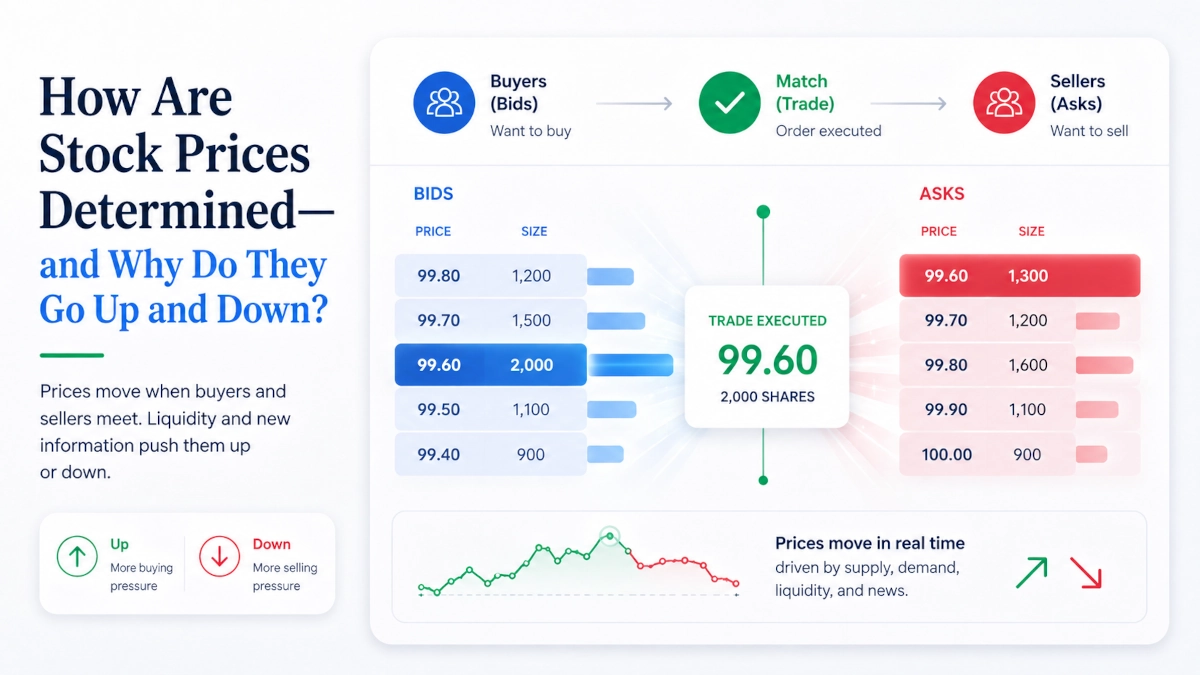
The market displays two important prices:
- Bid: the highest displayed price a buyer is currently willing to pay;
- Ask: the lowest displayed price a seller is currently willing to accept.
The difference is the bid-ask spread.
For a stock quoted at:
Bid: $50.00
Ask: $50.08
a market buy order would generally interact with the available ask side, not the last traded price and not the bid.
Liquidity affects what happens next. If enough shares are available at the best ask, the whole order may execute there. If not, the order may consume shares at several price levels.
Example:
100 shares available at $50.08
150 shares available at $50.10
250 shares available at $50.15
A market order for 300 shares could fill across all three levels, producing an average price above $50.08.
A limit order may wait in the market until a seller accepts the specified price, execute partially, or expire without a trade.
6. The trade executes
Execution occurs when all or part of the buy order is matched and completed at a price.
Common order statuses include:
| Status | What it normally means |
|---|---|
Submitted |
The broker has received the order |
Open or Working |
The order is active but not fully executed |
Partially filled |
Only part of the requested quantity has executed |
Filled |
The full requested quantity has executed |
Canceled |
The unexecuted portion was canceled |
Rejected |
The order was not accepted |
Expired |
The order ended under its time-in-force instruction |
Settled |
Cash and securities delivery has been completed |
Broker interfaces do not always use exactly the same labels.
A fill is an executed portion of an order. One order can generate several fills at different prices and times. The app may therefore display an average execution price.
Execution is the point at which you are economically committed to the trade. Settlement follows later.
7. You receive a trade confirmation
After execution, the broker records the transaction and provides a confirmation. Depending on the brokerage, this may be available immediately in the app and later as a formal confirmation document.
A trade confirmation can show:
- security name and ticker;
- buy or sell direction;
- quantity;
- execution price or prices;
- average execution price;
- trade date and time;
- settlement date;
- commission and transaction fees;
- whether the broker acted as agent or principal;
- the market or capacity information required by applicable rules.
Review confirmations and account statements. If the security, quantity, price or transaction is not what you authorized, contact the brokerage promptly through an official support channel.
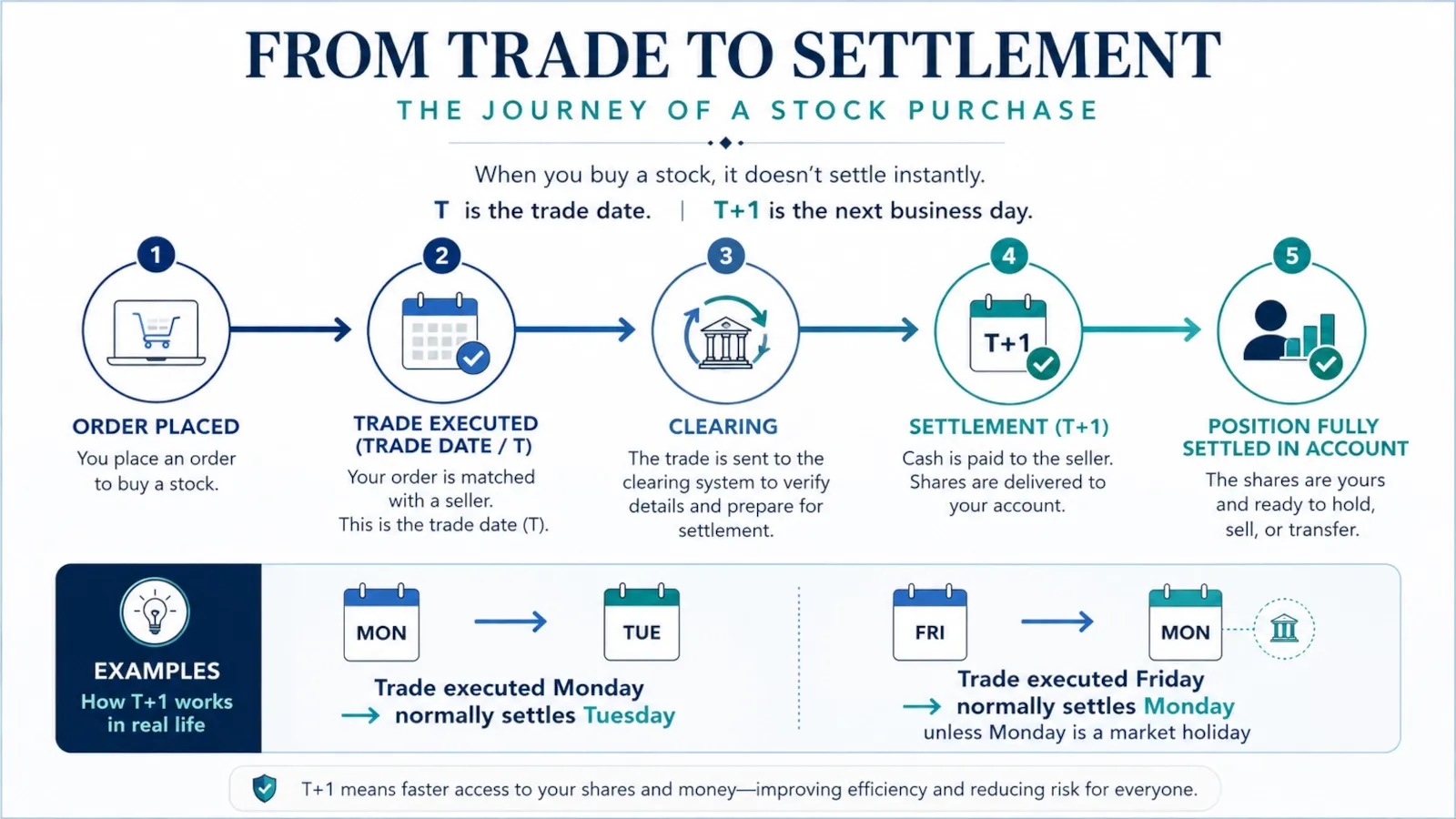
8. Clearing and settlement take place
Execution creates the trade. Clearing and settlement complete it.
During clearing, market infrastructure and participating firms determine what each side must deliver. Settlement is the final exchange:
Buyer delivers cash
Seller delivers securities
For most U.S. stock transactions, the standard settlement cycle is currently T+1, meaning the next business day after the trade date. FINRA’s settlement-cycle guidance explains that the trade date is the day the order executes, while the settlement date is when the transaction is finalized and funds and securities must be delivered.
Examples:
Trade executed Monday
→ normally settles Tuesday
Trade executed Friday
→ normally settles Monday, unless Monday is a market holidayThe position may appear in your account immediately after execution even though the transaction is still unsettled. Your broker may distinguish between:
- settled and unsettled cash;
- trade date and settlement date;
- available cash and buying power;
- shares held and shares available for certain account actions.
9. The position is recorded in your account
Once executed, the brokerage updates its records to show your position. After settlement, the delivery process is complete.
The account may display:
- quantity owned;
- average price;
- cost basis;
- current market price;
- market value;
- unrealized gain or loss;
- percentage return;
- settled status;
- dividends or corporate actions;
- cash and buying power.
These figures are not all calculated in exactly the same way by every broker.
For example:
- Average price may reflect the weighted average of your fills;
- Cost basis may include eligible transaction costs and may be affected by tax-accounting rules;
- Market value changes with the current quoted price;
- Unrealized gain or loss compares the current value with the broker’s recorded cost, but it is not a guaranteed amount you would receive after selling;
- currency conversion can affect values when the account and security use different currencies.
A complete market-order example
Assume a stock app shows a recent price of $50.00, but the best available ask is $50.08.
You submit:
Order: Buy 10 shares
Order type: Market
Displayed price: $50.00
Available ask: $50.08
The order reaches the broker, passes the account checks and is routed to an execution venue.
It fills as follows:
Execution: 10 shares at $50.08
Trade value: $500.80
Commission or fee: $1.00
Total cash used: $501.80
The position could then show:
Quantity: 10 shares
Average execution price: $50.08
Recorded cost including fee: $501.80
Illustrative average cost: $50.18 per share
Settlement: next business day under the U.S. T+1 standard
The exact treatment of fees and cost basis depends on the broker, account and applicable tax rules.
The key lesson is that the $50.00 shown before submission was not a guaranteed purchase price. The order executed against the available ask.
A complete limit-order example
Now assume the same market:
Bid: $50.00
Ask: $50.08
You enter:
Order: Buy 10 shares
Order type: Limit
Buy limit: $49.50
The limit order cannot execute above $49.50. Because the best seller currently asks $50.08, the order remains open.
Possible outcomes:
- the market falls and sellers become available at
$49.50or below, allowing execution; - only part of the order fills;
- the price never reaches the limit and the order expires;
- you cancel the order before execution.
A limit order controls the maximum purchase price. It does not guarantee that you will buy the stock.
Who gets the money when you buy a stock?
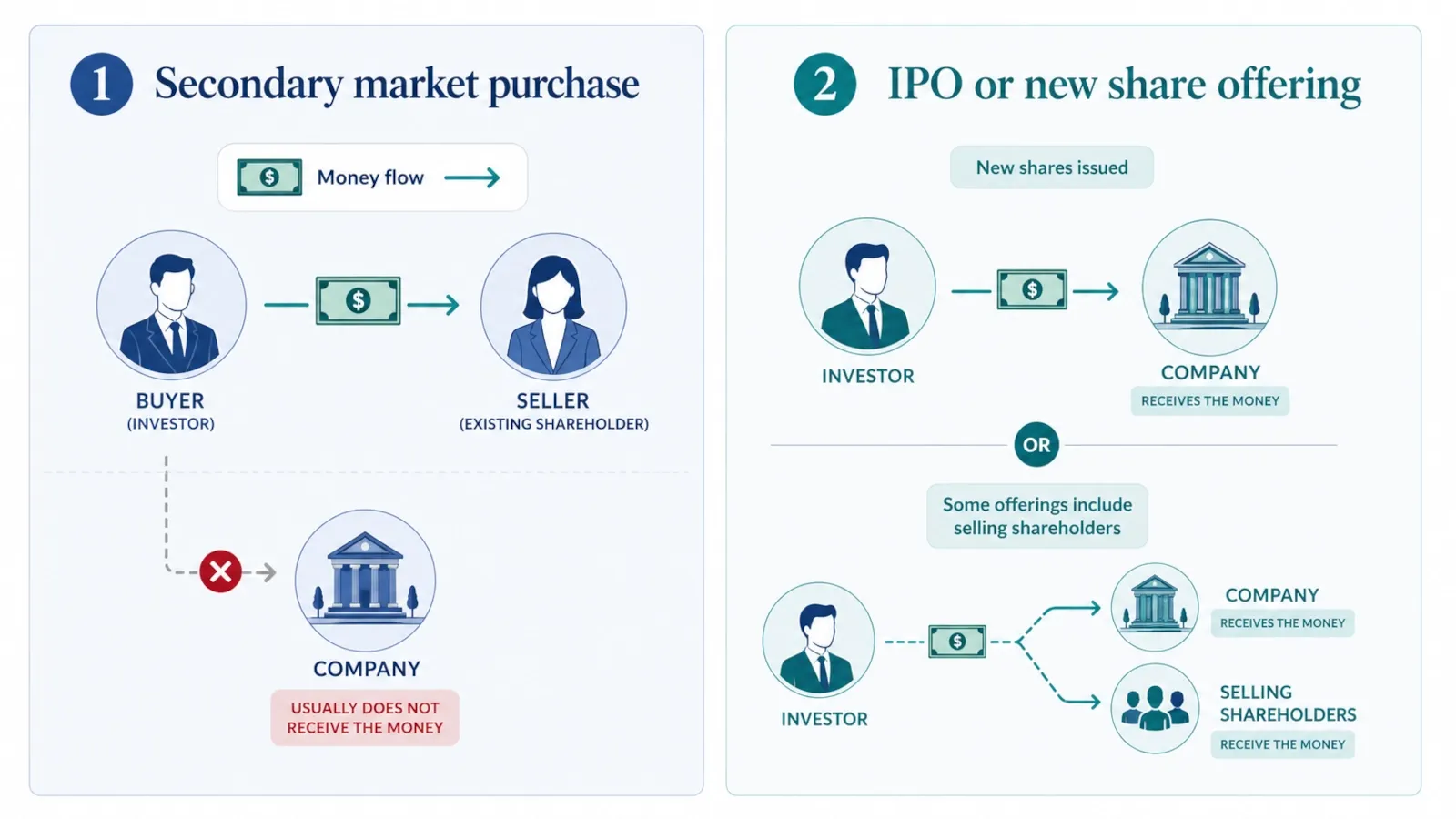
The answer depends on whether the transaction occurs in the secondary market or as part of a new offering.
In a normal secondary-market purchase
The economic flow is:
Buyer → sellerYou are buying shares that are already outstanding from another market participant. That seller may be an individual investor, institution, market maker or another trading firm.
The company whose stock is being traded does not normally receive your purchase money from that secondary-market transaction.
The broker, exchange, market maker, clearing participants and other intermediaries may receive commissions, fees, spreads or rebates depending on the arrangement. But the consideration for the shares ultimately belongs to the selling side.
In an IPO or new share offering
The flow may instead be:
Investor → companyor:
Investor → company and selling shareholdersIn a primary offering, the company issues new shares and can receive proceeds after underwriting discounts and offering expenses.
In a secondary component of an offering, existing shareholders sell shares and receive the relevant proceeds.
An IPO can contain both newly issued shares and shares sold by existing owners. The offering documents explain the allocation.
When you buy a stock, do you actually own it?
Yes—but the way ownership is recorded depends on how the security is held.
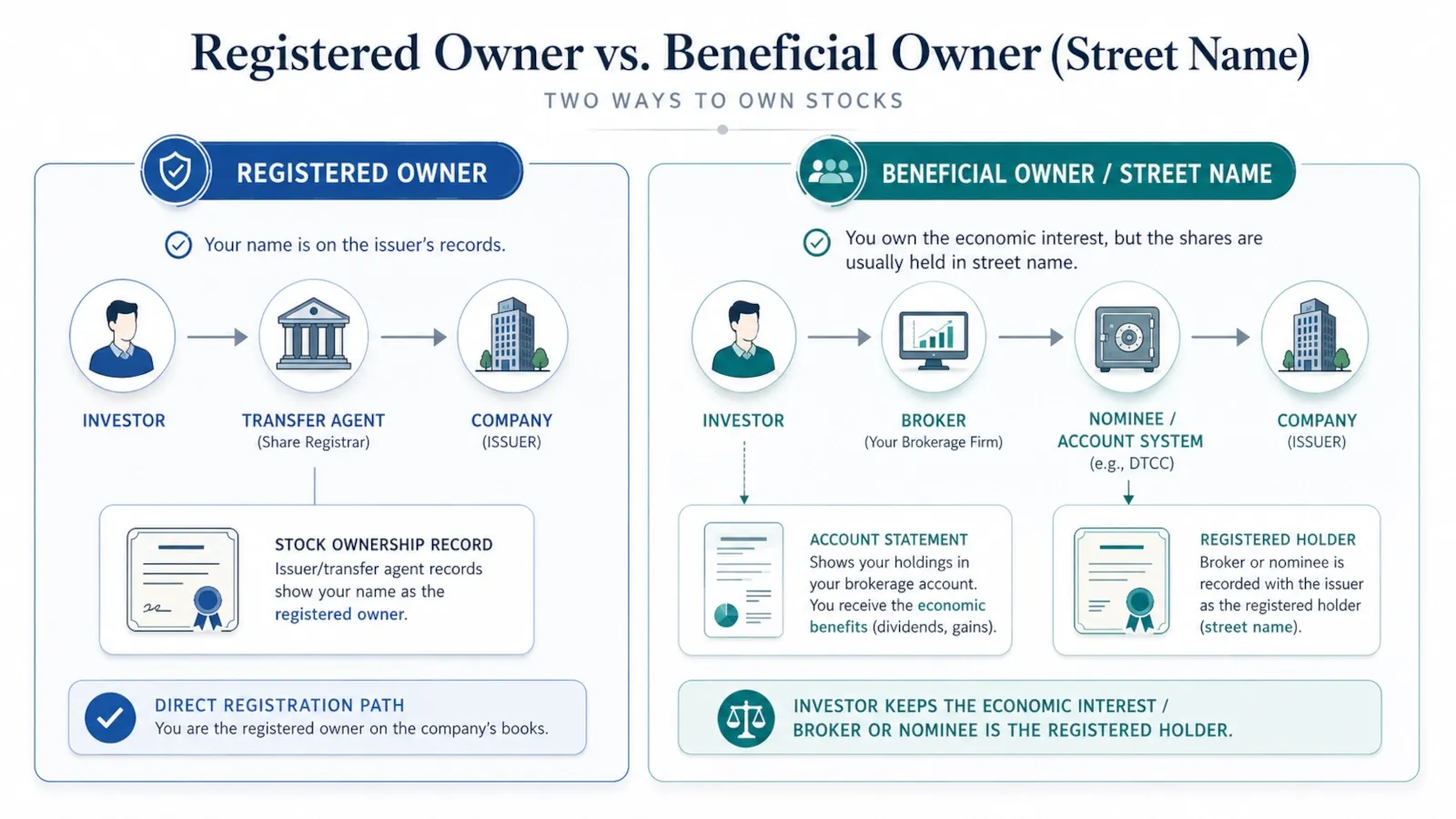
A public-company shareholder can hold shares directly as a registered owner or indirectly as a beneficial owner.
Registered owner
Your name appears directly in the issuer’s records, usually through the company’s transfer agent.
Direct registration may make you the record holder. Communications and corporate actions can come directly from the issuer or transfer agent.
Beneficial owner
This is the more common arrangement for ordinary brokerage accounts.
The broker, bank or another nominee appears as the registered holder, while the broker’s records identify you as the beneficial owner. This arrangement is commonly called holding securities in street name.
The SEC’s explanation of street-name holding says that most brokerage firms automatically hold securities this way. The investor usually receives account statements rather than a paper stock certificate.
Street-name holding does not mean the broker may simply treat your fully paid shares as its own property. Broker-dealers are subject to custody, recordkeeping and customer-protection requirements, although the exact framework and protections depend on the jurisdiction and account.
What do you actually own when you buy a stock?
When you buy an actual share, you generally own:
- an economic interest in the corporation;
- the rights attached to that class of shares;
- the ability to sell or transfer the position, subject to market, broker and legal rules;
- declared distributions for which you are eligible;
- voting rights if the class and holding arrangement provide them;
- a residual claim on assets after creditors and higher-priority claims if the company is liquidated.
You do not directly own:
- a specific percentage of each office, factory or machine that you may personally use;
- the right to withdraw money from the company’s bank accounts;
- control over daily business decisions;
- a guaranteed dividend;
- a guaranteed market price;
- protection from investment loss.
Your ownership is also proportional. Owning 10 shares of a company with one billion shares outstanding represents a very small fraction of the equity.
What shareholder rights do you receive?
Rights depend on the security.
Common-stock rights
Common shareholders may receive:
- voting rights on directors and certain corporate matters;
- dividends if the board declares them;
- participation in some corporate actions;
- residual claims in liquidation after creditors and preferred claims.
Some common shares have enhanced, reduced or no voting rights.
Preferred-stock rights
Preferred shares often have:
- priority over common shares for specified dividends;
- priority over common shares in liquidation;
- limited or no ordinary voting rights;
- special redemption, conversion or call provisions.
Fractional-share rights
A fractional share represents less than one full share, but the broker’s program determines important details.
FINRA’s guidance on fractional shares notes that:
- some brokers allow fractional-share voting and others do not;
- fractional shares generally cannot be transferred to another brokerage as fractions;
- some brokers execute fractional orders immediately while others aggregate them;
- extended-hours trading may be unavailable.
Read the broker’s fractional-share agreement rather than assuming a fractional position has every feature of a whole share.
Why can your purchase price be different from the price shown?
The displayed figure may be:
- the last completed trade;
- a delayed quote;
- the midpoint between bid and ask;
- an indicative price;
- the current value of a related product;
- a real-time quote available for only a limited number of shares.
The execution price is determined by the available market when the order reaches the execution venue.
Last price versus bid and ask
Suppose the last trade was $50.00, but the current market is:
Bid: $49.98
Ask: $50.08
The last price describes a past transaction. A market buyer normally interacts with the current ask side.
Bid-ask spread
A wider spread can increase the immediate cost of entering and exiting a position. Spreads often widen when:
- the security has low trading volume;
- the market is volatile;
- important news is pending;
- trading occurs outside regular hours;
- fewer market participants are quoting prices.
Slippage
Slippage is the difference between the expected price and the actual average execution price.
It can occur when:
- the market moves while the order is traveling and being processed;
- the requested quantity is larger than the available quantity at the best price;
- the stock is volatile;
- the order is executed across several price levels.
Market and limit orders
The central distinction is:
A market order prioritizes prompt execution, not an exact price. A limit order controls the acceptable price, but does not guarantee execution.
Investor.gov’s order-type guidance also warns that the last-traded price is not necessarily the price at which a market order will execute.
Fractional-order handling
A broker may aggregate fractional orders before executing whole shares in the market. That process can affect the timing and price reported to the customer. Ask the broker how fractional orders are handled.
What changes inside your brokerage account?
After the purchase, the account moves cash into the position and records the transaction.
Consider this simplified example:
10 shares × $50.00 = $500.00
Estimated fee = $1.00
Total cash used = $501.00
Illustrative average cost = $50.10 per share
The brokerage account may show:
| Field | What it tells you |
|---|---|
| Quantity | Number of whole or fractional shares held |
| Average price | Weighted average execution price, depending on the broker |
| Cost basis | Broker’s recorded acquisition cost for reporting purposes |
| Market price | Current quoted value per share |
| Market value | Quantity multiplied by the current market price |
| Unrealized gain/loss | Difference between current value and recorded cost |
| Trade date | Date the order executed |
| Settlement date | Date cash and securities delivery is due |
| Settled cash | Cash that has completed settlement |
| Buying power | Amount the broker currently allows you to deploy |
A positive unrealized gain does not become guaranteed cash merely because it appears on screen. The market can move before a sale, and selling can involve spreads, fees, taxes and a different execution price.
What happens after you buy the stock?
After execution and settlement, the position remains in your account until you sell, transfer it, or a corporate event changes it.
Several things can happen.
The market price changes
The quoted price can rise or fall throughout the trading session. Your account will usually update the market value and unrealized gain or loss.
The company may declare a dividend
A dividend is paid only if the company declares one and you meet the eligibility rules. A company can reduce, suspend or eliminate its dividend.
You may receive voting materials
If the security and holding structure provide voting rights, the broker or another intermediary may send proxy materials and voting instructions.
Corporate actions may change the position
Examples include:
- stock splits;
- reverse splits;
- mergers;
- acquisitions;
- spin-offs;
- tender offers;
- rights offerings;
- symbol or exchange changes.
You can hold, buy more, sell or transfer
Your options depend on the market, broker, account type and instrument. Fractional shares may need to be sold rather than transferred as fractions.
Your return remains uncertain
Buying the stock starts the investment exposure. It does not lock in a future profit. The company can perform well while its share price falls, or perform poorly while the price temporarily rises. Market expectations, interest rates, liquidity, news and broader conditions can all affect price.
Are you buying a stock or something else?
A platform can display a familiar company name and a Buy button without necessarily giving you an ordinary share.
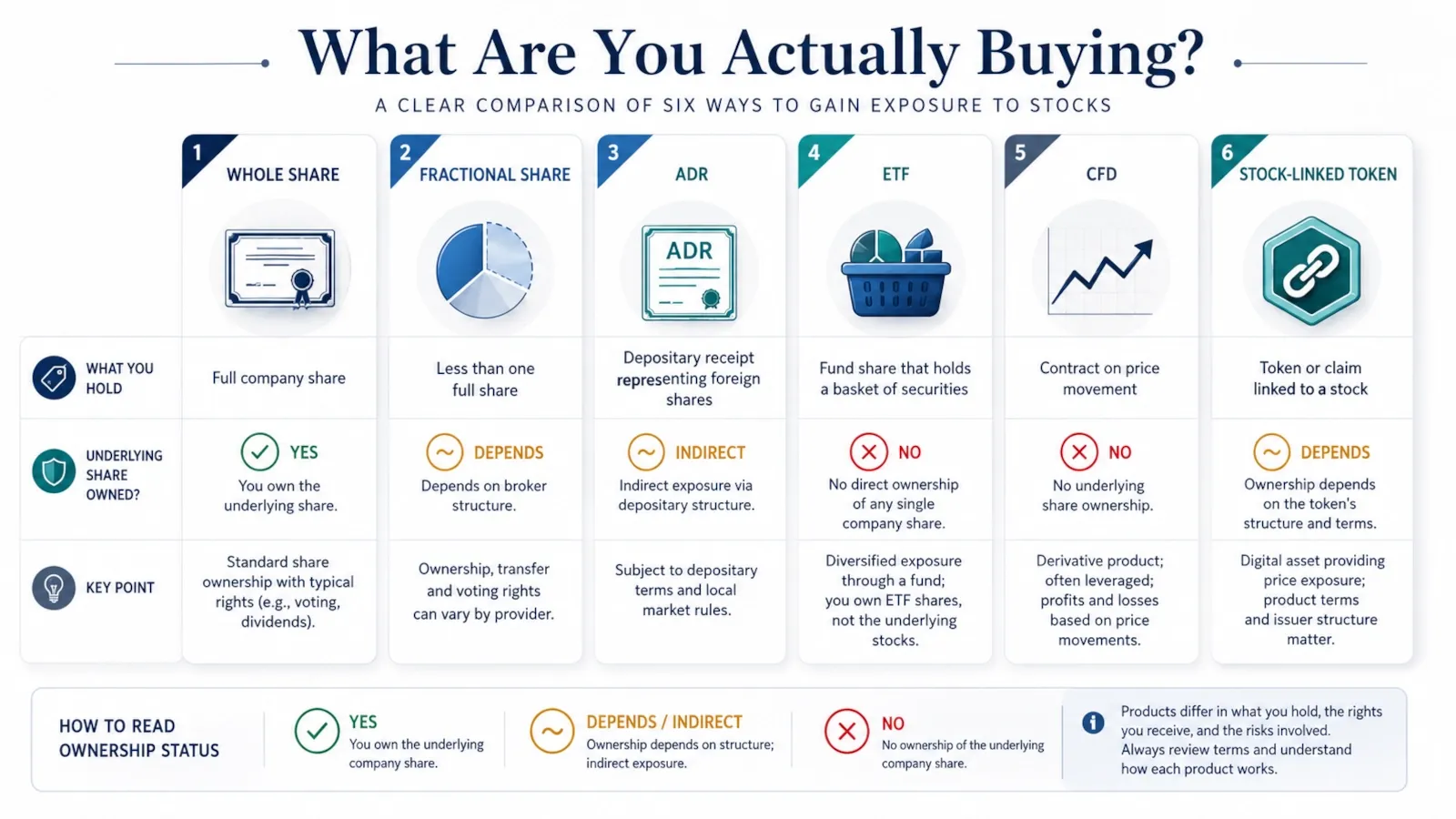
| Product | What you hold | Do you own the underlying company share directly? | Important point |
|---|---|---|---|
| Whole share | A full share of the specified stock | Generally yes, directly or beneficially | Rights depend on share class and custody |
| Fractional share | Less than one full share under a broker program | Economic ownership structure depends on the program | Voting, execution and transfer may be limited |
| ADR or ADS | A depositary security representing foreign shares | You hold the receipt rather than the local-market share directly | Fees, currency and depositary terms can apply |
| ETF share | A share in an investment fund | No direct ownership of each portfolio company | You own an interest in the fund |
| CFD | A contract based on price movement | No | Leverage and counterparty risk may apply |
| Stock-linked token | A token or contractual claim | It depends on the legal structure | Do not assume the issuer holds or transfers a real share |
Before buying, check:
What is the exact legal name of the product?
Do I own the underlying share?
Who holds or custodies the asset?
Can I transfer the position to another broker?
Do I receive voting rights?
How are dividends or equivalent payments handled?
Is leverage involved?
Which regulator and investor-protection framework apply?
A legitimate platform should make the product terms available before you trade.
What can go wrong?
Most ordinary stock purchases are processed quickly, but several outcomes are possible.
The order is rejected
Possible reasons include:
- insufficient cash or buying power;
- unsupported security;
- account restriction;
- invalid price or quantity;
- missing product permission;
- trading halt;
- market closure;
- compliance review.
A limit order never executes
The market may never reach your limit, or other orders may have priority at the same price.
The order fills only partially
There may not be enough liquidity at your price. The remaining quantity can stay open, expire or be canceled according to the order instructions.
The execution price is unexpected
A market order can move through several available prices. Fast markets, thin liquidity and extended-hours trading can increase this risk.
Trading is halted
An exchange or regulator can halt trading for news, order imbalances, volatility or regulatory reasons. During a halt, orders may remain pending, be rejected or be handled under broker-specific procedures.
Settlement or payment fails
A customer who does not provide required funds can face liquidation, fees or account restrictions. Operational failures between firms are normally addressed through market and clearing procedures, but delays can still occur.
You buy the wrong instrument
A CFD, leveraged product, option, warrant, ETF, ADR or token may be mistaken for an ordinary share. Always verify the product type and ticker.
The platform is unregistered or fraudulent
A professional-looking app does not prove that the firm is authorized. Verify the broker with the relevant regulator and use official contact details.
Common mistakes
Mistake 1: Treating the displayed price as guaranteed
A quote is not a promise. Check whether you are viewing the last trade, bid, ask, midpoint or delayed price.
Better approach: understand the order type and review the estimated order value before submission.
Mistake 2: Using a market order in a thin or highly volatile stock without understanding the risk
The order may execute at several prices or far from the last trade.
Better approach: review the spread, liquidity and volatility. Consider whether a limit order better matches your objective.
Mistake 3: Setting a limit price and assuming the purchase is complete
A limit order can remain open indefinitely under its time-in-force instruction.
Better approach: check the order status and distinguish open, partially filled, filled, canceled and expired.
Mistake 4: Confusing execution with settlement
A position can appear after execution even though cash and securities have not completed settlement.
Better approach: check the settlement date and the broker’s settled-cash rules.
Mistake 5: Assuming the company receives the money
In a normal exchange trade, you are generally buying from another holder.
Better approach: distinguish secondary-market trading from an IPO or new share issuance.
Mistake 6: Assuming every fractional-share program works the same way
Voting, transfers, execution timing and eligible securities vary.
Better approach: read the broker’s fractional-share disclosure.
Mistake 7: Assuming SIPC or another protection scheme covers investment losses
Custody protection is not insurance against a falling stock price.
Better approach: understand exactly what the applicable protection scheme covers and its limits.
Mistake 8: Ignoring currency and tax effects
A foreign-currency position can rise in local-market terms but lose value after exchange-rate movements. Taxes can depend on residence, account type, dividends, realized gains and other factors.
Better approach: keep the article’s mechanics separate from personal tax planning and consult qualified local guidance where necessary.
Security, privacy and financial safety notes
Verify the broker
Before funding an account:
- confirm the firm’s legal name;
- check registration with the relevant financial regulator;
- verify the official website and app publisher;
- read the custody, order-execution and fee disclosures;
- confirm which investor-protection scheme, if any, applies.
For U.S. firms, relevant checks can include FINRA’s BrokerCheck, SEC records and SIPC membership. Other countries have their own registers and compensation schemes.
Protect the brokerage account
Use:
- a unique password;
- multi-factor authentication;
- device security;
- official apps and bookmarks;
- transaction alerts;
- secure recovery methods.
Never share:
- authentication codes;
- backup codes;
- remote-access control of your device;
- screen-sharing access with an unsolicited caller;
- seed phrases or private keys;
- full identity documents through an unverified channel.
A legitimate broker or regulator will not ask you to move money to a “safe account” because of an unexpected phone call.
Understand margin and leverage
This article primarily describes a fully funded stock purchase.
If you buy with borrowed money in a margin account:
- interest can accrue;
- losses are amplified;
- the broker can issue a margin call;
- the broker may liquidate securities;
- you can lose more than the cash initially deposited.
A CFD or another leveraged derivative can create different and potentially greater risks than buying an ordinary fully paid share.
Understand custody protection
In the United States, SIPC protection can help restore securities and cash held by a failed SIPC-member broker, subject to eligibility and limits. It does not protect against market losses, poor investment performance or a security becoming worthless.
Investor-protection rules differ internationally. Do not assume U.S. SIPC coverage applies to a non-U.S. platform or affiliate.
Review confirmations and statements
Check:
- unfamiliar trades;
- incorrect quantities;
- unexpected fees;
- changes to contact details;
- margin balances;
- unusual cash transfers;
- securities you did not authorize.
Report discrepancies promptly through the firm’s official channels and keep written records.
Faster alternative: the 30-second explanation
The shortest accurate version is:
- You send a buy instruction to your broker.
- The broker validates it and chooses an execution venue.
- The order meets a seller or liquidity provider.
- The trade executes at an available price.
- The broker confirms the quantity, price, fees and settlement date.
- Clearing systems arrange delivery of cash and shares.
- Most U.S. stock trades settle on the next business day.
- The shares are normally held in street name, with you recorded as beneficial owner.
- The position then changes in value and may receive shareholder benefits according to the security’s terms.
This summary is useful when you only need the flow. The full guide matters when choosing an order type, interpreting the price, understanding custody or confirming what product you bought.
Common misconceptions
Myth: The company receives my money every time I buy
Reality: In a normal secondary-market trade, the purchase consideration generally goes to the seller. The company receives proceeds when it issues shares in a primary offering, subject to the offering structure and expenses.
Myth: I always pay the price shown on screen
Reality: A market order can execute at a different available price. The last trade is not a guarantee.
Myth: My order goes directly to the stock’s main exchange
Reality: The broker may route it to another exchange, a market maker, an ECN, an alternative system or an internal trading operation.
Myth: The shares are fully settled as soon as I press Buy
Reality: Submission, execution and settlement are separate stages.
Myth: Owning a stock guarantees dividends
Reality: Dividends must be declared and may be reduced, suspended or eliminated.
Myth: A limit order guarantees that I will buy the stock
Reality: It controls the maximum price but may never execute.
Myth: Every fractional share has the same voting and transfer rights
Reality: Broker programs differ.
Myth: Every product displaying a stock price gives me ownership
Reality: CFDs, tokens and other derivatives may provide price exposure without ownership of the underlying share.
Myth: You only lose money when you sell
Reality: A price decline creates an unrealized loss before a sale. Selling realizes the result, but the economic value has already changed. A company can also fail, suspend trading or become difficult to sell.
FAQ
What happens immediately after you buy a stock?
The broker validates and routes your order. Once it meets an available seller, the trade executes and the broker records the position. Clearing and settlement then arrange the final delivery of cash and securities.
How does buying a stock work?
You select the security, quantity and order type. The broker checks the order and sends it to an execution venue. The order is matched at an available price, confirmed, cleared and settled. The broker then continues to hold or record the position for you.
When you buy a stock, do you actually own it?
If you bought an actual share, yes. In most brokerage accounts, you are the beneficial owner while the broker or its nominee is the registered holder in street name. Product structure matters: CFDs and some tokens do not provide ordinary share ownership.
What do you actually own when you buy stock?
You own the economic interest and rights attached to the security and share class. You do not directly control or personally possess the company’s physical assets or bank accounts.
Who receives the money when you buy a stock?
In a normal secondary-market purchase, another seller ultimately receives the proceeds for the shares, while intermediaries may receive fees or spreads. In an IPO or new issuance, the company may receive some or all of the offering proceeds.
Why is the execution price different from the displayed price?
The display may show the last trade rather than the current ask. Prices can also move while the order is processed, and a larger order can fill at several price levels. A market order does not guarantee an exact price.
How long does a stock purchase take to settle?
Most U.S. stock transactions currently settle on the next business day after execution, known as T+1. Weekends and market holidays affect the date. Other markets may use different cycles.
Can a stock order be partially filled?
Yes. If only part of the requested quantity is available under the order’s price conditions, that portion may execute while the remainder stays open, expires or is canceled.
Can you sell a stock immediately after buying it?
A broker may allow a sale after execution, but account-funding and settlement rules still matter. In a U.S. cash account, a fully paid purchase can generally be sold, while buying and selling before paying for the security can create a Regulation T freeriding violation and possible account restrictions. Margin accounts operate under different rules. Check the broker’s settled-funds policy.
What happens if your broker fails?
Customer assets should be held and recorded under the applicable custody framework. In the United States, SIPC protection can help restore eligible securities and cash at a failed SIPC-member firm, subject to limits and conditions. It does not reimburse market losses. Protections in other countries differ.
Last tested
Tested on:
- U.S. stock-market order-routing framework
- U.S. T+1 settlement cycle
- SEC guidance on street-name and beneficial ownership
- FINRA guidance on fractional shares
- Investor.gov guidance on order types and cash accounts
- SIPC investor-protection guidance
Last tested: 2026-07-31
Related guides
Carefully selected guides to help you understand the topic and complete the next useful step.