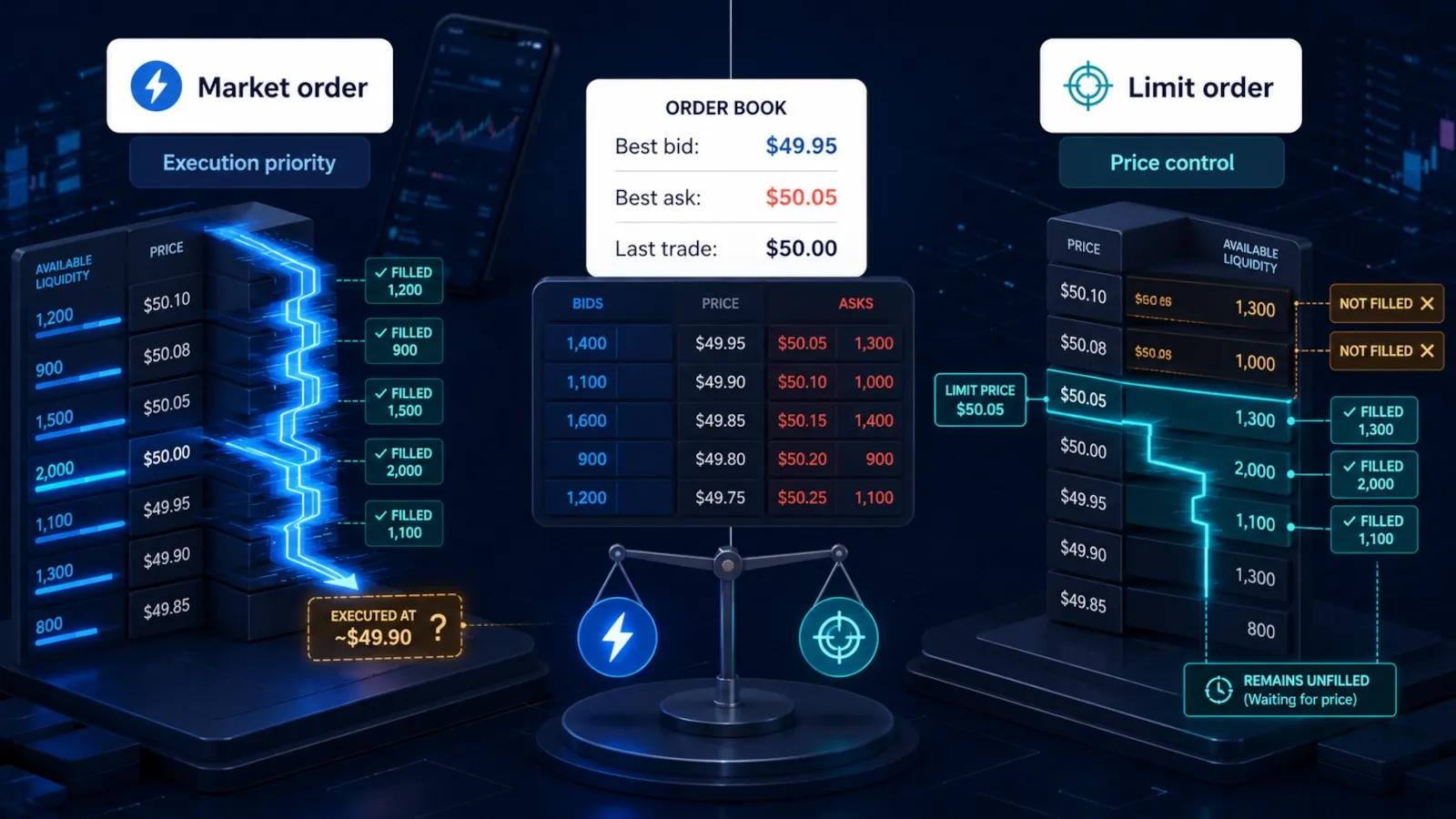
A market order and a limit order can both buy or sell the same stock, but they give your broker different instructions. A market order says that completing the trade is the priority. A limit order says that staying within a specified price is the priority.
That difference sounds simple, but it affects the price you may receive, whether the order fills, how long it remains open, and what can happen in volatile or thinly traded markets. This guide focuses primarily on U.S.-listed stocks and exchange-traded funds, or ETFs. Broker interfaces, supported order types, fees and extended-hours rules can vary.
Educational notice: This article explains order mechanics for general education. It is not personal investment advice or a recommendation to buy, sell or hold any security.
Quick answer
A market order prioritizes getting a trade executed as soon as reasonably possible, but it does not guarantee the final execution price. A limit order lets you set the maximum price you will pay when buying or the minimum price you will accept when selling, but it may be partially filled or remain completely unfilled.
Neither order is always better. The appropriate choice depends on liquidity, volatility, order size, urgency, trading hours and whether price certainty or execution certainty matters more to you.
The central trade-off is:
- Market order: greater emphasis on prompt execution, less control over the final price.
- Limit order: greater control over the acceptable price, less certainty that the trade will happen.
When to use this solution
Use this comparison when you are preparing to buy or sell a stock or ETF and your broker asks you to choose an order type.
It is especially useful when you need to understand:
- why the displayed stock price may differ from your execution price;
- whether an order can remain pending;
- how a buy limit differs from a sell limit;
- what slippage and partial fills mean;
- why liquidity and the bid-ask spread matter;
- how orders may behave before the market opens or after it closes;
- why a limit order is not the same as a stop or stop-limit order.
This guide does not attempt to cover every advanced instruction, such as immediate-or-cancel, fill-or-kill, all-or-none, market-on-open or algorithmic execution. Those instructions solve different problems and may not be available through every retail broker.
Before you start
Before placing an order, identify these details in your brokerage app or website:
- the security and ticker symbol;
- whether you are buying or selling;
- the number of shares or dollar amount;
- the current bid and ask, not only the last-traded price;
- whether the market is open, closed or in an extended-hours session;
- the order duration, such as Day or Good-Til-Canceled;
- any commissions, regulatory charges or platform-specific restrictions;
- whether fractional shares support the same order types as whole shares.
A quote can change between the moment you review it and the moment your broker receives the order. Treat every price shown before execution as information, not as a promise.
Market order vs limit order at a glance
| Feature | Market order | Limit order |
|---|---|---|
| Main priority | Prompt execution | Price control |
| Price guaranteed | No | Limit price or better, if executed |
| Execution guaranteed | Not absolute, but normally prioritised for prompt handling | No |
| Can remain open | Normally no once accepted during an executable session | Yes |
| Can receive a partial fill | Yes | Yes |
| Main risk | Slippage or an unexpectedly poor price | Missing the trade or receiving only a partial fill |
| Typical use case | Urgency matters more than small price differences | The acceptable price matters more than immediate execution |
| Buy instruction | Buy at the best available sell prices | Buy only at the limit price or lower |
| Sell instruction | Sell at the best available buy prices | Sell only at the limit price or higher |
A market order is often described as guaranteeing execution, but that wording is too absolute for practical education. A trading halt, rejection, unavailable liquidity, broker restriction or market closure can prevent normal execution. It is more accurate to say that a market order is designed to seek prompt execution at the best prices then available.
What is a market order?
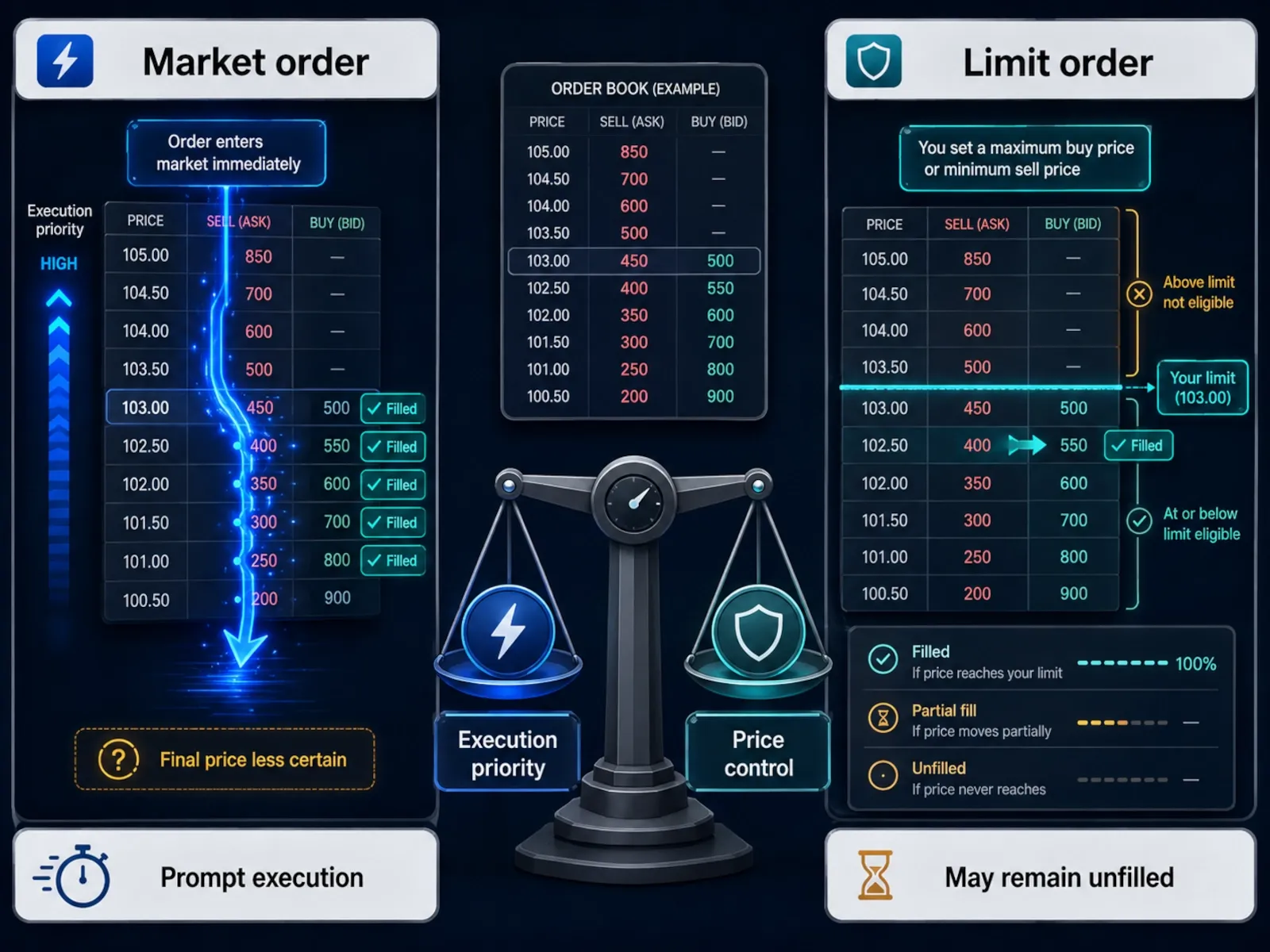
A market order instructs your broker to buy or sell a security as soon as reasonably possible at the best prices available when the order reaches an executable market.
It does not mean:
- buy at the price shown on the chart;
- buy at the last-traded price;
- sell at yesterday’s closing price;
- guarantee one price for the entire order.
The order interacts with available buyers and sellers. If there are not enough shares available at the best current price, the remaining quantity may execute at the next available prices.
How a market buy order works
A market buy normally interacts with the lowest available selling prices, beginning near the ask.
Suppose a quote shows:
Bid: $49.95
Ask: $50.05
Last trade: $50.00
The $50.00 last trade tells you where a previous transaction occurred. It does not mean that someone is currently willing to sell to you at $50.00. If the best current ask is $50.05, a small market buy may execute near $50.05 instead.
If the order is larger than the quantity available at the best ask, it may continue into higher-priced sell orders. This is one form of slippage.
How a market sell order works
A market sell normally interacts with the highest available buying prices, beginning near the bid.
Using the same quote:
Bid: $49.95
Ask: $50.05
Last trade: $50.00
A small market sell may execute near $49.95, not at the $50.00 last trade. If there are too few buyers at $49.95, part of the order may execute at lower bid prices.
Market order example
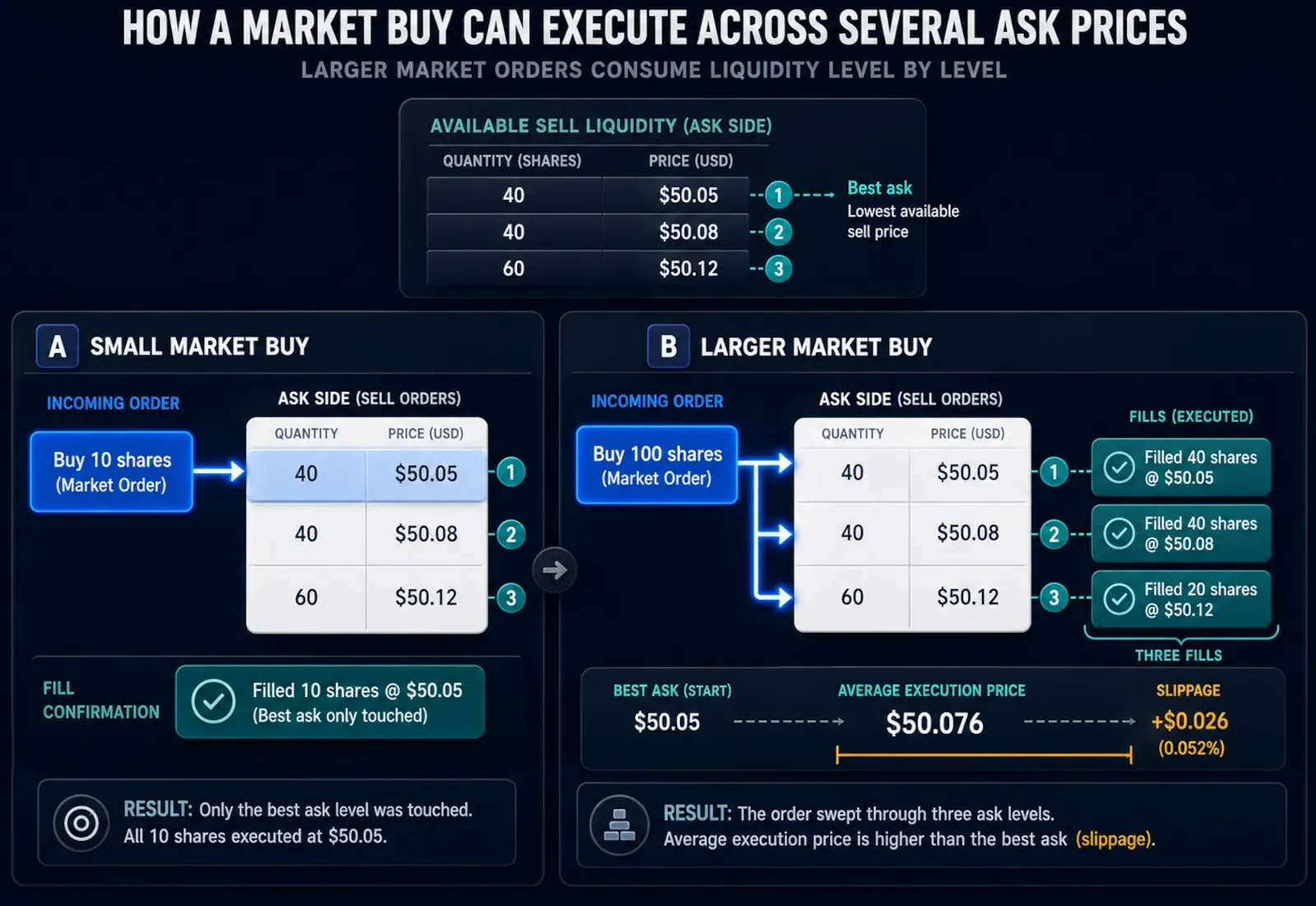
Assume the sell side of the market looks like this:
| Available sell quantity | Ask price |
|---|---|
| 40 shares | $50.05 |
| 40 shares | $50.08 |
| 60 shares | $50.12 |
A market order to buy 10 shares could fill entirely at $50.05 if that liquidity is still available when the order arrives.
A market order to buy 100 shares could be divided into several executions:
40 shares at $50.05
40 shares at $50.08
20 shares at $50.12
The volume-weighted average execution price would be:
((40 × $50.05) + (40 × $50.08) + (20 × $50.12)) ÷ 100
= $50.076 per share
The order filled quickly, but not at one single price. The larger the order relative to available liquidity, the more important market depth and price impact become.
Advantages of market orders
A market order can be useful because it:
- prioritizes completing the transaction;
- is straightforward for beginners to understand;
- normally fills quickly in liquid securities during regular hours;
- reduces the risk of missing a trade because the market moved away from a chosen limit;
- can be appropriate when the timing of the transaction matters more than a small price difference.
Risks and disadvantages of market orders
The main disadvantage is price uncertainty.
A market order can produce a worse-than-expected result when:
- the bid-ask spread is wide;
- the security is thinly traded;
- the market is moving quickly;
- the order is large relative to displayed liquidity;
- trading has just opened or is about to close;
- important news has caused a price gap;
- the order is entered outside regular trading hours;
- the quote is delayed or changes before the order arrives.
The price difference may be small in a highly liquid stock, but it can be significant in an illiquid stock, a newly listed security or a stressed market.
What is a limit order?
A limit order instructs your broker to trade only at a specified price or a better one.
For a buy limit, the limit is the most you are willing to pay. For a sell limit, the limit is the least you are willing to receive.
A limit order provides a price boundary, not an execution promise.
How a buy limit order works
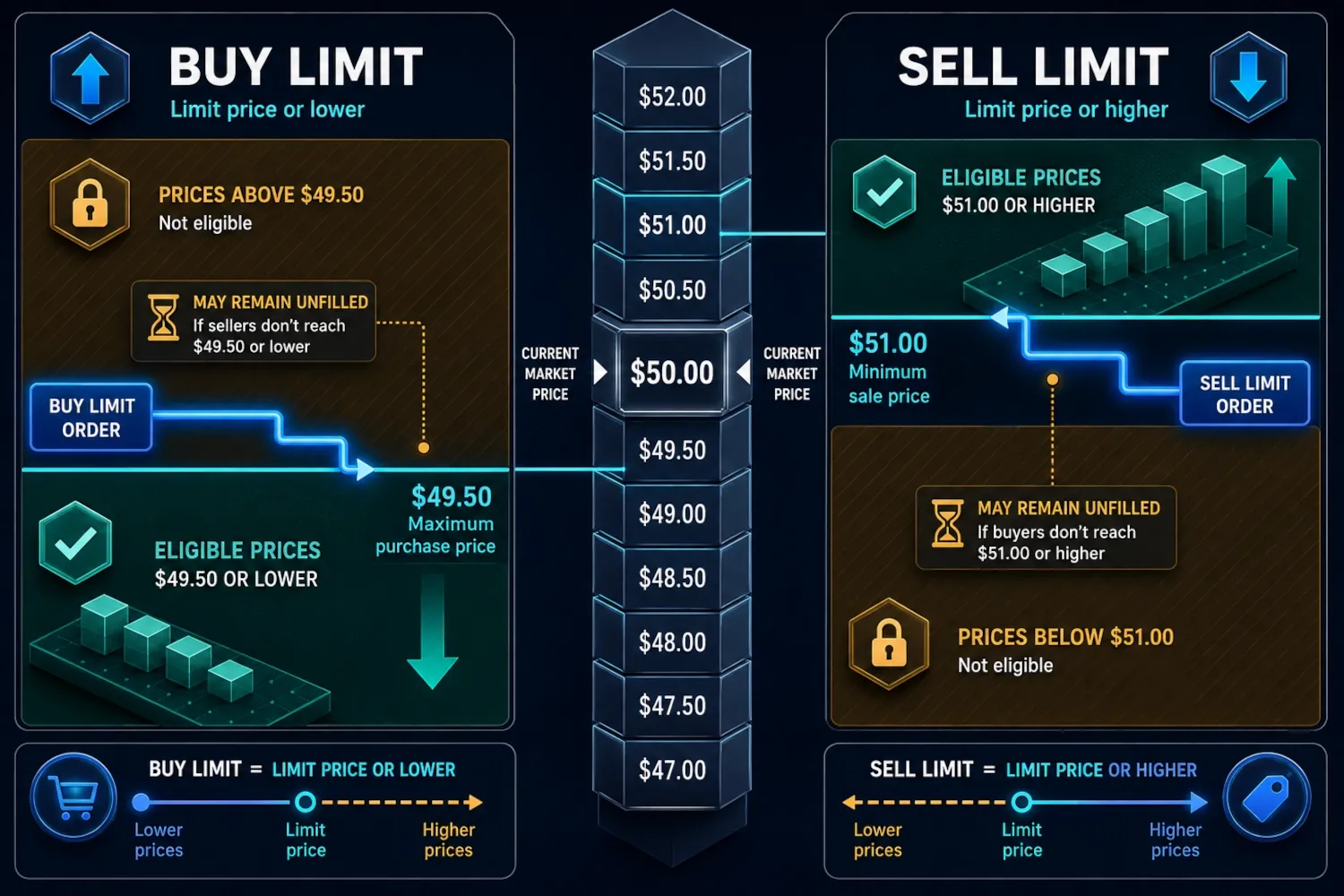
A buy limit order can execute only at the limit price or lower.
If you place:
Buy 100 shares
Limit price: $49.50
then $49.50 is your maximum acceptable purchase price. The order may execute at $49.50, $49.45 or another lower price if available. It cannot properly execute above $49.50.
If sellers never become available at $49.50 or below while the order is active, the order will not fill.
How a sell limit order works
A sell limit order can execute only at the limit price or higher.
If you place:
Sell 100 shares
Limit price: $51.00
then $51.00 is your minimum acceptable sale price. The order may execute at $51.00, $51.05 or another higher price if available. It should not execute below $51.00.
If buyers never become available at $51.00 or higher while the order is active, the shares will remain unsold.
Limit order example
Return to the quote:
Bid: $49.95
Ask: $50.05
Last trade: $50.00
A buy limit at $49.50 is below the current ask. It will normally wait unless the market falls and an eligible seller becomes available at $49.50 or lower.
A buy limit at $50.10 is above the current ask of $50.05. It is therefore marketable when entered: it can execute immediately against available sell orders, but only at prices no higher than $50.10.
That distinction is crucial. The $50.10 limit is a ceiling, not necessarily the price you pay.
Advantages of limit orders
A limit order can:
- prevent a purchase above your chosen maximum;
- prevent a sale below your chosen minimum;
- reduce exposure to sudden price moves;
- be useful when spreads are wide or liquidity is limited;
- allow an order to wait for a more acceptable price;
- provide clearer control during extended-hours sessions, where supported.
Risks and disadvantages of limit orders
The main disadvantage is execution uncertainty.
A limit order may:
- remain completely unfilled;
- receive only a partial fill;
- expire before the market reaches the limit;
- lose its opportunity if the price moves away;
- wait behind earlier orders at the same price;
- fill only after market conditions have changed materially.
Seeing the market trade at your limit price does not always prove that your order should have filled. There may have been insufficient quantity, earlier orders may have had priority, the quote may have come from another venue, or the trade may have occurred before your order became active.
Execution priority vs price control
The real difference between a market order and a limit order is not simply “fast versus slow.” It is the type of uncertainty you accept.
Market order: you accept uncertainty about the final price in exchange for a stronger emphasis on prompt execution.
Limit order: you accept uncertainty about whether the trade will happen in exchange for control over the worst acceptable price.
This trade-off becomes more important as volatility, spreads, order size and market fragmentation increase.
A limit order can also cross the market and become immediately executable. That is why “market order means immediate” and “limit order means waiting” are incomplete explanations. A marketable limit order can combine immediate execution potential with a price ceiling or floor.
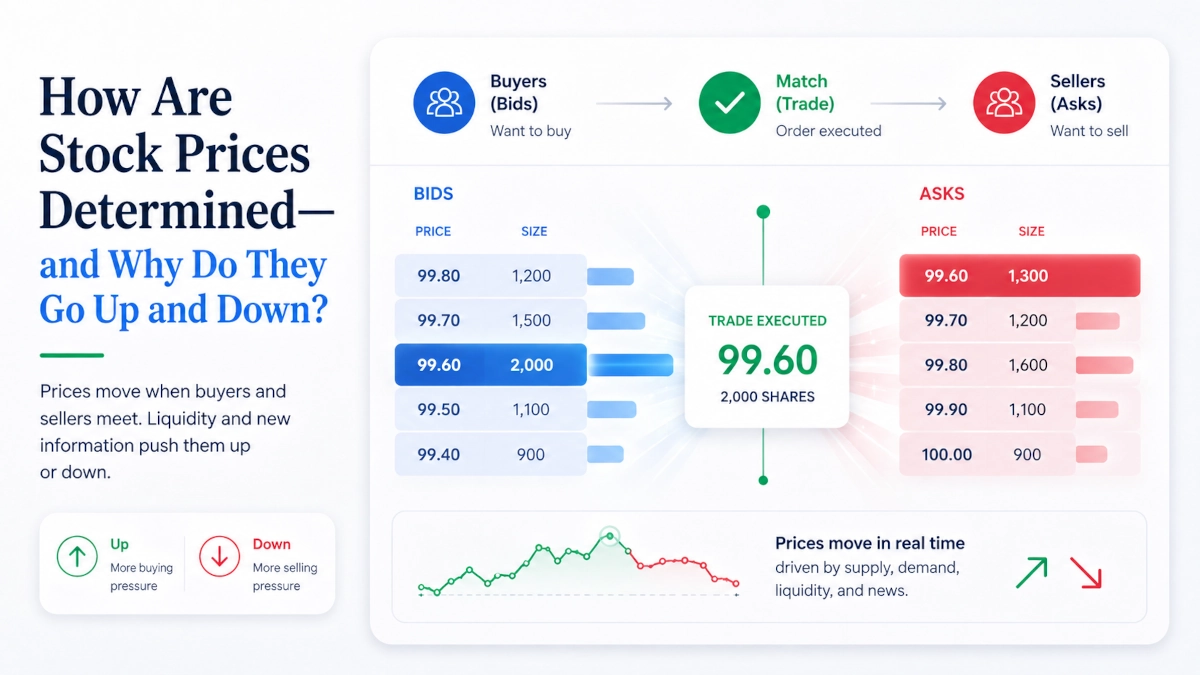
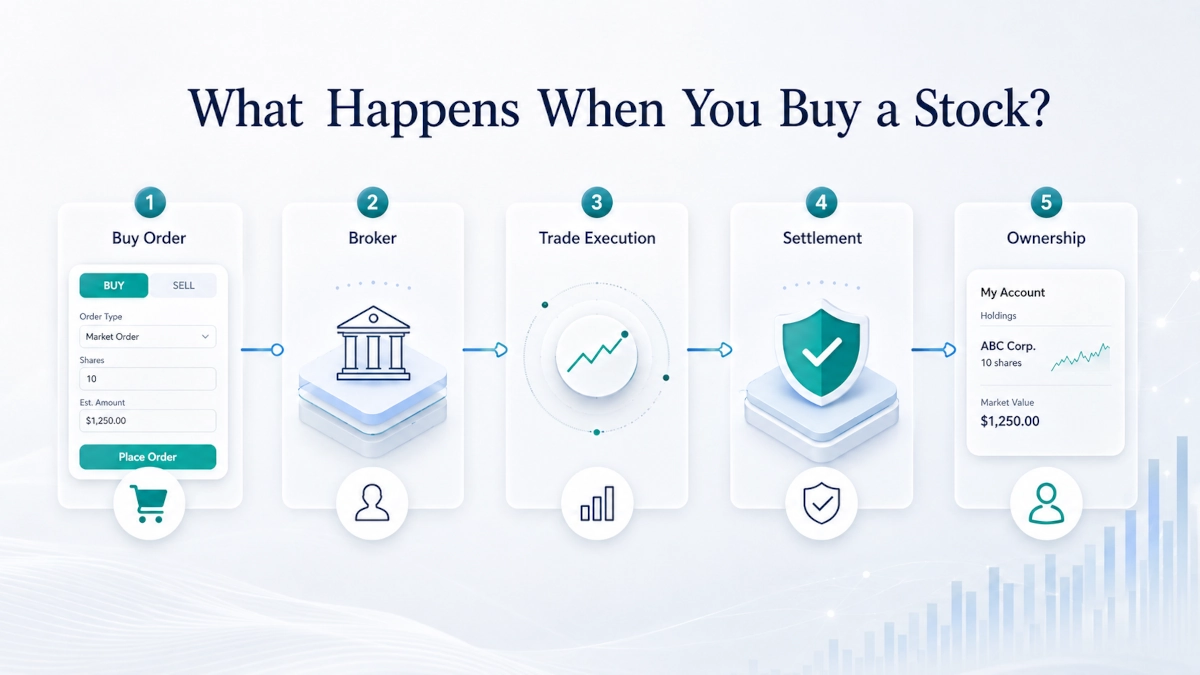
For a broader explanation of how brokers route and execute orders, see What Happens When You Buy a Stock?. For the wider market structure, see How Does the Stock Market Work?.
Market and limit order examples
The following examples use one consistent quote so that the differences are easy to compare.
Example quote and available liquidity
Last trade: $50.00
Best bid: $49.95
Best ask: $50.05
Visible sell orders:
| Quantity | Ask price |
|---|---|
| 40 shares | $50.05 |
| 40 shares | $50.08 |
| 60 shares | $50.12 |
Visible buy orders:
| Quantity | Bid price |
|---|---|
| 50 shares | $49.95 |
| 80 shares | $49.90 |
| 100 shares | $49.85 |
These examples are simplified. Real markets contain multiple venues, hidden liquidity, rapidly changing quotes, routing decisions and other orders entering or leaving the market.
Example 1: Market buy of 10 shares
A market buy of 10 shares can interact with the 40 shares offered at $50.05.
Possible result:
10 shares at $50.05The order executes promptly and does not reach the next ask level.
Example 2: Market buy of 100 shares
A market buy of 100 shares is larger than the 40 shares available at the best ask.
Possible result:
40 shares at $50.05
40 shares at $50.08
20 shares at $50.12
The order is fully filled, but across three prices. Its average price is $50.076 per share. This is a practical example of slippage and market impact.
Example 3: Buy limit at $49.50
A buy limit for 100 shares at $49.50 is below the current ask.
Possible outcomes:
- no fill if the market never reaches
$49.50; - a partial fill if only some shares become available;
- a full fill at
$49.50or lower; - expiration at the end of the session if it is a Day order;
- continued activity until cancellation or the broker’s time limit if it is GTC.
The price is controlled, but the purchase is not guaranteed.
Example 4: Marketable buy limit at $50.10
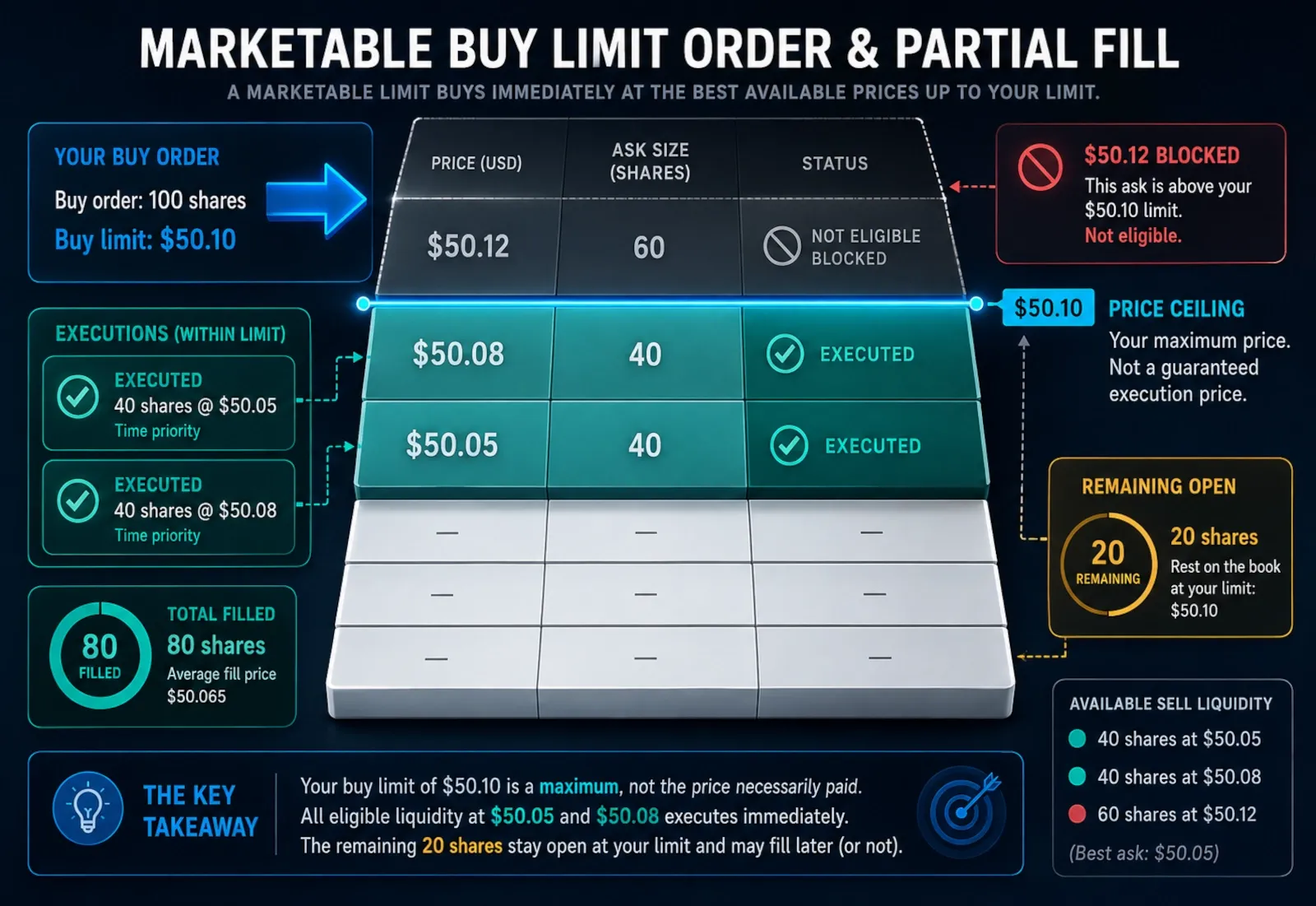
A buy limit for 100 shares at $50.10 is above the best ask of $50.05.
The order can execute immediately against prices up to $50.10:
40 shares at $50.05
40 shares at $50.08
The remaining 20 shares would not execute against the next ask of $50.12, because that price is above the $50.10 limit.
Possible result:
80 shares filled
20 shares remain open at a $50.10 limit
This is a partial fill. The order behaved like a market order for the liquidity available within the limit, but the limit protected the buyer from paying $50.12 or more.
Example 5: Sell limit above the bid
Suppose you place a sell limit for 100 shares at $50.50 while the best bid is $49.95.
The order is not currently marketable. It waits for a buyer willing to pay at least $50.50.
If the market reaches that level, the order may fill at $50.50 or a higher price. It may also remain partially or completely unfilled if there is not enough eligible demand.
Example 6: Market sell of 100 shares
A market sell of 100 shares begins with the highest available bids:
50 shares at $49.95
50 shares at $49.90
The average execution price would be $49.925 per share.
The trade completes promptly, but part of the order sells below the initial best bid because only 50 shares were available there.
How to choose between a market and limit order
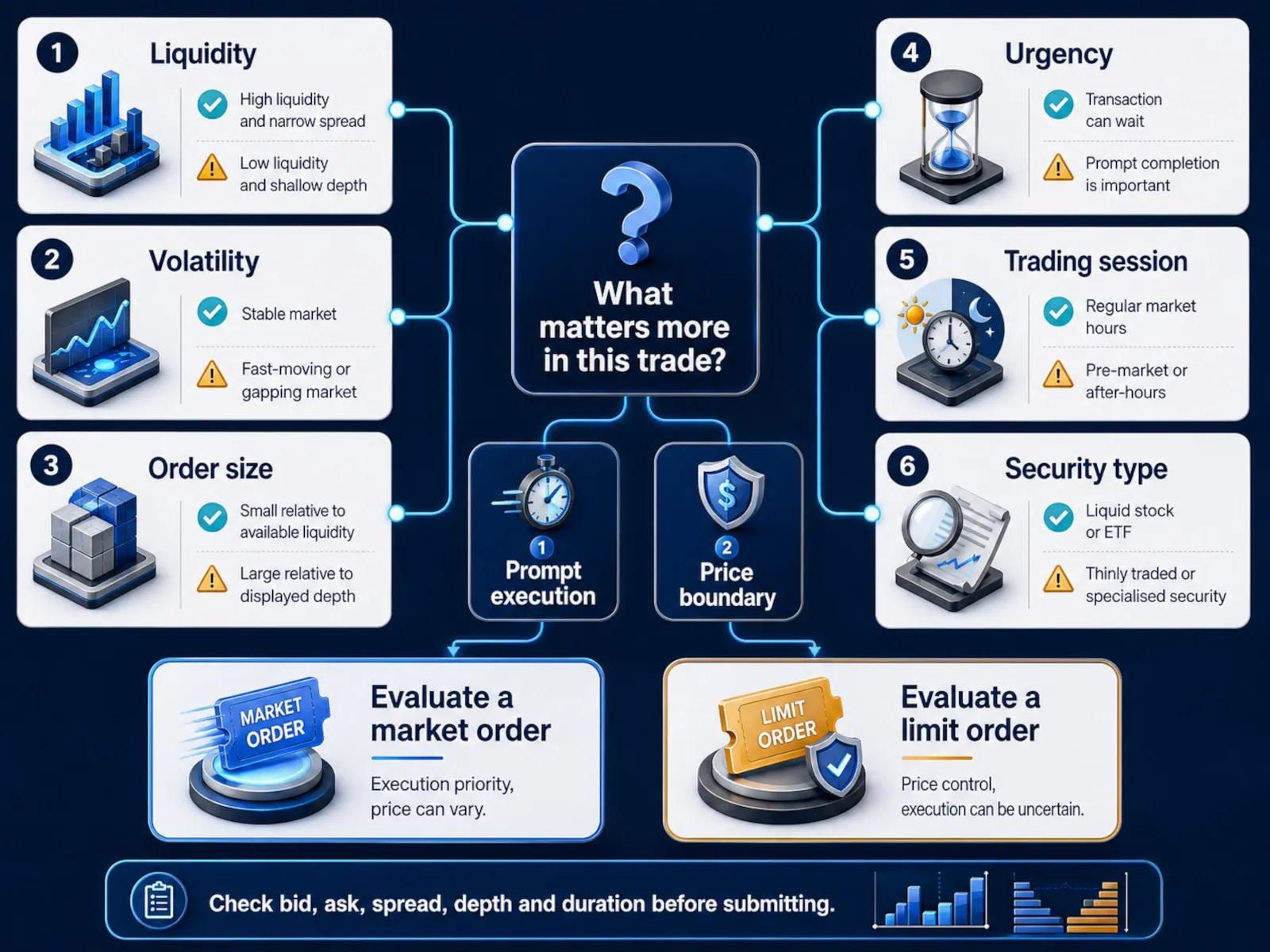
The order type should follow the trade-off you are willing to accept, not a universal rule.
1. Check whether the security is liquid
Review the bid, ask, spread and displayed size. A frequently traded large-cap stock may have a narrow spread and substantial available liquidity. A small or thinly traded security may have a wide spread and little depth.
The less liquid the security, the more carefully you should evaluate price uncertainty.
2. Compare your order size with available liquidity
An order for 10 shares can behave differently from an order for 10,000 shares. Even in the same security, a larger order may cross multiple price levels or create greater market impact.
Do not assume that the best displayed bid or ask can absorb your full order.
3. Decide whether timing or price matters more
Ask one direct question:
Would I be more concerned about missing the trade, or about receiving an unacceptable price?
If prompt completion is the overriding concern, a market order may better match that objective. If crossing a specific price boundary would be unacceptable, a limit order provides that boundary.
4. Check the trading session
Regular U.S. stock-market hours are generally 9:30 a.m. to 4:00 p.m. Eastern Time. Liquidity can be lower and spreads wider during pre-market and after-hours sessions.
Many brokers accept only limit orders during extended hours. Others require you to select a separate extended-hours session. An order entered before the opening may be queued, rejected or handled according to the broker’s specific rules.
5. Select the order duration deliberately
A limit price answers at what price the order may execute. Duration answers for how long it remains eligible.
- Day: normally expires if it does not execute during that trading day.
- Good-Til-Canceled: remains active until completed or canceled, subject to the broker’s own maximum duration.
Do not leave a GTC order active without reviewing it. Company news, earnings, dividends, splits and market conditions can change while the order remains open.
6. Review the complete order ticket
Before submitting, confirm:
- Buy or Sell;
- ticker symbol;
- quantity;
- order type;
- limit price, if applicable;
- Day or GTC;
- regular or extended-hours eligibility;
- estimated value and available buying power;
- any commissions or charges.
A misplaced decimal point, incorrect ticker or reversed buy/sell instruction can be more damaging than choosing the less suitable order type.
Should you use a market order or a limit order?
There is no responsible universal answer. Use the following matrix to identify what deserves the most attention.
| Situation | Main factor to evaluate |
|---|---|
| Highly liquid stock during normal hours | Spread, order size and urgency |
| Thinly traded or low-volume stock | Price control and market depth |
| Fast-moving or volatile market | Slippage and gap risk |
| Urgent need to exit a position | Probability and speed of execution |
| Non-urgent purchase | Risk that a limit order never fills |
| Large order relative to displayed size | Partial fills and price impact |
| Pre-market or after-hours trading | Lower liquidity, wider spreads and broker rules |
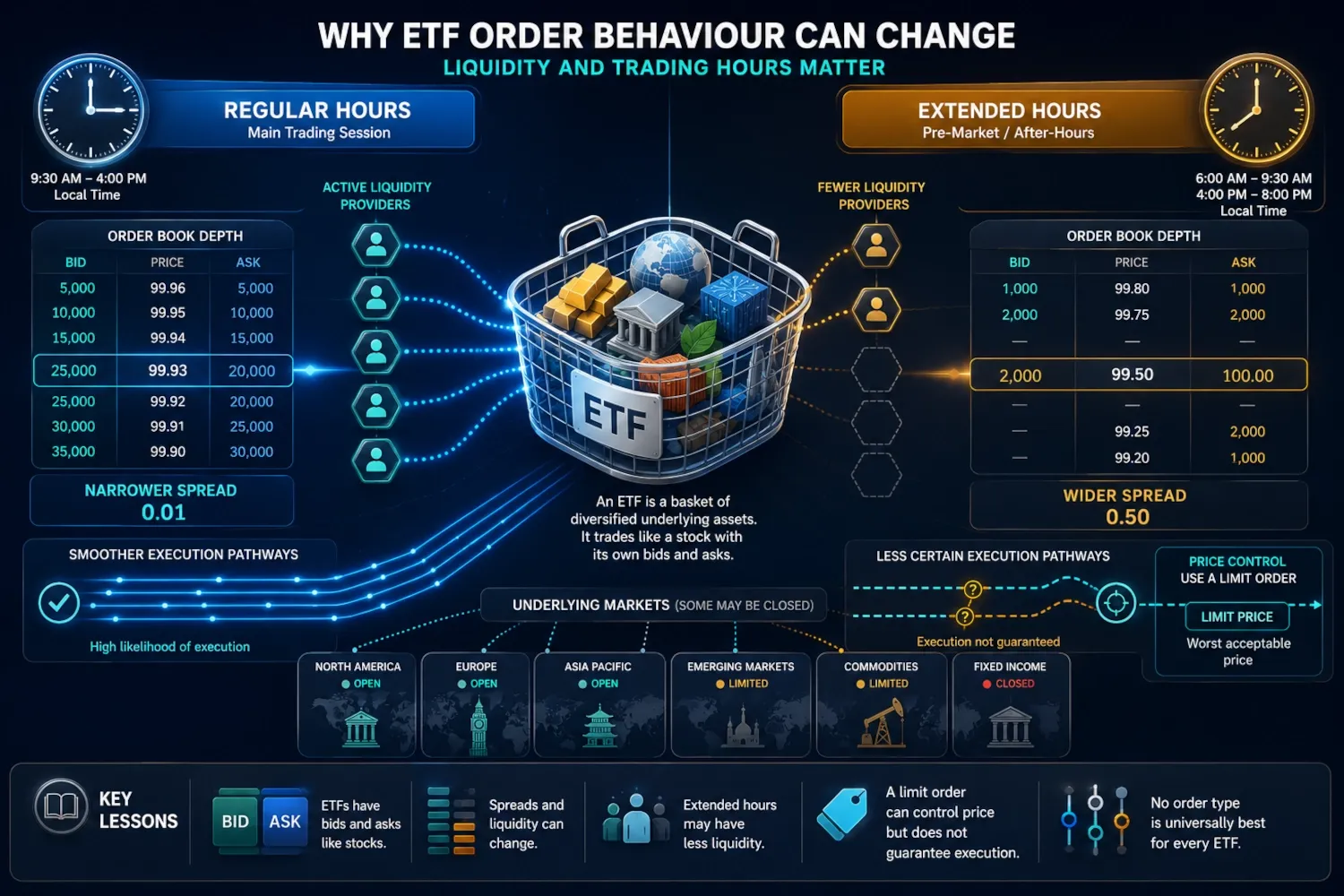
| ETF purchase or sale | Bid-ask spread, trading time and underlying-market conditions |
| Newly listed stock | Extreme opening volatility and broker restrictions |
| Fractional-share transaction | Order types and session support offered by the broker |
For beginners, the most important habit is not memorising one preferred order type. It is checking the current bid, ask, spread, session and order instructions before every submission.
Market order vs limit order for ETFs
ETFs trade on exchanges with a bid and an ask, just like individual stocks. The difference between those prices is a direct trading cost: buying normally interacts with the ask, while selling normally interacts with the bid.
A limit order can be useful when:
- the ETF has a wide spread;
- the market is volatile;
- the order is large relative to available liquidity;
- the underlying securities are not currently trading;
- you do not want to cross a specified price boundary.
However, “always use a limit order for ETFs” is too simplistic. A restrictive limit may leave the order unfilled, and a highly liquid ETF with a narrow spread can behave differently from a specialised or thinly traded fund.
Also consider timing. Spreads can be less stable near the opening and closing periods, during market stress, or when the ETF’s underlying assets trade in another time zone. Visible ETF volume is useful, but it is not the only measure of tradability; the liquidity of the underlying holdings and the activity of market makers also matter.
Bid, ask, spread, liquidity and slippage
Understanding these terms makes order behaviour much easier to predict.
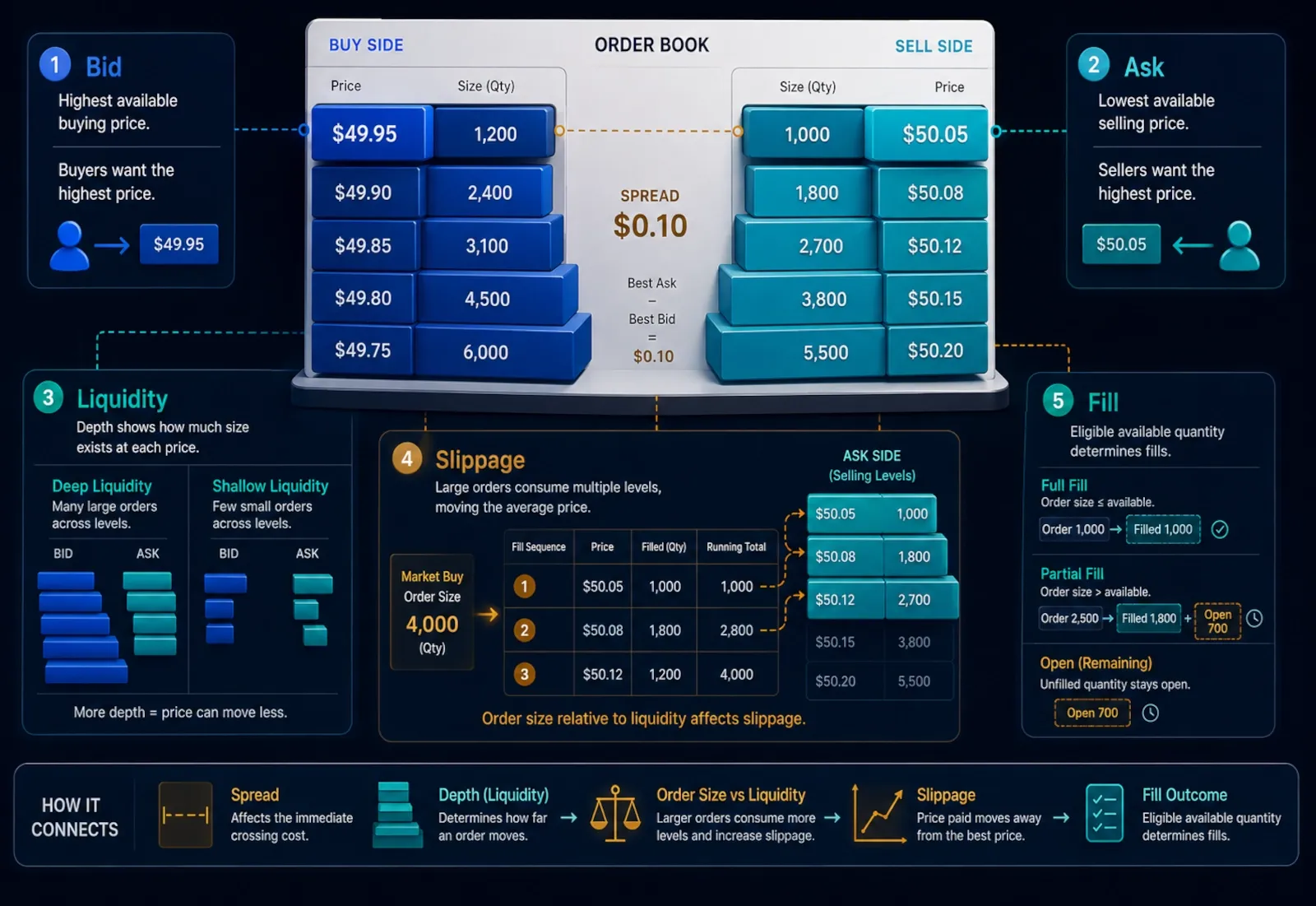
Bid
The bid is the highest displayed price a buyer is currently willing to pay for a specified quantity.
A market sell normally begins by interacting with available bids.
Ask
The ask, also called the offer, is the lowest displayed price a seller is currently willing to accept for a specified quantity.
A market buy normally begins by interacting with available asks.
Bid-ask spread
The spread is the difference between the bid and ask.
With:
Bid: $49.95
Ask: $50.05
the spread is $0.10 per share.
A wider spread generally increases the immediate cost of crossing from one side of the market to the other.
Liquidity
Liquidity describes how easily a security can be traded without causing a substantial change in price.
Liquid markets typically have:
- frequent trading;
- narrow spreads;
- substantial quantity near the best prices;
- more competition among buyers and sellers.
Liquidity can change throughout the day and may deteriorate suddenly during news events or market stress.
Slippage
Slippage is the difference between the price expected when placing an order and the price actually received.
Slippage is not automatically evidence that a broker made an error. Quotes change, orders take time to reach markets, and available quantity can disappear before execution.
Fill and partial fill
A fill is an executed portion of an order.
A partial fill occurs when only part of the requested quantity executes. The remaining quantity may stay open, be canceled or expire, depending on the order instructions and broker rules.
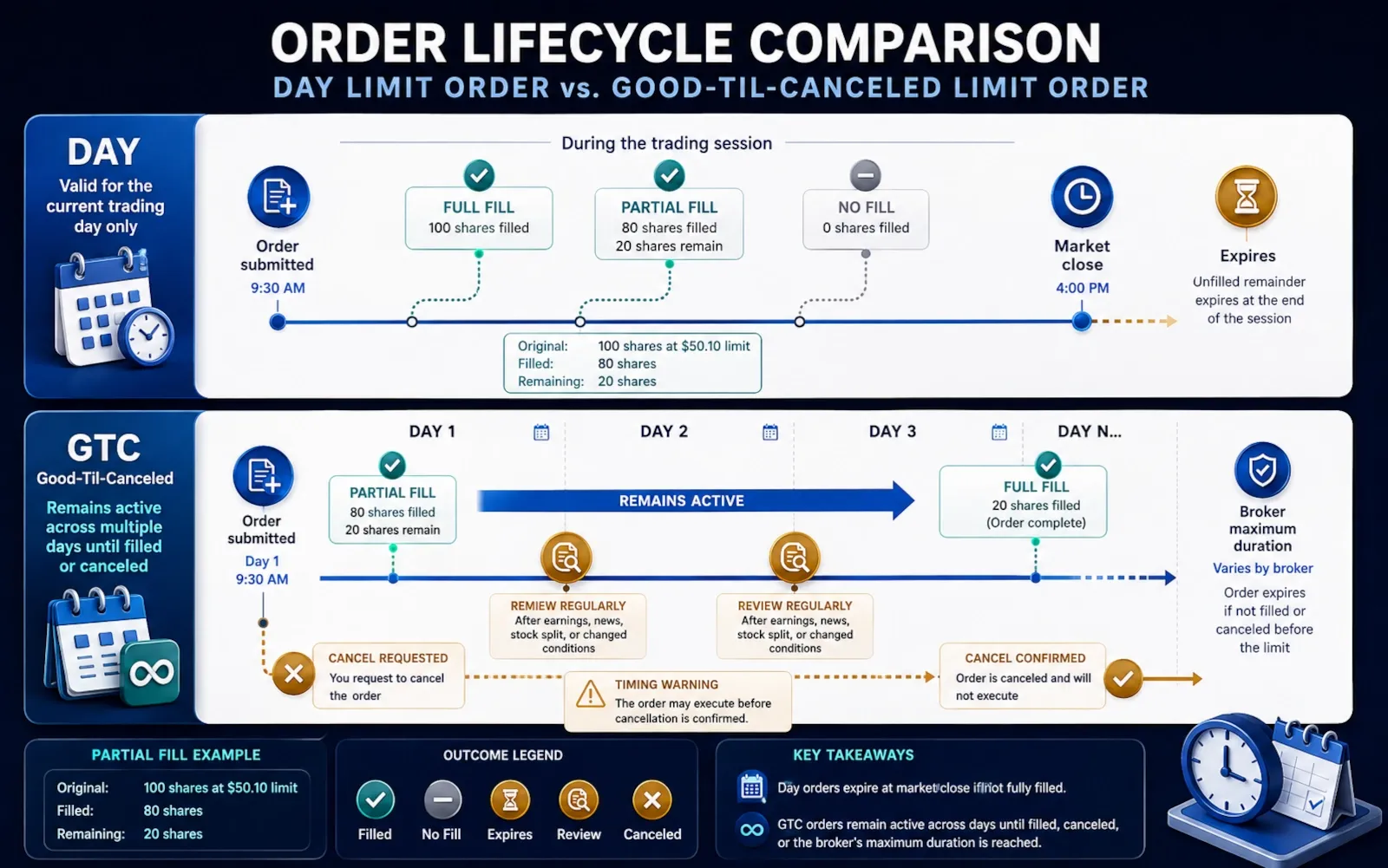
What happens if a limit order does not fill?
An unfilled limit order does not automatically become a market order. It remains subject to its original price and duration instructions unless you cancel or replace it.
Day order
A Day order normally expires at the end of the relevant trading session if it has not been executed. It does not automatically carry into the next regular trading day.
Check whether your broker treats extended-hours eligibility separately. A Day order entered during regular hours may not participate after the closing bell.
Good-Til-Canceled order
A Good-Til-Canceled, or GTC, order remains active until it is filled or canceled, but brokers usually impose their own maximum life for GTC orders.
A GTC order should be reviewed periodically. A price selected today may no longer make sense after earnings, material news, a stock split or a major change in market conditions.
Partial fill
If only part of a limit order executes, the remainder can continue working at the same limit, subject to duration and broker rules.
For example:
Original order: Buy 100 shares at a $50.10 limit
Filled: 80 shares
Remaining: 20 shares at a $50.10 limit
The remaining 20 shares may fill later, remain open or expire. Depending on the broker’s fee schedule, multiple executions could also affect total transaction costs.
Canceling or replacing the order
You can normally request cancellation or modification, but a request is not always instantaneous. The order could execute while the cancellation or replacement is being processed.
Do not assume an order is canceled until the broker confirms it.
Market order vs limit order when selling
The same execution-versus-price-control trade-off applies when selling, but the direction of the limit changes.
Market sell
A market sell seeks prompt execution against the best available bids.
It can be appropriate when completing the sale matters more than receiving a precise minimum price. The risk is that the final price may be lower than expected, especially when liquidity is weak or the market is falling quickly.
Sell limit
A sell limit establishes the minimum acceptable price.
If you set a sell limit at $51.00, the order can execute at $51.00 or higher. It cannot execute below the limit while the instruction remains valid.
The trade-off is that the shares may not sell at all.
A sell limit is not a stop-loss
A sell limit above the current market is generally used to seek a higher sale price. It does not protect you if the market falls away from that level.
A stop or stop-limit order uses a separate stop price to activate after a specified price condition is reached. These orders have different risks and should not be treated as interchangeable with an ordinary sell limit.
Market order vs limit order vs stop order
| Order type | When it becomes executable | Main priority or function |
|---|---|---|
| Market | Immediately when accepted in an executable session | Prompt execution |
| Limit | Immediately, but only at the limit price or better | Price control |
| Stop | After the stop price is reached | Becomes a market order |
| Stop-limit | After the stop price is reached | Becomes a limit order |
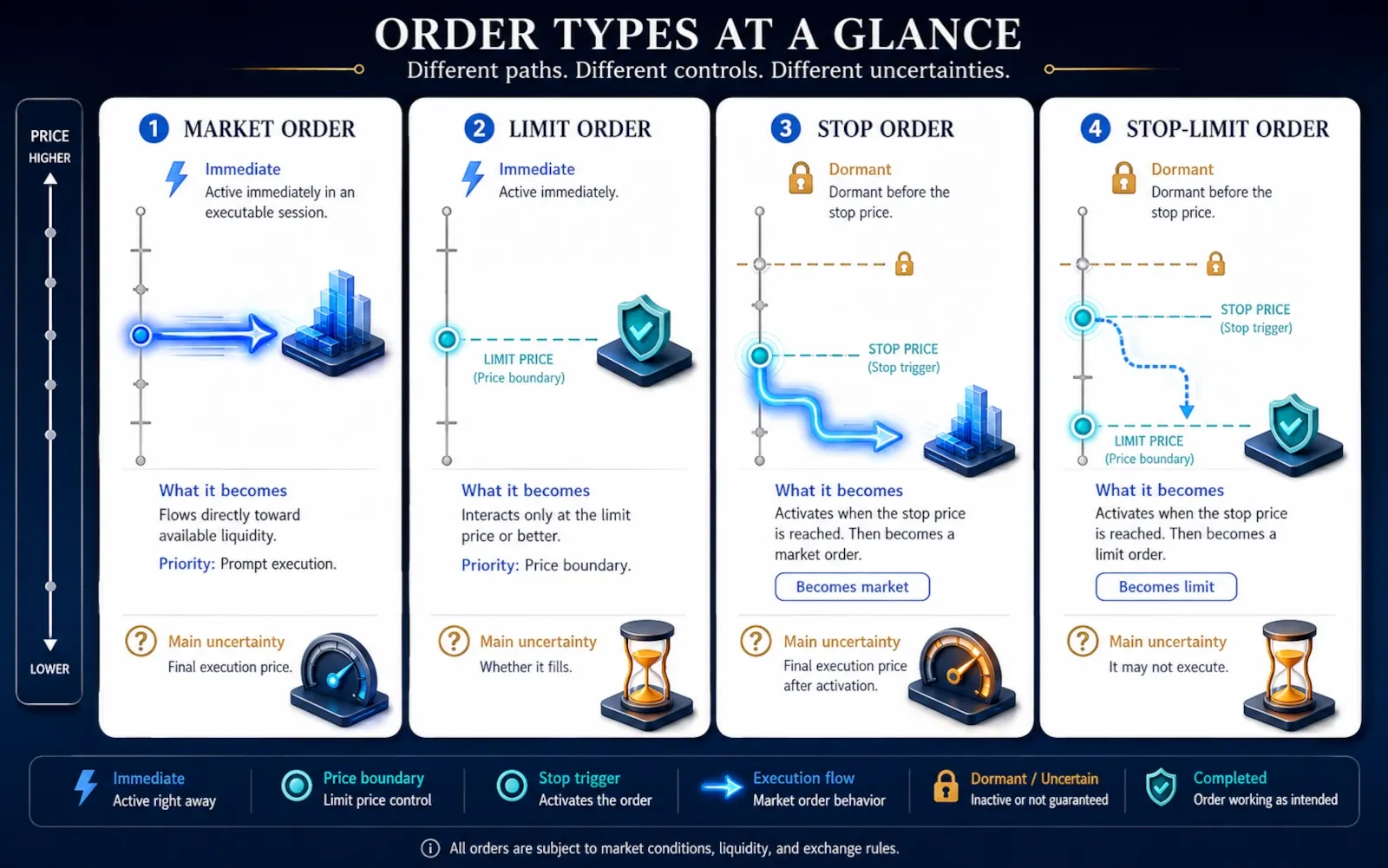
A stop order becomes a market order after activation, so its final price is not guaranteed.
A stop-limit order becomes a limit order after activation. It controls the acceptable execution price but may fail to execute if the market moves through the limit too quickly.
The stop price triggers the order. The limit price controls the price boundary after a stop-limit order has been triggered. They perform different jobs.
Common market and limit order mistakes
1. Treating the last price as the current purchase or sale price
The last price records a completed trade. A new market buy normally interacts with the current ask, and a new market sell with the current bid.
Better approach: review the live bid, ask and displayed quantities.
2. Believing a market order guarantees the displayed price
A market order does not lock the quote shown before submission.
Better approach: understand that quotes can change and large orders can execute across multiple price levels.
3. Believing a limit order guarantees execution
A limit protects the price boundary, not the completion of the trade.
Better approach: decide in advance whether missing the trade is acceptable.
4. Entering a buy limit above the ask without understanding marketability
A buy limit above the ask can execute immediately. The order may pay the best available prices up to the limit.
Better approach: treat the limit as a maximum, not as a target price.
5. Entering a sell limit below the bid without understanding marketability
A sell limit at or below the current bid can become immediately executable against available buyers, while retaining the minimum-price boundary.
Better approach: compare the limit with the live bid before submitting.
6. Confusing a limit order with a stop order
A regular limit order is active immediately, subject to its price. A stop order is dormant until its trigger condition is reached.
Better approach: verify both the order type and every price field in the ticket.
7. Ignoring the spread and liquidity
A stock can display an attractive last price while having a wide spread or little available quantity.
Better approach: evaluate the full quote and your order size.
8. Forgetting to check Day or GTC
An order can expire sooner than expected or remain open longer than intended.
Better approach: choose the duration deliberately and review open orders regularly.
9. Applying cryptocurrency examples directly to stocks and ETFs
Crypto venues can operate continuously and follow different market structures, protections and order-handling rules.
Better approach: use examples and rules that match the security and venue you are actually trading.
10. Assuming commission-free means cost-free
Even when a broker charges no advertised stock commission, the spread, price impact, regulatory charges, currency conversion, subscription plans or other fees may still affect the result.
Better approach: review the broker’s current fee schedule and execution disclosures.
Security, privacy and financial safety notes
- Verify the ticker symbol. Similar company names and symbols can lead to orders in the wrong security.
- Do not follow unsolicited trading instructions. Social-media posts, private messages and impersonation scams can create artificial urgency.
- Use a trusted broker and secure the account. Enable strong authentication, protect recovery methods and review login alerts.
- Never share one-time authentication codes. A legitimate broker should not ask you to disclose a code through an unsolicited call or message.
- Review open orders after major news. A stale GTC limit may remain active after the circumstances behind it have changed.
- Do not use borrowed money or margin without understanding the risks. Order type does not remove investment or leverage risk.
- Check currency and market. An international ticker, depositary receipt or foreign listing may trade in a different currency or session.
- Read broker-specific disclosures. Routing, fractional-share handling, extended-hours eligibility and fees vary.
A limit order can control one part of execution risk, but it cannot make an investment safe or prevent the security from losing value after the trade.
Faster alternative
For a quick decision, use this two-question rule:
- Would an unexpected execution price be unacceptable? Consider a limit order.
- Would missing or delaying the trade be more problematic than a modest price difference? A market order may better match that priority in a liquid market.
This shortcut is useful for orientation, but it leaves out important factors such as spread, order size, volatility, extended hours and available depth. Before submitting, still review the bid, ask, duration and complete order ticket.
Frequently asked questions
Which is better, a market order or a limit order?
Neither is universally better. A market order emphasizes prompt execution; a limit order emphasizes staying within a price boundary. The better fit depends on liquidity, volatility, urgency, order size and whether you are more willing to accept price uncertainty or execution uncertainty.
Is a limit order safer than a market order?
A limit order can reduce the risk of paying more or receiving less than a specified price. It does not remove investment risk, guarantee execution or protect the position after purchase. “Safer” depends on which risk you are trying to control.
Is a market order faster than a limit order?
A market order is designed for prompt execution. A non-marketable limit order may wait. However, a marketable limit order can also execute immediately if eligible prices and sufficient liquidity are available.
Can a limit order execute immediately?
Yes. A buy limit at or above the current ask, or a sell limit at or below the current bid, may be immediately marketable. It can execute against eligible prices while respecting the limit boundary.
What happens if my buy limit is above the current market price?
Compare the limit with the ask, not only the last price. If the buy limit is at or above the best ask, the order can execute immediately at the best available prices up to the limit. You do not necessarily pay the limit price.
Can I sell above my sell limit price?
Yes. A sell limit is the minimum acceptable price. If a better price is available, the order can execute above the limit.
Can a limit order be partially filled?
Yes. If only part of the requested quantity is available at eligible prices, that portion can execute while the remainder stays open, expires or is canceled according to the order instructions.
Why did my limit order not execute even though the price was reached?
Possible reasons include insufficient quantity, earlier orders at the same price, rapidly changing quotes, venue differences, delayed data, order activation timing or broker-specific conditions. A printed trade at your limit does not automatically guarantee that enough eligible liquidity reached your order.
Do market orders fill before limit orders?
There is no simple rule that every market order always fills before every limit order. Execution depends on whether an order is marketable, the prices available, venue rules, broker routing, order conditions and queue priority. Both a market order and a marketable limit order can be eligible for immediate execution.
Do brokers charge extra for limit orders?
Some brokers charge no separate commission for standard online stock market or limit orders, while others may apply commissions, contract charges, routing fees, subscriptions or other costs. Policies differ by broker, account, market and product. Check the current fee schedule rather than assuming both order types are free.
Should I use a market or limit order for an ETF?
Consider the ETF’s bid-ask spread, liquidity, order size, trading time and the market status of its underlying holdings. A limit order can control price, but an overly restrictive limit may not fill. There is no order type that is always best for every ETF.
What happens if I place an order before the market opens?
The result depends on the broker and the session selected. The order may be queued for the regular opening, accepted for pre-market trading, restricted to a limit order or rejected. If it waits for the opening, the eventual opening price may differ substantially from the previous close.
Is a limit order the same as a stop order?
No. A limit order is active immediately but executes only at the limit or better. A stop order activates only after the stop price is reached and then normally becomes a market order.
How do you use a limit order like a market order?
A marketable limit order can seek immediate execution while imposing a price boundary. For a buy, set a limit at or above the current ask; for a sell, set it at or below the current bid. Use care: a limit that is too restrictive may produce a partial fill, while a very wide limit provides less practical price protection.
Last tested
Tested on:
- U.S.-listed stock and ETF order mechanics;
- regular-hours and extended-hours concepts;
- SEC Investor.gov investor education materials;
- FINRA order-type, execution and fee guidance.
Last tested: 2026-08-04
Related guides
Carefully selected guides to help you understand the topic and complete the next useful step.