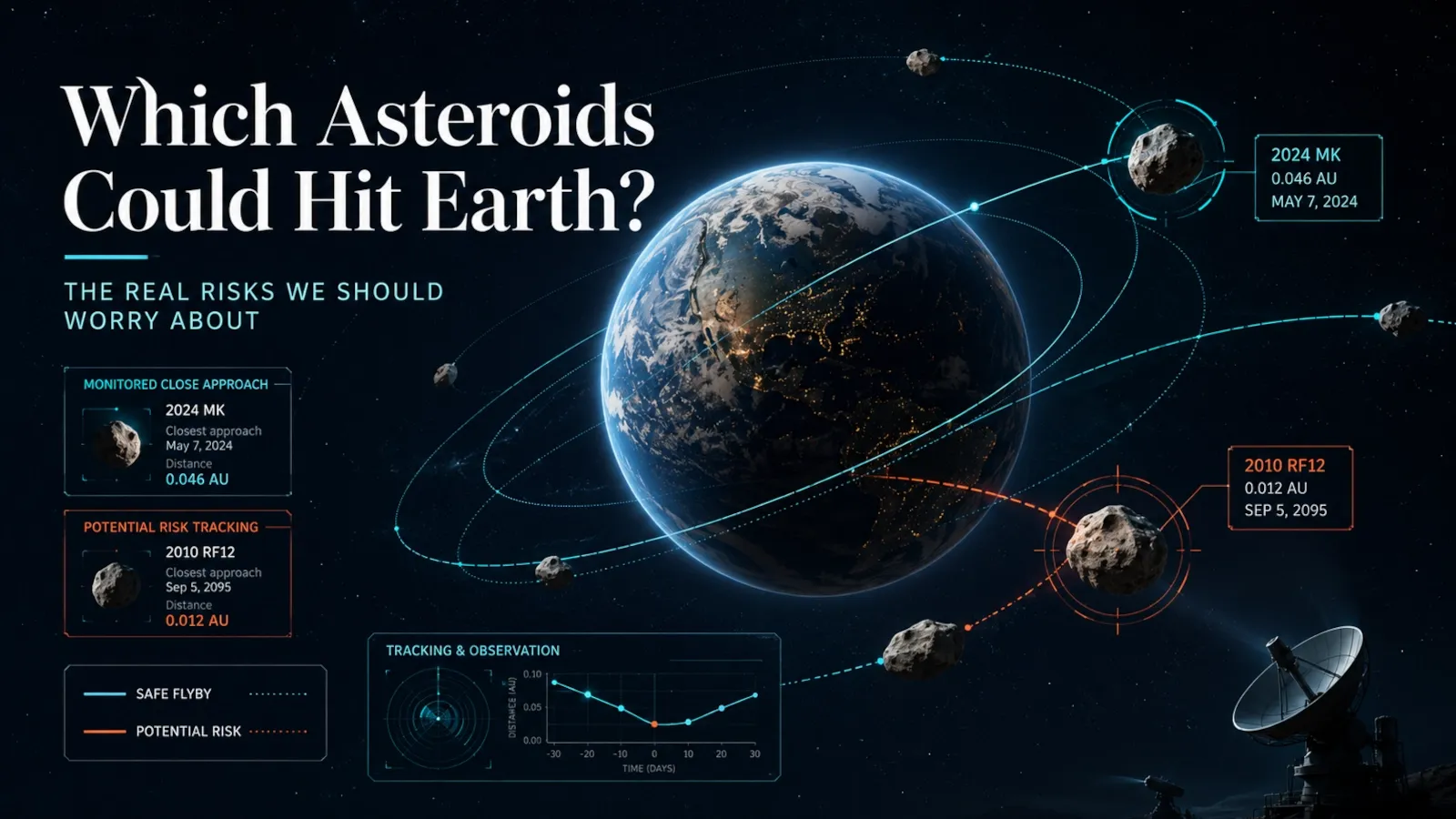
On 15 February 2013, a roughly house-sized asteroid entered Earth’s atmosphere over Chelyabinsk, Russia, at about 18 kilometres per second. It exploded high above the ground with an energy equivalent to roughly 440 kilotons of TNT. The shock wave shattered windows across a large area, damaged buildings and injured more than 1,600 people, mostly through flying glass.
Astronomers had not seen it coming.
That same day, the unrelated asteroid 2012 DA14 made a predicted close flyby of Earth. The contrast was striking: one object had been tracked in advance, while another arrived from close to the direction of the Sun and was detected only when it entered the atmosphere.
That is the real planetary-defense problem. It is not simply, “Which famous asteroid should we be afraid of?” It is:
Which asteroids actually pose a credible impact risk, how do scientists decide which ones deserve attention, what are we still missing, and what could we do if a dangerous object were found?
This guide answers those questions using the current risk frameworks and public monitoring systems operated by NASA and the European Space Agency (ESA).
Quick answer
No known asteroid larger than about 140 metres currently has a significant chance of hitting Earth within the next 100 years. NASA and ESA nevertheless monitor thousands of near-Earth objects and continuously recalculate their future trajectories as new observations arrive.
A few points are essential:
- A near-Earth asteroid is not automatically dangerous.
- A potentially hazardous asteroid is not an asteroid predicted to hit Earth.
- An object appearing on the NASA Sentry or ESA Risk List does not mean impact is likely; it means at least one mathematically possible impact trajectory has not yet been ruled out.
- Apophis will not hit Earth in 2029. Its 13 April 2029 flyby will be exceptionally close, but impact has been ruled out for at least a century.
- Asteroid 2024 YR4 is not an Earth-impact threat in 2032. Additional observations removed the Earth risk, and 2026 observations also ruled out its previously discussed lunar-impact possibility.
- The harder long-term problem is the population of objects that have not yet been discovered, particularly smaller, dark asteroids that can still cause severe regional damage.
- Planetary defense is no longer purely theoretical: NASA’s DART mission successfully changed the motion of an asteroid moonlet using a kinetic impactor.
If you only want the current official status, check the NASA CNEOS Sentry system and the ESA NEOCC Risk List rather than relying on viral posts or a permanent “top 10 dangerous asteroids” list.
Current asteroid threat status
Last checked: 17 August 2026
The safest way to describe the present situation is not to name one asteroid as “the asteroid most likely to destroy Earth.” That framing is misleading because official risk lists are dynamic and most listed possibilities are extremely small.
In the latest ESA NEO Coordination Centre database statistics available during this review, dated 28 July 2026, the catalogue contained 42,077 known near-Earth asteroids and 124 known near-Earth comets. Around 2,000 near-Earth asteroids were present on ESA’s Risk List.
That does not mean 2,000 asteroids are expected to hit Earth.
ESA’s Risk List is a catalogue of objects for which analysts have computed at least one non-zero impact probability. Many of those probabilities are tiny and disappear as the object’s orbit becomes better constrained.
NASA’s broader public guidance remains reassuring: there is no known asteroid larger than 140 metres with a significant chance of impacting Earth in the next 100 years.
| Object or category | Approximate status | What it actually means |
|---|---|---|
| Apophis | Safe 2029 flyby | Exceptionally close approach on 13 April 2029; no Earth impact for at least 100 years |
| 2024 YR4 | Earth and Moon impact ruled out for 2032 | A useful case study in how probabilities change when better observations arrive |
| NASA/ESA risk-list objects | Mostly very low probabilities | Possible mathematical impact solutions that require continued orbit refinement |
| Unknown NEO population | Still being discovered | The main reason surveys continue even when no known large asteroid poses a significant near-term threat |
Being on a risk list is not the same as being on a collision course.
When to use this solution
Use this guide when you want to understand:
- whether a current asteroid headline represents a real impact threat;
- what NASA means by “potentially hazardous”;
- why an asteroid’s impact probability can rise and later collapse;
- what will actually happen during Apophis’ 2029 flyby;
- why 2024 YR4 briefly attracted attention;
- why some dangerous objects can be difficult to discover;
- how asteroid size relates to possible damage;
- what the Torino and Palermo scales mean;
- whether humanity could deflect an asteroid;
- how to verify an asteroid claim yourself using official data.
This article is not a live emergency-warning service and should not be used as a substitute for official alerts from NASA, ESA, the International Asteroid Warning Network or national emergency authorities.
Before you start
Three distinctions will make the rest of this article much easier to understand.
- Close approach does not mean impact. Astronomers routinely track asteroids passing closer to Earth than people may expect.
- Probability is not prediction. A 0.1% impact probability is not a forecast that an impact will happen; it represents uncertainty in the orbit and a set of possible future trajectories.
- Risk changes with data. Early calculations can look more alarming because astronomers have only a short observational arc. More observations usually shrink the uncertainty.
The central idea of planetary defense is therefore not “guess which rock is dangerous.” It is discover, observe, calculate, refine and—if necessary—act early.
What exactly counts as a dangerous asteroid?
The word “dangerous” can refer to several different things, and mixing them together creates unnecessary fear.
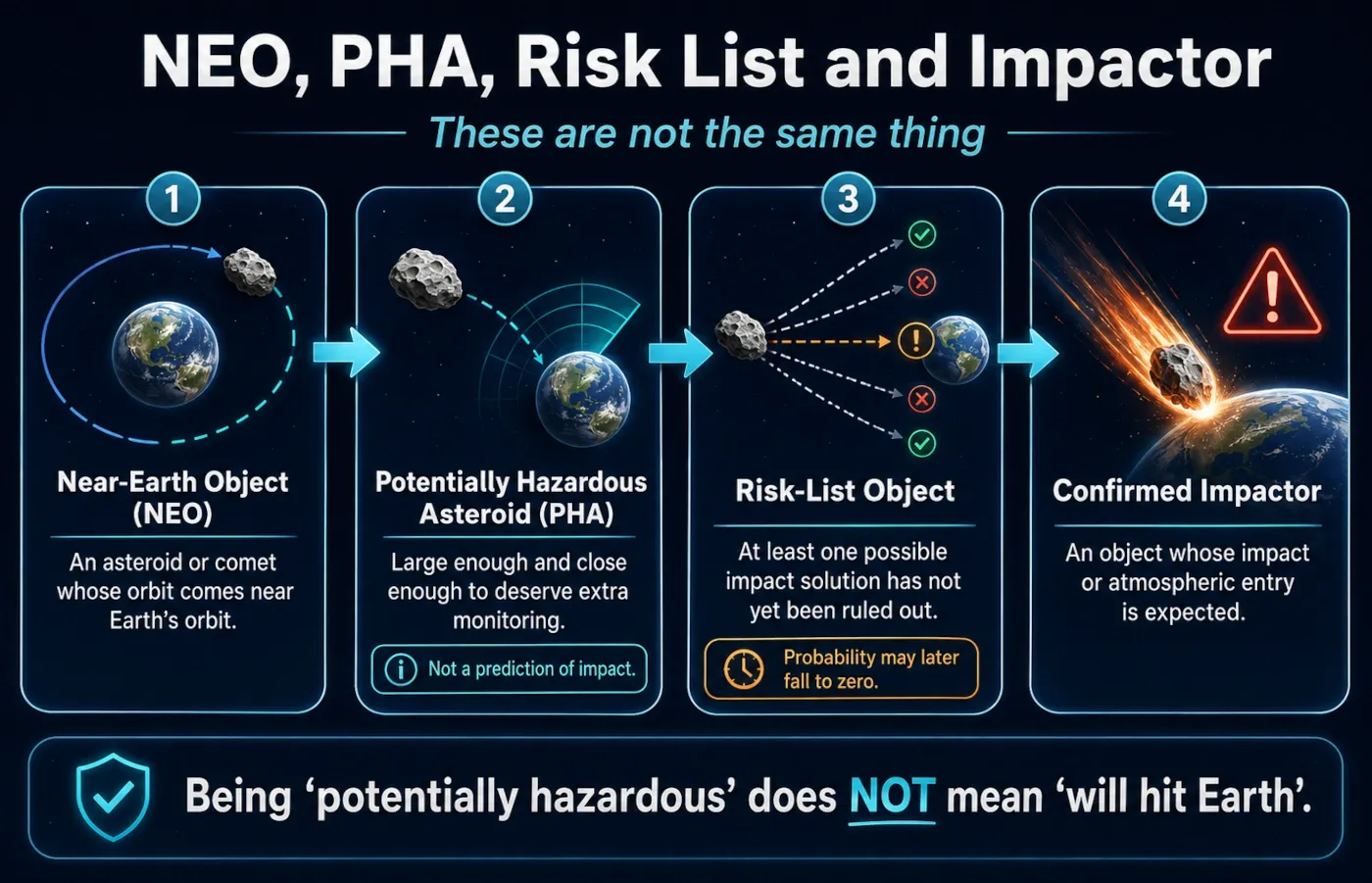
Near-Earth object: close enough to monitor, not necessarily hazardous
A near-Earth object (NEO) is an asteroid or comet whose orbit brings it into the wider neighbourhood of Earth’s orbit.
Most NEOs are not impact threats.
The term describes orbital geography, not destiny.
Potentially hazardous asteroid: a screening category
NASA classifies a near-Earth asteroid as a Potentially Hazardous Asteroid (PHA) when it meets orbital and brightness criteria that make it important enough to monitor more closely.
The formal CNEOS criteria include:
- a minimum orbit intersection distance with Earth of 0.05 astronomical units or less; and
- an absolute magnitude H of 22.0 or brighter.
This roughly identifies objects large enough to matter whose orbits can pass relatively near Earth’s orbit.
But the term potentially hazardous does not mean:
“This asteroid is going to hit Earth.”
It means:
“This object’s size and orbital geometry make it worth continued attention.”
Risk-list object: at least one possible impact solution exists
NASA Sentry and ESA’s NEO Coordination Centre propagate an asteroid’s orbit into the future while accounting for uncertainty.
Instead of calculating only one perfect line through space, analysts work with a range of trajectories compatible with the observations.
If one or more of those possible trajectories intersects Earth at a future date, the object may appear on an impact-risk list.
As new observations narrow the possible orbit, those impact solutions may disappear.
Confirmed impactor: a very different category
A confirmed or imminent impactor is an object whose trajectory has become precise enough that an atmospheric entry or surface impact is expected.
Small objects in this category have occasionally been detected shortly before impact. They are very different from a large asteroid sitting on a long-term risk list with a microscopic probability.
This distinction is one of the most important things to understand when reading asteroid news.
Which asteroids are scientists watching right now?
There is no scientifically useful permanent list titled “the five asteroids to worry about.”
The objects receiving the most attention change for several reasons:
- a new asteroid is discovered;
- the initial orbit is poorly constrained;
- an Earth-crossing solution appears in the uncertainty region;
- more observations are collected;
- the orbit is refined;
- the probability rises, falls or disappears.
NASA’s Sentry system automatically monitors the catalogue for possible Earth impacts, generally over the next 100 years. ESA’s NEOCC Risk List provides a comparable public view of objects with non-zero computed impact probabilities.
The correct question is therefore not:
“Which asteroid is number one today?”
It is:
“Does any known object currently have a probability and potential consequence high enough to require significant concern?”
For large asteroids over roughly 140 metres, the current answer is no known object has a significant chance of impact in the next century.
Is Apophis going to hit Earth in 2029?
No.
This is one of the most persistent asteroid misconceptions on the internet.
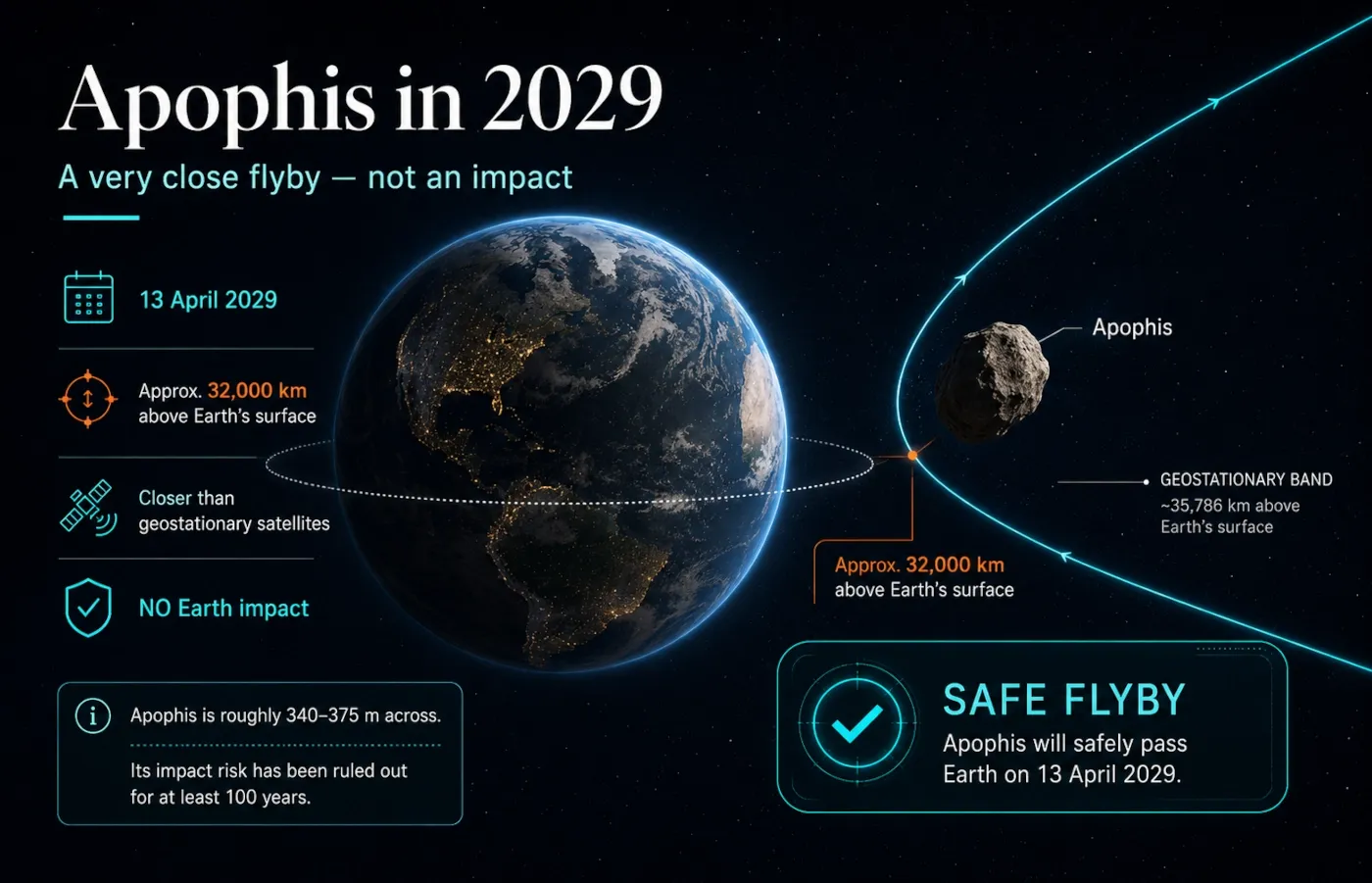
Asteroid (99942) Apophis will make an extraordinary close approach on 13 April 2029. It will pass roughly 32,000 kilometres above Earth’s surface, closer than many satellites in geosynchronous orbit.
Apophis is irregularly shaped; NASA gives a mean diameter of roughly 340 metres, while ESA commonly describes it as roughly 375 metres across. The different shorthand figures reflect how the size of an irregular object is summarised.
When Apophis was discovered in 2004, early observations left open small possibilities of future impacts. That made it famous.
Years of optical and radar observations transformed the situation. Astronomers now know the orbit far more accurately and have ruled out an Earth impact for at least the next 100 years.
So what happens on Friday, 13 April 2029?
A spectacularly close safe flyby.
Earth’s gravity will measurably alter Apophis’ orbit, and scientists will use the encounter as an exceptional natural experiment to study how a close planetary flyby affects an asteroid’s rotation, surface and trajectory.
It is an important planetary-science event—not a doomsday date.
What happened with asteroid 2024 YR4?
Asteroid 2024 YR4 is one of the best modern examples of why asteroid-risk probabilities must be interpreted carefully.
The roughly 60-metre object was discovered in late 2024. During early 2025, as astronomers added observations and refined its orbit, the calculated probability of an Earth impact on 22 December 2032 temporarily rose into the percentage range.
ESA’s estimate climbed as high as about 2.8% before later observations drove the Earth-impact probability down to 0.001% and then effectively removed the significant threat.
The object fell from Torino Scale Level 3 to Level 0.
For a time, a separate possibility remained: 2024 YR4 might strike the Moon in 2032. That probability was around 4%.
In February 2026, the James Webb Space Telescope observed the extremely faint asteroid again. Those measurements sharply improved its predicted 2032 position.
In March 2026, NASA and ESA announced that the lunar impact had also been ruled out. 2024 YR4 is expected to pass the Moon rather than hit it.
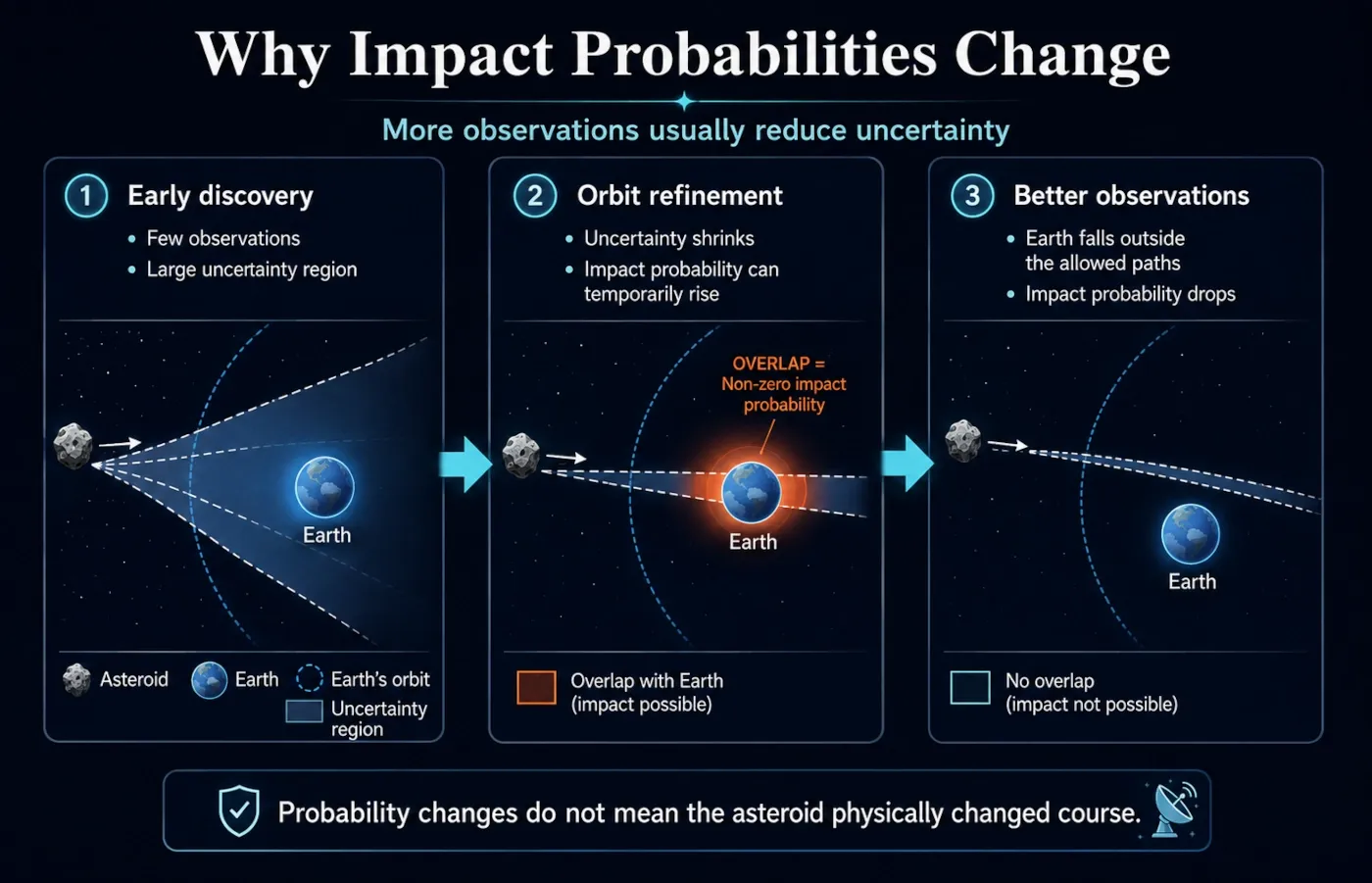
Nothing physically “pushed” the asteroid away from Earth or the Moon during these updates.
What changed was our knowledge of the orbit.
Why asteroid impact odds sometimes go up before they go down
This behaviour can seem contradictory:
If an asteroid is safe, why can the probability first rise from 1% to 2% or more?
Because a newly discovered asteroid does not initially have one perfectly known future position.
Imagine its future location not as a point, but as a long region of uncertainty.
At first:
Few observations
        ↓
Large orbital uncertainty
        ↓
Many possible future positions
        ↓
Some possible trajectories cross Earth
As new observations arrive:
More observations
        ↓
Smaller orbital uncertainty
        ↓
Fewer possible future trajectories
        ↓
Earth may occupy a larger fraction of the shrinking uncertainty region
        ↓
Calculated probability can temporarily rise
Then, with still better observations:
Orbit becomes more precise
        ↓
Uncertainty region shrinks further
        ↓
Earth falls outside the allowed trajectories
        ↓
Impact probability collapses
This is not a failure of astronomy.
It is exactly how uncertainty reduction is supposed to work.
The 2024 YR4 episode is especially valuable because it made this process visible to the public in real time.
The asteroids we should worry about most may be the ones we have not found yet
This is the less dramatic but more important answer to the original question.
Famous asteroids such as Apophis receive intense attention precisely because we know where they are.
The larger uncertainty comes from objects that have not yet been discovered.
That does not mean a hidden extinction-class asteroid is expected to arrive tomorrow. Large objects are easier to detect, and the known large-asteroid catalogue is much more complete than the catalogue of smaller objects.
The more difficult population includes asteroids that are:
- smaller;
- intrinsically dark;
- far from Earth when first observable;
- approaching from awkward directions;
- spending much of their observable geometry close to the Sun in our sky.
An object around 20 metres can produce an event such as Chelyabinsk. An object around 140 metres can be capable of major regional damage. Objects in these size ranges are much more numerous than kilometre-scale asteroids and can be more difficult to discover early.
This is why planetary defense is as much a survey problem as a deflection problem.
Why can we miss an asteroid before it hits Earth?
Asteroids do not glow brightly on their own. In visible light, astronomers usually detect them by reflected sunlight.
Several factors make detection difficult.
They are tiny on astronomical scales
A 20-metre asteroid is large compared with a building, but extremely small compared with the distances between planets.
At millions of kilometres away, it may be only a faint point of light.
Many are dark
Some asteroid surfaces reflect very little visible light.
A dark asteroid can therefore be physically significant while remaining faint in optical surveys.
Their motion has to be extracted from a background of stars
Survey telescopes take repeated images and search for points of light that move in a way consistent with Solar System objects.
Finding the object is only the first step. Astronomers must then obtain enough observations to calculate its orbit.
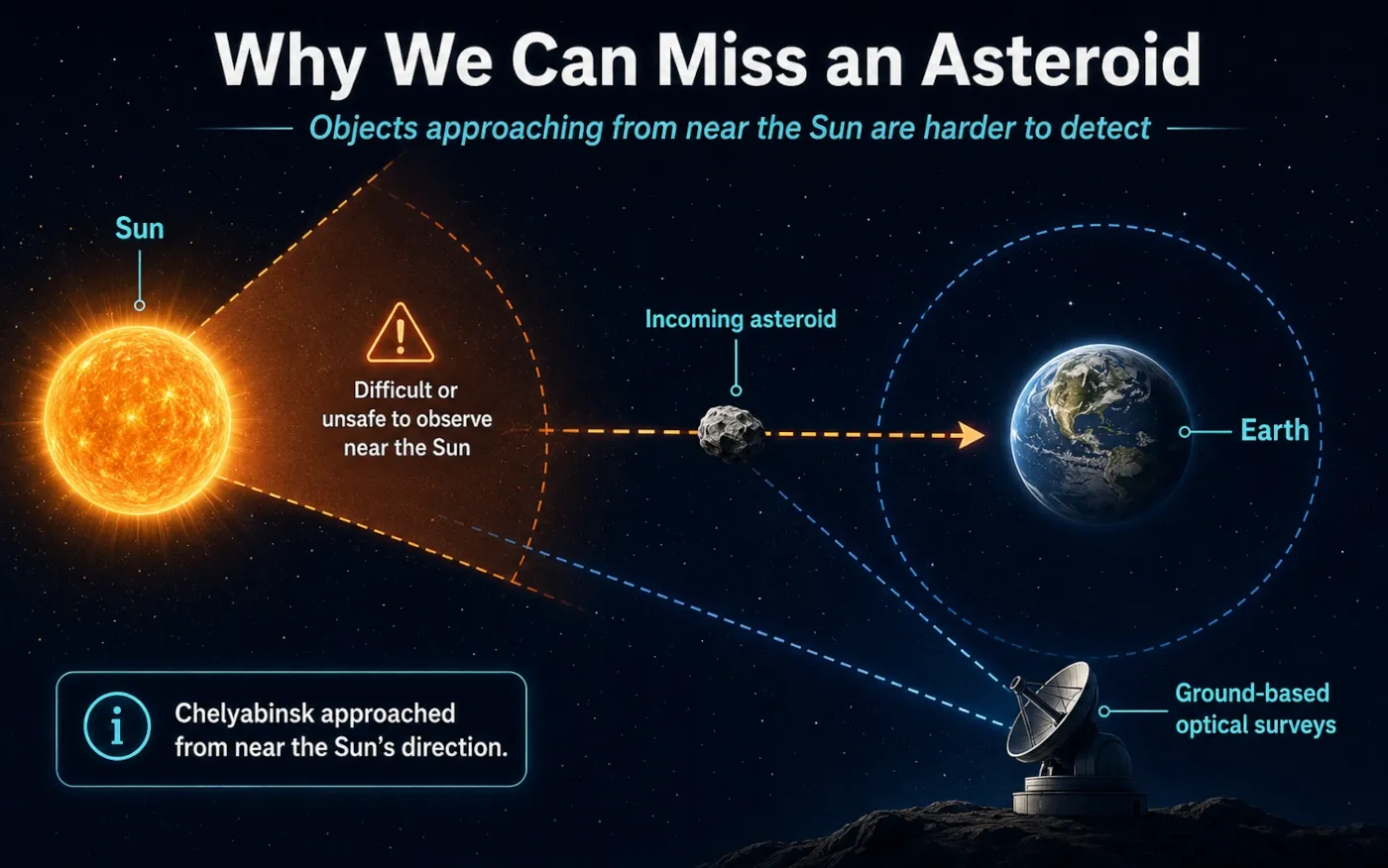
The Sun creates a major observational blind zone
Chelyabinsk is the classic example.
NASA’s reconstruction showed that the impactor approached Earth from a direction that stayed within roughly 15 degrees of the Sun in the sky—an area ground-based asteroid surveys cannot safely scan.
The object was therefore effectively hidden in daylight until atmospheric entry.
Why Chelyabinsk caught us by surprise
Chelyabinsk matters because it shows that an asteroid does not need to be enormous to cause widespread disruption.
On 15 February 2013, an approximately 18-metre object entered the atmosphere over Russia at about 18.6 kilometres per second.
It broke apart roughly 23 kilometres above the ground.
The airburst released energy equivalent to around 440 kilotons of TNT. The resulting shock wave blew out windows over hundreds of square kilometres and injured more than 1,600 people, mostly through broken glass.
No asteroid crater was required for serious damage.
The object’s approach from the daytime sky prevented pre-impact detection.
Just over 16 hours later, the unrelated asteroid 2012 DA14 passed about 27,700 kilometres above Earth’s surface. Astronomers had predicted that flyby. NASA’s orbital analysis confirmed that the two objects came from completely different directions and were unrelated.
The lesson is not that asteroid tracking “doesn’t work.”
It is that survey completeness, observing geometry and object size determine how much warning we can get.
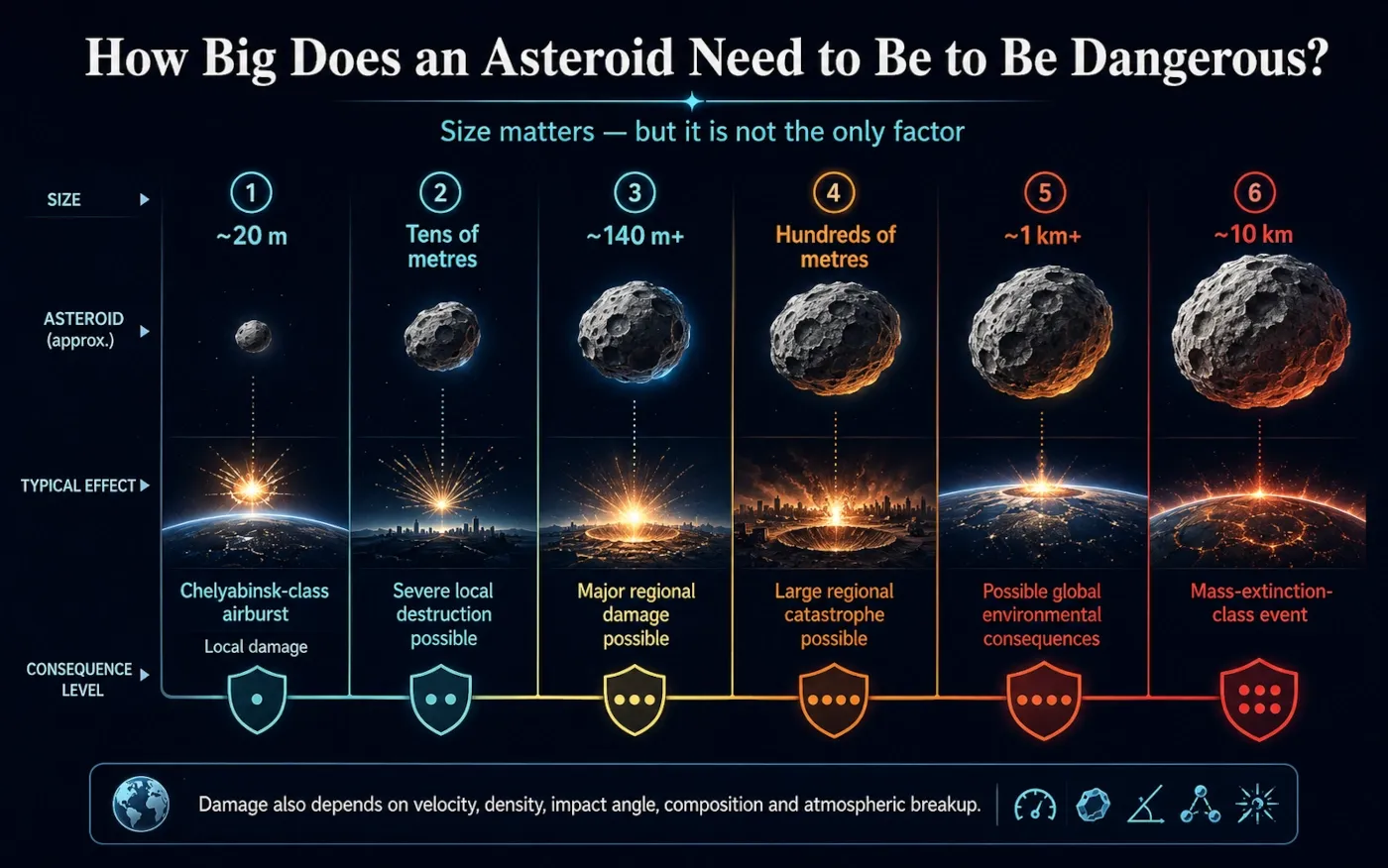
How large does an asteroid have to be to be dangerous?
There is no single diameter at which an asteroid becomes “dangerous.”
Damage depends on several variables:
- diameter;
- density;
- internal structure;
- impact velocity;
- impact angle;
- atmospheric breakup;
- whether it hits land or ocean;
- where the impact occurs.
The following scale is therefore approximate, not a prediction tool.
| Approximate size | Possible broad effect | Important caveat |
|---|---|---|
| A few metres | Usually burns up or fragments in the atmosphere | Small meteorites may reach the ground |
| ~20 m | Chelyabinsk-class airburst and local damage | Outcome depends strongly on strength and entry geometry |
| Tens of metres | Severe local destruction is possible | Airburst can be more important than crater formation |
| ~140 m and above | Major regional damage is possible | This size is a major planetary-defense survey threshold |
| Several hundred metres | Devastating regional consequences | Exact effects vary enormously with impact conditions |
| ~1 km and above | Potential global-scale environmental consequences | Such impacts are very rare |
| ~10 km class | Mass-extinction-scale consequences are possible | Chicxulub is the key geological example |
An asteroid does not have to “destroy Earth” to be a global catastrophe.
The Chicxulub impactor, widely associated with the end-Cretaceous mass extinction, did not physically destroy the planet. It radically disrupted Earth’s climate and ecosystems.
The phrase “destroy Earth” is therefore usually the wrong scientific question.
A better question is:
How much energy would this specific object deliver, and what physical and environmental consequences would follow?
What would happen if an asteroid hit Earth?
The outcome depends heavily on size and composition.
Small objects
Most very small objects burn up, fragment or explode in the atmosphere.
They may create bright fireballs without causing meaningful damage on the ground.
Airburst-producing objects
Some tens-of-metres objects can release much of their energy in the atmosphere.
Chelyabinsk showed that the resulting pressure wave can damage structures even when the main disruption occurs many kilometres above the ground.
Larger surface impactors
A larger and stronger object can reach the surface or ocean with much more of its kinetic energy intact.
Consequences can include:
- blast damage;
- thermal radiation;
- crater formation;
- seismic effects near the impact region;
- ejecta;
- atmospheric dust and aerosols;
- ocean waves if the impact is in water;
- climate effects for sufficiently large events.
The exact outcome cannot be inferred from diameter alone.
What if an asteroid hit the ocean?
An ocean impact does not automatically produce a planet-wide “mega-tsunami.”
It can generate enormous waves and severe regional consequences, but the result depends on:
- asteroid diameter;
- velocity;
- impact angle;
- ocean depth;
- distance from coastlines;
- how efficiently impact energy couples into the water.
For smaller events, atmospheric disruption may occur before a coherent object reaches the ocean surface.
For larger objects, both atmospheric and ocean effects become important.
This is why professional impact modelling uses the complete physical scenario rather than a rule such as “ocean impact = global tsunami.”
How NASA and ESA calculate asteroid impact risk
Orbit determination begins with astrometry: precise measurements of where an asteroid appears against the background sky at known times.
From those observations, analysts estimate an orbit.
But every observation has uncertainty.
So planetary-defense systems work with a family of possible orbits that remain compatible with the data.
Those possibilities are numerically propagated into the future.
If Earth overlaps one of those possible future trajectories, a virtual impactor may be identified.
Systems such as NASA Sentry and ESA’s Aegis/NEOCC infrastructure then evaluate information including:
- possible impact date;
- impact probability;
- estimated object size;
- impact velocity;
- uncertainty;
- Palermo Scale;
- Torino Scale where relevant.
The calculation is repeated when the observational dataset changes.
That last point is crucial:
An asteroid risk value is a current statistical assessment, not a permanent property of the asteroid.
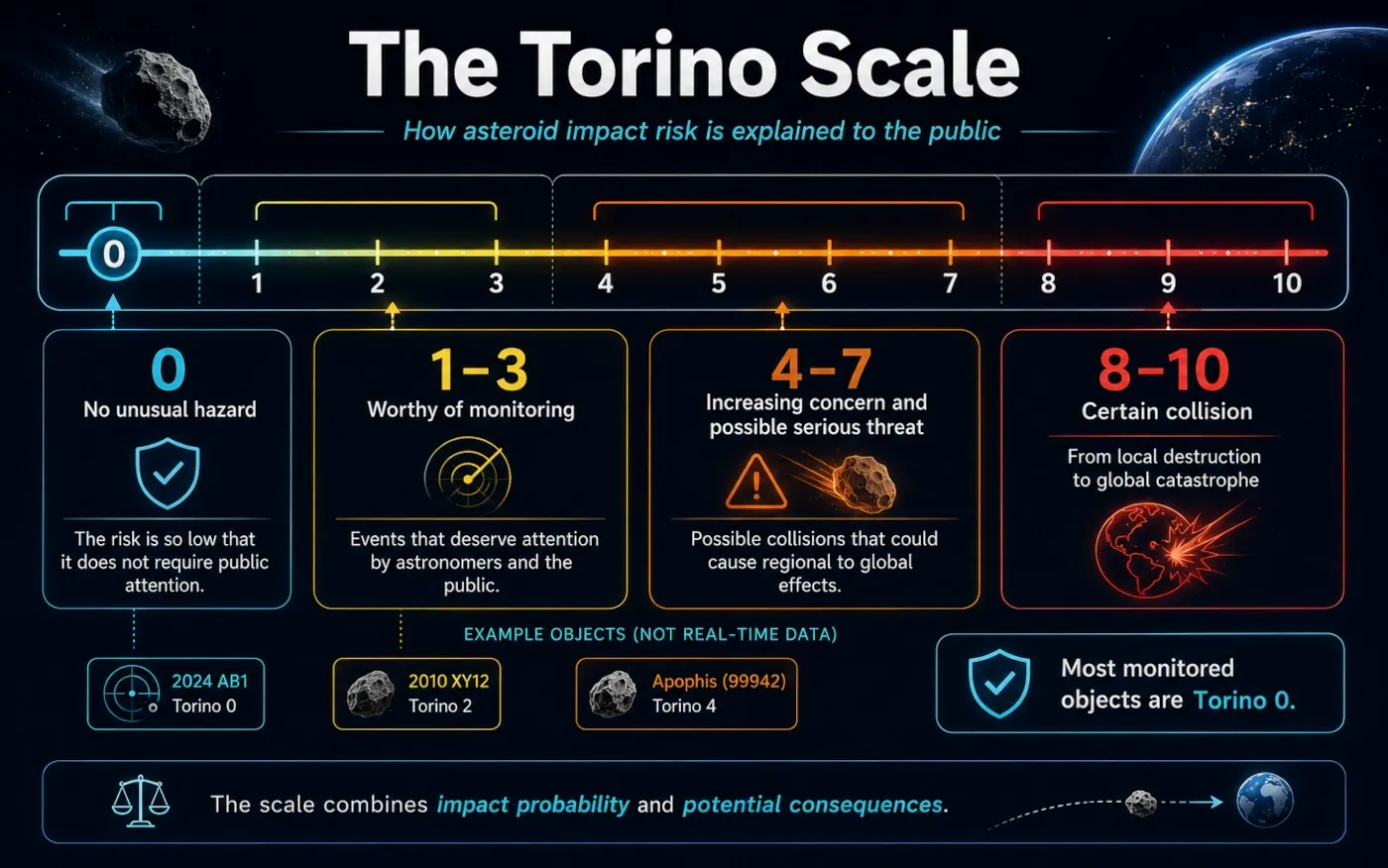
What is the Torino Scale?
The Torino Impact Hazard Scale is designed to communicate asteroid-impact risk to the public in a relatively intuitive way.
It runs from:
0 → 10It combines:
- the probability of impact; and
- the expected impact energy.
Broadly:
- 0 means no unusual level of danger;
- low positive values indicate events that may merit monitoring;
- higher levels represent increasingly serious situations;
- 10 represents a certain collision capable of global climatic catastrophe.
The scale is deliberately discrete and communication-focused.
Most objects that appear on risk lists are Torino 0.
A Torino rating is therefore far more informative than a headline saying only that an asteroid “has a chance of hitting Earth.”
What is the Palermo Scale?
The Palermo Technical Impact Hazard Scale is more analytical.
Instead of simply placing an event into a public-facing category, it compares the calculated impact risk with the background risk from objects of similar or larger size over the time remaining before the possible impact.
A Palermo value of:
- 0 corresponds roughly to the background hazard level;
- a negative value means the event is below that background risk;
- increasingly positive values represent increasingly significant risk relative to the background.
The scale is logarithmic.
For example, a Palermo value of -2 represents a risk roughly one hundredth of the background level used for the comparison.
The Torino and Palermo scales therefore answer related but different questions:
| Scale | Best thought of as |
|---|---|
| Torino | Public communication of probability + consequence |
| Palermo | Technical comparison with the expected background impact hazard |
Could we stop an asteroid heading for Earth?
Potentially, yes—but the answer depends on the object and, above all, on warning time.
Planetary defense is not about waiting until an asteroid is almost at Earth and then trying to “shoot it down.”
The preferred goal is usually to alter the object’s velocity by a tiny amount years before the predicted encounter.
A small change made early can accumulate into a very large positional difference by the time the asteroid reaches Earth’s orbit.
Kinetic impactor
A kinetic impactor deliberately crashes a spacecraft into an asteroid to change its velocity.
This method has now been demonstrated in space.
Gravity tractor
A gravity tractor is a proposed slow-deflection technique.
A spacecraft would hover near an asteroid for a long time. The tiny gravitational attraction between spacecraft and asteroid would gradually change the asteroid’s trajectory.
It is gentle and potentially precise, but it requires substantial warning time and has not been demonstrated as an operational asteroid-deflection mission.
Nuclear option
Nuclear explosive devices have been studied for difficult planetary-defense scenarios.
The serious concept is not simply “blow the asteroid into pieces.”
A stand-off nuclear explosion could, in principle, heat and vaporise part of an asteroid’s surface. The ejected material would create a reaction force that changes the object’s velocity.
Nuclear approaches remain undemonstrated for planetary defense in space and would involve major technical, legal and geopolitical considerations.
They are generally discussed as potential options for difficult cases in which other techniques might not provide enough momentum change or enough time.
Civil defense
Not every scenario requires a space mission.
For a smaller object discovered shortly before a local or regional impact, evacuation, sheltering and emergency-response planning could be more realistic than trying to launch a deflection mission.
Planetary defense therefore includes both space-based mitigation and terrestrial emergency planning.
What NASA’s DART mission proved
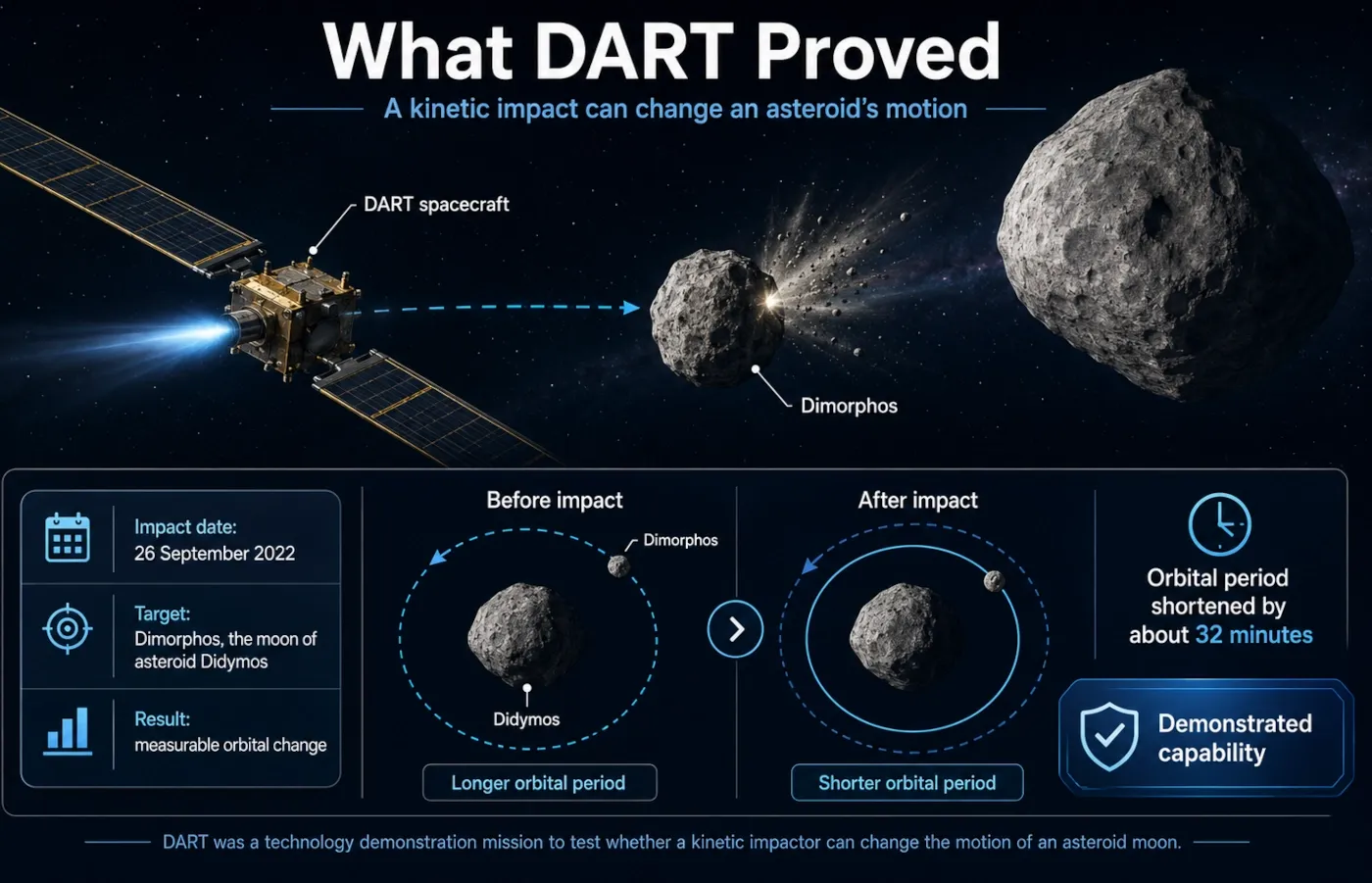
NASA’s Double Asteroid Redirection Test (DART) changed planetary defense from theory to demonstrated capability.
On 26 September 2022, the DART spacecraft intentionally collided with Dimorphos, the small moon of asteroid Didymos.
Neither object threatened Earth.
The purpose was experimental: determine whether a spacecraft impact could measurably change an asteroid’s motion.
It did.
Before impact, Dimorphos orbited Didymos in about 11 hours 55 minutes. After the impact, the orbital period was shortened by roughly 32 minutes.
Later analyses also showed that ejecta thrown from Dimorphos amplified the momentum transfer.
DART therefore demonstrated two critical things:
- a spacecraft can autonomously target and strike a small asteroid; and
- a kinetic impact can measurably alter an asteroid’s motion.
It does not mean every future asteroid can be deflected by simply repeating DART.
The effectiveness of a kinetic impact depends on:
- asteroid size;
- mass;
- structure;
- composition;
- rotation;
- available warning time;
- achievable spacecraft mass and velocity;
- how the asteroid surface responds to the collision.
But it is the first full-scale proof that asteroid deflection by kinetic impact is physically achievable.
Why warning time matters more than movie-style firepower
Suppose an asteroid will intersect Earth’s orbit at a future point.
The objective is not necessarily to move the asteroid by thousands of kilometres immediately.
It is to make Earth and the asteroid reach the crossing point at different times.
With twenty years of warning, a very small velocity change can accumulate over millions of kilometres of travel.
With two months of warning, the same small change may be insufficient.
That creates the basic rule of planetary defense:
Find dangerous objects early.
Discovery is itself a mitigation technology because warning time expands the range of options.
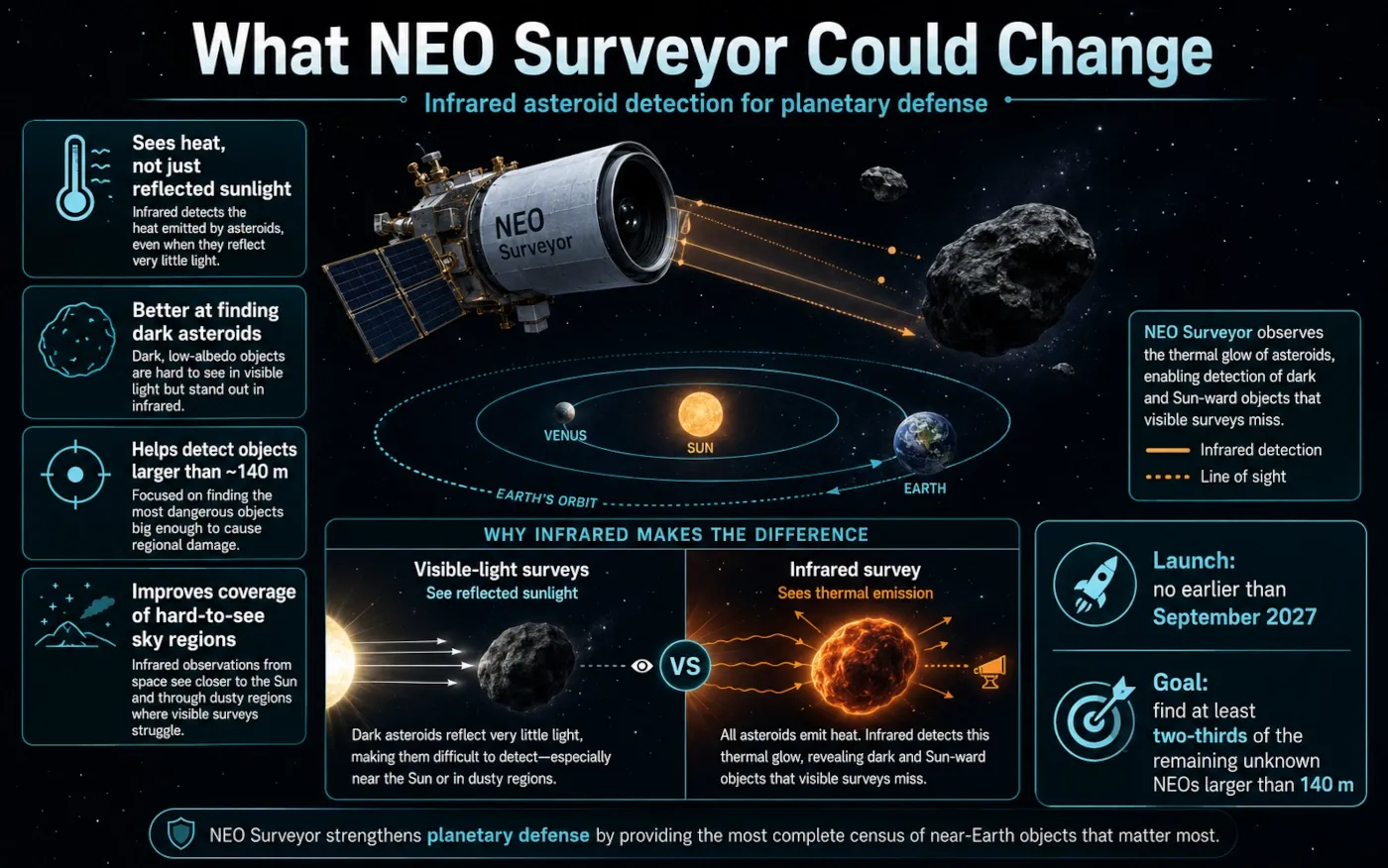
What NEO Surveyor could change
NASA’s Near-Earth Object Surveyor (NEO Surveyor) is designed specifically to improve the discovery and characterisation of asteroids and comets that could pose an impact hazard.
The mission is scheduled to launch no earlier than September 2027.
Unlike ordinary visible-light asteroid surveys, NEO Surveyor will observe in two heat-sensitive infrared wavelength bands.
That matters because dark asteroids may reflect little sunlight but still emit thermal infrared radiation.
NASA says the telescope’s five-year baseline survey is designed to find at least two-thirds of the near-Earth objects larger than 140 metres that remain to be discovered.
That 140-metre population matters because objects of that scale can cause major regional damage in an impact.
NEO Surveyor will also observe closer to the Sun’s direction than conventional night-time ground surveys can comfortably cover, helping address an important detection gap illustrated by the Chelyabinsk event.
How to check whether an asteroid is really a threat
You do not need to rely on a social-media post, a YouTube thumbnail or a news headline.
Use the official monitoring systems.
1. Check NASA CNEOS Sentry
Open NASA’s Sentry: Earth Impact Monitoring system.
Look for the asteroid designation.
Important fields include:
- impact date or dates;
- cumulative impact probability;
- maximum individual impact probability;
- Palermo Scale;
- Torino Scale where applicable;
- estimated diameter or absolute magnitude;
- number of possible impact solutions.
Do not interpret the presence of an asteroid on the page as proof of future impact.
2. Check the ESA NEOCC Risk List
ESA’s Risk List is an independent public source.
For each listed object, look at:
- possible impact date;
- estimated size;
- impact probability;
- predicted impact velocity;
- Palermo Scale;
- Torino Scale;
- how long it has remained on the list;
- risk-history plots where available.
3. Check whether new observations changed the assessment
Asteroid probabilities can move quickly.
Look for:
- NASA Planetary Defense updates;
- ESA NEOCC news;
- observatory campaigns;
- radar measurements;
- James Webb observations for very faint targets;
- announcements that an object has been removed from a risk list.
A screenshot of yesterday’s probability may already be obsolete.
4. Separate close approach from impact probability
A close flyby can be spectacular without being dangerous.
Apophis in 2029 is the perfect example.
Do not treat phrases such as:
“closer than some satellites”
as equivalent to:
“will collide with Earth.”
They are completely different statements.
5. Look at consequence and probability together
An extremely small object with a relatively high atmospheric-entry probability is not equivalent to a kilometre-scale object with a tiny theoretical impact solution.
Impact risk is always a combination of:
probability × consequenceThat is why scales such as Torino and Palermo exist.
Common mistakes
Mistake 1: treating “potentially hazardous” as “will hit Earth”
A PHA is an asteroid that meets size and orbital-screening criteria.
It is not a confirmed impactor.
Do instead: check the actual impact probability in NASA Sentry or ESA NEOCC.
Mistake 2: ranking danger only by asteroid size
A large asteroid on a well-known safe orbit is not a greater immediate threat than a smaller object on an actual impact trajectory.
Do instead: consider orbit, uncertainty, probability, size and warning time together.
Mistake 3: treating every close approach as a warning
Thousands of near-Earth objects make close approaches.
Do instead: distinguish minimum distance from impact probability.
Mistake 4: assuming a rising probability means the asteroid changed course
In many cases, the asteroid’s physical orbit has not changed at all.
What changed is the precision of our measurements.
Do instead: follow the orbit-refinement history.
Mistake 5: assuming “risk list” means “danger list”
ESA’s Risk List includes objects with non-zero mathematical impact probabilities, many far below levels that should concern the public.
Do instead: read the Palermo and Torino values and the actual probability.
Mistake 6: using a permanent “most dangerous asteroids” list
Risk rankings are dynamic.
An article naming a fixed top 10 can become wrong as soon as new observations arrive.
Do instead: use live NASA and ESA systems and record the date of any snapshot.
Mistake 7: assuming we have no way to alter an asteroid
That statement is now outdated.
Do instead: recognise that DART demonstrated kinetic impact as a real deflection technique, while remembering that every asteroid scenario would require its own mission analysis.
Security, privacy and safety notes
This topic attracts misinformation because very small probabilities can produce dramatic headlines.
Use official sources for urgent claims
If a post claims NASA has issued an asteroid warning “for today,” verify it through NASA CNEOS, NASA Planetary Defense, ESA NEOCC or another official astronomical authority.
Do not treat reposted graphics as current simply because they contain NASA or ESA logos.
Do not try to observe near the Sun
The fact that some asteroids approach from the Sun’s direction does not mean you should point binoculars, cameras or a telescope near the Sun.
Direct or magnified solar viewing without properly designed solar equipment can cause permanent eye injury and can damage equipment.
If you see a brilliant meteor, move away from windows
Chelyabinsk showed that the damaging shock wave may arrive after the visible flash.
Do not stand behind windows to watch a persistent trail. Moving away from glass is safer if a major atmospheric blast has occurred.
Do not confuse uncertainty with secrecy
When an impact probability changes, that is normally evidence that new observations are being incorporated—not evidence that scientists are hiding a known collision.
NASA and ESA publish risk tables precisely so that these calculations can be independently examined.
Faster alternative
If you do not need the full explanation and only want to answer:
“Is this asteroid actually a threat?”
use this faster method:
- Search the object’s official designation in NASA CNEOS Sentry.
- Check the same object in the ESA NEOCC Risk List.
- Look at the latest update date.
- Check the impact probability, Torino Scale and Palermo Scale.
- Read the latest NASA/ESA bulletin if the object has recently received unusual attention.
This is faster than reading multiple news articles and usually gives you the underlying data.
What you lose is the context needed to understand why the probability may be changing.
Final verdict: which asteroids should we actually worry about?
The scientifically useful answer is not a list of dramatic asteroid names.
At present, no known large asteroid poses a significant impact threat to Earth over the next century.
Apophis is not going to hit Earth in 2029.
2024 YR4 is not going to hit Earth in 2032, and its previously discussed lunar-impact possibility has also been ruled out.
Objects appear on NASA and ESA risk lists because some mathematically possible trajectories have not yet been excluded—not because collision is expected.
The more important long-term concern is the population of objects that have not yet been discovered, particularly asteroids large enough to cause severe local or regional damage but small, dark or geometrically difficult enough to evade early detection.
That is why the best planetary-defense strategy begins long before any deflection mission:
Find them early, observe them accurately, refine the orbit, communicate the risk correctly, and act only if the evidence justifies it.
DART has shown that changing an asteroid’s motion is possible.
The remaining challenge is making sure we discover a dangerous object early enough to use that capability.
FAQ
Is there a NASA asteroid warning for today?
NASA continuously publishes asteroid close-approach and impact-monitoring data, but a routine close approach is not an emergency warning.
For a current claim, check NASA CNEOS and official NASA Planetary Defense updates.
Which asteroid is the biggest threat to Earth?
There is currently no known large asteroid with a significant probability of hitting Earth in the next 100 years.
A “biggest threat” ranking can also be misleading because official risk lists change as new observations refine asteroid orbits.
Is an asteroid heading toward Earth in 2029?
Apophis will make a very close approach on 13 April 2029, but it will not hit Earth.
Impact has been ruled out for at least the next century.
Why is 13 April 2029 associated with asteroids?
That is the date of Apophis’ close flyby.
It will pass roughly 32,000 kilometres above Earth’s surface, making it an exceptional scientific event.
Are any asteroids expected to hit Earth in 2026?
Very small objects enter Earth’s atmosphere routinely, and some can be detected before entry.
That is different from a known large hazardous asteroid impact. No known large asteroid is currently expected to cause a significant Earth impact in 2026.
Could an asteroid like Chelyabinsk happen again?
Yes.
Small asteroids strike Earth’s atmosphere much more frequently than large ones. Most are harmless, but Chelyabinsk demonstrated that an object only tens of metres across can cause local damage through an atmospheric airburst.
Can we stop an asteroid from hitting Earth?
Potentially, if it is discovered early enough.
NASA’s DART mission demonstrated that a kinetic impactor can change an asteroid’s motion. Other concepts include gravity tractors and, for difficult scenarios, nuclear deflection or disruption concepts.
Could a nuclear weapon stop an asteroid?
Nuclear methods have been studied as possible planetary-defense options, particularly for difficult or short-warning scenarios.
They are not a simple “blow it up” solution, and no nuclear asteroid-deflection technique has been demonstrated in space.
How big would an asteroid need to be to destroy a city?
There is no single diameter because the outcome depends on velocity, density, strength, entry angle and whether the object explodes in the atmosphere.
Objects in the tens-of-metres range can cause severe local damage, while larger objects can affect much wider regions.
How big would an asteroid need to be to destroy Earth?
No realistic known asteroid impact scenario would literally destroy the planet.
Even the roughly 10-kilometre-class Chicxulub impactor caused a mass extinction without physically destroying Earth.
The meaningful questions are whether an impact could devastate a region, disrupt civilisation or trigger global environmental consequences.
What happens if an asteroid hits the ocean?
A sufficiently large ocean impact can generate enormous waves and severe regional effects.
The result depends on asteroid size, impact speed and angle, water depth and distance from coastlines. An ocean impact does not automatically mean a global mega-tsunami.
Are we 100% sure an asteroid killed the dinosaurs?
The scientific consensus is that the Chicxulub impact was a primary cause of the end-Cretaceous mass extinction about 66 million years ago, with extensive geological evidence linking the impact to global environmental disruption.
Would NASA tell the public if a dangerous asteroid were found?
Planetary-defense monitoring is explicitly built around public and international communication.
NASA’s Planetary Defense Coordination Office works with international organisations including the International Asteroid Warning Network, and NASA CNEOS and ESA NEOCC publicly expose impact-risk data.
What keeps asteroids away from Earth?
There is no planetary shield that reliably keeps asteroids away.
Most asteroids simply follow orbits that do not intersect Earth at the same place and time. Planetary gravity—including Jupiter’s—can alter small-body orbits, but it is too simplistic to describe any one planet as Earth’s guaranteed “protector.”
Sources and methodology
This article uses official planetary-defense and near-Earth-object resources as its primary evidence base.
The main sources are:
- NASA Center for Near Earth Object Studies (CNEOS) for orbital classes, Sentry impact monitoring and Chelyabinsk trajectory analysis.
- NASA Planetary Defense Coordination Office / NASA Science for current planetary-defense guidance, DART and 2024 YR4.
- NASA Jet Propulsion Laboratory for Asteroid Watch and NEO Surveyor.
- ESA NEO Coordination Centre (NEOCC) for the current NEO catalogue, public Risk List, impact probabilities and Palermo/Torino explanations.
- ESA Planetary Defence for Apophis and 2024 YR4 updates.
Risk-list values and catalogue counts are time-sensitive. Any numerical snapshot should therefore be read together with its review date.
The article deliberately avoids presenting a permanent “most dangerous asteroids” ranking because NASA and ESA update orbital solutions continuously.
Last tested
Tested and reviewed on:
- NASA CNEOS Sentry
- NASA CNEOS NEO definitions
- NASA Planetary Defense resources
- NASA JPL Asteroid Watch
- NASA JPL NEO Surveyor
- NASA DART mission resources
- NASA Apophis resources
- NASA 2024 YR4 resources
- ESA NEOCC Risk List and database statistics
- ESA NEOCC Torino and Palermo Scale documentation
- ESA Apophis resources
- ESA 2024 YR4 resources
Last tested: 2026-08-17
Last editorial review: 2026-08-17
Related guides
Carefully selected guides to help you understand the topic and complete the next useful step.