
The zipper looks almost too simple to have a complicated history. Pull one small slider and two flexible sides lock together. Pull it the other way and they separate again.
Yet the question “Who invented the zipper?” does not have a completely satisfactory one-name answer.
That is because the object we now call a zipper emerged through several distinct inventions. Elias Howe patented an early continuous garment fastener in 1851. Whitcomb L. Judson developed a commercially promoted “clasp locker” in the 1890s. Gideon Sundback then replaced the unreliable hook-and-eye arrangement with the interlocking-element design that became the modern zipper. A decade later, B.F. Goodrich helped give the fastener the name zipper. YKK, whose initials appear on countless modern sliders, entered the story later as a manufacturer rather than the inventor.
The clearest historical answer is therefore not to choose one of those names and erase the others. It is to understand what each person actually contributed.
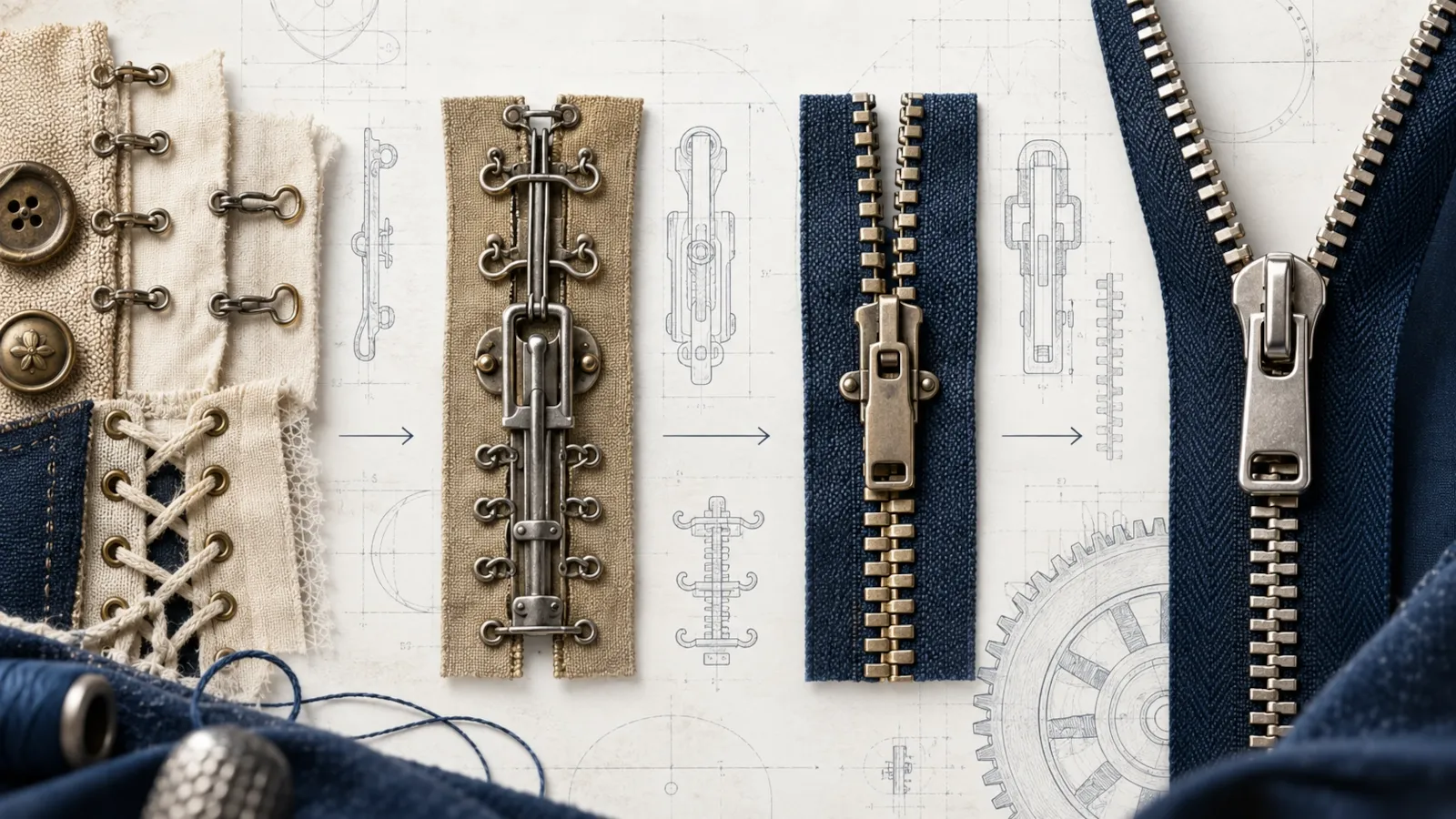
From early garment fasteners to Sundback’s interlocking design, the modern zipper emerged through several stages of engineering refinement.
Quick answer
Whitcomb L. Judson is commonly credited with developing the first commercially promoted precursor to the zipper, the “Clasp Locker,” patented in 1893. Gideon Sundback created the practical interlocking fastener that became the modern zipper, with his key U.S. patent filed in 1914 and granted in 1917.
An earlier inventor, Elias Howe Jr., had patented a continuous garment-fastening system in 1851, but it did not become the modern zipper or a successful commercial product.
So, if you need the shortest accurate answer:
- Who invented the zipper in 1893? Whitcomb L. Judson.
- Who invented the modern zipper? Gideon Sundback.
- Who proposed an earlier zipper-like garment fastener? Elias Howe Jr.
- Who gave the fastener the name “zipper”? B.F. Goodrich popularised the name in the 1920s.
- Did YKK invent the zipper? No. YKK was founded later, in 1934.
When to use this explanation
This article is the right starting point if you are trying to answer any of these questions:
- Who invented the zipper?
- Who invented the zipper in 1893?
- When was the zipper invented and by whom?
- Who invented the modern zipper?
- Did Elias Howe invent the zipper?
- Is the zipper a Swedish invention?
- Why is it called a zipper?
- Did YKK invent the zipper?
- What does YKK stand for?
- What did people use before zippers?
- When did zippers become common?
It is not a repair guide, sewing tutorial or buying guide. Questions such as how to fix a separated zipper, replace a slider or choose the strongest zipper are separate practical topics.
Before you start
Three distinctions make the history much easier to understand.
- A precursor is not necessarily the modern product. An inventor can create an important earlier mechanism without creating the design we use today.
- Development date, patent filing date and patent grant date are different events. This is why sources may mention 1913, 1914 or 1917 when discussing Sundback.
- The inventor, the person who named the product and the company that later dominated manufacturing are not the same thing.
If you remember those three points, most of the apparent contradictions disappear.
Was there really one inventor of the zipper?
Not in the simple sense implied by the question.
The zipper is better understood as a chain of engineering improvements.
A useful analogy is the modern bicycle or electric light. Once an idea has several essential parts, one inventor may establish the concept, another may solve its mechanical weaknesses, and a later manufacturer may make it cheap and reliable enough for mass adoption.
The zipper followed that pattern.
Elias Howe showed that the two sides of a garment could be joined through a continuous fastening mechanism. Whitcomb Judson tried to turn that general idea into an automatic shoe fastener. Gideon Sundback then redesigned the fastening elements and slider so thoroughly that the result looked and behaved much like a modern zipper.
The word zipper came later still.
That is why two apparently conflicting statements can both contain part of the truth:
Whitcomb Judson invented an important early zipper precursor.
and
Gideon Sundback invented the modern zipper.
The mistake is treating those statements as if they described exactly the same machine.
Zipper invention timeline
| Year | Milestone | Why it matters |
|---|---|---|
| 1851 | Elias Howe Jr. receives U.S. Patent 8,540 for an “Improvement in Fastenings for Garments” | An early continuous garment-fastening concept |
| 1891 | Whitcomb Judson files the application that becomes U.S. Patent 504,038 | The clasp-locker concept is formally documented |
| 1893 | Judson’s patent is granted and his fastener is promoted at the Chicago World’s Fair | The first major commercial push for a zipper-like fastener |
| 1906 | Gideon Sundback joins the fastener business | The engineer who will transform the mechanism enters the story |
| By 1913 | Sundback has developed the basic form of the modern interlocking fastener | The key mechanical breakthrough is essentially in place |
| 1914 | Sundback files the U.S. patent application for his “Separable Fastener” | The modern design enters the patent record |
| 1917 | U.S. Patent 1,219,881 is granted | Sundback’s modern fastener is formally patented |
| 1923 | B.F. Goodrich uses Zipper as a trademark for an overshoe using the fastener | The name zipper begins to spread |
| 1930s | Zippers become much more common in clothing | The fastener moves from niche applications to mainstream fashion |
| 1934 | Tadao Yoshida founds the company that develops into YKK | The future global zipper manufacturer enters the industry |
The key lesson from the timeline is that there is no single magical year in which a fully modern zipper appeared from nowhere.
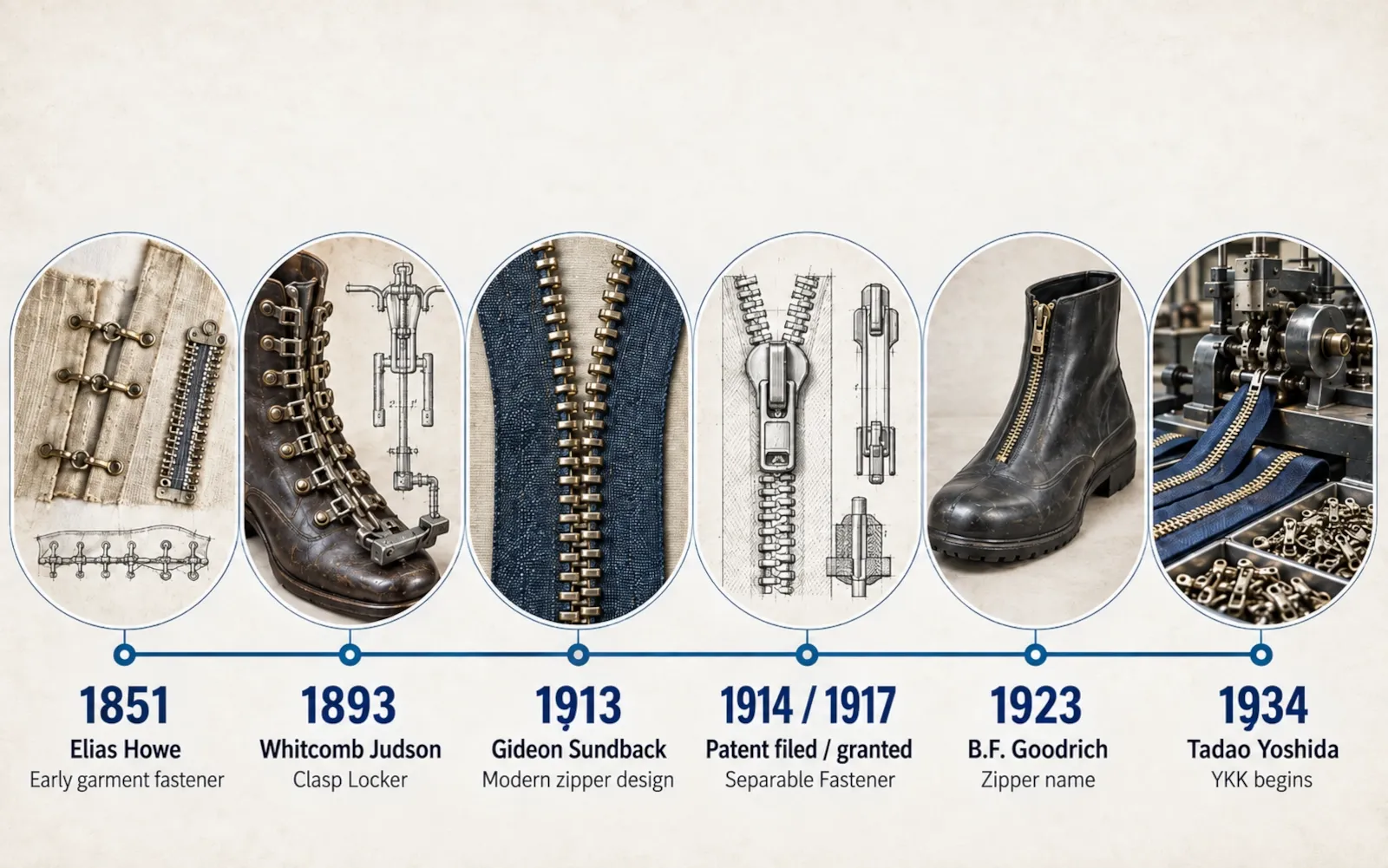
A visual timeline of the key milestones that shaped the zipper, from Howe’s early garment fastener to the rise of YKK.
How to understand who invented the zipper in seven steps
1. Start with Elias Howe’s 1851 garment fastener
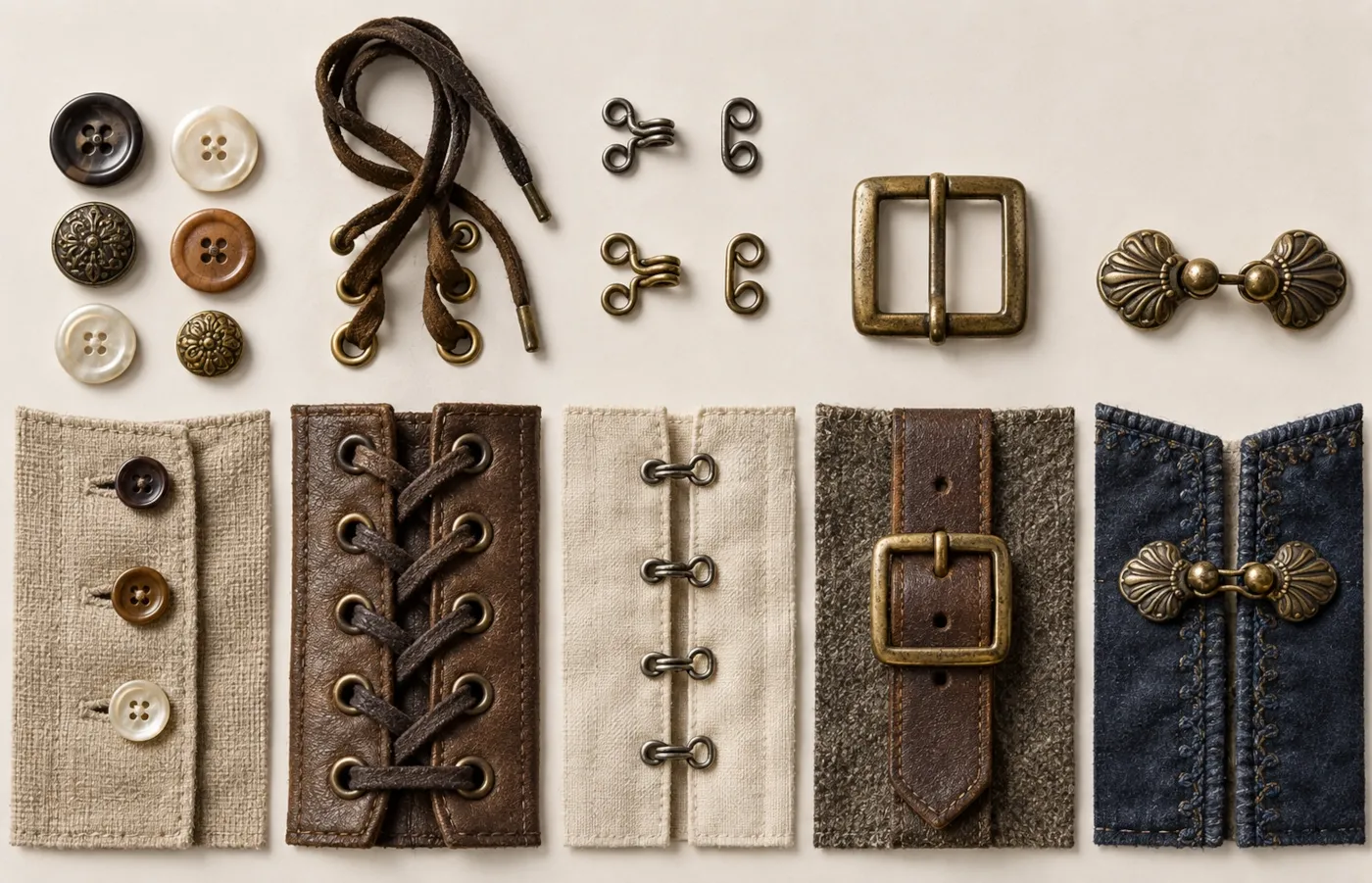
Before continuous slide fasteners became practical, garments and footwear relied on separate closures such as buttons, laces, buckles and hooks.
Elias Howe is best known for his role in sewing-machine history, but in 1851 he also received U.S. Patent No. 8,540 for an “Improvement in Fastenings for Garments.”
His patent described a system for opening, closing and fastening two sides of a garment using clasps, ribs, links and a sliding arrangement.
That makes Howe an important early figure in zipper history.
But calling Howe the inventor of the modern zipper would go too far.
His mechanism did not establish the later commercial zipper industry, and it did not use the compact rows of interlocking elements that define Sundback’s mature design. It is more accurate to describe Howe’s patent as an early ancestor of the continuous slide fastener.
This distinction matters because internet summaries sometimes turn every early patent into “the first zipper.” Invention history is rarely that tidy.
2. Whitcomb Judson turns the idea into the 1893 Clasp Locker
The next major step came from American engineer Whitcomb L. Judson.
In the late nineteenth century, fastening clothing and footwear could be surprisingly laborious. Shoes and boots might use long rows of buttons, laces or individual hooks. Garments used buttons, hooks and eyes, brooches and other closures that had to be engaged one at a time.
Judson wanted a more automatic solution.
His U.S. Patent No. 504,038, granted on 29 August 1893, described a “Clasp Locker or Unlocker for Shoes.” The patent’s goal was remarkably modern: engage or disengage an entire series of clasps through one continuous movement.
The device was designed especially for shoes, but Judson explicitly noted that the concept could also apply to items such as belts, mail bags and flexible seams.
This is why 1893 appears so often in answers to “Who invented the zipper?”
Judson had moved the idea from a general garment fastener toward a recognisable consumer product: two sides lined with fastening components, operated together through a moving device.
He also promoted the invention at the World’s Columbian Exposition in Chicago in 1893, giving the mechanism a level of public visibility earlier systems had never achieved.
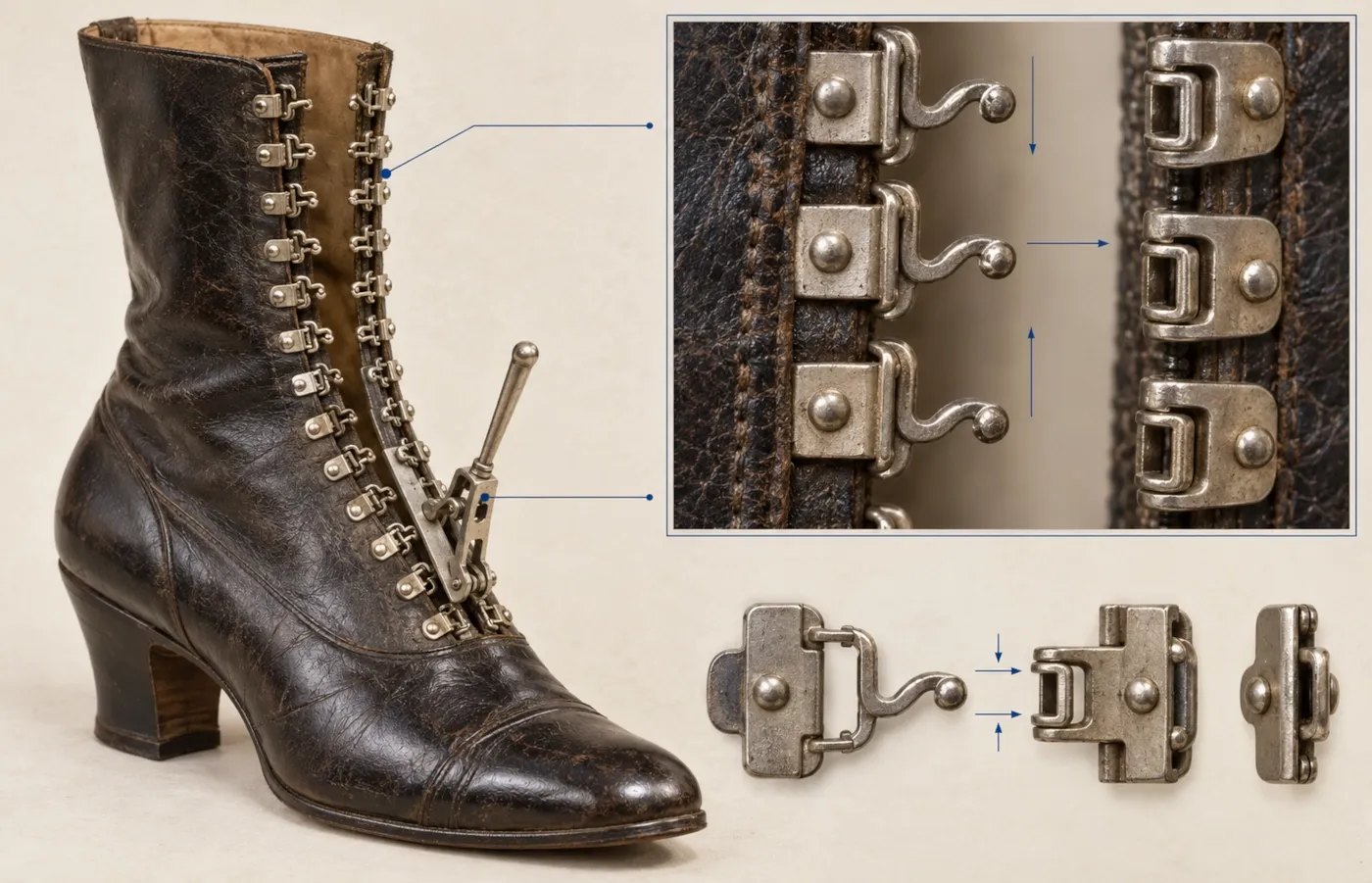
Judson’s clasp locker was an ingenious step forward, but its complex hook-and-eye mechanism was still more fragile and awkward than a modern zipper.
3. Understand why Judson’s fastener was not yet the modern zipper
Judson’s device was ingenious, but it was mechanically troublesome.
The early system still depended on a complicated arrangement of hooks and eyes or clasp-like elements. The parts had to align correctly, and the mechanism was sensitive to distortion. Historical accounts describe these early fasteners as unreliable and prone to opening or jamming.
This is a fundamental engineering problem.
A closure used on clothing has to satisfy several requirements at once:
- engage quickly;
- resist forces trying to pull the two sides apart;
- remain flexible as the garment bends;
- tolerate thousands of opening and closing cycles;
- avoid opening accidentally;
- be manufacturable with very small dimensional errors;
- work even when the user pulls the slider imperfectly.
Judson had demonstrated that a continuous fastener could be commercially interesting. He had not yet solved all of those requirements.
That gap is what Gideon Sundback eventually closed.
4. Gideon Sundback abandons the old hook-and-eye logic
Gideon Sundback, a Swedish-born electrical engineer who moved to North America, joined the fastener company connected with Judson’s work in the early twentieth century.
For several years, improvements still revolved around versions of the older hook-and-eye system.
Sundback’s decisive step was to move away from that basic architecture.
Instead of relying on larger hooks engaging corresponding eyes, his mature design used two dense rows of small interlocking metal elements attached to flexible stringers. A slider brought the two rows together in one direction and separated them in the other.
The change sounds modest until you look at what it solved.
Increasing the number of fastening elements distributed the load across many small connections. Shaping the elements so that each could engage its neighbours made the closed chain much more stable. The slider no longer had to manage a sparse collection of awkward hooks; it could continuously guide a regular, precisely spaced sequence of elements into engagement.
The National Inventors Hall of Fame notes that Sundback increased the number of fastening elements dramatically and added complementary projections and recesses that allowed adjacent elements to interlock.
This is the point where the history stops looking like a strange nineteenth-century clasp system and starts looking like the zipper on a jacket today.
5. Separate 1913, 1914 and 1917
These three dates are often presented as if one of them must be wrong.
They refer to different milestones.
The Smithsonian’s historical account places Sundback’s creation of the modern zipper design by December 1913.
The U.S. patent record for Sundback’s “Separable Fastener” lists a filing date of 27 August 1914.
The patent, U.S. No. 1,219,881, was granted on 20 March 1917.
So an accurate summary is:
Sundback had developed the essential modern design by 1913, filed his key U.S. patent in 1914 and received the patent in 1917.
The patent describes two flexible stringers carrying interlocking members and a sliding device that locks them when moved in one direction and unlocks them when moved in the other.
That functional description is recognisably a modern zipper.
6. Solve the manufacturing problem, not only the geometry
Inventing a working prototype is not the same as creating a practical mass-produced technology.
A zipper depends on repetition and precision. Dozens of tiny elements must be shaped and spaced consistently. If the dimensions are wrong, the chain can fail to engage or can separate under load.
The engineering narrative in the supplied video transcript highlights an important part of Sundback’s achievement that short histories often skip: he also worked on machinery for manufacturing the fastener accurately and in quantity.
The transcript describes a process in which shaped metal stock was cut into individual elements, formed so neighbouring pieces could interlock and then clamped onto fabric tape at controlled spacing.
The exact machinery evolved, but the larger lesson remains important:
The modern zipper was a manufacturing invention as much as a geometric one.
A clever tooth shape is useless if factories cannot reproduce it with sufficient precision.
That principle is still visible in modern zipper production. YKK explains that a zipper’s elements, slider and tape must be manufactured to tight tolerances, with the dimensions of the interlocking elements being particularly critical to smooth operation and resistance to separation.
7. Let B.F. Goodrich give the fastener the name everyone remembers
Sundback did not originally call his invention a zipper.
Early commercial names included forms of “Hookless Fastener.”
The word zipper arrived through a different company.
In the early 1920s, B.F. Goodrich used the slide fastener on rubber overshoes. According to Merriam-Webster, company president Bertram G. Work coined Zipper and Goodrich used the term as a trademark for a slide-fastener overshoe in 1923.
The name was vivid and easy to remember. It evoked the quick zip of the mechanism in motion.
Within only a few years, the trademark had begun to escape the product that created it and enter ordinary language as the generic name for the fastener itself.
So B.F. Goodrich did not invent the mechanism.
It helped invent the word by which the mechanism is now known.
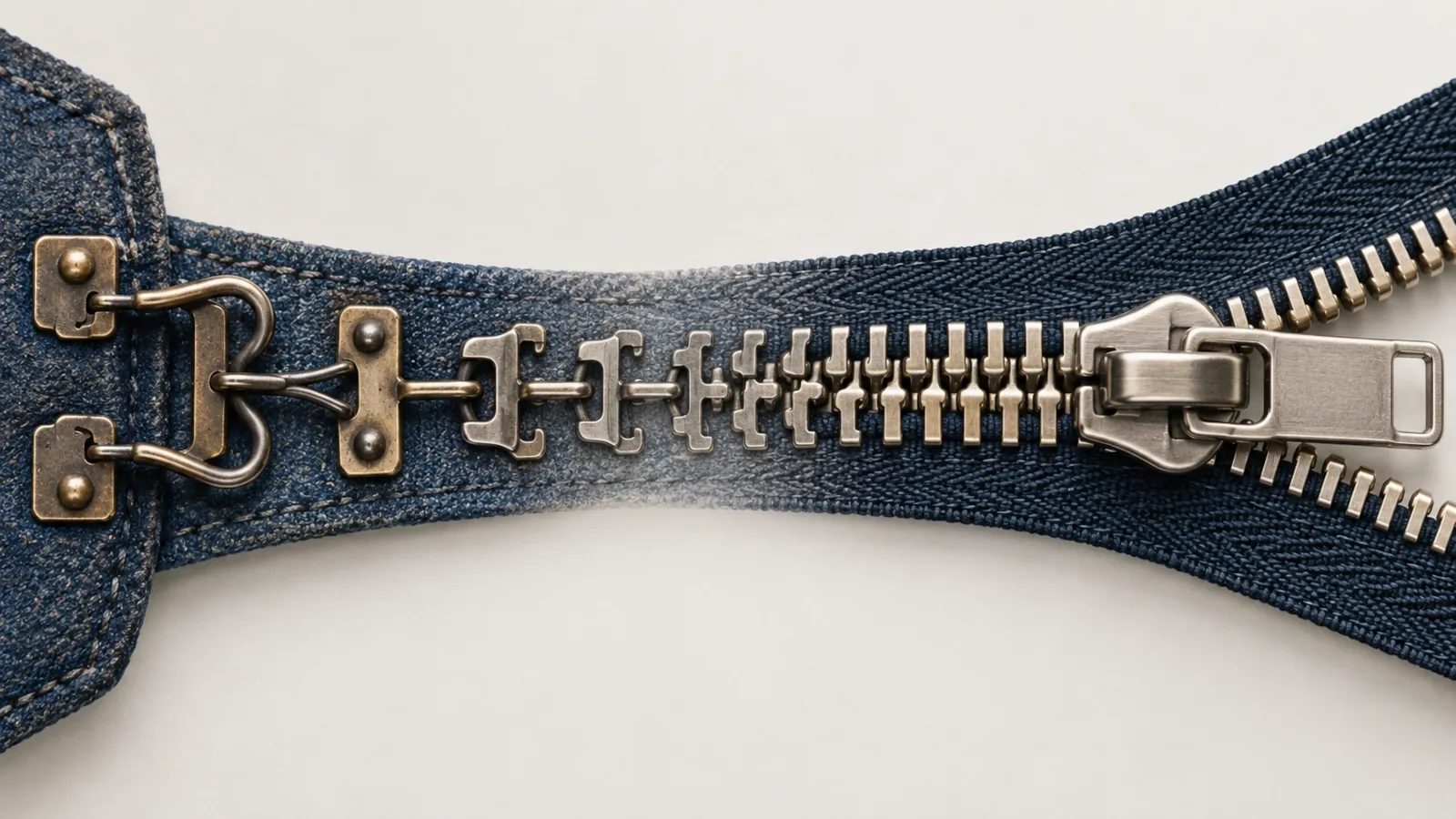
The crucial breakthrough was the transition from sparse, complicated clasps to dense, repeatable interlocking elements guided by a compact slider.
What exactly did Sundback change?
Sundback’s contribution becomes clearer when the old and new systems are compared directly.
| Judson-style clasp system | Sundback-style modern fastener |
|---|---|
| Relied on more complicated hooks and eyes or clasp-like parts | Used dense rows of small interlocking elements |
| More vulnerable to misalignment | Regular geometry made engagement more repeatable |
| Earlier versions were unreliable in daily use | Improved stability and ease of operation |
| Demonstrated the commercial concept | Established the practical architecture of the modern zipper |
| Important precursor | Direct ancestor of modern metal zippers |
The key innovation was not simply “adding teeth.”
It was the system formed by the elements, their spacing, the flexible tape/stringers and the slider geometry.
A successful zipper works because all of those parts constrain one another.
The individual elements cannot easily disengage sideways when neighbouring elements, the tape and the closed chain hold them in position. Yet the slider can deliberately move the elements through the geometry needed to join or separate them.
That combination of strength when closed and low effort when operated correctly is the central mechanical trick.
How does a zipper actually work?
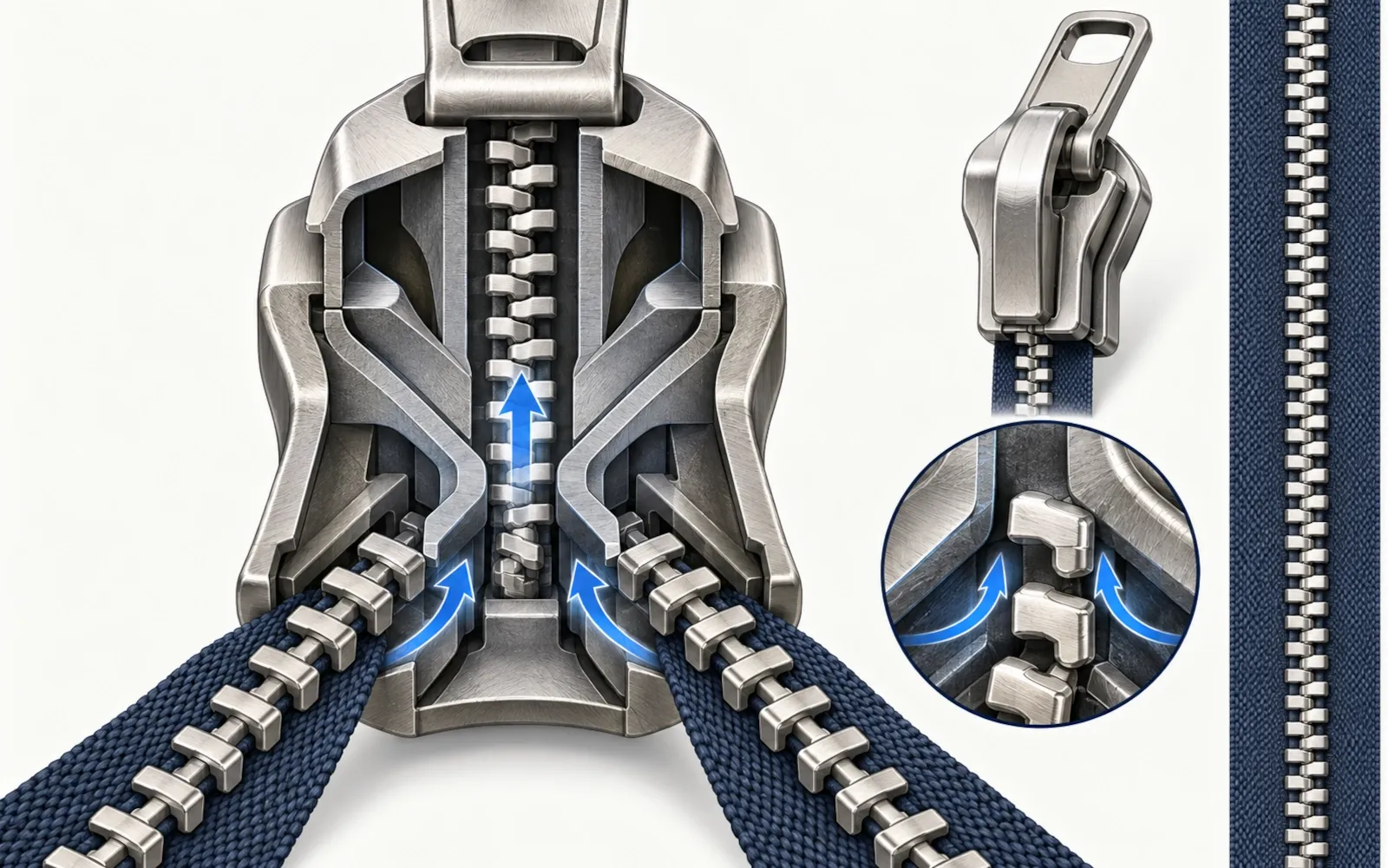
A cutaway view of the slider shows how its Y-shaped internal channel guides two separate rows of elements into one interlocked chain.
Modern zippers vary in material and construction, but a conventional zipper can be understood through three main components:
- Elements — the teeth or interlocking features along each side.
- Slider — the moving body that joins or separates the elements.
- Tape — the flexible fabric strips that hold the elements and are sewn into the product.
The important part is inside the slider.
YKK describes the interior as a Y-shaped tunnel.
When the slider moves in the closing direction, the two separate rows enter the arms of the Y. The slider guides them towards the narrower combined channel, forcing corresponding elements into the orientation required to mesh.
Move the slider in the opposite direction and a central divider forces the engaged rows apart.
This explains an everyday puzzle: why is it difficult to push zipper teeth together directly with your fingers, while pulling the slider feels effortless?
Your fingers are trying to control many tiny interactions at once. The slider’s internal geometry controls those interactions automatically and continuously.
It is a small mechanical guide that converts one simple hand motion into a precisely ordered sequence of engagements.
Why does the zipper resist being pulled apart?
When a closed zipper is loaded across its width, many elements share the force. Their interlocking shapes resist direct separation, while the tape keeps neighbouring elements at controlled spacing.
The easiest route for opening the chain is therefore not brute force across the closed zipper. It is to use the slider, which deliberately changes the angle and spacing of the elements in the correct sequence.
That is why the zipper can be both secure and easy to operate.
Are all modern zippers made from separate teeth?
No.
Many modern zippers use coil constructions in which a continuous synthetic coil forms the interlocking elements. Coil zippers became important because they are light, flexible and well suited to products such as bags and luggage.
The materials changed.
The core principle did not: a slider still guides two flexible rows of interlocking structures together and apart.
How were early zippers manufactured?
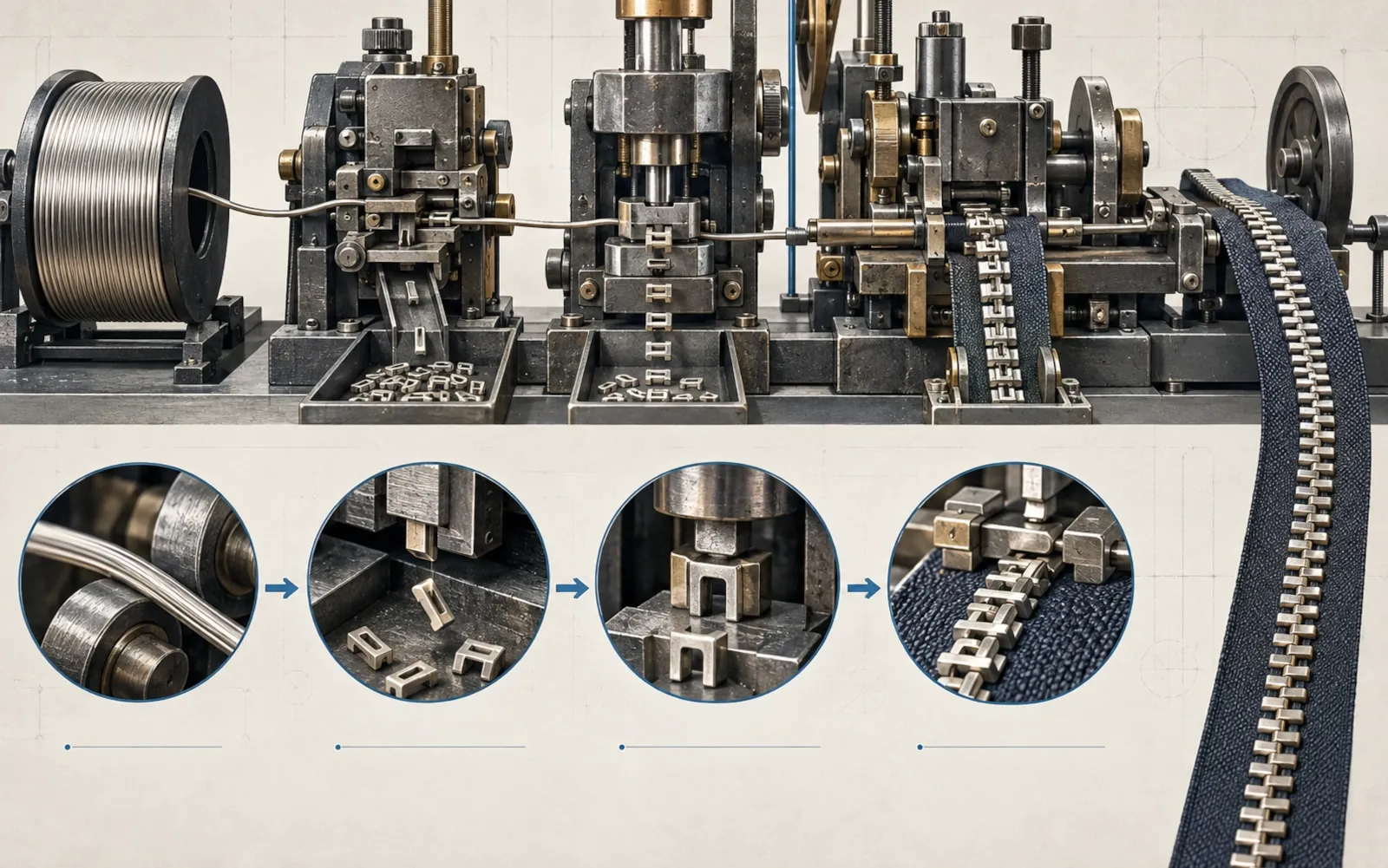
Early zipper production depended on repeatable precision: forming each small element consistently and attaching it to tape at exactly controlled spacing.
Sundback’s fastener created a production challenge that Judson’s concept had not solved satisfactorily.
The elements had to be:
- very small;
- shaped consistently;
- positioned at regular intervals;
- attached securely to flexible tape;
- compatible with the slider.
The video transcript supplied for this article describes Sundback’s production machinery as taking shaped metal wire, cutting individual pieces, stamping complementary features into them and clamping them onto fabric tape.
This manufacturing step deserves attention because it explains why a patent drawing alone was not enough.
A zipper with inconsistent spacing will not behave like a zipper. If the elements arrive at the slider at the wrong positions or angles, they cannot mesh reliably.
Modern YKK production still emphasises the same principle: tiny dimensional errors matter. The company states that zipper elements require very high precision because variations can cause a closed chain to separate.
The design may be more than a century old, but the product remains a precision mechanism.
What were zippers first used for?
The modern zipper did not immediately conquer clothing.
Early uses were comparatively specialised.
Historical accounts connect early fasteners with:
- shoes and boots;
- money belts;
- tobacco pouches;
- bags and similar containers.
This makes sense.
These products benefited from fast opening and closing without requiring consumers to accept the zipper immediately as a visible fashion feature.
The Smithsonian notes that widespread clothing use came later, especially in the 1930s.
This slow adoption is a useful reminder that a technically superior mechanism does not automatically replace a familiar one. Buttons and laces were cheap, understood, repairable and deeply embedded in clothing design.
The zipper had to become not only functional, but culturally normal.
When did zippers become common in clothing?
The 1930s were a major turning point.
By then, improved manufacturing had made slide fasteners more dependable, and clothing makers were finding more places to use them.
The Smithsonian’s account highlights 1937 as a notable year, including the so-called “Battle of the Fly,” when the zipper was promoted as an alternative to buttons in men’s trousers.
Fashion adoption mattered because it changed the zipper from a specialised closure into an everyday object.
Once consumers encountered zippers on trousers, dresses, jackets, luggage and children’s clothing, the mechanism no longer looked experimental.
It looked modern.
That cultural association with speed, convenience and modernity also helps explain why the zipper spread even though buttons remained cheaper and perfectly functional for many uses.
Why is it called a zipper?
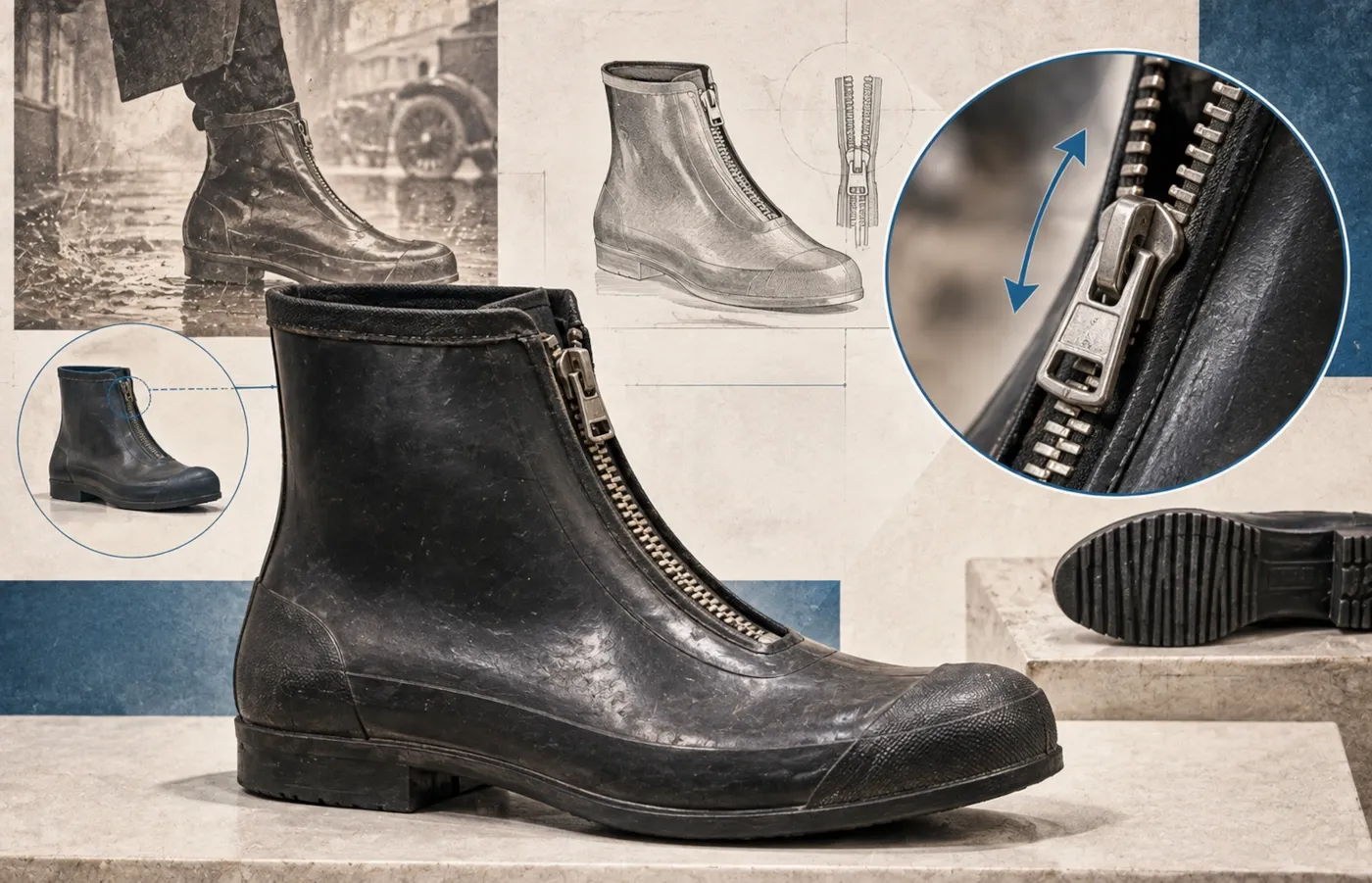
The name “zipper” became associated with slide fasteners after they were used on rubber overshoes in the 1920s.
Because the name was created after the mechanism.
B.F. Goodrich used Sundback-style slide fasteners on rubber overshoes and adopted Zipper as a product name in 1923.
Merriam-Webster credits B.F. Goodrich president Bertram G. Work with coining the term. The word was an example of sound symbolism: zip already suggested quick movement, and the fastener made a sharp, rapid sound as it opened and closed.
The name proved almost too successful.
By 1926, only a few years after the trademark use, zipper was already appearing generically for the fastening mechanism.
That means the object had existed before the everyday English word we now use for it.
Earlier descriptions included terms such as:
- clasp locker;
- hookless fastener;
- separable fastener;
- slide fastener.
In technical and industrial contexts, slide fastener remains a useful generic term.
Did YKK invent the zipper?
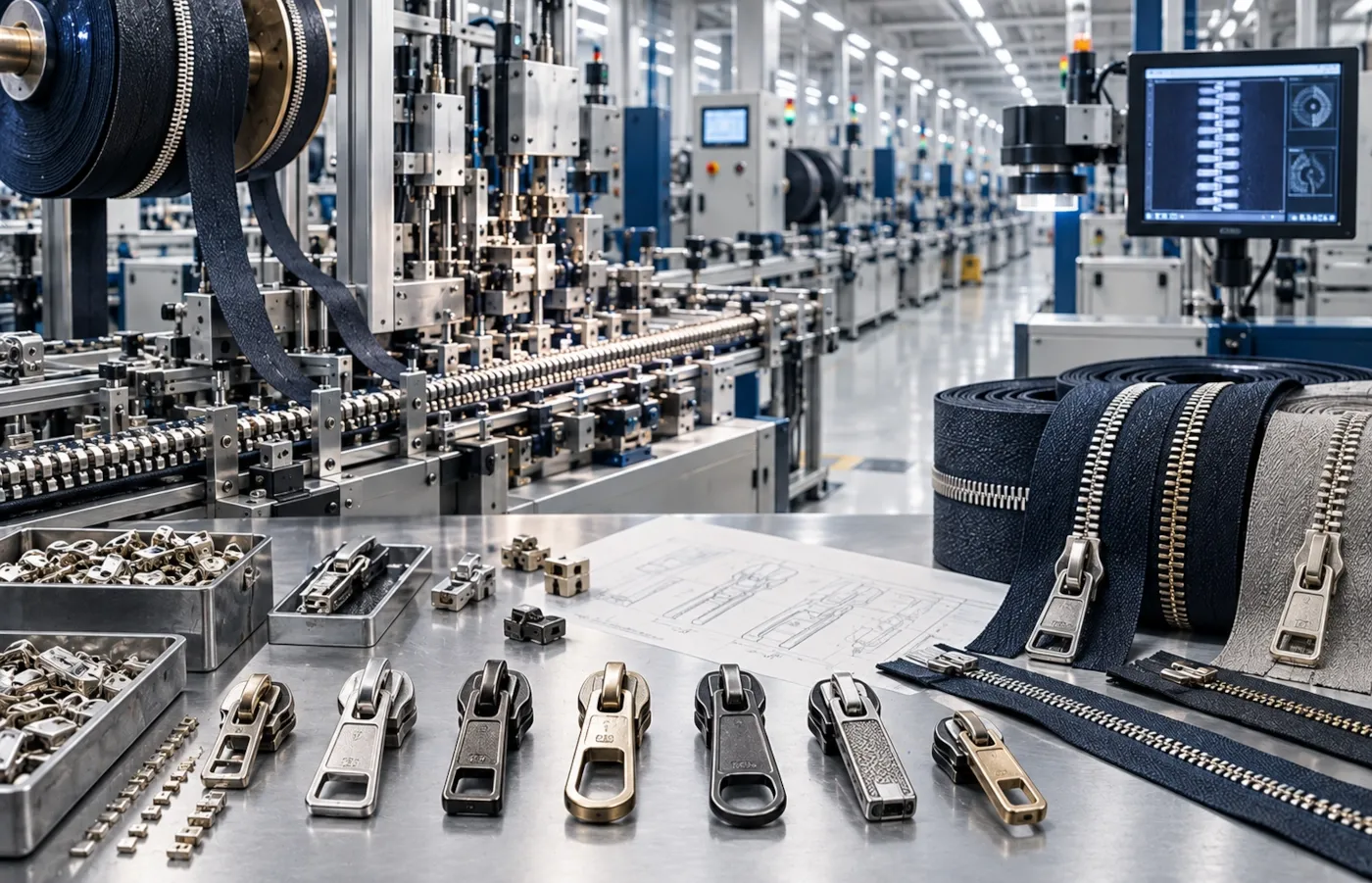
YKK helped define modern zipper manufacturing through scale, precision and quality control, even though the zipper itself had been invented decades earlier.
No.
YKK entered the zipper story decades after Judson and Sundback.
Tadao Yoshida founded San-S Shokai in Tokyo in 1934 to produce and sell fastening products. The business later evolved into the company associated with the YKK name.
YKK’s official corporate history states that the YKK trademark was registered in 1946.
So if a zipper slider says YKK, those letters identify the manufacturer. They are not the initials of the zipper’s inventor and they do not identify a special type of zipper.
YKK became influential because of manufacturing scale, vertical integration and quality control — not because it created the original zipper concept.
What does YKK stand for?
YKK is derived from the former Japanese company name:
Yoshida Kogyo Kabushikikaisha
YKK’s own company materials translate the name approximately as Yoshida Industrial Joint-Stock Company or simply explain it as the corporate name from which the initials were taken.
The “Yoshida” refers to founder Tadao Yoshida.
This is why the same three letters can appear on zippers attached to products from completely different clothing, luggage and equipment brands: YKK supplies fastening products to other manufacturers.
Is the zipper a Swedish invention?
Calling the zipper simply a “Swedish invention” is misleading.
Gideon Sundback was Swedish-born, and his nationality is an important part of his biography. But the invention history crossed countries and generations.
- Elias Howe was American.
- Whitcomb Judson was American and worked in Chicago.
- Sundback was born in Sweden but developed his decisive zipper work while working in North America.
- B.F. Goodrich was an American company that popularised the word zipper.
- YKK was founded later in Japan.
So the zipper does not fit neatly into a one-country origin story.
A better description is that the modern zipper emerged from nineteenth- and early-twentieth-century fastening experiments in the United States, culminating in the work of Swedish-born engineer Gideon Sundback in North America.
Which country invented the zipper?
For the same reason, there is no useful one-word country answer.
If the question refers to Judson’s 1893 clasp locker, the answer points to the United States.
If it refers to Sundback personally, he was born in Sweden.
If it refers to where Sundback developed and patented the modern fastener, the story again belongs largely to the North American industrial context.
History is more accurate here than a flag.
What did people use before the zipper?
Before zippers became practical and cheap, people closed clothing and footwear with combinations of:
- buttons;
- laces;
- hooks and eyes;
- clasps;
- buckles;
- brooches and pins.
These older fasteners could be highly reliable.
Their disadvantage was often speed.
A row of buttons or laces is a sequence of individual operations. A zipper turns many small fastening actions into one continuous motion.
That is the deep conceptual idea shared by Judson and Sundback: automating a repeated fastening task.
Why was the zipper such an important engineering idea?
The zipper solves a deceptively difficult problem.
Imagine trying to design a closure that must be:
- flexible enough for clothing;
- strong enough to resist opening;
- quick to operate;
- reversible;
- lightweight;
- inexpensive;
- compact;
- manufacturable at enormous scale.
A rigid latch is easy to make strong but cannot bend with fabric.
A row of buttons is flexible but slow to operate.
Hook-and-loop fasteners are fast but behave differently under load and have a very different physical profile.
The zipper combines flexibility with a controlled chain of interlocking elements.
Its genius lies in local control.
The user does not need to align every element. The slider handles only the small region where joining or separation is happening at that moment. Once the slider moves on, the already joined section supports itself.
This is why Sundback’s design could survive for more than a century without requiring a complete reinvention.
The materials, coatings, slider designs and specialised applications have evolved dramatically. The underlying mechanical logic remains recognisable.
Common myths about the zipper’s invention
Myth 1: “Whitcomb Judson invented the exact zipper we use today.”
Not quite.
Judson invented and promoted an important early clasp locker, but his mechanism still differed substantially from the reliable interlocking-element zipper associated with Sundback.
Myth 2: “Gideon Sundback invented the zipper from nothing.”
Also misleading.
Sundback inherited an existing technical problem and a history that included Howe, Judson and other fastening experiments. His importance comes from solving the problem well enough to create the modern architecture.
Myth 3: “The zipper was invented in 1917.”
1917 is the year Sundback’s key U.S. patent was granted.
The design had been developed earlier, and the patent application was filed in 1914.
Myth 4: “The zipper is Swedish because Sundback was Swedish.”
Sundback was Swedish-born, but the commercial and patent history of the modern zipper developed in North America and built on earlier American inventions.
Myth 5: “YKK invented the zipper.”
No.
YKK was founded in 1934, long after the essential invention milestones. It became one of the most important zipper manufacturers.
Myth 6: “B.F. Goodrich invented the zipper.”
B.F. Goodrich helped popularise the name zipper. It did not invent Sundback’s fastener mechanism.
Myth 7: “Elias Howe’s 1851 patent was already the modern zipper.”
Howe’s fastener is an important early precursor, but it did not have the later interlocking-element architecture and did not establish the modern zipper industry.
Security, privacy and safety notes
There are no meaningful privacy or account-security risks in researching zipper history, but a few accuracy and safety points matter.
Historical accuracy: do not treat every “first” in invention history as interchangeable. An early patent, the first commercial product, the modern engineering design and the popular name can belong to different people.
Patent dates: a patent filing date is not the same as a grant date, and neither necessarily equals the exact day an inventor first completed a prototype.
Engineering diagrams: simplified illustrations of zipper teeth are educational models. Modern zippers include different constructions, including metal, moulded plastic and coil designs.
Safety-critical equipment: ordinary clothing zippers should not be used as a model for judging specialised pressure-resistant, watertight, protective or life-safety fasteners. Those products are engineered and tested for specific loads and environments.
Repair advice: forcing a damaged slider or clamping it with tools can worsen a zipper. Repair guidance belongs in a dedicated troubleshooting procedure rather than an invention-history article.
Faster alternative
If you only need the history in 30 seconds, use this sequence:
1851 — Elias Howe: patents an early continuous garment fastener.
1893 — Whitcomb Judson: patents and publicly promotes the Clasp Locker, an important commercial zipper precursor.
1913–1917 — Gideon Sundback: develops the modern interlocking fastener, files his key patent in 1914 and receives it in 1917.
1923 — B.F. Goodrich: uses Zipper as the name of an overshoe fitted with the fastener, helping the word become generic.
1934 onward — YKK: enters zipper manufacturing and eventually becomes one of the industry’s dominant producers.
So the most accurate one-sentence answer is:
Judson pioneered the commercial zipper precursor, but Sundback created the modern zipper.
FAQ
Who invented the zipper in 1893?
Whitcomb L. Judson is the name most closely associated with the 1893 milestone. His U.S. Patent No. 504,038 for a “Clasp Locker or Unlocker for Shoes” was granted on 29 August 1893, and his fastener was publicly promoted at the Chicago World’s Fair that year.
Who invented the modern zipper?
Gideon Sundback is generally credited with the modern zipper. His interlocking-element design evolved into the architecture recognisable in modern metal zippers.
When was the modern zipper invented?
Sundback had developed the essential modern design by about 1913. His key U.S. patent application was filed in 1914, and U.S. Patent 1,219,881 was granted in 1917.
Did Elias Howe invent the zipper?
Elias Howe patented an important early continuous garment fastener in 1851. It belongs in zipper history, but it was not the same mechanism as the modern zipper and did not become the successful commercial design later associated with Judson and Sundback.
Why is it called a zipper?
B.F. Goodrich used Zipper as a trademark for an overshoe using the fastener in 1923. The name evoked the quick zip of the mechanism and rapidly became a generic word for the fastener itself.
What were zippers called before they were called zippers?
Earlier names included Clasp Locker, Hookless Fastener, Separable Fastener and the more general technical term slide fastener.
Did YKK invent the zipper?
No. YKK was founded in Japan in 1934, after the key Judson and Sundback inventions. YKK became a major zipper manufacturer rather than the original inventor.
What does YKK stand for on a zipper?
YKK comes from Yoshida Kogyo Kabushikikaisha, the former Japanese corporate name associated with the company founded by Tadao Yoshida.
Is the zipper an American or Swedish invention?
Neither label tells the whole story. Judson’s key 1893 work was American. Sundback was Swedish-born but developed his modern fastener while working in North America. The invention is best understood as a multinational sequence of engineering developments.
What did people use before zippers?
Common alternatives included buttons, laces, hooks and eyes, clasps, buckles and pins. These worked, but many required each fastening point to be handled separately.
Were zippers used in the 1800s?
Zipper-like fasteners existed in the nineteenth century. Howe patented an early garment fastener in 1851, and Judson’s clasp locker was patented and publicly demonstrated in 1893. The reliable modern zipper, however, belongs to the early twentieth century.
Were zippers used in World War I?
Yes, slide fasteners were beginning to find specialised uses around that period, including money belts and other small products. They had not yet become the universal clothing closure familiar today.
When did zippers become popular?
Their adoption accelerated during the 1920s and especially the 1930s, as manufacturing improved and clothing designers began using them more widely. Smithsonian sources highlight 1937 as a notable point in their growing acceptance in men’s clothing.
How does a zipper stay closed?
The slider guides the two element rows into interlocking engagement. Once joined, the element geometry, neighbouring elements and tape resist direct separation. Many modern sliders also include locking mechanisms that help prevent unintended movement.
Is a coil zipper different from Sundback’s metal-tooth zipper?
Yes. A coil zipper uses continuous synthetic coils rather than separate metal teeth. It is a later construction, but the same general idea remains: a slider joins or separates two complementary flexible rows.
Sources and patent references
For the invention dates and mechanical history, the strongest evidence is the original patent record plus institutional and manufacturer histories.
-
Elias Howe Jr., U.S. Patent 8,540 — “Improvement in Fastenings for Garments” (1851)
https://patents.google.com/patent/US8540A/en -
Whitcomb L. Judson, U.S. Patent 504,038 — “Clasp Locker or Unlocker for Shoes” (1893)
https://patents.google.com/patent/US504038A/en -
Gideon Sundback, U.S. Patent 1,219,881 — “Separable Fastener” (filed 1914, granted 1917)
https://patents.google.com/patent/US1219881A/en -
Smithsonian Libraries and Archives — “The Up and Down History of the Zipper”
https://blog.library.si.edu/blog/2010/05/03/the-up-an-down-history-of-the-zipper/ -
Smithsonian National Museum of American History — Sundback’s Modern Slide Zipper Patent Model
https://americanhistory.si.edu/collections/object/nmah_860486 -
National Inventors Hall of Fame — “How Gideon Sundback Perfected the Zipper”
https://www.invent.org/blog/inventors/gideon-sundback-zipper -
YKK Americas — “History of the Zipper”
https://ykkamericas.com/history-of-the-zipper/ -
YKK Corporation — “What’s the Structure of a Zipper?”
https://www.ykk.com/english/ykk/tech/01.html -
YKK Corporation — Corporate History
https://www.ykk.com/english/corporate/group/outline.html -
Merriam-Webster — history of “zipper” as a trademark that became a generic word
https://www.merriam-webster.com/wordplay/8-words-from-trademarks/canola -
Veritasium — “Why Are These 3 Letters on Almost All of My Zippers?”
https://www.youtube.com/watch?v=9szhjhO9epA
Last tested
Reviewed against:
- the original U.S. patent records for Howe, Judson and Sundback;
- Smithsonian institutional histories and collection records;
- the National Inventors Hall of Fame;
- official YKK corporate and engineering documentation;
- Merriam-Webster’s history of the word zipper;
- the supplied Veritasium video transcript for additional historical and engineering narrative.
Last reviewed: 2026-09-22
Related guides
Carefully selected guides to help you understand the topic and complete the next useful step.