Quick answer
Arthur Scherbius, a German electrical engineer and inventor, is the person most directly credited with creating the Enigma cipher machine. He filed a German patent application for a rotor-based cipher apparatus on 23 February 1918, years before the Nazi Party came to power. Commercial Enigma machines were then developed and marketed in the 1920s.
But three different achievements are often incorrectly merged into one story:
| Question | Short answer |
|---|---|
| Who invented the Enigma machine? | Arthur Scherbius developed the machine that became Enigma. |
| Who first broke military Enigma? | Marian Rejewski, working with fellow Polish mathematicians Jerzy Różycki and Henryk Zygalski, made the first decisive cryptanalytic breakthrough in the early 1930s. |
| What did Alan Turing do? | Alan Turing, later working with Gordon Welchman and many others at Bletchley Park, developed powerful British methods for attacking wartime Enigma traffic and helped create the electromechanical Bombe system. |
So the accurate story is not “Alan Turing invented or single-handedly broke Enigma.” It is a chain of invention, mathematical cryptanalysis, intelligence sharing, engineering, operational mistakes, captured material, and industrial-scale codebreaking.
When to use this explanation
Use this guide if you want a complete answer to any of these questions:
- Who invented Enigma?
- Who invented the Enigma machine?
- Was Enigma invented by the Nazis?
- How did the Enigma machine work?
- Who broke the Enigma code first?
- Did the Polish or the British break Enigma?
- What did Alan Turing actually do at Bletchley Park?
- What was the Bombe?
- Why was Naval Enigma harder to break?
- Did Germany ever realise Enigma was vulnerable?
- Could a modern computer crack Enigma today?
This article focuses on the history and engineering of the Enigma family, especially the German military machines used before and during the Second World War. It is not a biography of Alan Turing, a complete military history of Ultra intelligence, or a reconstruction of every Enigma variant ever manufactured.
Before you start
Four distinctions make the rest of the story much easier to understand:
- Enigma was a family of machines, not one single fixed model. Commercial, Army, Air Force, Navy and intelligence variants differed in important ways.
- “Breaking Enigma” did not mean discovering one permanent password. German networks changed keys regularly, often every day, so cryptanalysts had to recover changing settings repeatedly.
- Enigma is technically a cipher machine, not a codebook. “Enigma code” is common everyday language, but the machine performed letter-by-letter encipherment.
- No single person broke Enigma alone. The result came from Polish, British, French and later American cryptanalysts, engineers, intercept operators, intelligence officers, service personnel and thousands of support staff.
Main explanation
The Enigma story is easiest to understand as three separate problems.
First, someone had to invent a practical rotor cipher machine. That was the role associated most directly with Arthur Scherbius.
Second, someone had to discover how to recover the secret settings of the military machine without possessing the key. The first decisive mathematical breakthrough came from the Polish Cipher Bureau, especially Marian Rejewski, Jerzy Różycki and Henryk Zygalski.
Third, the Allies had to turn cryptanalysis into a repeatable wartime process fast enough to matter before the keys changed again. That is where Bletchley Park, Alan Turing, Gordon Welchman, the Bombe, captured documents, operator mistakes and large operational teams became essential.
That distinction prevents the most common historical error: treating “invented Enigma,” “first broke Enigma,” and “built the British wartime attack on Enigma” as if they were the same achievement.
Who invented the Enigma machine?
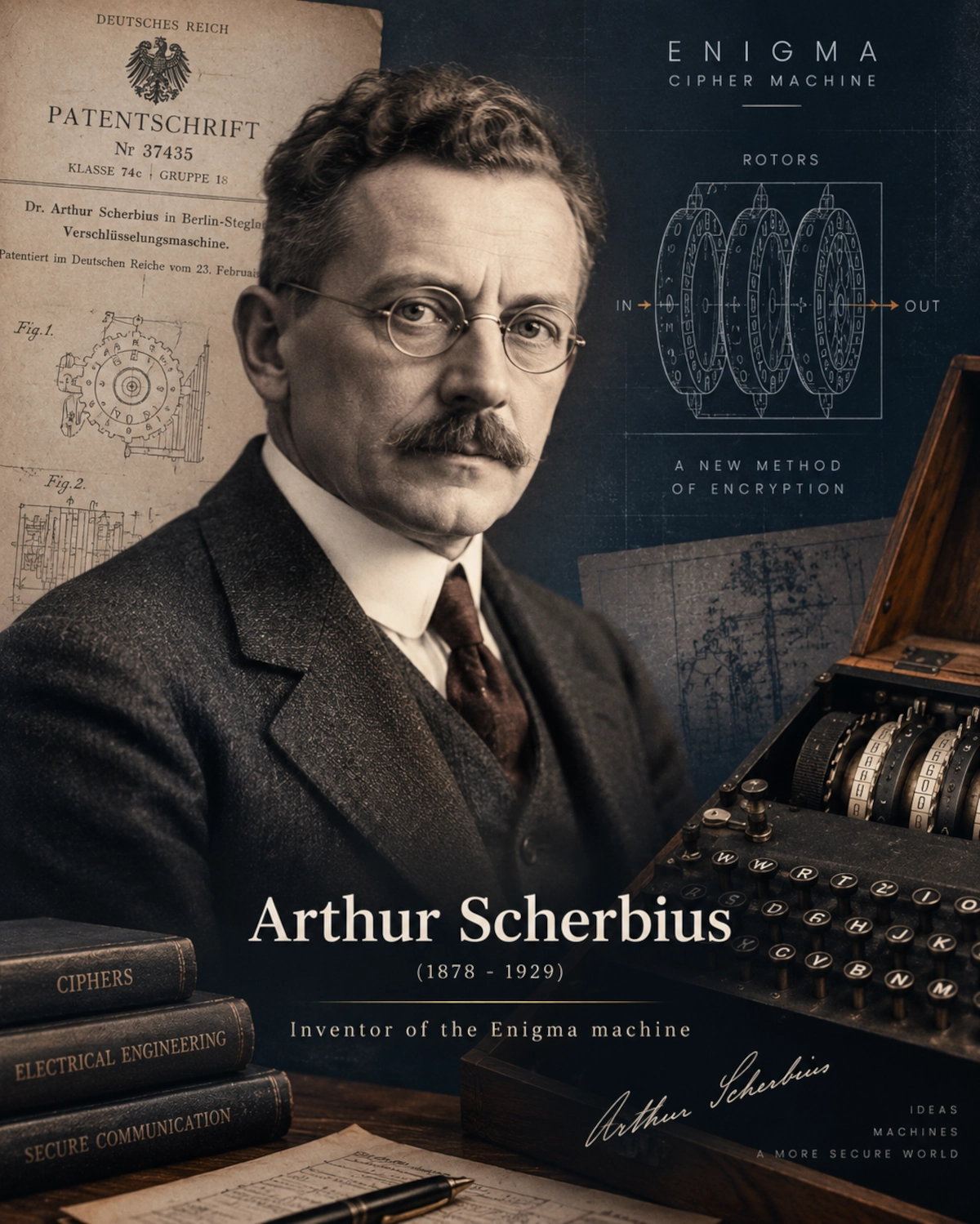
Arthur Scherbius was a German electrical engineer born in 1878. During and immediately after the First World War, he became interested in the problem of protecting messages transmitted over modern communication systems.
According to the Deutsche Biographie, Scherbius submitted his rotor-based cipher invention for patent protection on 23 February 1918. The German patent later appeared as DRP 416219. The Science Museum Group also identifies Scherbius as one of several engineers who discovered the rotor concept and as the designer and developer of the Enigma cipher machine.
The timing matters. Enigma predates Nazi rule by more than a decade.
Scherbius initially saw a market among organisations that needed commercial secrecy: businesses, banks, governments and diplomatic services. Early machines were commercial products, and the technology was promoted during the 1920s. The Science Museum Group dates commercial production from 1923.
The German armed forces later adopted and modified the idea for military use. Military Enigma was therefore not simply the same machine Scherbius first marketed to businesses. It evolved into a family of more secure systems with different rotors, procedures and — crucially — a plugboard on widely used military models.
Was Enigma invented by the Nazis?
No.
This is one of the simplest but most important corrections in the whole Enigma story.
Scherbius filed his original patent application in 1918. Adolf Hitler did not become German chancellor until 1933. Commercial Enigma machines were already being developed and sold years earlier.
What Nazi Germany did was adopt, modify and deploy Enigma at enormous military scale. German military organisations used strengthened versions for operational communications, while different services and networks could use different procedures, rotor sets and key material.
That difference is important because a commercial Enigma that a foreign government could buy in the 1920s was not enough by itself to read German military traffic. Cryptanalysts still had to determine the secret internal wiring and operating procedures of military versions and, above all, recover the changing keys.
Was Arthur Scherbius the first person to invent a rotor cipher machine?
Not quite.
Scherbius is the right answer to “Who invented the Enigma machine?”, but the broader history of rotor cryptography is more complicated.
Around the end of the First World War, several inventors in different countries independently worked on electromechanical cipher machines based on rotating wired wheels. Historical discussions commonly include Edward Hebern in the United States, Hugo Alexander Koch in the Netherlands, Arvid Damm in Sweden and Scherbius in Germany. Research into Dutch rotor-machine history has also identified earlier Dutch work by Theo van Hengel and Rudolf Spengler.
This means two statements can both be true:
- Arthur Scherbius is the inventor most directly associated with Enigma.
- He did not invent the general idea of rotor cryptography in complete isolation from every other inventor.
That distinction is more historically accurate than saying one person invented the entire rotor-cipher concept.
What was the Enigma machine actually used for?
Early Enigma was intended for protecting confidential communications in civilian and governmental environments. Its later military importance came from one major advantage: it made a changing substitution cipher practical in a portable electromechanical machine.
During the Second World War, German organisations used Enigma for large volumes of operational traffic. Army, Air Force, Navy and other networks could have their own keys and procedures.
The important point is that Enigma was not typically being used to encrypt a document that stayed inside the machine. Operators used it to transform plaintext into ciphertext, and that ciphertext could then be transmitted — commonly by radio in Morse code — to another station.
The receiving operator needed:
- a compatible Enigma machine;
- the correct rotor selection and order;
- the correct ring and starting settings;
- the correct plugboard configuration when a plugboard was used;
- the correct operating procedure for that network.
With the matching settings, Enigma’s reciprocal electrical design meant the receiver could type the ciphertext and recover the plaintext.
How did the Enigma machine work?
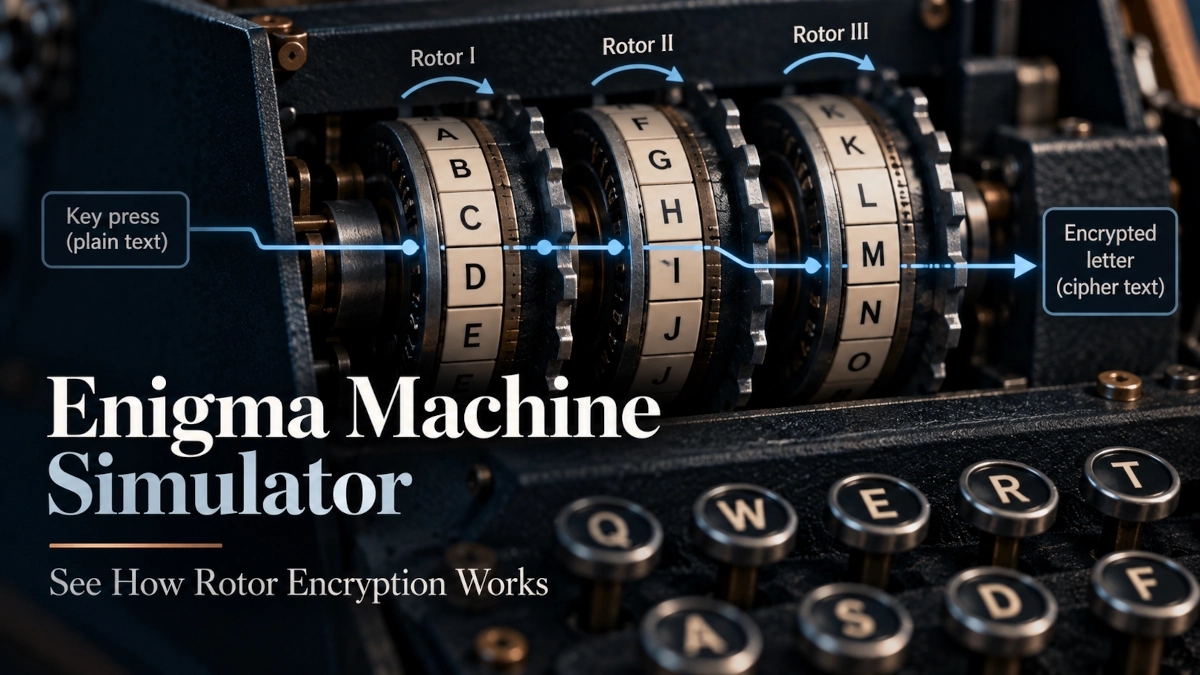
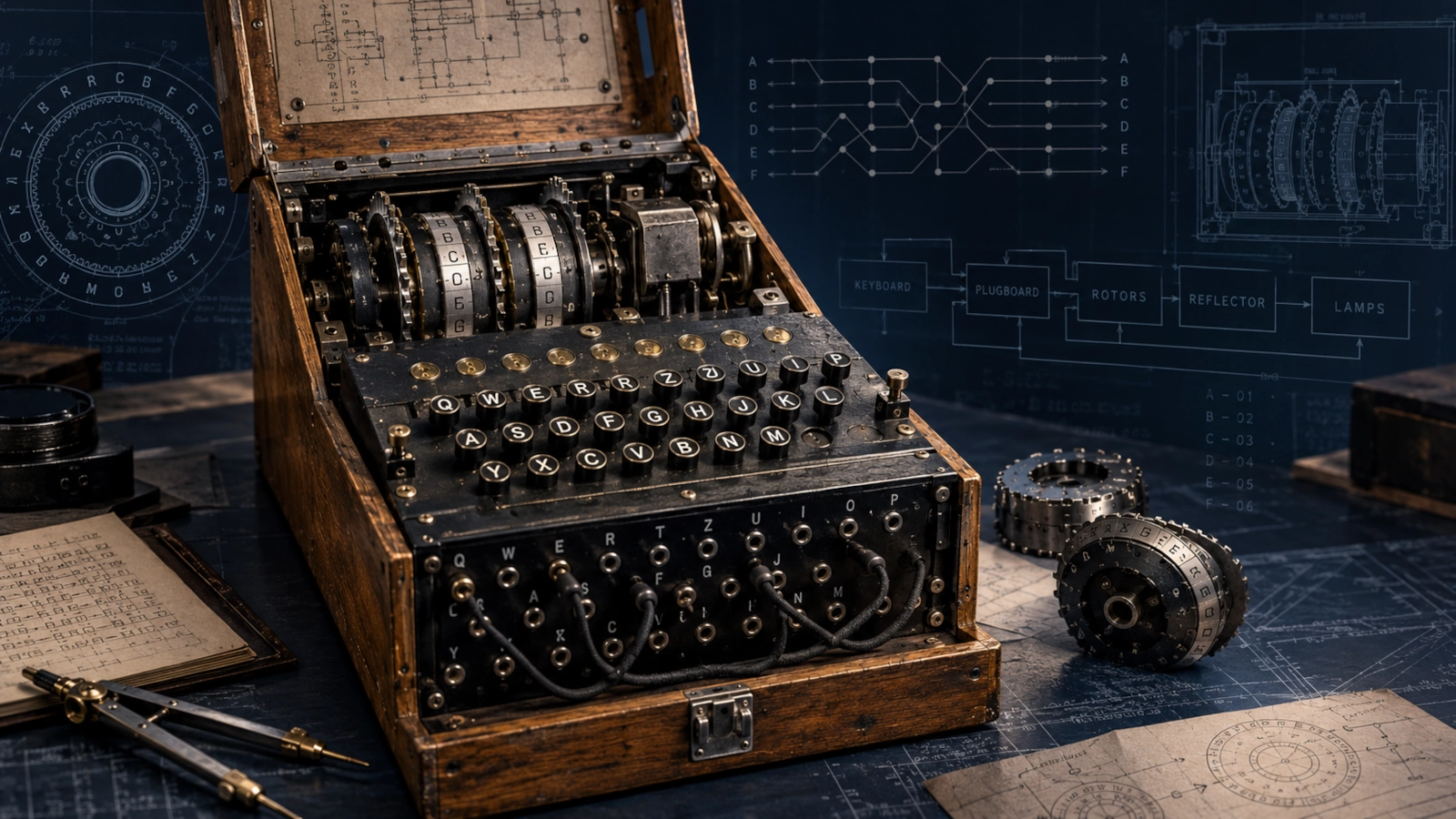
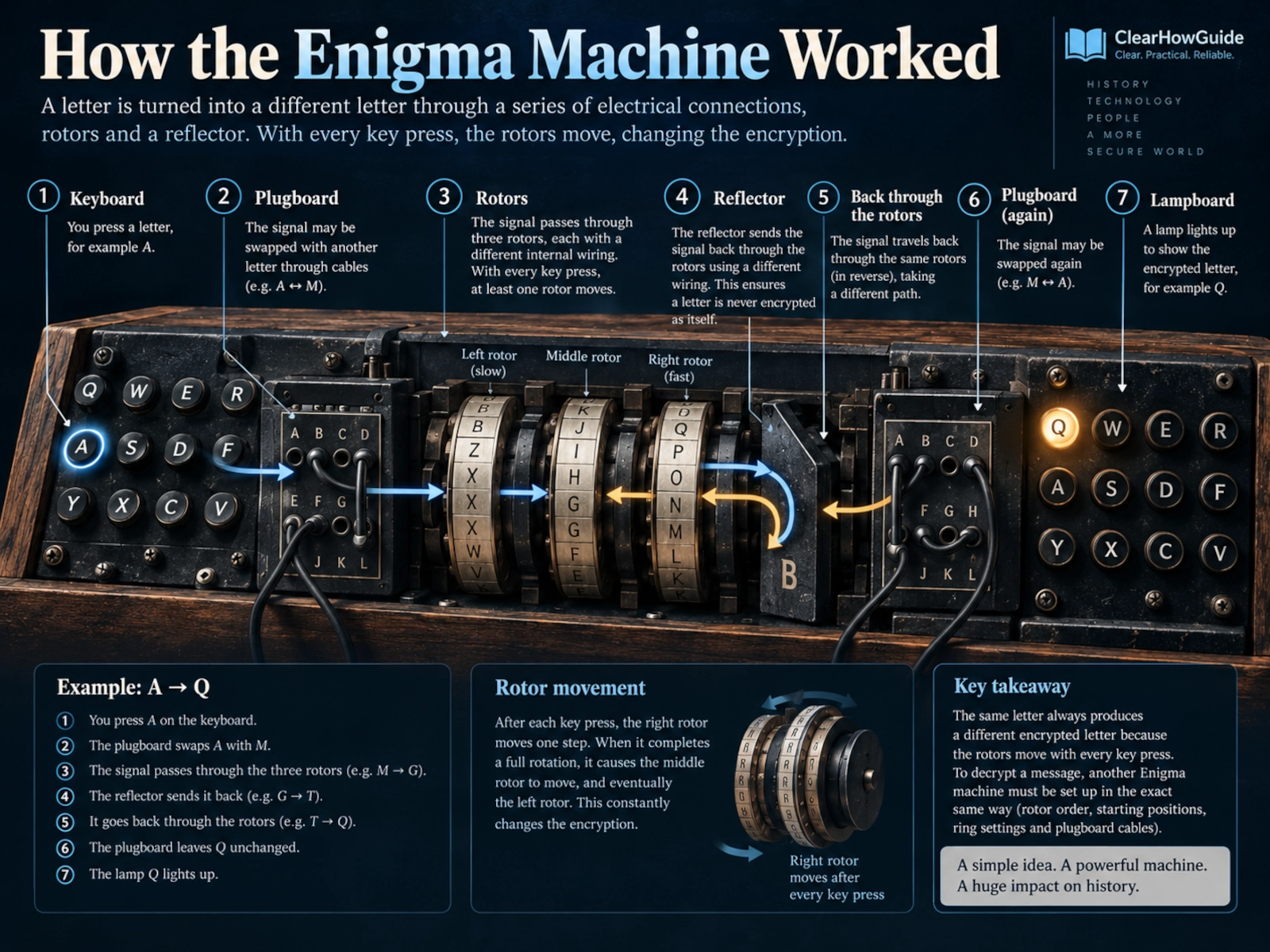
A military Enigma looked superficially like a typewriter in a wooden box, but pressing a key did not print a letter. Instead, an electrical current travelled through a configurable network and illuminated a letter on a lampboard.
A simplified signal path for a common plugboard-equipped machine is:
keyboard → plugboard → rotors → reflector → back through the rotors → plugboard → lampboard
The keyboard and lampboard
When the operator pressed a key, the machine sent electrical current into the cipher circuit. The output appeared as a lit letter on the lampboard.
If the operator pressed A and G lit up, G was the encrypted output for that keypress.
But pressing A again would usually produce a different letter.
That is because the internal state of the machine changed as the rotors stepped.
The rotors
Each rotor contained 26 electrical contacts on each side and internal wiring that permuted one letter position into another.
You can imagine a rotor as a scrambled electrical alphabet.
Current might enter one contact corresponding to one letter and leave through a completely different contact. Passing through several rotors compounded the substitution.
The operator could also change:
- which rotors were installed;
- the order of those rotors;
- their starting positions;
- their ring settings.
Different military variants offered different rotor choices, so there is no single universal Enigma keyspace number that applies to every model and period.
The reflector
After passing through the rotors, the signal reached a reflector. The reflector paired electrical paths and sent the current back through the rotor stack by another route.
This design made Enigma reciprocal: with identical settings, the same machine configuration could be used for both enciphering and deciphering.
The reflector also created one of Enigma’s best-known structural properties:
At a given machine state, a letter could not encrypt to itself.
That fact did not “solve” Enigma on its own, but it later became extremely useful when cryptanalysts tested guesses about possible plaintext.
The plugboard
Many German military Enigmas included a plugboard (Steckerbrett) at the front of the machine.
Cables connected pairs of letters, swapping them before the signal entered the rotors and again after the signal returned. This dramatically increased the number of possible configurations.
The plugboard is one reason simple descriptions such as “Enigma had X combinations” are often misleading. The number depends on the model, rotor choices, ring settings, plugboard practice and what exactly is being counted.
Why did the same letter encrypt differently each time?
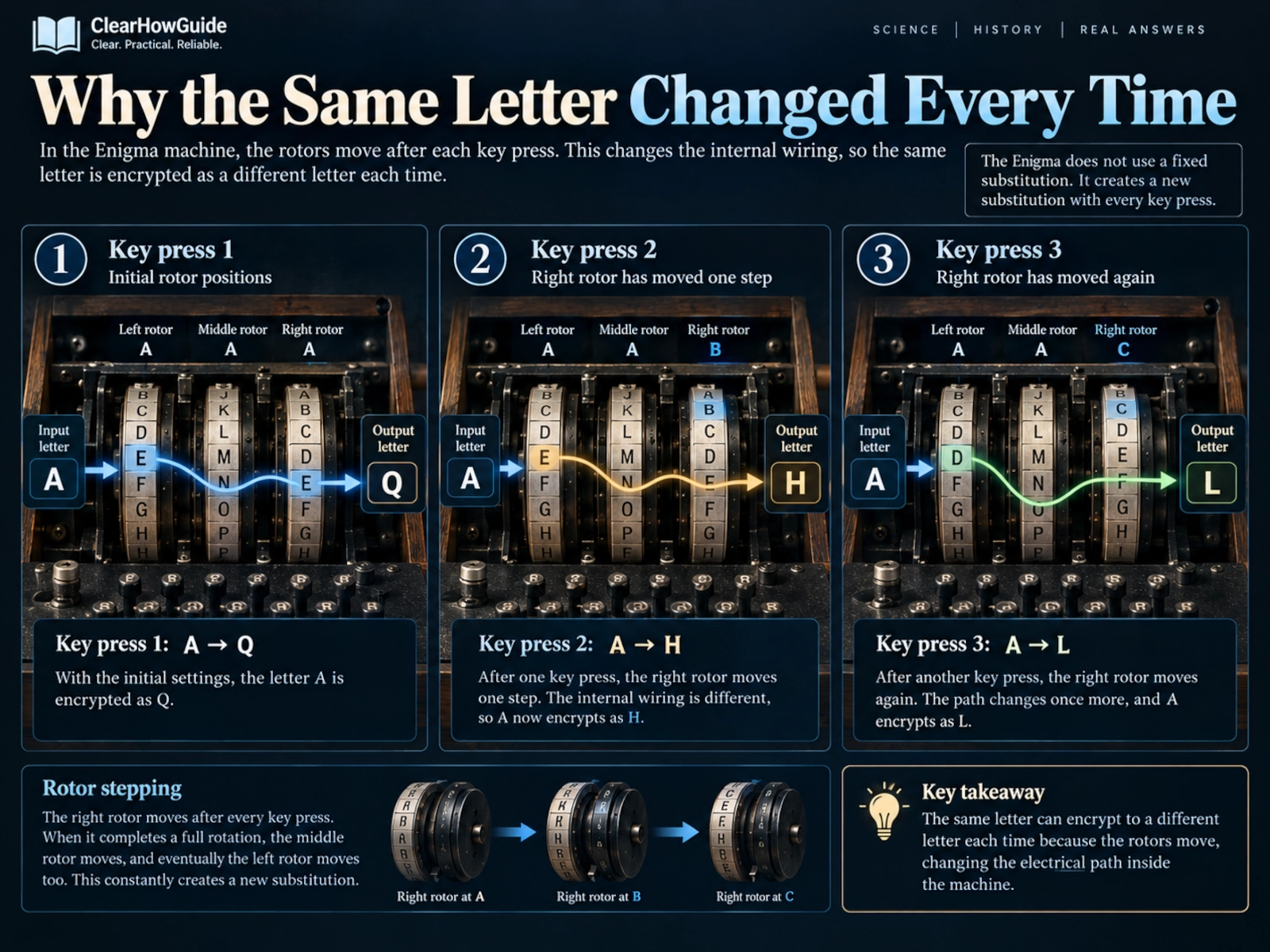
The reason is rotor stepping.
On a common three-rotor Enigma, pressing a key advanced the right-hand rotor. At turnover positions, movement could propagate to another rotor. The exact stepping behaviour is more subtle than a simple car odometer — including the famous “double-step” effect on common Wehrmacht Enigmas — but the core idea is straightforward:
Every step changes the electrical mapping.
So the machine does not use one fixed substitution such as:
A → G
for an entire message.
Instead, it behaves more like:
- first
A→G - next
A→P - next
A→X
depending on the rotor state at each keypress.
That changing substitution is what made rotor machines far more formidable than a Caesar cipher or ordinary monoalphabetic substitution.
Initial settings
- Rotors
- I — II — III
- Ring
- A — A — A
- Position
- A — A — A
- Reflector
- B
- Plugboard
- None
Current state
- Position
- A — A — A
- Letters processed
- 0
- Last input
- —
- Last output
- —
ConfigurationSettingsShow or hide
Machine · single-letter experiment
Follow one keypress
← Forward: right → middle → left → reflector
↳ Reverse: left → middle → right → lamp
Lampboard
Output letter: —
Keyboard
Choose a key, or focus this machine and type A–Z. Typing in settings or the message field leaves the machine unchanged.
Signal path
Inside the last keypress
Press a key to trace its path through the machine.
Message workspace
Process a message
Only A–Z enters the machine. Spaces, punctuation, digits and other characters do not advance the rotors.
Message controls
Playback
Step processes one normalized letter. Play processes one complete key animation at a time.
Why was Enigma so difficult to crack?
Enigma combined several layers of uncertainty:
- which rotors were selected;
- the order of those rotors;
- the rotor starting positions;
- the ring settings;
- plugboard pairings;
- different operating procedures;
- different networks using different keys;
- key changes that forced cryptanalysts to begin again.
And the challenge was not merely to solve a theoretical puzzle eventually.
Wartime intelligence expires.
A message about a convoy, aircraft movement or military operation may become useless if it is deciphered days later. Codebreakers therefore had to recover useful keys fast enough for the information to affect decisions.
That is why the history of Enigma is not simply a story about a huge number of possible settings. It is about reducing a huge search problem using mathematics, machine structure, predictable language, traffic analysis, human mistakes, captured material and automation.
Steps
1. The Polish Cipher Bureau made the first decisive break
The first major cryptanalytic success against German military Enigma did not happen at Bletchley Park.
It happened in Poland.
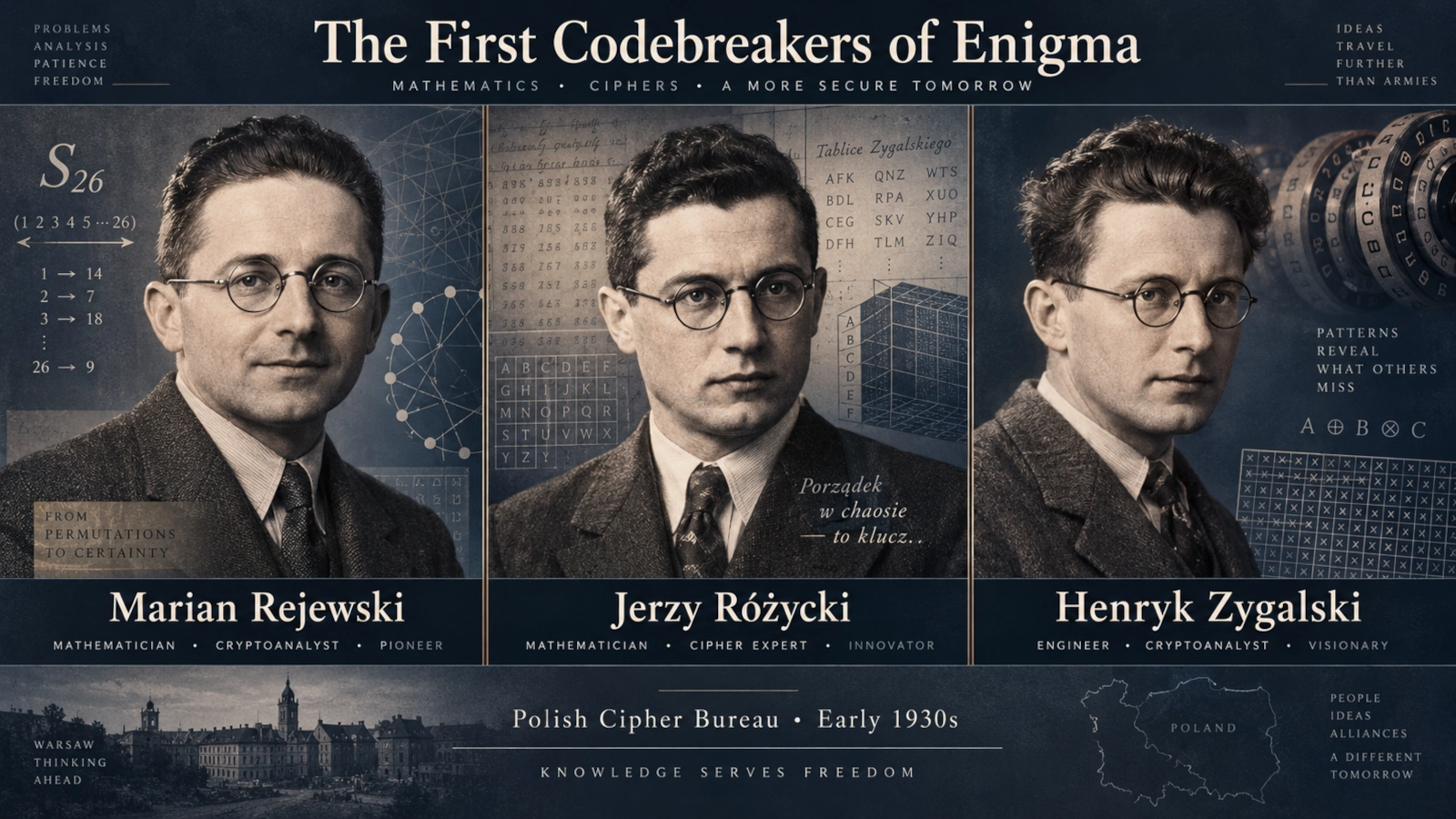
In the early 1930s, Polish intelligence faced Germany as a direct strategic threat and invested heavily in mathematical cryptanalysis. The Polish Cipher Bureau recruited mathematicians including Marian Rejewski, Jerzy Różycki and Henryk Zygalski.
French intelligence had obtained German Enigma-related documentation from a source inside the German cipher establishment and shared useful material with Poland. Rejewski then applied permutation theory to the machine’s indicator system.
A major procedural weakness helped him.
At one stage, German operators encrypted a three-letter message setting twice. Repeating the same underlying three letters created mathematical relationships between ciphertext positions. Rejewski recognised that these relationships could be studied as permutations.
By the end of 1932 and into 1933, the Polish team had achieved something extraordinary: they reconstructed the military Enigma’s logical structure and rotor wiring closely enough to build replicas and recover settings.
The NSA credits Rejewski with the initial analysis that enabled later Allied exploitation of Enigma.
2. Poland developed machines and methods before the war
The Polish Cipher Bureau did not stop at a one-time solution.
It created methods and devices to keep attacking Enigma as procedures changed. These included the bomba kryptologiczna, as well as other techniques associated with Różycki and Zygalski.
This is why it is inaccurate to describe Poland merely as giving Britain “a clue.”
The Polish contribution included years of successful mathematical work, knowledge of military Enigma, replica machines and practical attack methods.
But German security changes made the problem substantially harder. More rotors became available and plugboard practice grew more complex. With invasion approaching, Poland no longer had the resources to scale its existing approach indefinitely.
3. Poland shared its Enigma breakthrough with Britain and France in 1939
In July 1939, only weeks before Germany invaded Poland, Polish cryptanalysts met British and French representatives near Warsaw.
They shared their knowledge of Enigma, including reconstructed machines and cryptanalytic techniques.
This transfer was foundational.
The British effort did not begin from a blank sheet of paper in September 1939. The information from the Polish Cipher Bureau gave Bletchley Park a major head start on the machine and the problem it had to solve.
The historical chain is therefore:
Polish breakthrough → transfer to Britain and France → wartime British development and scaling
not:
Britain independently discovers everything from scratch.
4. Bletchley Park combined mathematics with intelligence about human behaviour
Once the war began, Britain’s Government Code and Cypher School operated from Bletchley Park.
Intercept stations collected encrypted German radio traffic and sent it for analysis. Cryptanalysts searched for anything that could reduce uncertainty.
Some weaknesses came not from Enigma hardware but from its users.
“Cillies”
People are bad at randomness.
Operators sometimes chose predictable message settings based on names, places or familiar letter combinations. British cryptanalysts referred to some of these non-random choices as cillies.
A “random” setting based on a girlfriend’s name or a location is not random at all if an adversary can guess the habit.
The Herivel tip
John Herivel developed another insight based on operator behaviour.
Under particular procedures, operators had to move their rotors away from a daily configuration. Some did so lazily, changing settings only slightly. Looking at enough early traffic could therefore reveal clustering that gave clues about the underlying daily settings.
The broader lesson is timeless:
A cryptographic system can be mathematically strong and still be weakened by poor operational behaviour.
5. Turing and Welchman turned the attack into an industrial process
Alan Turing joined the British effort with a background uniquely suited to the problem: mathematics, logic and the theory of computation.
His task was not to invent Enigma and not to rediscover the Polish breakthrough. It was to create an attack that could work against changed wartime procedures at useful speed.
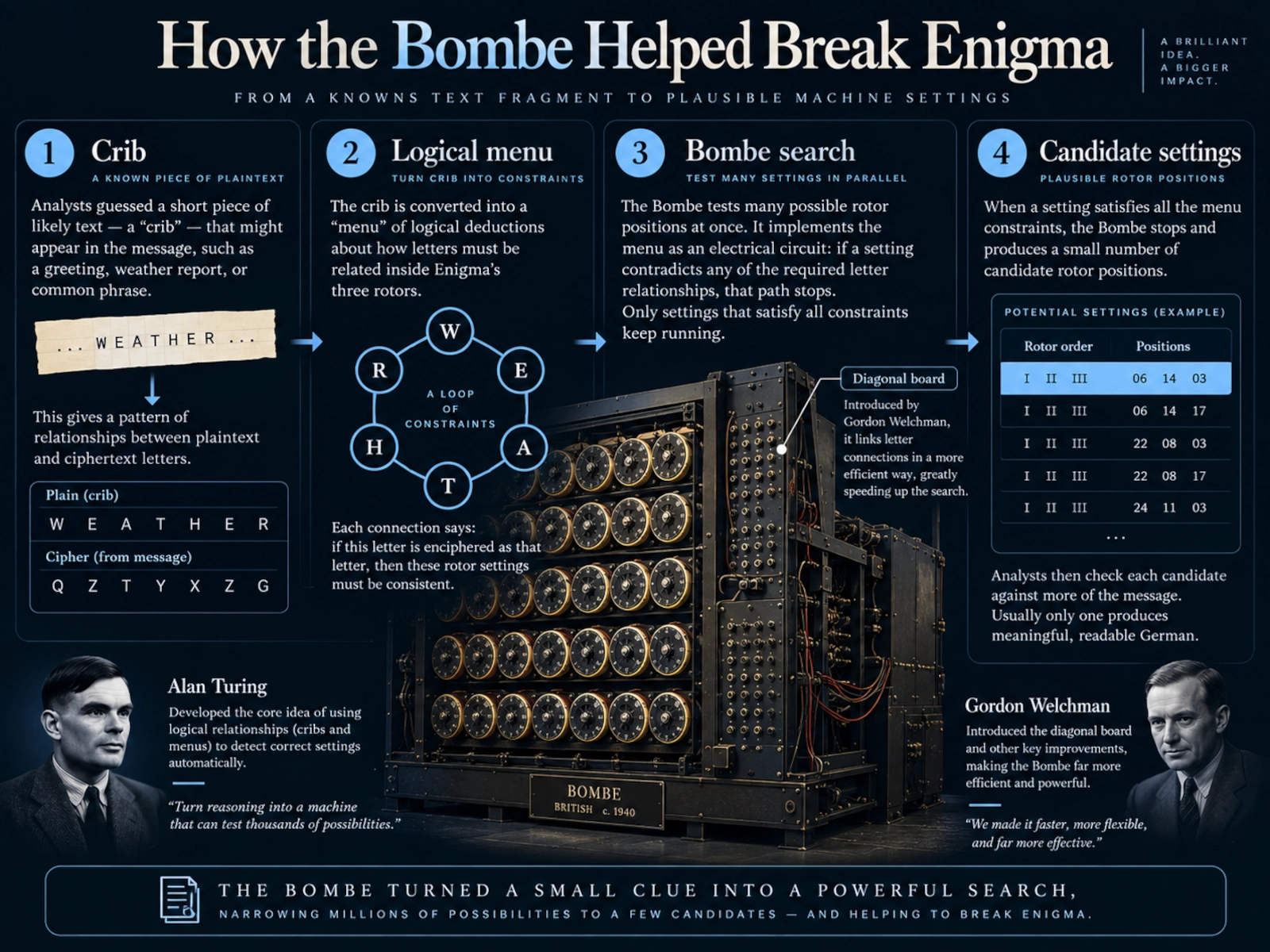
One of the crucial ideas was to use a crib — a well-founded guess about part of the plaintext.
A weather report was a classic example. If an intercepted message came from a station known to transmit weather information at a predictable time, cryptanalysts might guess that a phrase such as a weather term appeared somewhere in the plaintext.
The no-letter-to-itself property helped align that guess with ciphertext. If a guessed plaintext letter lined up with the same ciphertext letter, that alignment was impossible and could be rejected immediately.
Turing then exploited logical relationships created by a crib. Instead of testing every complete key naively, the attack looked for contradictions and consistency across linked letter relationships.
That process was mechanised in the British Bombe.
Gordon Welchman’s major contribution was the diagonal board, which connected reciprocal plugboard implications and greatly reduced false stops. The combination transformed Turing’s attack into a much more practical wartime system.
Who broke Enigma first?
If “broke Enigma” means the first successful cryptanalytic reconstruction and systematic reading of German military Enigma, the answer is the Polish Cipher Bureau, with Marian Rejewski at the centre of the initial breakthrough and Jerzy Różycki and Henryk Zygalski contributing essential methods.
The NSA dates the Polish breakthrough to the early 1930s and explicitly credits Rejewski’s analysis as enabling later Allied exploitation.
Britain’s later achievement was different in scale and wartime context. Bletchley Park had to attack changing networks continuously, process enormous volumes of traffic, adapt to new procedures and machines, and turn successful cryptanalysis into operational intelligence.
So asking “Did Poland or Britain break Enigma?” presents a false choice.
A better answer is:
Polish cryptanalysts broke military Enigma first; British cryptanalysts and engineers built on that foundation and developed a much larger wartime system for repeatedly breaking changing Enigma keys.
France also belongs in the story because French intelligence supplied German material that helped the Polish attack, and the United States later became deeply involved in the attack on four-rotor Naval Enigma.
What did Alan Turing actually do?
Alan Turing’s contribution was enormous — but it becomes more impressive, not less, when described accurately.
At Bletchley Park, Turing:
- developed new cryptanalytic methods for wartime Enigma;
- played a central role in the attack on Naval Enigma;
- developed Banburismus, a statistical technique for reducing possible Naval Enigma wheel orders;
- designed the logical basis of the British Bombe attack;
- worked within a larger team that included Gordon Welchman and engineers such as Harold “Doc” Keen;
- built on information and ideas received from the Polish Cipher Bureau.
Turing did not sit down one day, press a button and permanently “crack Enigma.”
The actual wartime process involved:
- intercepted signals;
- traffic analysis;
- cribs;
- cryptanalytic menus;
- Bombe runs;
- checking candidate stops;
- recovering settings;
- deciphering traffic;
- translation and intelligence analysis;
- strict controls on how the resulting intelligence was used.
This was a system, not a lone-genius moment.
How Enigma’s weaknesses were exploited
Enigma was not defeated by one magical flaw.
It was attacked through a combination of structural properties, operating mistakes and intelligence.
1. A letter could not encrypt to itself
Because of the reflector-based design, a letter could not emerge as itself at a given machine state.
This allowed codebreakers to reject impossible crib alignments quickly.
It was a valuable property for cryptanalysis — but calling it “the fatal flaw” is too simplistic.
2. German messages contained predictable language
Military organisations are repetitive.
Weather reports, standard headings, routine reports, place names, ranks and formatting habits created predictable plaintext.
A good crib did not need to reveal an entire message. It only needed to create enough constraints to test candidate machine settings.
3. Operators made predictable choices
Cillies, insufficiently random settings and procedural shortcuts reduced security.
These weaknesses show why good cryptography depends on both mathematics and disciplined implementation.
4. Procedures sometimes leaked relationships
The early doubled message-setting procedure exploited by the Polish team was a major example.
Changing the procedure closed one weakness, but cryptanalysis evolved with it.
5. Captured documents and machines mattered
Allied forces captured codebooks, key material and Enigma equipment from ships, weather vessels and submarines.
These captures did not replace mathematics, but they could dramatically reduce uncertainty and restore access to traffic after changes.
For Naval Enigma especially, physical intelligence and cryptanalysis repeatedly reinforced one another.
How did the Bombe work?
The British Bombe was not a general-purpose computer, and it did not simply “decode a message” by trying every possible plaintext.
It was an electromechanical machine designed to test large numbers of possible Enigma states against logical constraints derived from a crib.
A simplified Bombe workflow looked like this:
- Cryptanalysts proposed a plausible crib.
- They aligned the crib against the ciphertext, rejecting positions that violated Enigma’s no-self-encryption rule.
- The surviving alignment produced relationships between letters at different machine positions.
- Those relationships were converted into a menu for the Bombe.
- The Bombe simulated linked Enigma-like transformations across many possible rotor positions.
- Electrical contradictions eliminated impossible settings.
- A stop identified a candidate worth checking.
- Operators and checking equipment tested whether the candidate produced meaningful plaintext.
A standard British Bombe contained multiple Enigma-equivalent drum sets. The National Museum of Computing describes the standard machine as containing 36 Enigma equivalents and reports that a full scan of 17,576 positions for a wheel order could take about 10.4 minutes without stops on the relevant machines.
The machine therefore did something more intelligent than blindly enumerate every theoretical key. It used known structure to eliminate impossible states quickly.
Gordon Welchman’s diagonal board
Turing’s original logic could still produce too many false stops.
Gordon Welchman recognised that plugboard relationships are reciprocal: if R is connected to Y, then Y is connected to R.
His diagonal board propagated those implications across the Bombe’s electrical network.
That improvement sharply reduced false positives and made the Bombe system far more practical.
The historically accurate name Turing-Welchman Bombe reflects the importance of both contributions.
What made Naval Enigma harder?
The German Navy used particularly strict procedures because submarine operations depended on secure radio communication.
Naval Enigma was harder for several reasons:
- the Navy used a larger set of available rotors than common Army and Air Force configurations;
- naval messages often followed stricter procedures;
- U-boat traffic offered fewer convenient mistakes;
- codebooks and short-signal systems added further layers around the Enigma encipherment;
- from February 1942, important U-boat traffic moved to the four-rotor M4 system.
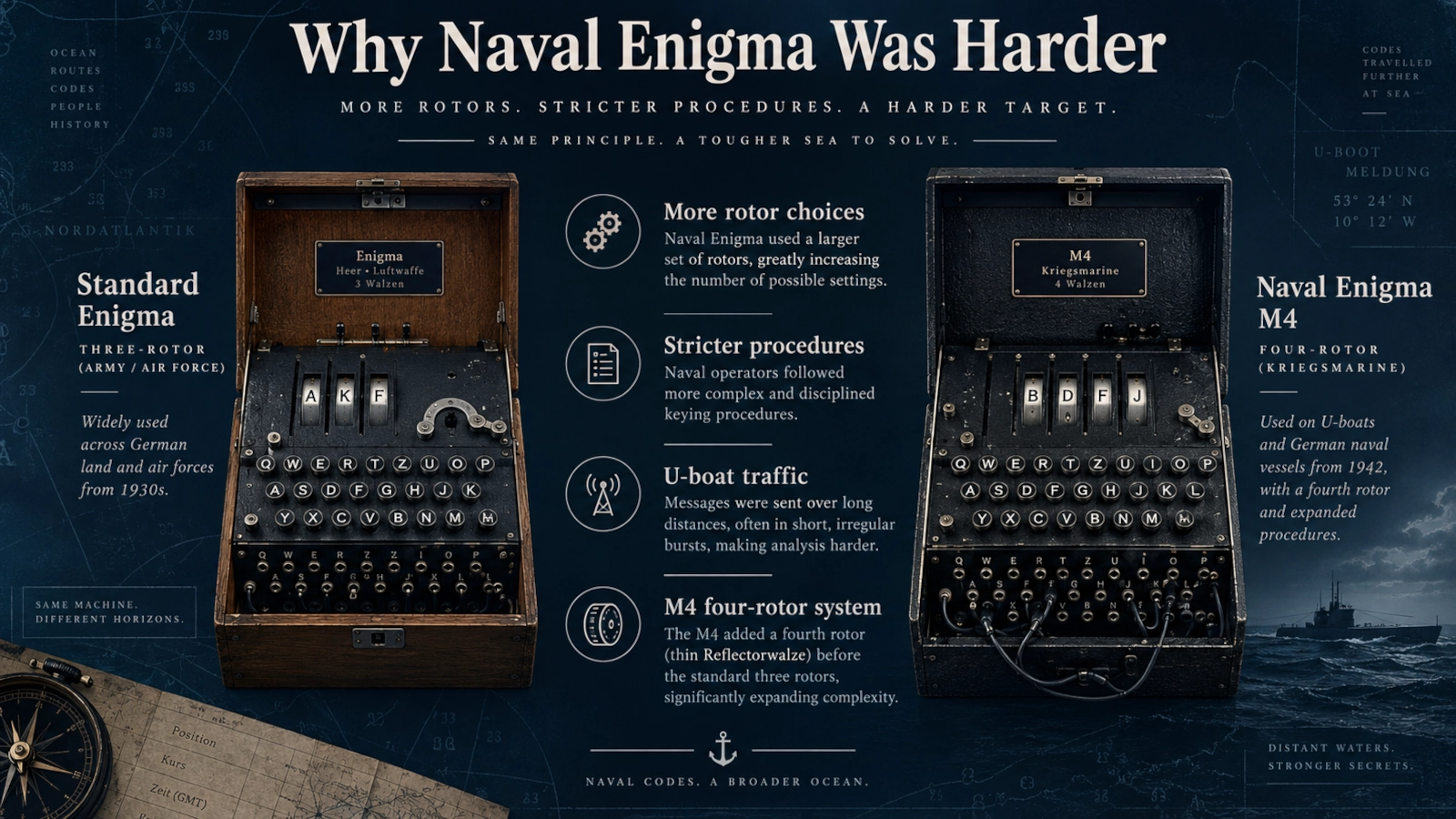
The four-rotor change produced a major blackout in Allied reading of U-boat traffic.
Bletchley Park had already attacked naval communications before that change, but M4 required new work, new machinery and continued access to useful intelligence.
Turing’s Banburismus helped reduce possible wheel orders before the four-rotor transition. Captured naval material also remained important.
In 1941, the capture of material from German vessels — including U-110 — yielded key documents that assisted Allied work on Naval Enigma.
In 1944, the U.S. Navy captured U-505, recovering an Enigma machine with current rotors, codebooks and communications material. The capture was kept secret because revealing that a U-boat and its cryptographic material had fallen intact into Allied hands could have jeopardised ongoing intelligence.
The United States also built specialised Bombes for four-rotor Naval Enigma. U.S. Navy women in the WAVES helped build and operate this machinery.
Did Germany know Enigma had been broken?
The most accurate answer is:
German authorities had suspicions and investigated possible compromises, but they did not understand the full scale and continuity of Allied Enigma exploitation.
This is more precise than saying either “Germany never suspected anything” or “Germany knew Enigma was broken.”
Declassified historical material shows that German organisations investigated security concerns, operator behaviour, possible betrayal and the theoretical vulnerability of Enigma under certain conditions.
But the Allies protected Ultra, the intelligence derived from high-grade decrypts, with extraordinary secrecy. Operational commanders were expected to disguise the source of intelligence when acting on it — for example, by arranging reconnaissance that could plausibly “discover” information already known from signals intelligence.
German confidence was also reinforced by an understandable assumption: even if an enemy captured a machine, the enormous changing keyspace and daily procedures appeared to make routine decryption impractical.
The mistake was not believing that Enigma was mathematically perfect. It was failing to appreciate how effectively Allied cryptanalysis, intelligence collection, machinery and operational discipline had been combined.
Could a modern computer crack Enigma today?
Yes, historical Enigma can be attacked far faster with modern computing — but “How many seconds does it take?” does not have one universal answer.
The difficulty depends on:
- which Enigma model is being attacked;
- how many rotors are available;
- whether a plugboard is used and how;
- what parts of the key are known;
- message length;
- whether a crib is available;
- how much ciphertext from the same key is available;
- whether historical operating procedures are assumed;
- which algorithm and hardware are used.
A modern program does not have to imitate the wartime Bombe exactly. It can combine brute force with statistical language scoring, known historical constraints, optimisation and parallel computing.
For a classroom challenge with a known model and enough ciphertext, a modern computer can often solve configurations that would have been a major wartime task.
For an arbitrary short ciphertext with missing context and an unspecified Enigma variant, the problem can remain ambiguous.
So claims such as “a modern laptop cracks Enigma instantly” are only meaningful when the test conditions are stated.
Enigma myths vs facts
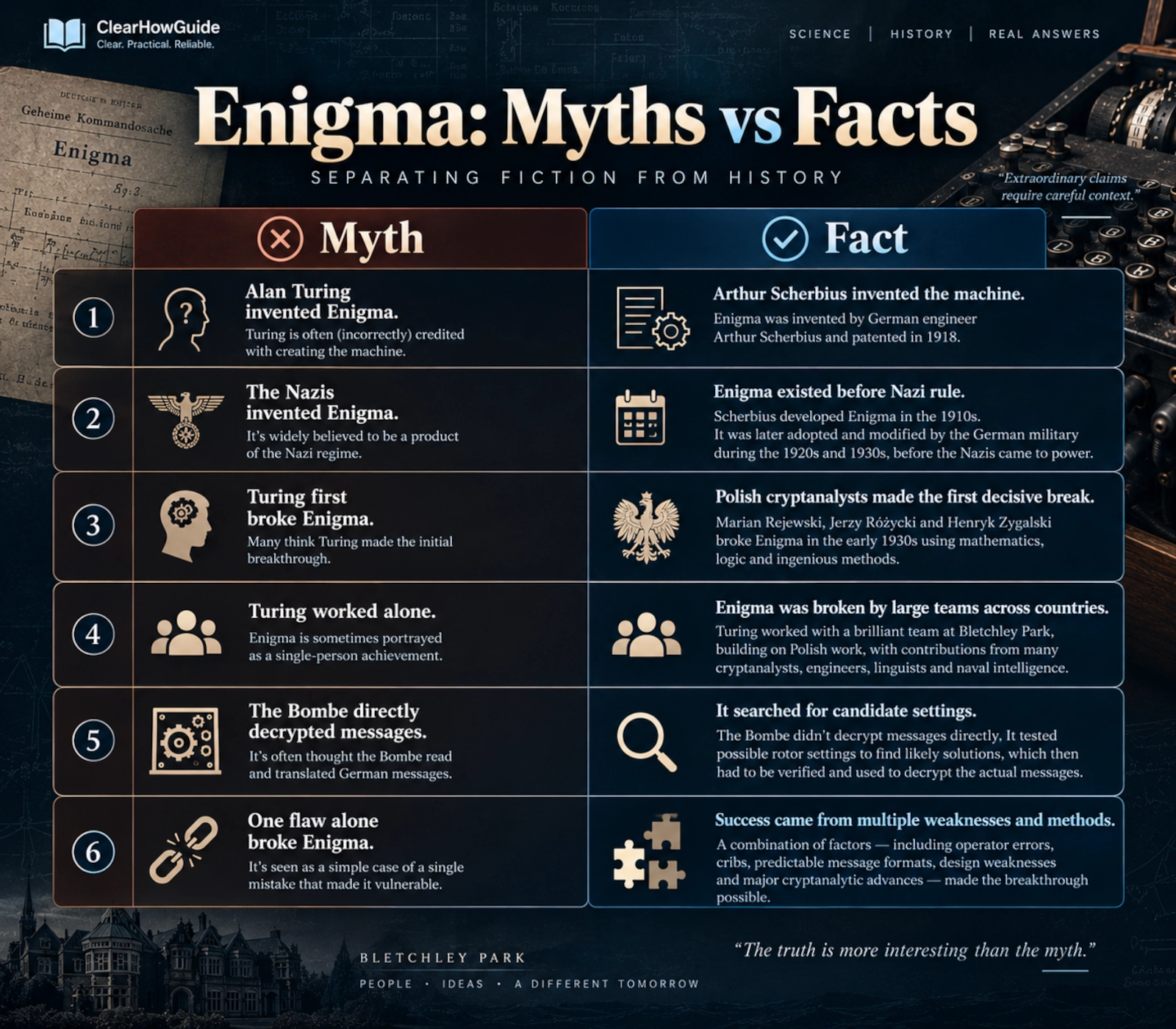
| Myth | What the history actually shows |
|---|---|
| Alan Turing invented Enigma. | Arthur Scherbius developed the machine that became Enigma. |
| The Nazis invented Enigma for World War II. | Enigma began as a commercial rotor-cipher system years before Nazi rule. |
| Alan Turing was the first person to break Enigma. | Polish cryptanalysts made the first decisive break of German military Enigma in the early 1930s. |
| Turing broke Enigma alone. | The wartime attack depended on Polish work, Bletchley Park teams, Gordon Welchman, engineers, intercept operators, Bombe operators, captured material and later American support. |
| The Bombe decrypted messages directly. | It searched for candidate machine settings that could satisfy constraints derived from cribs. |
| Enigma had one fixed number of possible keys. | Keyspace depended on model, rotor set, plugboard practice and operating procedure. |
| One flaw made Enigma easy to break. | Success came from several machine properties, procedural weaknesses, predictable plaintext, human behaviour, intelligence and automation. |
| Once Enigma was broken, every German message could be read. | Different networks and keys varied in difficulty; some keys were broken quickly, some late and some not at all. |
| Germany never suspected a cryptographic problem. | German authorities investigated security concerns, but did not grasp the full Allied exploitation. |
| Colossus was built to break Enigma. | Colossus was associated with attacks on the Lorenz cipher, not the ordinary Enigma problem solved with Bombes. |
Enigma timeline: 1918–1945
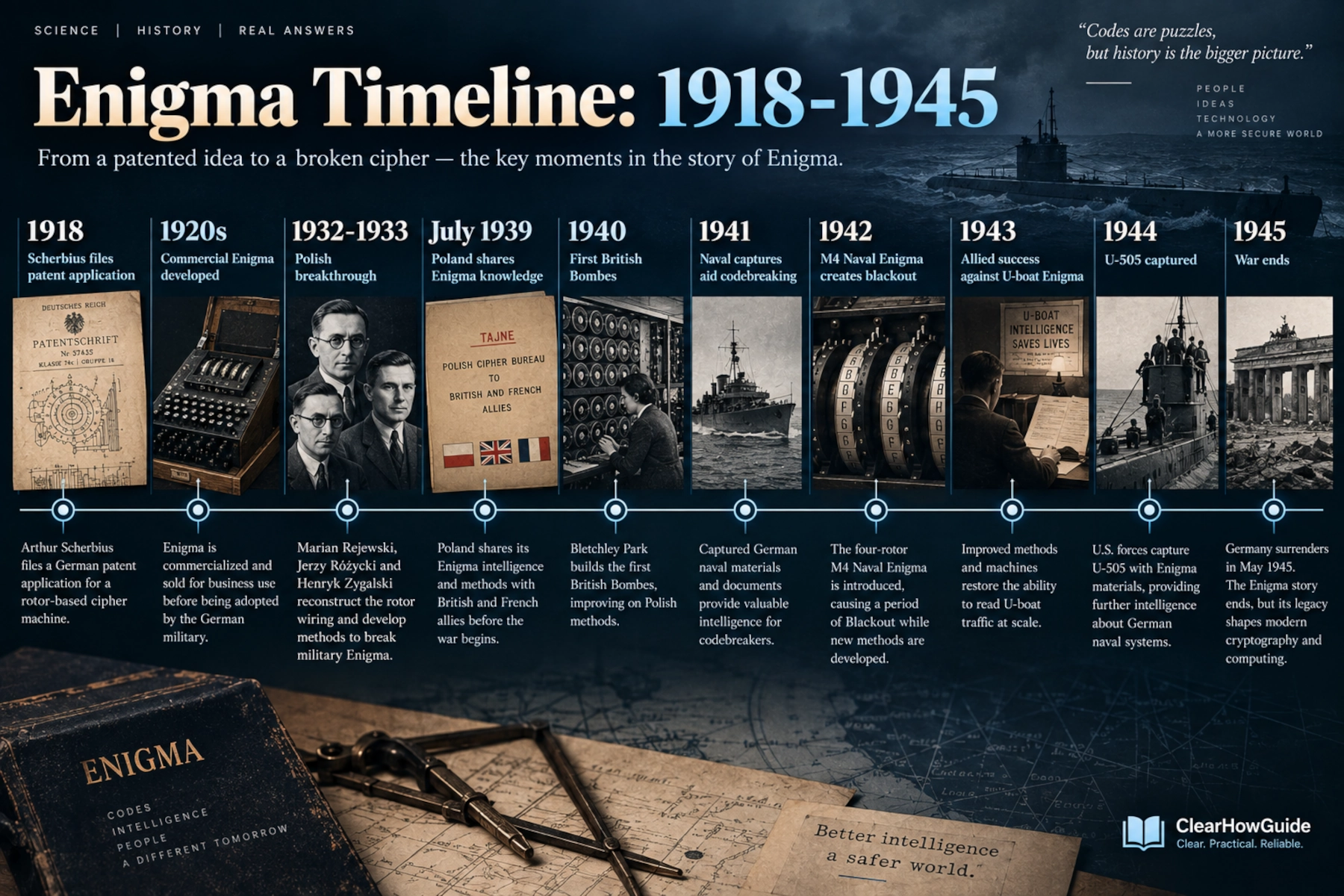
| Year | What happened |
|---|---|
| 1918 | Arthur Scherbius filed a German patent application for a rotor-based cipher apparatus. |
| 1920s | Commercial Enigma machines were developed and marketed; German organisations gradually explored and adopted military variants. |
| 1932–1933 | Marian Rejewski made the decisive mathematical breakthrough against German military Enigma; the Polish Cipher Bureau reconstructed the machine and developed repeatable attacks. |
| Mid-1930s | Polish cryptanalysts continued reading and attacking German Enigma traffic as procedures evolved. |
| 1938–1939 | German changes, including a larger available rotor set and more complex plugboard use, made the Polish problem much harder. |
| July 1939 | Poland shared its Enigma knowledge, replicas and methods with Britain and France. |
| September 1939 | Germany invaded Poland; Britain entered the war and Bletchley Park’s wartime operation accelerated. |
| 1940 | The first British Bombes entered service; Turing’s attack and Welchman’s diagonal board established a scalable method for many Enigma networks. |
| 1941 | Captured naval cryptographic material helped Bletchley Park read important U-boat traffic more consistently. |
| February 1942 | German U-boat traffic shifted to the four-rotor M4, causing a major Allied intelligence blackout. |
| Late 1942–1943 | British and American work restored effective attacks on four-rotor Naval Enigma; American Bombes expanded capacity. |
| 1944 | The U.S. Navy captured U-505 with an Enigma machine, rotors, codebooks and communications material. Ultra intelligence continued supporting Allied operations. |
| 1945 | Germany surrendered; the scale of Allied Enigma exploitation remained secret from the public for decades. |
What did Alan Turing do after Bletchley Park?
Turing’s scientific career did not end with Enigma.
After the war he joined the National Physical Laboratory, where he produced the design for the ACE — Automatic Computing Engine, an important early stored-program computer concept.
He later moved to the University of Manchester, worked on early digital computing and returned to questions about machine intelligence. His 1950 paper Computing Machinery and Intelligence introduced the imitation-game framework now commonly associated with the Turing Test.
He also worked on mathematical biology and morphogenesis.
Turing’s wartime work remained highly classified, so his public scientific career unfolded without most people knowing the full extent of his Bletchley Park contribution.
Common mistakes
Mistake 1: Saying “Alan Turing broke Enigma” with no context
That sentence is too compressed to be useful.
A better formulation is:
Polish cryptanalysts first broke military Enigma; Turing and the Bletchley Park team later developed new methods and machinery that helped turn Enigma exploitation into a large-scale wartime operation.
Mistake 2: Treating the Bombe like a modern computer that decrypted text
The Bombe was a specialised electromechanical search machine.
It helped identify candidate Enigma settings. Other processes were required to verify those candidates and turn recovered settings into readable intelligence.
Mistake 3: Giving one giant “number of Enigma combinations” as if every machine were identical
Commercial Enigma, common three-rotor military machines, Naval Enigma and M4 did not all have the same configuration space.
Whenever a keyspace number is quoted, ask:
- which model?
- which rotor set?
- how many plugboard pairs?
- are ring settings being counted?
- are equivalent settings excluded?
- are we describing theoretical or operational possibilities?
Mistake 4: Saying human error alone broke Enigma
Operator mistakes were extremely valuable, but they were only part of the attack.
Mathematical cryptanalysis, machine properties, intelligence documents, captured equipment, message structure and automation were also crucial.
Mistake 5: Treating Poland as a footnote
The Polish Cipher Bureau’s achievement was foundational, not incidental.
Rejewski, Różycki and Zygalski had already solved major parts of the military Enigma problem years before Bletchley Park’s wartime effort.
Mistake 6: Assuming “broken” meant permanent access
Keys changed. Procedures changed. Machines changed.
A network readable one week could become difficult or unreadable after a security change.
Security, privacy and safety notes
Enigma is historically important, but it is not secure encryption for modern use.
Do not use an Enigma simulator, rotor-cipher app or historical cipher for protecting:
- passwords;
- financial information;
- private messages;
- authentication secrets;
- business records;
- personal or medical information.
Modern cryptography is built around well-studied algorithms, large digital keys, authenticated encryption and secure protocols. Enigma belongs in history, education and cryptanalysis demonstrations.
There are also several historical limitations worth keeping in mind:
- Enigma was not one machine. Any simplified diagram usually represents one common configuration, not the entire family.
- Keyspace figures vary. Different historians and technical papers may count theoretical configurations differently.
- “Cracking Enigma” is not a binary event. Different networks were solved at different times and with different reliability.
- Ultra’s impact cannot be measured with a stopwatch. Claims that Enigma intelligence shortened the war by a precise number of months or years are counterfactual estimates, not experimentally measurable facts.
- Popular films compress teams into individuals. Dramatic storytelling should not be treated as a substitute for archival history.
Faster alternative
If you only need the essential answer, remember these five facts:
- Arthur Scherbius invented the machine that became Enigma and filed his German patent application in 1918.
- Enigma existed commercially before the Nazis came to power.
- Marian Rejewski, Jerzy Różycki and Henryk Zygalski of the Polish Cipher Bureau made the first decisive break of military Enigma in the early 1930s.
- Poland shared its Enigma knowledge with Britain and France in July 1939.
- Alan Turing, Gordon Welchman and the wider Bletchley Park operation developed new wartime attacks and the Turing-Welchman Bombe to recover changing Enigma keys at scale.
That short version is historically much closer to reality than “Alan Turing cracked Enigma.”
FAQ
Who invented Enigma?
Arthur Scherbius is the inventor most directly credited with the Enigma cipher machine. He filed a German patent application for his rotor-based cipher apparatus on 23 February 1918 and helped develop the commercial machine that became known as Enigma.
Who invented the Enigma machine used in World War II?
The wartime machines evolved from Scherbius’s commercial Enigma design. German military organisations modified the system over time, adding features and procedures that made military versions significantly more secure than early commercial machines.
Who broke the Enigma code first?
The Polish Cipher Bureau made the first decisive break of German military Enigma. Marian Rejewski led the initial mathematical breakthrough, with Jerzy Różycki and Henryk Zygalski contributing additional methods.
Did the British or the Polish break Enigma?
Both, at different stages and in different ways.
Polish cryptanalysts broke military Enigma first and shared their work with Britain and France in 1939. British codebreakers then developed new wartime methods and machinery to attack changing Enigma networks at much larger scale.
How did Alan Turing break Enigma?
Turing developed a crib-based logical attack that could be mechanised. The British Bombe tested many rotor states against constraints derived from probable plaintext. Gordon Welchman’s diagonal board then made the system far more efficient by reducing false stops.
Was Enigma invented by the Nazis?
No. Scherbius’s Enigma work dates to 1918 and commercial development to the 1920s. Nazi Germany later adopted and expanded military use of the technology.
Why was Enigma so hard to crack?
Because its substitution changed as the rotors stepped, while rotor selection, order, starting positions, ring settings and plugboard connections created a huge and changing search problem. Different networks also changed keys regularly.
What was the fatal flaw in Enigma?
There was no single flaw that explains the entire break.
The property that a letter could not encrypt to itself was extremely useful for testing cribs, but the Allied success also depended on predictable plaintext, operating mistakes, Polish mathematical breakthroughs, captured intelligence and specialised machines.
Did a woman help crack Enigma?
Yes — many women contributed to the Allied Enigma effort.
Women worked as cryptanalysts, translators, clerical specialists, intercept personnel and Bombe operators. Joan Clarke worked as a cryptanalyst in Hut 8, while large numbers of women in the Women’s Royal Naval Service (WRNS) operated British Bombes. In the United States, women in the WAVES helped build and operate U.S. Navy Bombes.
It is therefore misleading to describe Enigma codebreaking as the work of a few famous men.
Did the Germans realise Enigma had been broken?
German authorities investigated possible security compromises and sometimes suspected betrayal, operator mistakes or cryptanalytic attacks. They did not, however, understand the full scale and persistence of Allied Enigma exploitation.
Allied handling of Ultra intelligence was designed specifically to protect that secret.
Can a modern computer crack Enigma?
Yes, modern computers can attack historical Enigma configurations much faster than wartime electromechanical machinery. But the exact time depends on the Enigma model, what settings are known, the amount of ciphertext, whether a crib exists and the attack method. There is no honest universal “X seconds” answer.
How quickly could Enigma be broken during the war?
It varied enormously.
Some keys could be recovered within hours; others took much longer or were never solved in time to be useful. The daily-key system meant a late solution could lose much of its operational value because the network would change settings again.
Did the U.S. Navy capture an Enigma machine?
Yes. On 4 June 1944, the U.S. Navy captured the German submarine U-505. The boarding party recovered classified publications, codebooks, communications equipment and an Enigma machine with current rotors. Keeping the capture secret was important because revealing it could have compromised Allied codebreaking.
Where can you see an Enigma machine today?
Original Enigma machines are held by several museums and collections around the world. Examples include the Science Museum in London, The National Museum of Computing at Bletchley Park, the National Cryptologic Museum in the United States, the Museum of Science and Industry in Chicago with U-505-related material, and other military, communications and computing museums.
Always check a museum’s current exhibition information before travelling, because individual objects can be moved, conserved or loaned.
How many Enigma machines still exist?
There is no single authoritative public worldwide count.
Tens of thousands of machines were produced across different variants, but many were destroyed, lost, deliberately scuttled or dismantled at the end of the war. Surviving examples are now distributed among museums, government collections and private owners. Any precise global number should therefore be treated cautiously unless it comes from a documented registry.
What did Alan Turing do after Bletchley Park?
After the war, Turing worked at the National Physical Laboratory on the ACE computer design, later joined the University of Manchester, contributed to early computing and machine intelligence, and published the 1950 paper that introduced the imitation game now associated with the Turing Test. He also worked on mathematical biology and morphogenesis.
Sources and further reading
For readers who want to go beyond a simplified wartime story, these are strong starting points:
- Deutsche Biographie — Arthur Scherbius
- Science Museum Group — Arthur Scherbius
- Science Museum Group — Three-ring Enigma cypher machine
- NSA — Marian Rejewski
- NSA — Solving the Enigma
- The National Museum of Computing — The Turing-Welchman Bombe
- The National Museum of Computing — Enter Turing and Welchman
- The National Museum of Computing — Running the Bombe
- Bletchley Park — Alan Turing
- GCHQ — Alan Turing
- U.S. Naval History and Heritage Command — Capture of U-505
Last tested
Research basis reviewed against:
- Science Museum Group collection records
- NSA cryptologic history publications and exhibits
- The National Museum of Computing Enigma and Bombe resources
- Bletchley Park historical material
- GCHQ Alan Turing historical material
- U.S. Naval History and Heritage Command records
Last tested: 2026-09-23
Related guides
Carefully selected guides to help you understand the topic and complete the next useful step.