Antimatter sounds like a substance from science fiction, but it is real physics. Positrons — the antimatter partners of electrons — occur naturally. Antiprotons and antihydrogen can be produced in laboratories. At CERN, researchers routinely create, slow, trap and study antimatter in quantities so small that they are measured in individual particles and atoms rather than grams.
The difficult part is not proving that antimatter exists. The difficult part is producing useful antiparticles, slowing them enough to control them, preventing them from touching ordinary matter, and combining them into anti-atoms that can be studied precisely.
This guide explains the entire chain.
Quick answer: How is antimatter made?
Antimatter is made by converting energy into particle-antiparticle pairs.
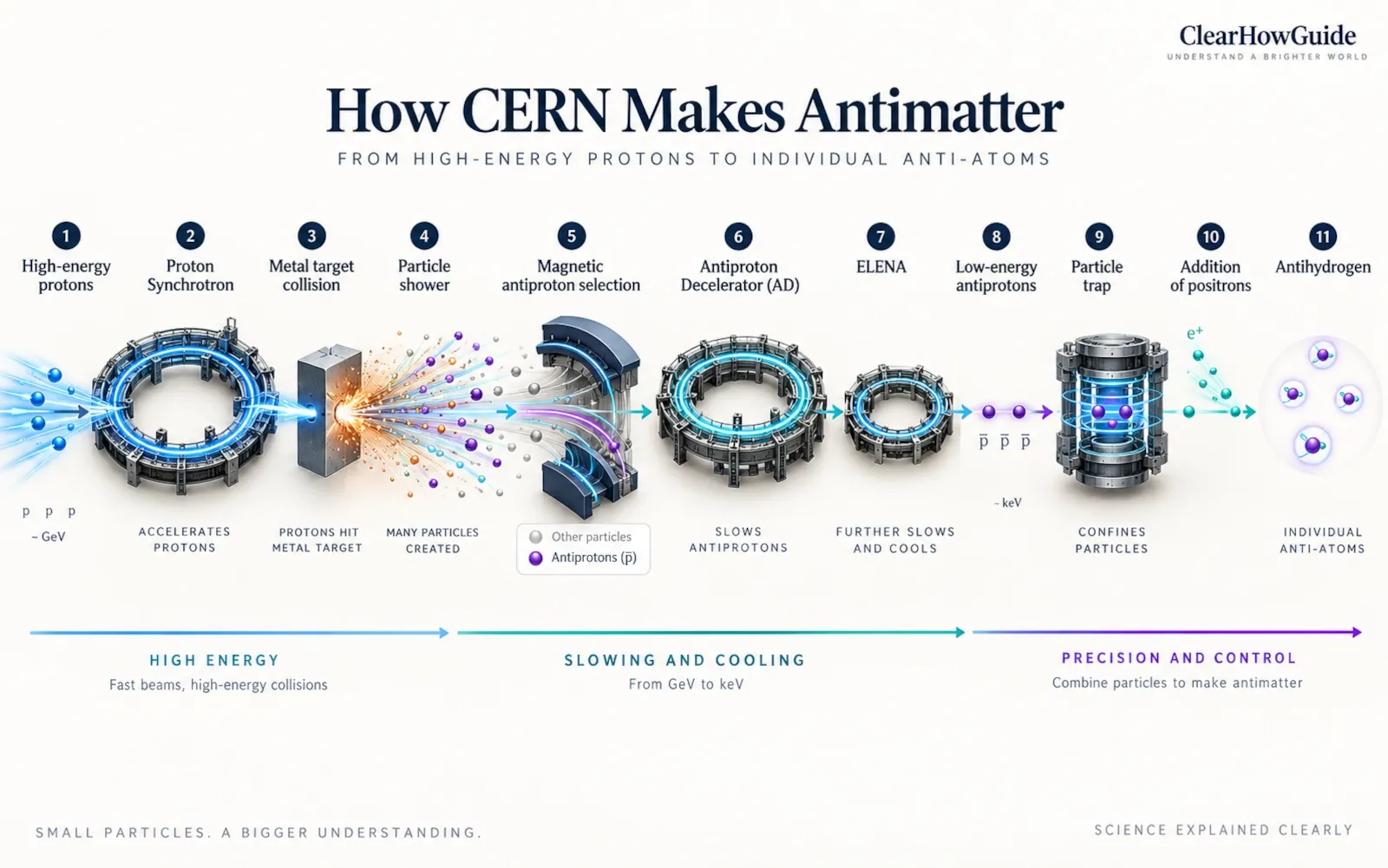
At CERN, a high-energy proton beam from the Proton Synchrotron is fired into a metal target. The violent nuclear collisions create a spray of secondary particles that includes antiprotons. Magnetic systems select the antiprotons, and the Antiproton Decelerator (AD) and ELENA ring slow and cool them so experiments can trap them.
To make antihydrogen, scientists bring antiprotons together with positrons, the antiparticles of electrons. An antihydrogen atom consists of one antiproton and one positron.
The process requires particle accelerators, ultra-high vacuum, powerful electromagnetic traps and cryogenic systems. The quantities produced are microscopic. You cannot realistically make or store useful amounts of antimatter at home.
When to use this explanation
This guide is for readers who want to understand:
- how scientists actually create antimatter;
- how CERN makes antiprotons;
- how antiprotons are slowed enough for experiments;
- how antiprotons and positrons are combined into antihydrogen;
- how antimatter is stored without touching normal matter;
- how much antimatter can currently be produced;
- whether antimatter exists naturally;
- why scientists study matter-antimatter symmetry;
- whether antimatter falls under gravity;
- whether claims about antimatter prices and antimatter bombs reflect practical reality.
If you are looking only for a definition of antimatter, the short version is simple: antimatter is made of antiparticles that have the same mass as corresponding matter particles but opposite values of some quantum properties, such as electric charge.
The interesting question is how we create and control it.
Before you start
A few distinctions make the rest of the article much easier to understand.
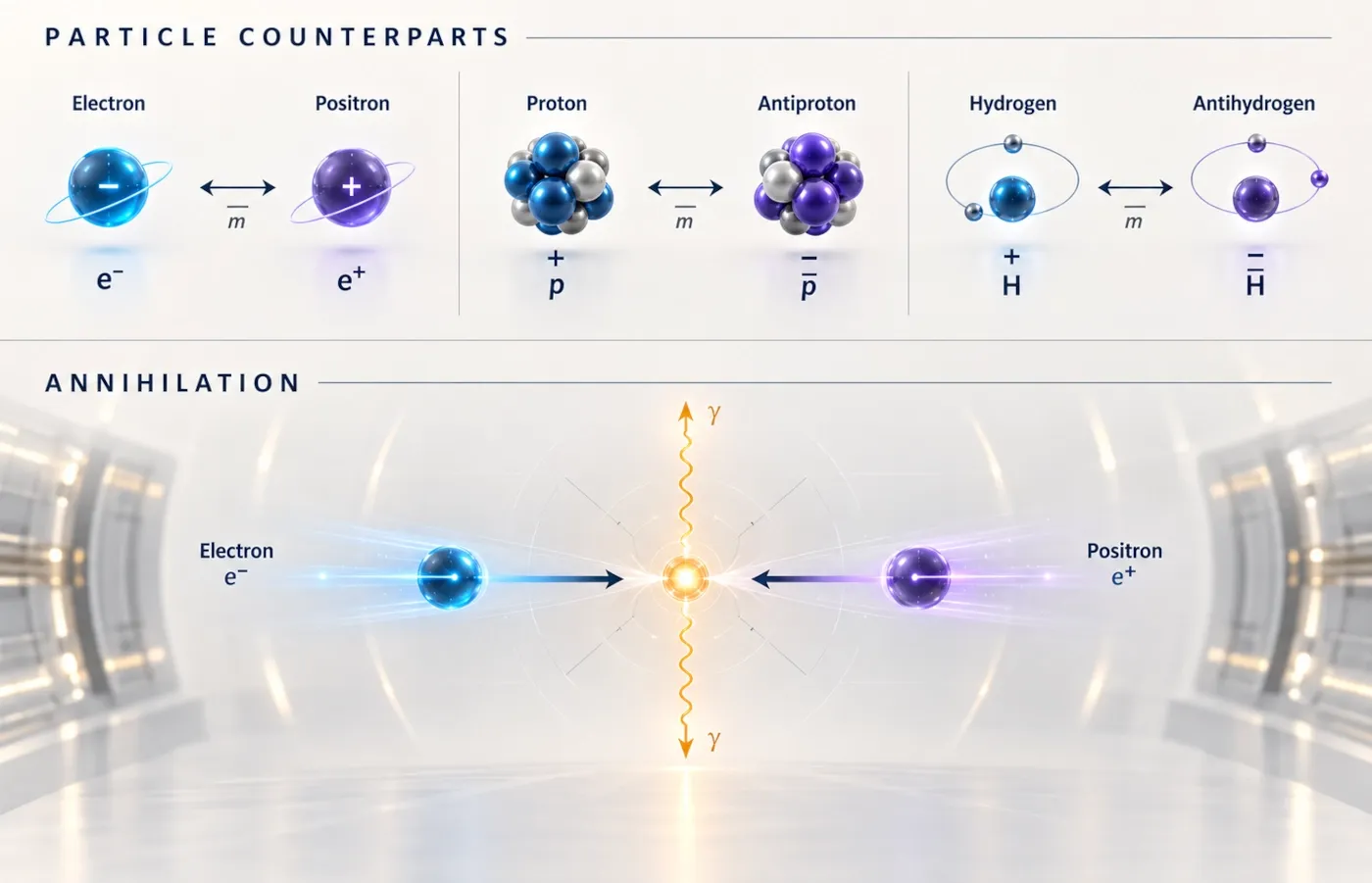
- An electron is ordinary matter. A positron is its antiparticle.
- A proton is ordinary matter. An antiproton is its antiparticle.
- A hydrogen atom contains a proton and an electron.
- An antihydrogen atom contains an antiproton and a positron.
- Charged antiparticles can be confined with electric and magnetic fields.
- Neutral anti-atoms such as antihydrogen require a different type of magnetic trapping.
- “Making antimatter” usually means producing antiparticles first, then in some experiments assembling them into anti-atoms.
It is also important to separate two very different questions:
- Can antimatter be created? Yes.
- Can we manufacture macroscopic amounts such as a gram? Not with anything close to current technology.
What is antimatter?
For many matter particles, nature provides a corresponding antiparticle.
An electron carries negative electric charge; its antiparticle, the positron, has the same mass but positive charge. A proton and an antiproton have the same mass within extremely precise experimental limits, but opposite electric charge.
The idea emerged from relativistic quantum theory. Paul Dirac’s work on the electron predicted states that eventually led physicists to the concept of the positron. Carl Anderson experimentally discovered the positron in cosmic-ray tracks in 1932.
Antimatter is therefore not “negative mass” and it is not a separate magical substance. It is part of the same framework of particle physics that describes ordinary matter.
Some neutral particles are their own antiparticles, while many matter particles have distinct antimatter partners. At the atomic scale, researchers can assemble antiparticles into anti-atoms. The simplest and best studied is antihydrogen.
What happens when matter and antimatter meet?
A particle and its corresponding antiparticle can annihilate.
Annihilation does not mean that energy disappears. The particle-antiparticle system is transformed into other particles, often photons or other products allowed by conservation laws.
The familiar relation
[ E = mc^2 ]
tells us why even a tiny amount of mass corresponds to a large amount of energy.
For example, when an electron meets a positron at low energy, their rest mass can be converted into gamma-ray photons. Proton-antiproton annihilation is more complicated because protons are composite particles made of quarks, so the final state typically contains multiple secondary particles.
This is the physical reason antimatter is difficult to store: if an antiproton or anti-atom reaches the material wall of its container, it annihilates.
How do scientists make antimatter?
There is no single machine that produces every kind of antimatter in the same way.
Different antiparticles are produced with different techniques.
Positrons can come from certain radioactive decays or from high-energy processes in which photons and nuclei help create electron-positron pairs. Antiprotons require far more energetic collisions.
At CERN’s Antimatter Factory, the practical chain begins with ordinary protons.
The basic logic is:
High-energy protons
        ↓
Metal target
        ↓
High-energy nuclear collisions
        ↓
Particle shower
        ↓
Antiprotons selected with magnets
        ↓
Antiproton Decelerator (AD)
        ↓
ELENA
        ↓
Low-energy antiprotons
        ↓
Traps and experiments
        ↓
+ positrons
        ↓
Antihydrogen
The surprising part is how much engineering is required between “an antiproton appears” and “an antiproton is useful for an experiment”.
How CERN makes antiprotons step by step
1. Start with a high-energy proton beam
CERN uses protons from the Proton Synchrotron (PS).
These are ordinary matter particles, accelerated to high energy. The goal is not to turn each proton directly into an antiproton. Instead, the proton beam supplies enough collision energy to create a dense shower of new particles.
2. Fire the protons into a target
The proton beam strikes a metal target.
The collisions are energetic enough to disrupt nuclei and produce many secondary particles. At the quark level, enough energy can be converted into new quark-antiquark pairs. In a small fraction of the resulting interactions, the right antiquarks combine to form antiprotons.
The target therefore does not emit a neat beam of pure antimatter. It produces a chaotic mixture.
3. Select the antiprotons
The particle spray contains many unwanted products moving at different angles and energies.
Magnetic elements exploit the fact that charged particles bend in magnetic fields. The beamline is tuned so that antiprotons with suitable momentum can be selected and focused.
Only a fraction of the particles leaving the target become part of the usable antiproton beam.
4. Send the antiprotons into the Antiproton Decelerator
Freshly produced antiprotons are far too energetic for precision experiments.
CERN’s Antiproton Decelerator (AD) does the opposite of what most people expect from an accelerator: it slows particles down.
The AD uses bending and focusing magnets to keep antiprotons circulating, while electric fields reduce their energy. Cooling systems reduce the spread in their motion so the beam becomes more controlled.
CERN states that the AD slows the antiprotons to about one tenth of the speed of light.
That is still much too fast for efficient trapping.
5. Slow them again in ELENA
The Extra Low ENergy Antiproton ring (ELENA) is coupled to the AD.
ELENA reduces antiproton energy from about 5.3 MeV to 0.1 MeV (100 keV) and uses electron cooling to improve the beam quality.
This extra deceleration is crucial. CERN says ELENA increases the number of antiprotons that experiments can trap by roughly one to two orders of magnitude compared with using the AD alone.
The result is not a macroscopic lump of antimatter. It is a carefully prepared beam of low-energy antiprotons that can be delivered to experiments such as ALPHA, BASE, ASACUSA, AEgIS and GBAR.
How do antiprotons become antihydrogen?
An antiproton by itself is not an anti-atom.
Antihydrogen requires:
1 antiproton + 1 positron → 1 antihydrogen atomThe concept is simple. The experiment is not.
Researchers must first accumulate antiprotons and positrons, cool them, confine them and bring them together under conditions where an antiproton can capture a positron.
The ALPHA approach
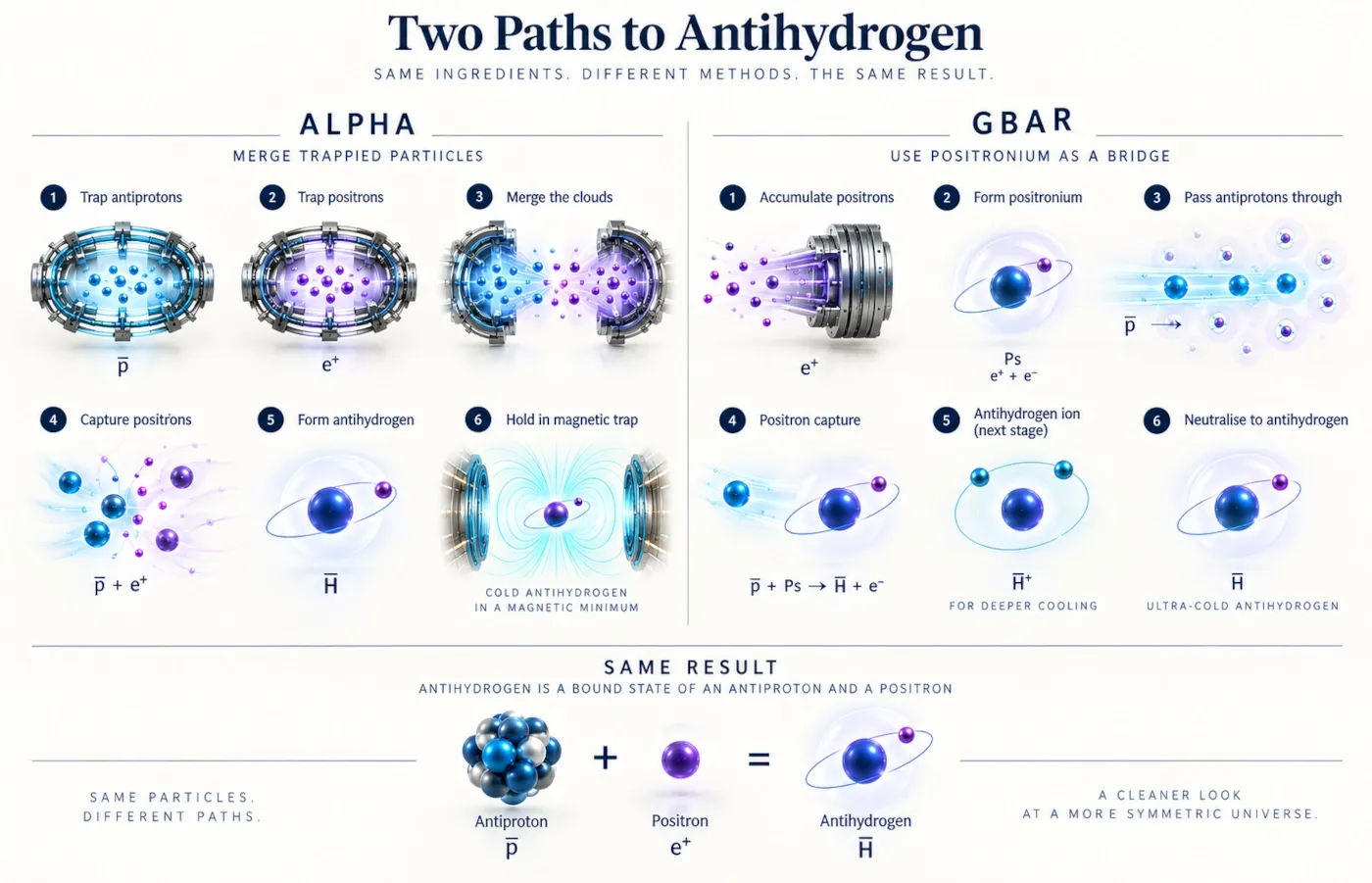
The ALPHA experiment accumulates antiprotons and positrons in particle traps and merges the two populations.
Some antiprotons capture positrons and form neutral antihydrogen.
That word neutral creates a new problem.
A Penning-type electromagnetic trap is excellent for charged particles because electric and magnetic fields can act directly on charge. Once antihydrogen forms, however, the anti-atom has no net electric charge.
Without another trapping method, it drifts until it hits ordinary matter and annihilates.
ALPHA therefore uses a specially shaped magnetic minimum trap. Antihydrogen has a magnetic moment, so sufficiently cold anti-atoms can be confined by a magnetic field even though they are electrically neutral.
The GBAR approach
GBAR uses a more elaborate route because its ultimate goal is extraordinarily cold antihydrogen for precision gravity measurements.
It produces positrons, accumulates them, converts some into positronium — a short-lived bound state of an electron and a positron — and sends antiprotons through the positronium cloud.
In a successful interaction, an antiproton can capture a positron and become antihydrogen.
GBAR’s longer-term strategy involves creating a positively charged antihydrogen ion, cooling it very strongly, and then removing an extra positron with a laser to leave ultra-cold neutral antihydrogen.
The reason for all this complexity is not that GBAR has forgotten an easier way to make antihydrogen. It is that precision gravity measurements require anti-atoms with extremely low kinetic energy.
Why making antimatter is so inefficient
Particle physics lets us create antimatter. It does not make the process economical.
Every stage discards most of the initial energy or particles.
The chain includes:
- accelerating a huge number of ordinary protons;
- striking a target and creating a broad particle shower;
- selecting only the antiprotons with useful trajectories and energies;
- decelerating and cooling them;
- transferring them between machines;
- capturing only a fraction in traps;
- combining them with positrons;
- trapping only sufficiently cold antihydrogen atoms.
That is why statements such as “CERN can make antimatter” are true but easy to misunderstand.
CERN is not operating an antimatter production line in the industrial sense. It is operating an extraordinarily precise scientific facility that creates tiny numbers of antiparticles and anti-atoms for experiments.
How much antimatter can CERN actually make?
This is where science fiction and experimental reality diverge dramatically.
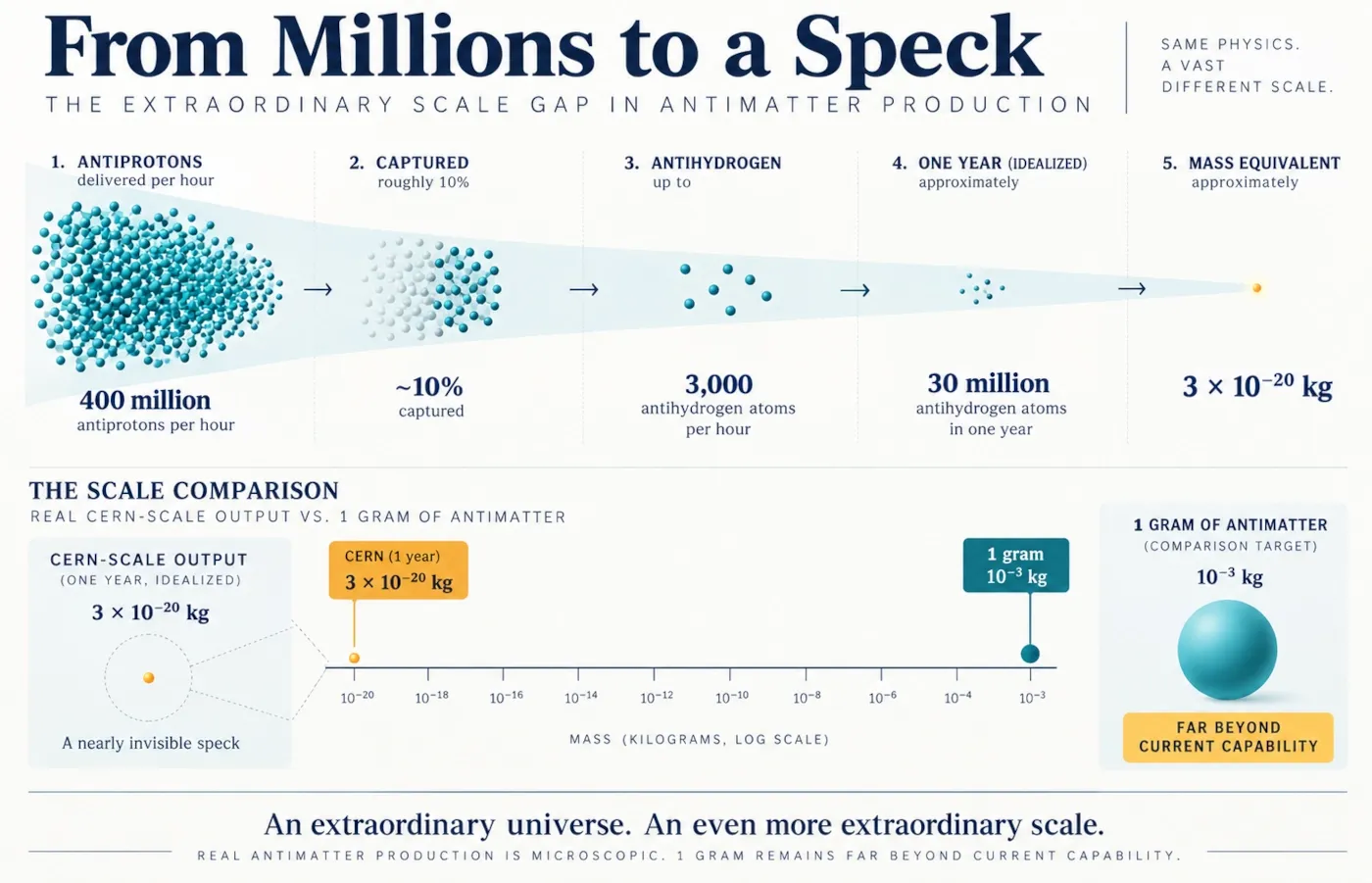
CERN’s current public antimatter information states that, while the Antimatter Factory is operating, it delivers on the order of 400 million antiprotons per hour to antimatter experiments, of which roughly 10% are captured.
At ALPHA, those captured antiprotons can be used to create up to around 3,000 antihydrogen atoms per hour, according to CERN.
Even if one imagines an ideal trap with no losses and the Antimatter Factory operating continuously for a full year, CERN estimates only around 30 million antihydrogen atoms, corresponding to roughly:
[ 3 \times 10^{-20}\ \text{kg} ]
That is:
0.00000000000000000003 kgA gram is:
[ 10^{-3}\ \text{kg} ]
The gap is enormous.
This is why “one gram of antimatter” is useful as a thought experiment, but not as a description of something laboratories are close to manufacturing.
How long does it take to make antimatter?
There is no single answer because “making antimatter” can mean different stages.
Antiprotons are produced in accelerator cycles and delivered to experiments in bunches. An experiment may then spend additional time decelerating, cooling, accumulating and mixing particles.
The Nature paper describing ALPHA-g reports that ELENA typically delivered about 7.5 million antiprotons at 100 keV every 120 seconds during that experiment.
Making antihydrogen adds another layer: only a fraction of the antiprotons and positrons involved end up as trapped anti-atoms.
So antimatter production should not be imagined as a machine slowly filling a bottle gram by gram. It is a repeated sequence of particle-production and trapping cycles in which the useful yield is tiny.
How is antimatter stored without touching matter?
Antimatter cannot simply be placed in a normal container.
A material bottle is made of matter. Contact would destroy the stored antiparticles.
The solution is to make the particles “float” inside a region from which ordinary matter has been removed as completely as possible.
Charged antimatter: Penning traps
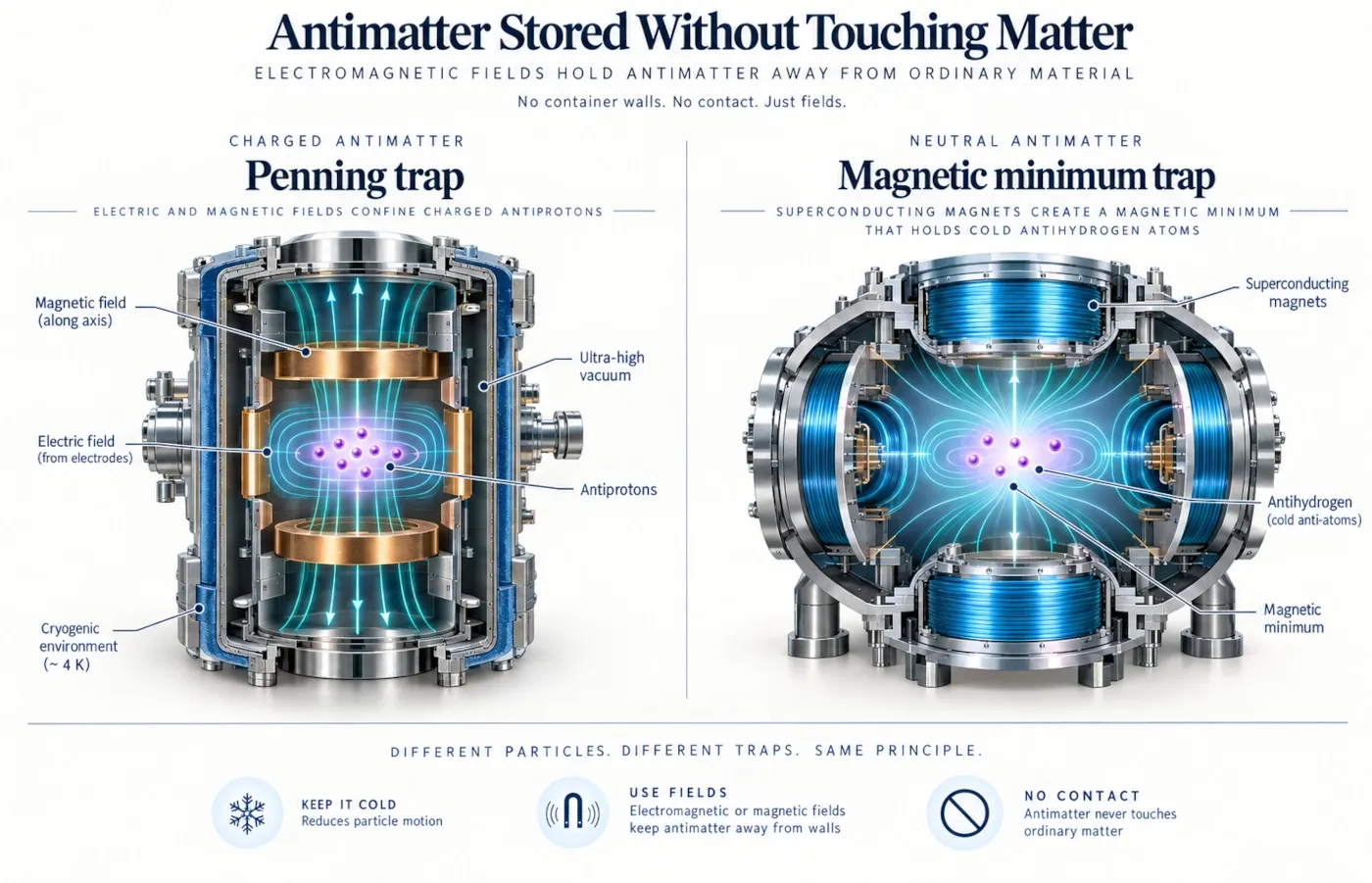
Charged antiparticles such as antiprotons can be confined in electromagnetic traps.
A Penning trap combines:
- a strong magnetic field to restrict radial motion;
- electric fields produced by electrodes to confine particles along the trap axis;
- ultra-high vacuum so there are almost no gas molecules to collide with;
- cryogenic temperatures that improve vacuum and experimental stability.
CERN reports that BASE has achieved vacuum conditions around 5 × 10^-19 mbar, and antiprotons have been stored for more than a year.
That is a remarkable result: a particle that annihilates if it touches ordinary matter can survive for months or years when electromagnetic fields keep it suspended in an exceptionally clean vacuum.
Neutral antimatter: magnetic minimum traps
Antihydrogen cannot be held by ordinary electric confinement because its total charge is zero.
But antihydrogen has a magnetic moment.
Experiments such as ALPHA use carefully designed magnetic fields that create a magnetic minimum. Very cold antihydrogen atoms in suitable quantum states can remain trapped in this minimum instead of reaching the walls.
This requirement explains why temperature matters so much. Fast anti-atoms have enough kinetic energy to escape the shallow magnetic trap. Cold anti-atoms are easier to confine.
Can antimatter now be transported?
Yes — in tiny, carefully trapped quantities.
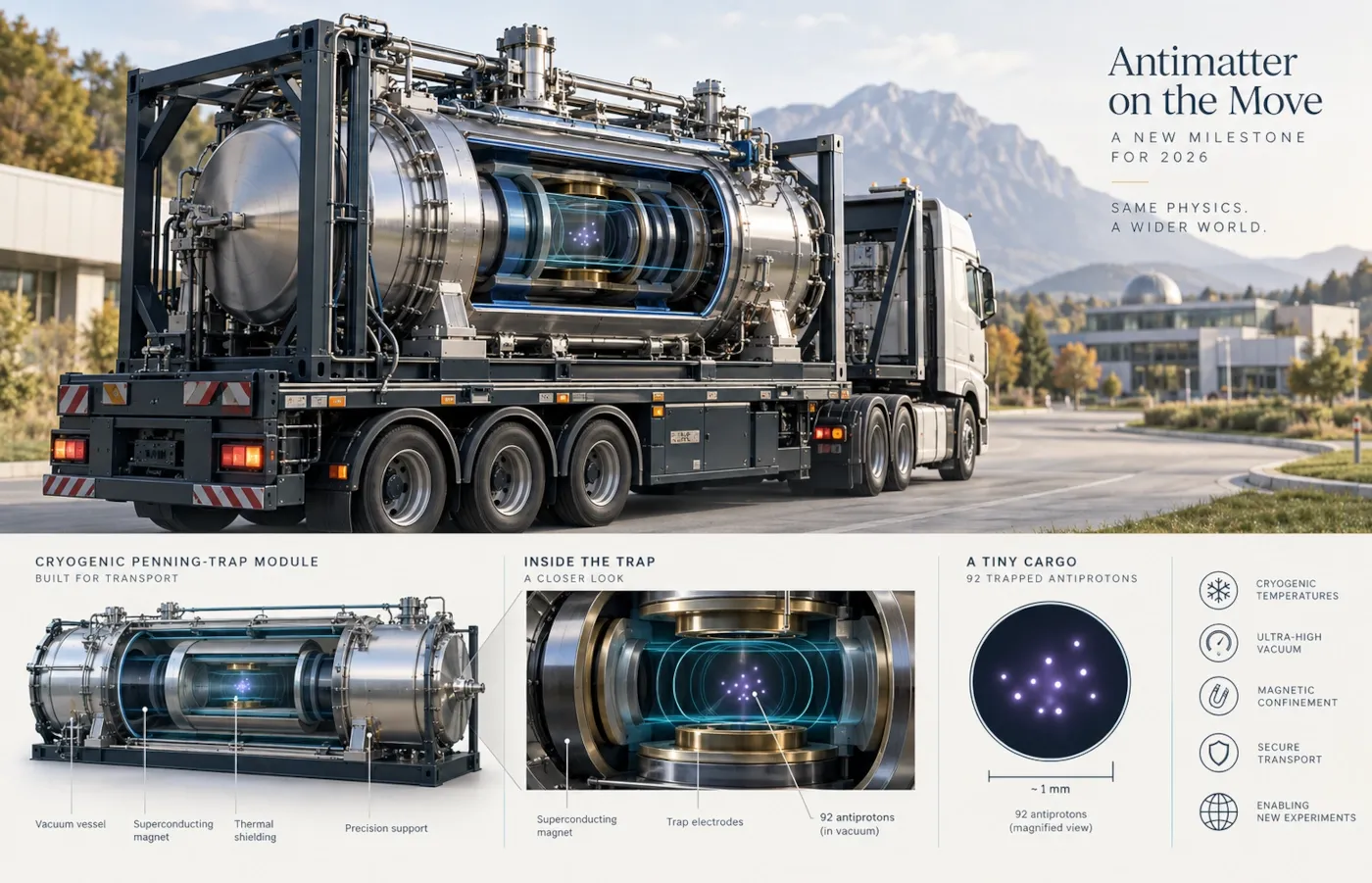
On 24 March 2026, CERN’s BASE collaboration announced a world-first demonstration: researchers accumulated 92 antiprotons inside a portable cryogenic Penning trap, disconnected the trap from the experimental facility, loaded it onto a truck and transported it across CERN’s main site while maintaining the antimatter.
This does not mean laboratories can now ship bottles containing visible amounts of antimatter.
It means something scientifically important: antiprotons may no longer have to be studied only beside CERN’s accelerator complex.
The BASE-STEP programme aims to transport trapped antiprotons to other precision laboratories, where quieter magnetic environments could permit measurements that are difficult near operating accelerator infrastructure.
The portable trap is therefore a research instrument, not a container for bulk antimatter.
Why do scientists make antimatter?
The goal is not to stockpile energy.
The most important reason is to test fundamental physics.
Our best theories say that matter particles and antimatter particles should have extremely closely related properties. Experiments can compare:
- proton and antiproton mass and charge-to-mass ratio;
- proton and antiproton magnetic moments;
- hydrogen and antihydrogen spectra;
- matter and antimatter response to gravity;
- symmetry principles such as CPT.
If any precisely measured property of antimatter differed from the Standard Model prediction, it could be evidence of physics beyond the Standard Model.
Antimatter is therefore valuable because it gives physicists a mirror against which to test some of the deepest assumptions in modern physics.
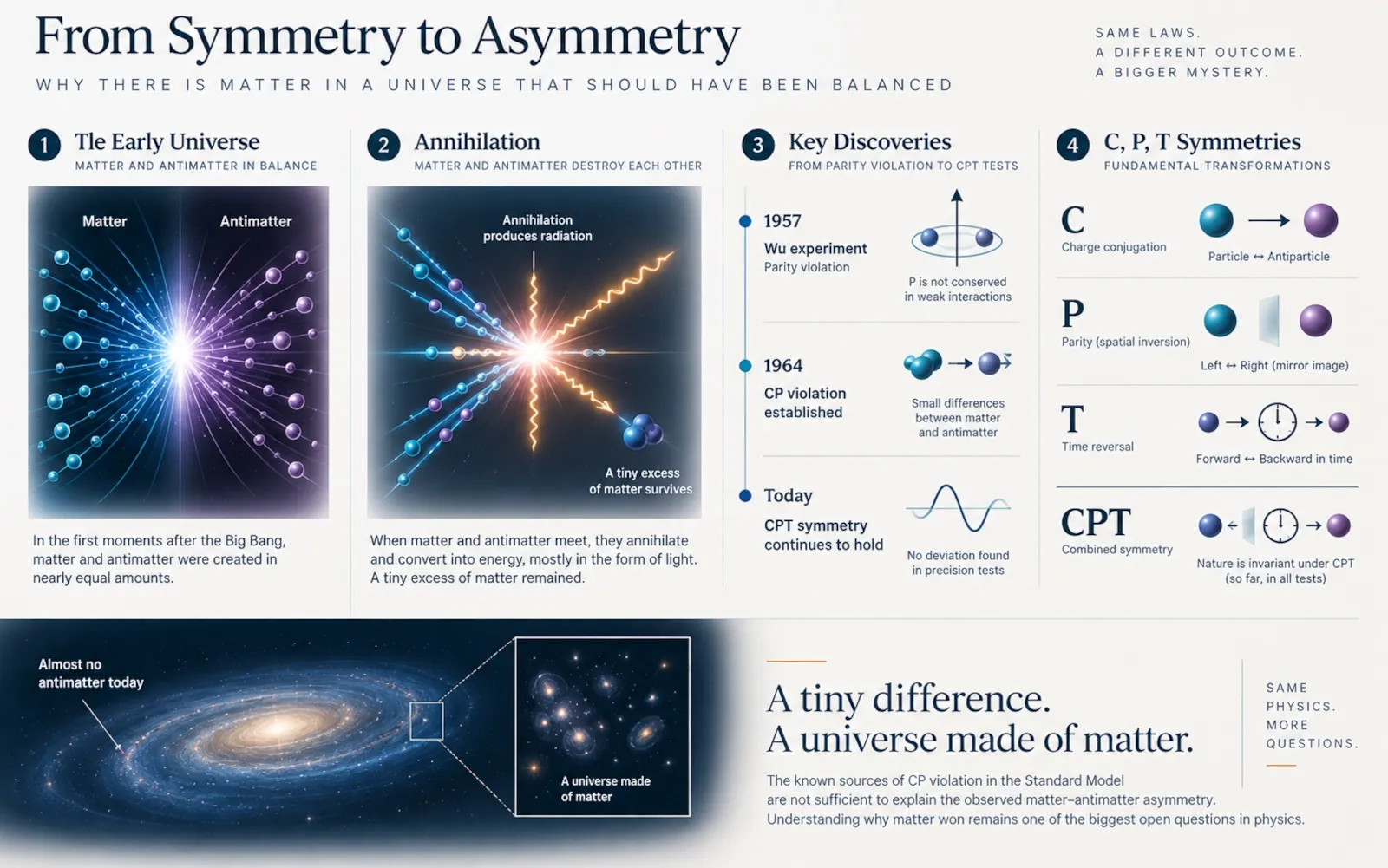
What is the matter-antimatter asymmetry?
The observable Universe is overwhelmingly made of matter.
That is difficult to reconcile with the expectation that the hot early Universe should have produced matter and antimatter in almost equal amounts.
If the balance had been perfectly exact and all particle-antiparticle pairs had annihilated, the Universe would look profoundly different from the one we see today.
Some process must have left a tiny excess of matter.
That leftover matter eventually became galaxies, stars, planets and us.
Particle physics does contain mechanisms that distinguish matter from antimatter, particularly CP violation in weak interactions. But the amount of CP violation contained in the Standard Model is not sufficient to explain the observed cosmic imbalance.
That is one reason precision antimatter experiments are so important: physicists are searching for subtle differences that could point toward missing physics.
What does CPT symmetry have to do with antimatter?
CPT combines three transformations:
- C — charge conjugation: replace particles with antiparticles;
- P — parity: reflect spatial coordinates as in a mirror;
- T — time reversal: reverse the direction of time in the equations.
Under broad assumptions used by relativistic quantum field theory, the combined CPT transformation is expected to be an exact symmetry.
One practical consequence is that a particle and its antiparticle should have equal masses and lifetimes, while certain properties such as electric charge and magnetic moment are related by sign.
That is why experiments such as BASE compare protons and antiprotons with extraordinary precision.
A confirmed violation of CPT symmetry would not be a small technical correction. It would force physicists to rethink deep structural assumptions behind modern quantum field theory.
What did the Wu experiment change?
The 1957 experiment led by Chien-Shiung Wu, with Ernest Ambler, Raymond Hayward, Dale Hoppes and Ralph Hudson, tested whether parity is conserved in beta decay.
It was not.
The experiment showed that the weak interaction can distinguish left from right. Parity, once treated as an obvious symmetry of nature, is violated by the weak force.
This was a turning point.
Later experiments also demonstrated CP violation, showing that even the combination of charge conjugation and parity is not universally respected.
CPT, however, remains consistent with experimental tests.
This historical sequence matters because the matter-antimatter puzzle is fundamentally a puzzle about symmetry: nature treats matter and antimatter almost — but not perfectly — the same.
Does antimatter fall up or down?
It falls down, within the precision reached so far.
This question remained experimentally difficult for decades because charged antiparticles are terrible objects for a gravity experiment. Electromagnetic forces are so much stronger than gravity that tiny stray electric fields can overwhelm the gravitational effect on an antiproton.
Neutral antihydrogen solves that problem.
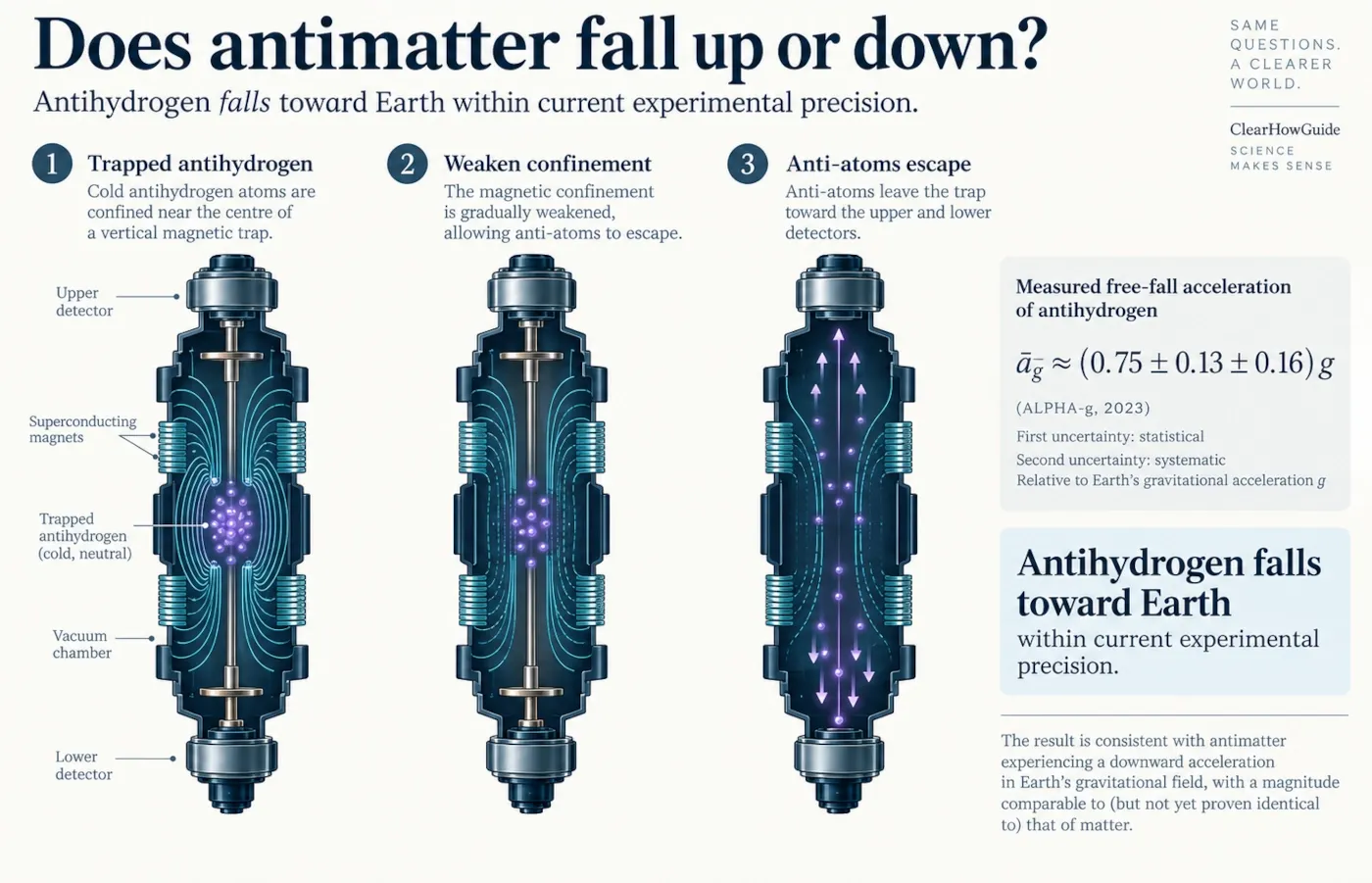
In 2023, the ALPHA-g collaboration directly observed the motion of trapped antihydrogen released in Earth’s gravitational field.
The measured acceleration was directed toward Earth and was consistent, within the experiment’s uncertainty, with the gravitational acceleration experienced by ordinary matter.
The published result was approximately:
[ a_{\bar{g}} = (0.75 \pm 0.13 \pm 0.16)g ]
The uncertainties were still large enough that the experiment was not a precision equality test between matter and antimatter gravity. But it strongly ruled out the simple idea that antihydrogen experiences a 1g gravitational repulsion upward.
So the scientifically correct summary is:
antihydrogen has been directly observed behaving consistently with ordinary attractive gravity, and precision tests continue.
Can you make antimatter at home?
No — not in the sense people normally mean by “make antimatter”.
Some natural radioactive processes emit positrons, and positrons are antimatter. That does not make a household object an antimatter factory in any useful engineering sense.
Producing and controlling antiprotons requires high-energy particle-physics infrastructure. Creating antihydrogen requires antiprotons, positrons, high vacuum, electromagnetic trapping, cooling and precision timing.
The equipment includes systems such as:
- particle accelerators;
- radiation shielding;
- high-vacuum beamlines;
- superconducting magnets;
- cryogenic systems;
- high-voltage electrodes;
- particle detectors;
- precision timing and control hardware.
This is not a safe or realistic home experiment.
If your goal is to understand antimatter experimentally, the useful alternative is to study publicly available CERN results, detector data, simulations and particle-physics educational resources.
Does antimatter occur naturally?
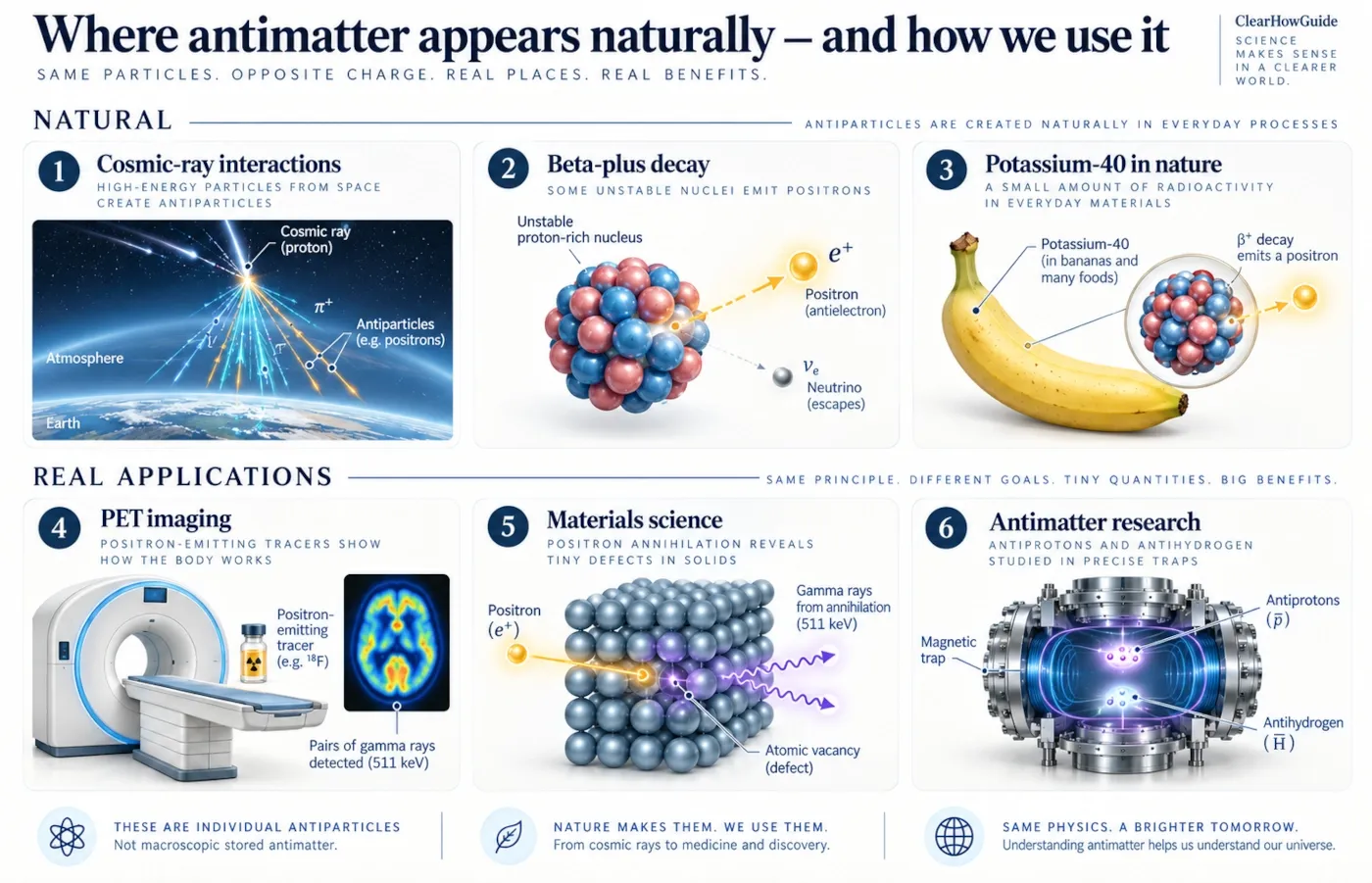
Yes, but generally as isolated antiparticles rather than macroscopic objects made of antimatter.
Natural processes can create antiparticles when enough energy is available.
Examples include:
- cosmic-ray interactions;
- some radioactive beta-plus decays;
- high-energy astrophysical processes.
Positrons are therefore present in nature.
What we do not observe is evidence for large nearby regions made of bulk antimatter — anti-planets, anti-stars or anti-galaxies sitting next to matter regions in a way that would produce obvious annihilation boundaries.
Scientists continue to investigate the cosmic matter-antimatter problem, but the nearby Universe is clearly matter-dominated.
Why do bananas produce positrons?
Bananas contain potassium, including tiny amounts of the naturally radioactive isotope potassium-40.
Most potassium-40 decays do not produce positrons, but a very small branch can ultimately produce a positron through beta-plus decay.
That positron is an antiparticle.
This is why statements such as “bananas contain antimatter” circulate online.
The better wording is:
natural radioactive processes in materials such as potassium-containing foods can occasionally produce individual positrons.
That is genuine antimatter, but the quantity is unimaginably far from anything that could be accumulated as a visible antimatter sample.
How much does antimatter cost?
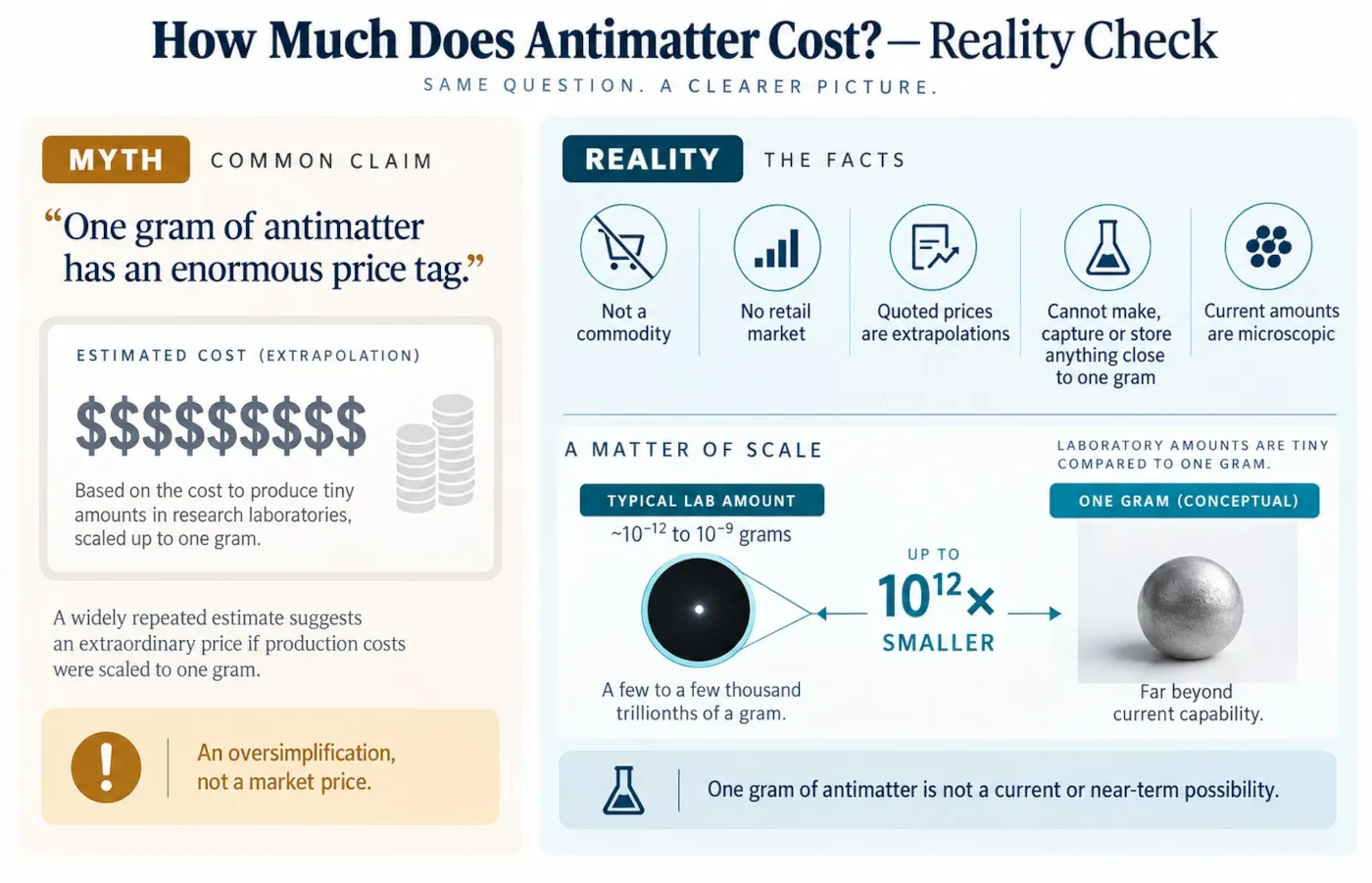
Claims about a “price per gram” should be treated very carefully.
Antimatter does not have a normal commodity price because there is no market where one can order a gram.
Numbers quoted online are usually production-cost extrapolations: someone estimates the cost of accelerator operation needed to produce an extremely tiny amount, then scales that cost mathematically to one gram.
That extrapolation can produce spectacular numbers, but it does not mean a gram is available at that price.
The real obstacle is more fundamental:
current facilities cannot produce, capture and store anything remotely close to a gram.
So the practical answer to “How much is one gram of antimatter?” is not a price tag.
It is:
One gram of antimatter is not a commercially available product, and producing or storing a gram is far beyond current technology.
Can you buy antimatter?
Not as a bulk substance.
Laboratories can produce antiparticles and anti-atoms for research, but these are not products sold by mass.
Medical and scientific systems can use positron-emitting isotopes, and particle-physics laboratories exchange expertise, beam access and research samples under tightly controlled scientific programmes. That is fundamentally different from buying antimatter in a container.
If a website claims to sell grams, milligrams or even visible quantities of “real antimatter”, treat the claim as scientifically implausible.
What is antimatter used for?
Antimatter and antiparticle physics have both direct applications and fundamental-research uses.
Fundamental physics
This is the main role of CERN’s low-energy antimatter programme.
Researchers use antiprotons and antihydrogen to test:
- CPT symmetry;
- spectroscopy of antihydrogen;
- proton-antiproton property comparisons;
- gravity on neutral antimatter;
- nuclear structure with antiproton probes;
- possible differences between matter and antimatter.
Medical imaging
Positrons are central to PET — positron emission tomography.
A patient receives a radiotracer containing a positron-emitting isotope. When a positron annihilates with an electron, the resulting gamma rays can be detected to reconstruct where the tracer is concentrated.
PET does not require storing macroscopic antimatter. It uses short-lived positrons generated by radioactive isotopes inside the body.
Materials science
Positron annihilation techniques can also probe defects and microscopic structures in materials.
Again, the useful object is the individual antiparticle and its interaction with matter — not a bottle of antimatter.
Is antimatter dangerous?
Antimatter is physically capable of releasing energy through annihilation, but the quantities produced in laboratories are extraordinarily small.
That distinction matters.
A hypothetical macroscopic quantity could release a great deal of energy when annihilating with an equal mass of matter. But real antimatter laboratories operate with particle counts many orders of magnitude below macroscopic masses.
The everyday hazards around antimatter experiments come primarily from the accelerator infrastructure needed to create and manipulate particles:
- ionising radiation;
- high voltages;
- powerful magnets;
- cryogenic equipment;
- vacuum systems;
- high-energy particle beams.
Those risks are handled through standard accelerator and radiation-safety controls.
The antimatter itself is not sitting in a warehouse waiting to explode.
Could antimatter bombs really exist?
Physics does not forbid matter-antimatter annihilation from releasing a large amount of energy.
Engineering reality is another matter.
A weapon would require producing, capturing, storing, transporting and deliberately releasing a macroscopic amount of antimatter.
Current production is separated from that scenario by an enormous technological gap.
CERN’s published production figures make the scale clear: even a full year of idealised antihydrogen production would correspond to only about (3 \times 10^{-20}) kg.
That is why modern antimatter research should not be confused with practical antimatter weapons.
The scientifically interesting problem today is how to manipulate tens, thousands or millions of antiparticles with extreme precision — not how to manufacture grams.
How CERN’s antimatter chain fits together
Putting the whole process into one sequence makes the engineering easier to understand.
Step 1 — Produce energetic antiprotons
High-energy protons strike a metal target.
The collisions convert some of the available energy into new particle-antiparticle pairs. Among the secondary particles are antiprotons.
Step 2 — Select useful antiprotons
Magnets separate and focus antiprotons with the required charge and momentum from the much larger particle shower.
Step 3 — Decelerate them in the AD
The Antiproton Decelerator repeatedly slows and cools the circulating antiproton beam.
Step 4 — Decelerate them further in ELENA
ELENA reduces the energy to around 100 keV and improves the beam so experiments can capture many more antiprotons.
Step 5 — Trap the charged antiparticles
Electromagnetic traps confine antiprotons and positrons inside ultra-high vacuum.
Step 6 — Combine antiprotons with positrons
Experiments merge the two populations under controlled conditions.
Some antiprotons capture positrons and become antihydrogen.
Step 7 — Trap the neutral antihydrogen
Because antihydrogen has no net electric charge, researchers use specially shaped magnetic fields rather than simple electrostatic confinement.
Step 8 — Measure it before it annihilates
Once trapped, antihydrogen can be studied through spectroscopy, controlled release, gravitational measurements and other precision techniques.
That is what “making antimatter” means in a modern research laboratory.
It is not merely creating an antiparticle. It is building an entire chain that converts a fleeting high-energy product into a controlled experimental system.
Common mistakes
Mistake 1: Thinking antimatter means negative mass
Antimatter is not defined by negative mass.
Antiparticles have positive inertial mass and, in the case of antihydrogen, current experiments show gravitational behaviour consistent with attraction toward Earth.
Mistake 2: Thinking CERN converts ordinary matter directly into equal amounts of antimatter
The target collision creates a broad shower of particles and antiparticles.
Only a tiny fraction become useful antiprotons.
Mistake 3: Thinking a particle accelerator “fills a tank” with antimatter
Research facilities produce discrete particles or atoms and trap only a fraction of them.
The quantities are microscopic.
Mistake 4: Treating online “price per gram” numbers as a market price
There is no normal retail price for a gram of antimatter because a gram cannot currently be produced and stored.
Mistake 5: Assuming antimatter explodes by itself
Antimatter annihilates when it interacts with ordinary matter. Isolated antiparticles in a well-designed trap do not spontaneously “explode”.
Mistake 6: Assuming neutral antihydrogen is easy to trap
Neutrality removes the electric handle used to confine charged particles. Only sufficiently cold antihydrogen atoms in suitable magnetic states can be retained by magnetic minimum traps.
Mistake 7: Assuming “falls down” means gravity tests are finished
ALPHA-g established attractive gravity for antihydrogen at current precision. The next scientific goal is much more precise comparison with ordinary matter.
Security, privacy and safety notes
This article explains established particle-physics concepts and laboratory methods at a high level. It is not a construction manual for accelerator hardware, radiation sources, high-voltage systems, cryogenic equipment or weapons.
Particle accelerators and antimatter experiments operate in controlled research facilities because they involve hazards that can include intense ionising radiation, strong magnetic fields, high voltage, vacuum equipment and cryogenic systems.
Do not attempt to reproduce accelerator or high-energy radiation setups outside an appropriately licensed research environment.
For readers concerned about antimatter as a destructive material, the most important safety fact is scale: present-day laboratories produce and store quantities many orders of magnitude below macroscopic amounts.
Faster alternative
If you only need the essential answer, remember this chain:
Energy creates particle-antiparticle pairs
        ↓
CERN selects antiprotons from high-energy collisions
        ↓
AD + ELENA slow and cool them
        ↓
Electromagnetic traps hold charged antiparticles
        ↓
Antiprotons + positrons can form antihydrogen
        ↓
Magnetic traps hold sufficiently cold anti-atoms
And remember the practical limit:
We can make and study antimatter, but we cannot manufacture or store it in macroscopic quantities.
That single distinction resolves most of the confusion surrounding antimatter.
Frequently asked questions
Is antimatter real?
Yes. Positrons were discovered in 1932, antiprotons in 1955, and CERN first produced antihydrogen atoms in 1995. Modern experiments routinely create and study antiprotons and antihydrogen.
Is it possible to make antimatter?
Yes. High-energy interactions can convert energy into particle-antiparticle pairs. CERN deliberately produces antiprotons and combines antiprotons with positrons to create antihydrogen.
Where is antimatter kept on Earth?
Research antimatter is held in specialised traps inside particle-physics laboratories. CERN’s Antimatter Factory is the world’s dedicated low-energy antiproton facility, and experiments such as BASE and ALPHA use electromagnetic and magnetic trapping systems.
How long can antimatter be stored?
It depends on the type of antimatter and the apparatus. CERN reports that antiprotons have been stored in BASE for more than a year. Antihydrogen has also been confined long enough for precision measurements, with CERN reporting storage times up to around 100 hours in current antihydrogen work.
What does antimatter look like?
Individual antiparticles and anti-atoms are far too small to see directly with your eyes. Scientists detect them through their motion, electromagnetic interactions, spectra and the particle signatures produced when they annihilate.
Can antimatter travel faster than light?
No evidence shows that antimatter violates the speed limit set by special relativity. Antimatter obeys the same relativistic framework used for ordinary particles.
Can antimatter travel back in time?
No. Some mathematical descriptions of antiparticles can be formulated using time-reversed interpretations, but real positrons and antiprotons in laboratories move forward in time like ordinary particles.
Does antimatter have gravity?
Yes. The 2023 ALPHA-g experiment directly observed antihydrogen behaving consistently with gravitational attraction toward Earth. Precision comparisons with ordinary matter continue.
Does antimatter exist in space?
Yes. High-energy astrophysical processes and cosmic-ray interactions produce antiparticles. Experiments in space and on Earth detect cosmic positrons and antiprotons.
Can someone buy one gram of antimatter?
No. A gram of antimatter is far beyond present production and storage capability. Online estimates of a theoretical “price per gram” are extrapolations, not retail prices.
How big is one gram of antimatter?
Mass does not determine a unique physical volume without specifying the form and density. More importantly, one gram of stored antimatter does not exist with current technology, so there is no practical one-gram sample whose size can be measured.
Who discovered antimatter?
Paul Dirac’s relativistic quantum theory predicted the existence of an electron antiparticle. Carl Anderson discovered the positron experimentally in 1932. Antimatter was therefore both a theoretical prediction and an experimental discovery developed through multiple contributions.
What can destroy antimatter?
Contact with corresponding ordinary matter leads to annihilation. In practice, the challenge is preventing antiparticles or anti-atoms from reaching gas molecules or material surfaces.
Is antihydrogen the same as hydrogen?
They have corresponding structures: hydrogen contains a proton and electron; antihydrogen contains an antiproton and positron. Precision experiments test whether their measurable properties are exactly related as expected by fundamental symmetries.
What scientists still do not know
Antimatter is no longer mysterious because it is hypothetical.
It is mysterious because the known laws describe it too well while the Universe still seems to prefer matter.
Experiments have repeatedly found close agreement between matter and antimatter:
- antiprotons have the expected charge and mass relationships;
- proton and antiproton magnetic properties agree to extraordinary precision;
- antihydrogen spectroscopy agrees with hydrogen within experimental limits;
- antihydrogen falls toward Earth;
- CPT symmetry continues to survive demanding tests.
Yet the observable Universe is overwhelmingly matter.
The Standard Model contains CP violation, but not enough to explain the cosmic asymmetry.
That leaves physicists with a profound possibility: the missing explanation may involve physics that has not yet been discovered.
This is why scientists go to such lengths to make a few anti-atoms, cool them nearly to rest and keep them away from the walls of a trap.
The goal is not the antimatter itself.
The goal is to find out whether, somewhere in those extremely precise comparisons, nature finally reveals why anything made of matter exists at all.
Sources and further reading
Primary and institutional sources used for this guide include:
- CERN — Antimatter
- CERN — The Antiproton Decelerator
- CERN — ALPHA
- CERN — BASE
- CERN — First atoms of antimatter produced at CERN
- CERN — GBAR joins the anticlub
- CERN — BASE experiment succeeds in transporting antimatter
- Nature — Observation of the effect of gravity on the motion of antimatter
- Physical Review — Experimental Test of Parity Conservation in Beta Decay
Last tested
Tested against:
- CERN Antimatter overview
- CERN Antiproton Decelerator and ELENA documentation
- CERN ALPHA documentation
- CERN BASE documentation
- CERN BASE-STEP transport announcement
- ALPHA-g gravity result in Nature
- Wu et al. parity experiment in Physical Review
Last tested: 2026-09-14
Related guides
Carefully selected guides to help you understand the topic and complete the next useful step.