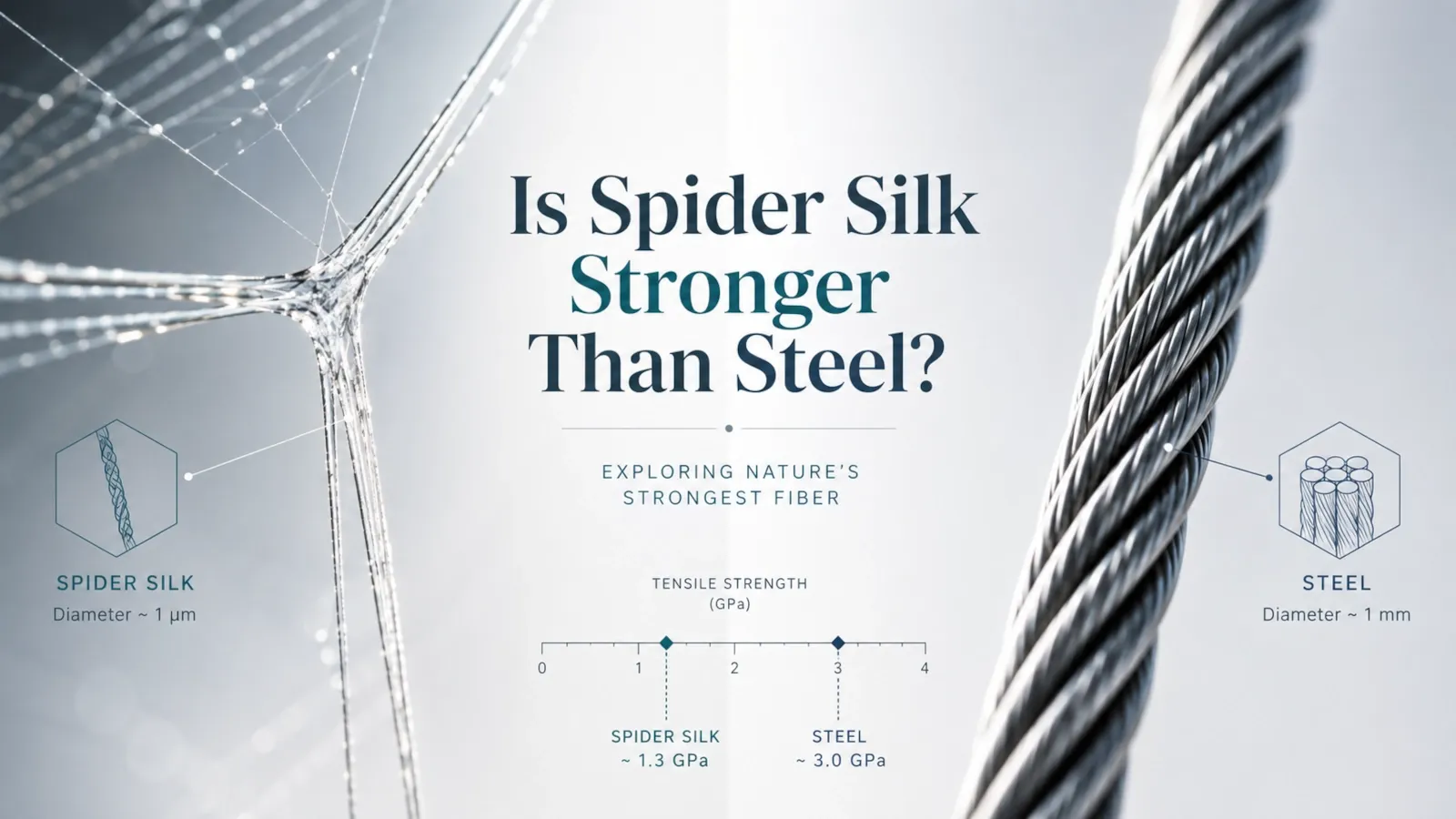
If you are wondering whether a spider web is really stronger than steel, the first thing to know is that the famous comparison is slightly misphrased. A web is a structure. Spider silk is the material from which that structure is built, and spiders can produce several different kinds of silk for different jobs.
The second problem is the word stronger. In materials science, “strong” can mean several different things. A material can resist a very large pulling force yet be brittle. Another can be less strong in absolute terms but much lighter, stretch farther and absorb far more energy before it breaks.
That distinction is the key to understanding spider silk.
Quick answer
Spider silk is not simply stronger than steel in every sense. Some high-performance dragline silks reach tensile strengths in the same broad gigapascal range as strong steels, while specialized ultrahigh-strength steels can exceed them in absolute tensile strength. Steel is also dramatically stiffer.
Spider silk becomes extraordinary when weight and energy absorption matter. It is far less dense than steel, so its strength-to-weight ratio can be exceptional. It can also combine high tensile strength with large extension before failure, giving some spider silks remarkable toughness—the ability to absorb energy before breaking.
So the scientifically accurate answer is:
- Absolute tensile strength: it depends on the silk and the steel.
- Strength-to-weight: spider silk can outperform steel.
- Toughness: some spider silks are exceptional.
- Stiffness: steel wins by a wide margin.
- Overall: there is no single universal “stronger” winner.
When to use this solution
This explanation is for readers who want more than the usual claim that spider silk is “five times stronger than steel.”
Use it if you want to understand:
- what scientists actually measure when they test spider silk;
- why spider web and spider silk are not interchangeable terms;
- how strong spider silk really is;
- why strength, toughness and stiffness are different;
- whether spider silk could hold a person or support a Spider-Man-style swing;
- whether it could stop a bullet;
- how it compares with Kevlar;
- why we do not simply farm spiders for industrial fiber;
- and how researchers are trying to manufacture spider-like silk at scale.
If you only need the one-sentence answer, skip to Faster alternative near the end.
Before you start
Keep four points in mind before comparing numbers.
- There is no single material called “spider silk.” Spiders produce different silks, and properties vary by species, silk type, individual and test conditions.
- There is no single material called “steel” either. Mild steel, tool steel, maraging steel and experimental ultrahigh-strength steels have very different mechanical properties.
- Tensile strength is not toughness. A material can be very strong but absorb relatively little energy before breaking.
- A fiber is not a structure. The performance of a whole web, rope, fabric or armor panel depends on geometry, thickness, defects, joints and how the load is applied.
A 2024 comparative analysis covering data across 164 spider species emphasized just how much silk performance can vary. That is one reason any claim of the form “spider silk has a strength of exactly X” should immediately be treated with caution.
Main explanation: “stronger” is not one number
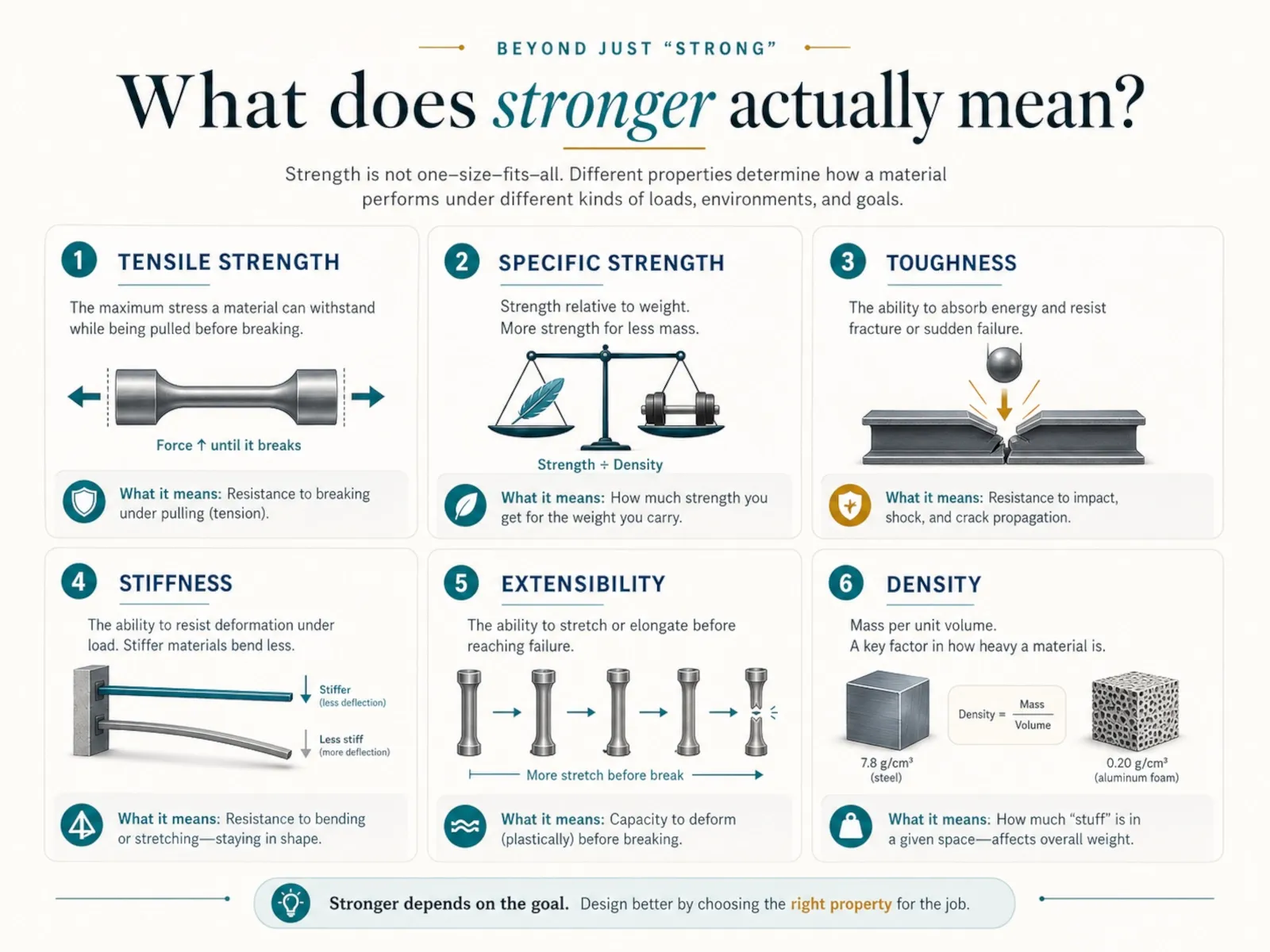
The phrase stronger than steel sounds simple because everyday language treats strength as one property. Materials science does not.
Imagine three materials:
- one resists enormous tension but barely stretches;
- another is lighter and survives a similar load for its mass;
- a third stretches far enough to absorb a large impact without snapping.
Which one is “stronger”?
There is no answer until you define the property you care about.
| Property | What it measures | Simple question |
|---|---|---|
| Tensile strength | Maximum tensile stress before failure | How hard can I pull before it breaks? |
| Specific strength | Strength relative to density or mass | How much strength do I get for the weight? |
| Toughness | Energy absorbed per unit volume before fracture | How much energy can it take before breaking? |
| Stiffness | Resistance to elastic deformation | How difficult is it to stretch? |
| Extensibility | How far it can elongate before failure | How much can it stretch? |
| Density | Mass per unit volume | How heavy is it for its size? |
This is why apparently contradictory statements about spider silk can all contain a piece of the truth.
Steps: how to compare spider silk and steel correctly
1. Identify the silk being discussed
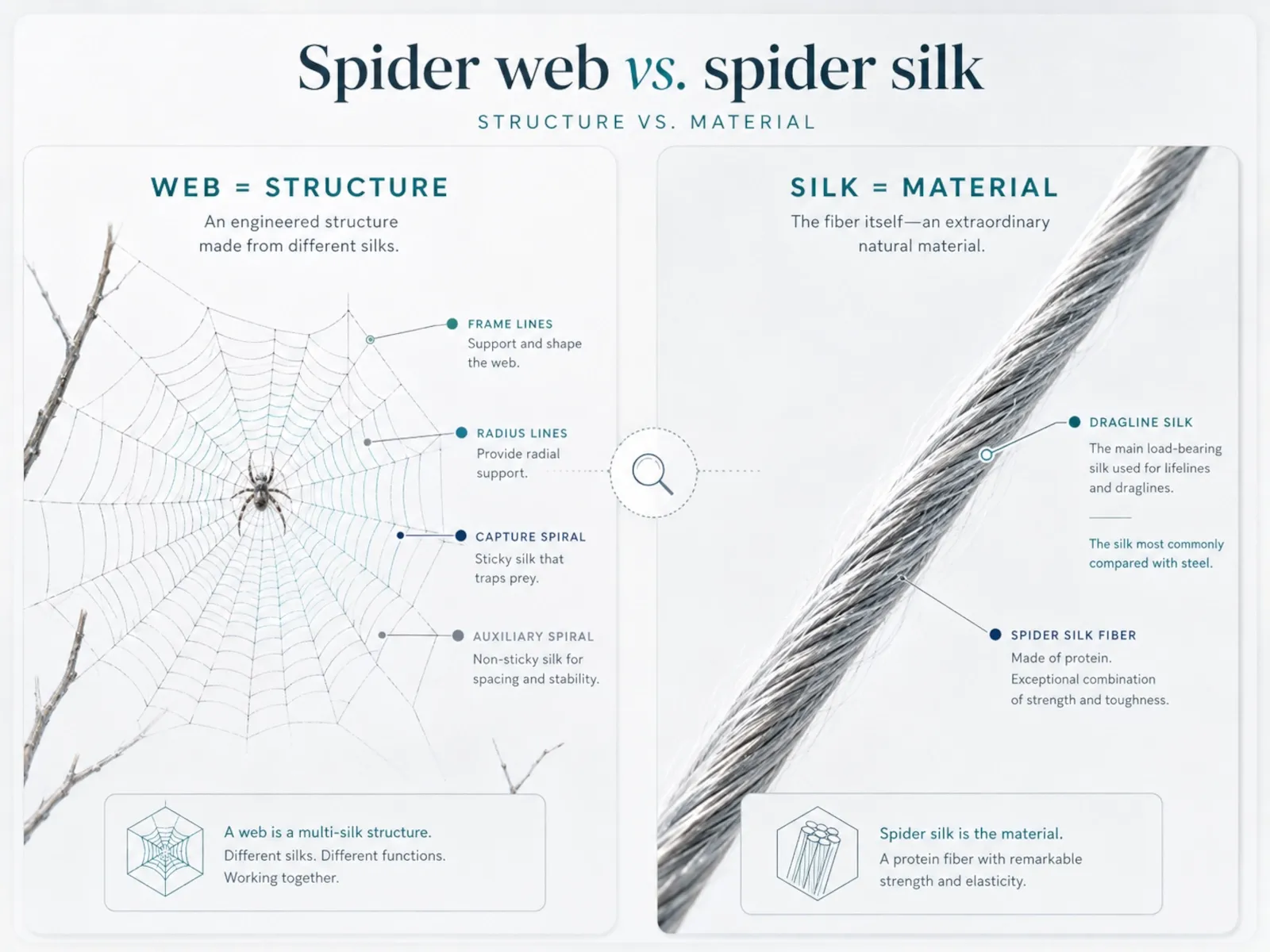
The silk most commonly compared with steel is major ampullate silk, often called dragline silk. It forms structural lines such as frame threads, radii and the spider’s safety line.
Do not assume values measured for one silk type apply to every thread in a web.
2. Compare the same mechanical property
Tensile strength must be compared with tensile strength. Toughness must be compared with toughness. Young’s modulus must be compared with Young’s modulus.
Comparing the tensile strength of one material with the toughness of another creates a meaningless winner.
3. Decide whether mass matters
If two cables must weigh the same, low density becomes a major advantage. This is where spider silk becomes particularly impressive.
If weight does not matter and you simply need a very stiff structural member, steel may be the better material.
4. Separate the material from the finished object
A single fiber, a braided rope, a spider web and a layered ballistic panel are different engineering systems.
The properties of the fiber set limits, but the design of the final structure determines how those properties are used.
Spider web vs. spider silk: what’s the difference?
A spider web is a structure. Spider silk is the protein-based fiber used to build it.
Many spiders can produce several different silks. In orb webs, for example, major ampullate dragline silk is used for major structural elements, while other silks can be optimized for capture, wrapping prey, temporary construction or egg protection.
That matters because a web does not behave like one giant uniform strand. Its geometry redistributes load. Some threads stretch, some go slack, some fail, and the architecture can help localize damage rather than allowing the entire structure to collapse.
Research on three-dimensional web mechanics has shown that web architecture and construction sequence contribute to the performance of the finished structure. In other words, you cannot calculate the “strength of a web” from one fiber-strength number alone.
How strong is spider silk?
The most useful answer is: strong enough to operate in the high hundreds of megapascals to low gigapascal range, but highly variable.
One of the most famous measurements comes from the Darwin’s bark spider (Caerostris darwini). In a 2010 PLOS ONE study:
- forcibly collected major ampullate silk averaged 1,652 ± 208 MPa ultimate strength;
- radial silk taken from webs averaged 1,850 ± 340 MPa;
- the forcibly collected silk averaged 52% true breaking strain;
- and its average toughness was 354 ± 93 MJ/m³, with measured values from 233 to 520 MJ/m³.
Those are extraordinary numbers, but the study itself makes an important point: the tensile strength was high, not uniquely unmatched. What made the silk exceptional was the combination of strength and very high extensibility, producing outstanding toughness.
A later comparative analysis across 164 species reinforces the broader lesson: spider silk performance varies substantially across the spider tree of life. There is no honest single value for “the tensile strength of spider silk.”
What does “stronger than steel” actually mean?
There are four separate comparisons hidden inside that phrase.
By absolute tensile strength
Spider dragline silk can reach the same general strength scale as high-strength structural metals, but steel can go higher.
For perspective, experimental high-carbon martensitic steels have reported ultimate tensile strengths around 2.4–2.6 GPa. That exceeds the approximately 1.65–1.85 GPa values reported for Darwin’s bark spider dragline silk in the 2010 study.
So the statement “spider silk always has a higher tensile strength than steel” is false.
By strength-to-weight
This is where the picture changes.
Spider silk has a density of roughly 1.3 g/cm³, while steel is around 7.8 g/cm³. Steel is therefore about six times denser.
A silk fiber can provide an impressive amount of tensile capacity for very little mass. Depending on which silk and steel are compared, spider silk can therefore beat steel convincingly on specific strength even when the steel has greater absolute tensile strength.
By toughness
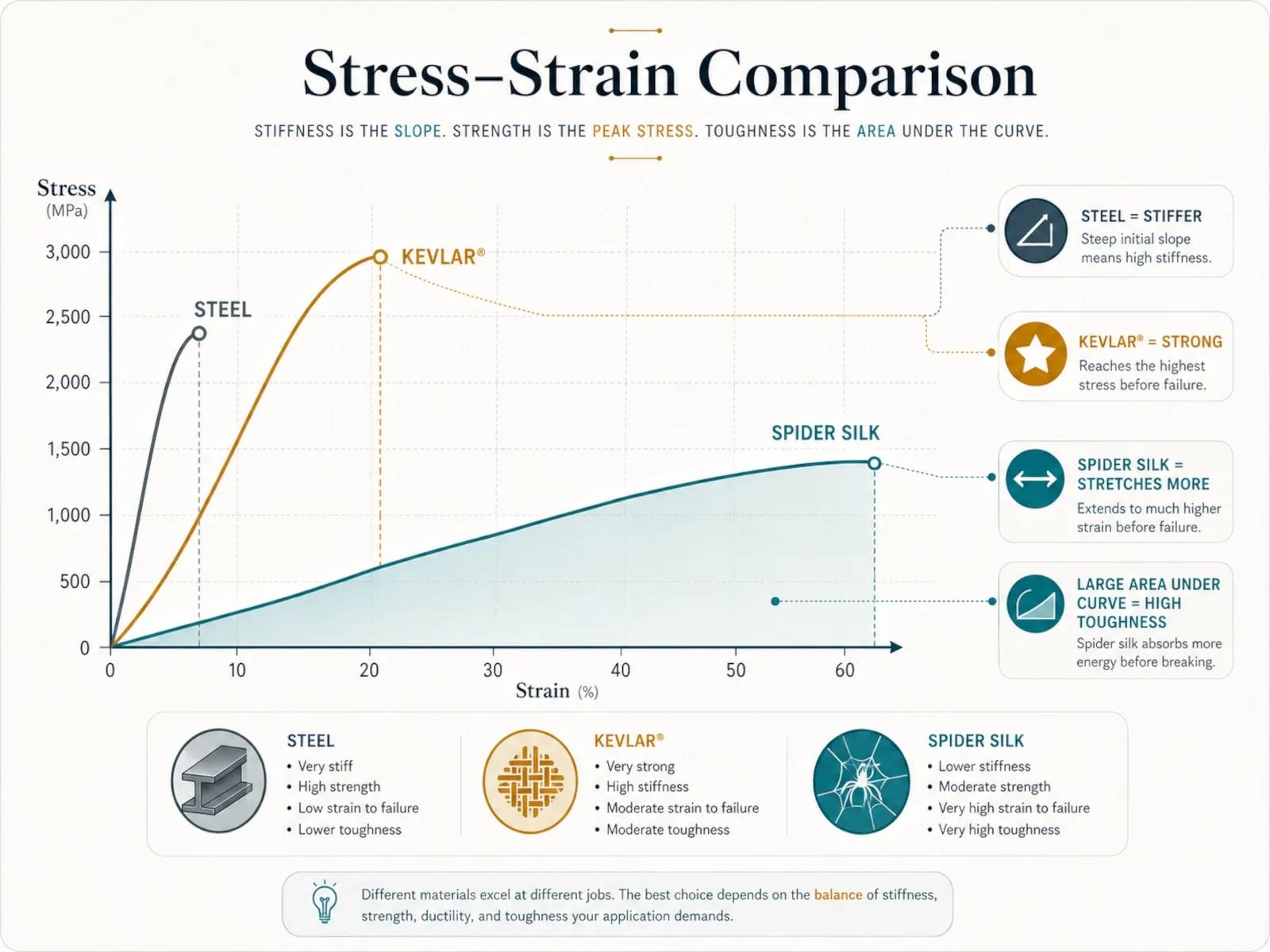
Toughness is the area under a stress-strain curve: the energy absorbed before the material breaks.
This is one of spider silk’s signature advantages. A fiber that is both strong and capable of large extension can absorb much more energy than a strong but relatively low-extension material.
The Darwin’s bark spider study reported an average of 354 MJ/m³ and a maximum measured value of 520 MJ/m³ for forcibly collected major ampullate silk.
Be careful with terminology here. This is tensile work-to-fracture toughness measured as energy per volume. It is not the same quantity as fracture toughness, which engineers commonly report in units such as MPa√m.
By stiffness
Steel wins decisively.
The Darwin’s bark spider study reported a Young’s modulus around 11.5 GPa for major ampullate silk. Typical steels are roughly an order of magnitude stiffer again, around the familiar ~200 GPa scale.
That is not a flaw in spider silk. A web benefits from being able to deform and dissipate energy rather than behaving like a rigid wall.
Spider silk vs. steel: the numbers
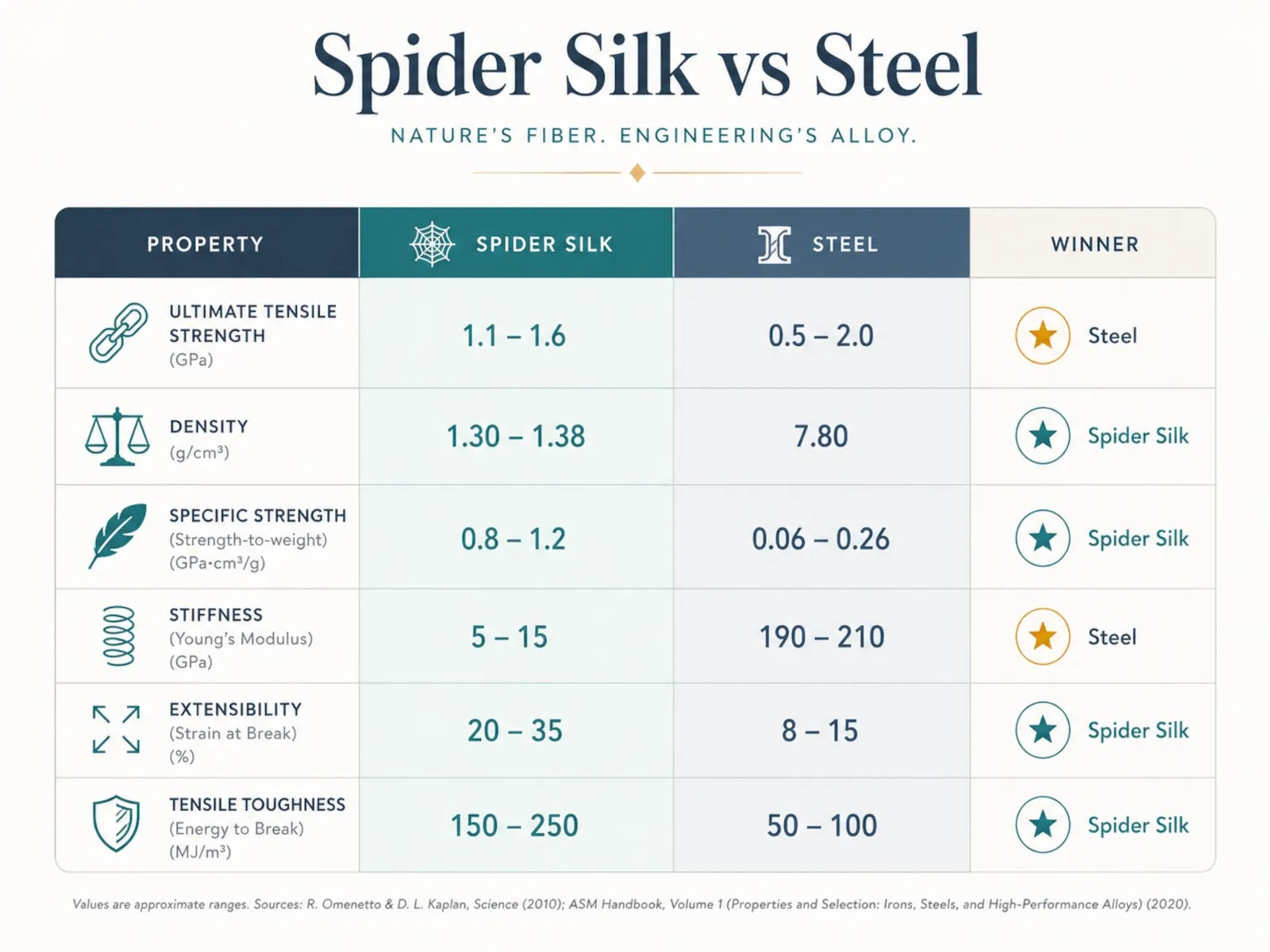
The most useful comparison is not a single winner but a property-by-property table.
| Property | High-performance spider dragline silk | Steel | What the comparison means |
|---|---|---|---|
| Ultimate tensile strength | Can reach roughly the low-GPa range; C. darwini measured around 1.65–1.85 GPa in the 2010 study | Varies enormously; ultrahigh-strength grades can exceed 2 GPa | Depends on the specific materials |
| Density | About 1.3 g/cm³ | About 7.8 g/cm³ | Silk is far lighter |
| Specific strength | Excellent | Lower for an equal tensile strength because steel is denser | Silk can win strongly by weight |
| Young’s modulus / stiffness | C. darwini around 11.5 GPa in the cited study | Roughly ~200 GPa for steel | Steel is much stiffer |
| Breaking strain | Can be very high; C. darwini averages in the tens of percent and some samples stretched much farther | Depends on grade; many ultrahigh-strength steels trade some ductility for strength | Silk can be highly extensible |
| Tensile toughness | Exceptional in some species; C. darwini reached up to 520 MJ/m³ in the cited tests | Highly grade- and test-dependent | Some spider silks are extraordinary energy absorbers |
The word depends is not an attempt to avoid an answer. It is the scientifically correct answer because both categories contain many different materials.
So, is spider silk stronger than steel?
Here is the cleanest verdict.
| Question | Verdict |
|---|---|
| Does spider silk always have higher tensile strength than steel? | No |
| Can spider silk reach the same broad tensile-strength range as strong steels? | Yes |
| Can spider silk be stronger than steel for the same mass? | Yes, depending on the silk and steel compared |
| Can some spider silks absorb exceptional amounts of energy before breaking? | Yes |
| Is spider silk stiffer than steel? | No |
| Is “spider silk is five times stronger than steel” a universal scientific law? | No |
The fairest one-sentence conclusion is:
Spider silk’s real advantage is not that it universally beats steel at one number; it is the rare combination of high strength, low density, large extensibility and high toughness.
Is spider silk really five times stronger than steel?
The famous “five times stronger than steel” line is an oversimplification.
There is no universal experiment in which all spider silk is five times stronger than all steel. The ratio changes depending on:
- the spider species;
- the silk type;
- the steel grade;
- whether you compare equal cross-sectional area or equal mass;
- whether you mean tensile strength or specific strength;
- humidity and temperature;
- strain rate;
- how the silk was spun or collected.
The slogan makes more sense when people are talking about strength relative to weight. Because silk is much less dense than steel, the same mass of silk can provide much more fiber cross-section.
That is a real engineering advantage. It is not the same as saying a hair-thin thread of silk will always outperform a same-thickness wire made from any steel.
Why is spider silk so strong?
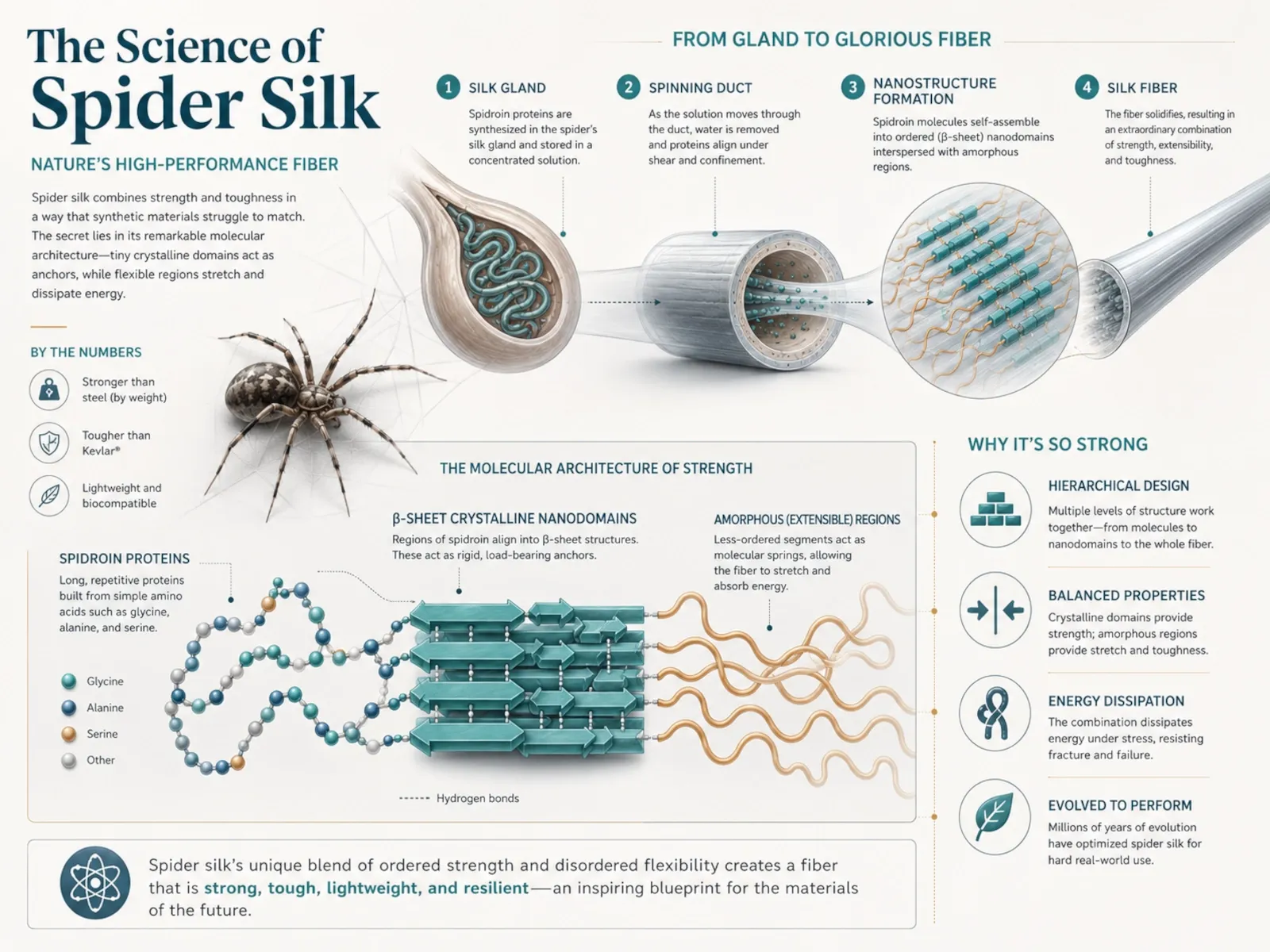
Spider silk is made primarily from large proteins called spidroins. After spinning, dragline silk has a hierarchical structure rather than a perfectly uniform molecular arrangement.
A useful simplified model contains two major elements:
- relatively ordered β-sheet-rich crystalline nanodomains, which help carry load and provide strength;
- less ordered amorphous or semi-amorphous regions, which can deform and contribute to extensibility.
That combination helps explain why a fiber can resist substantial tension without behaving like a rigid brittle filament.
The spinning process matters too. In the spider’s gland and duct, concentrated spidroins undergo changes in chemistry, water content, flow and alignment before being converted into a solid fiber. Research on spider-silk self-assembly shows that this transformation is sophisticated and still not completely understood.
That last point matters. “Nanocrystals plus stretchy regions” is a useful explanation for beginners, but it is not the complete molecular story. Modern comparative research continues to investigate how sequence, protein structure, spinning and environmental conditions combine to determine final mechanical performance.
Are all spider silks equally strong?
No.
Spiders use a silken toolkit, not one universal thread.
Depending on the species, silks can be optimized for jobs such as:
- structural support and safety lines;
- sticky capture spirals;
- wrapping prey;
- temporary scaffolding;
- egg protection;
- attachment to surfaces.
Even within dragline silk, mechanical properties vary substantially among species and individuals.
The 2024 cross-species analysis of 164 species is especially useful here because it warns against a common storytelling mistake: selecting one spectacular spider and presenting its values as the definition of all spider silk.
Darwin’s bark spider: one of the toughest silks known
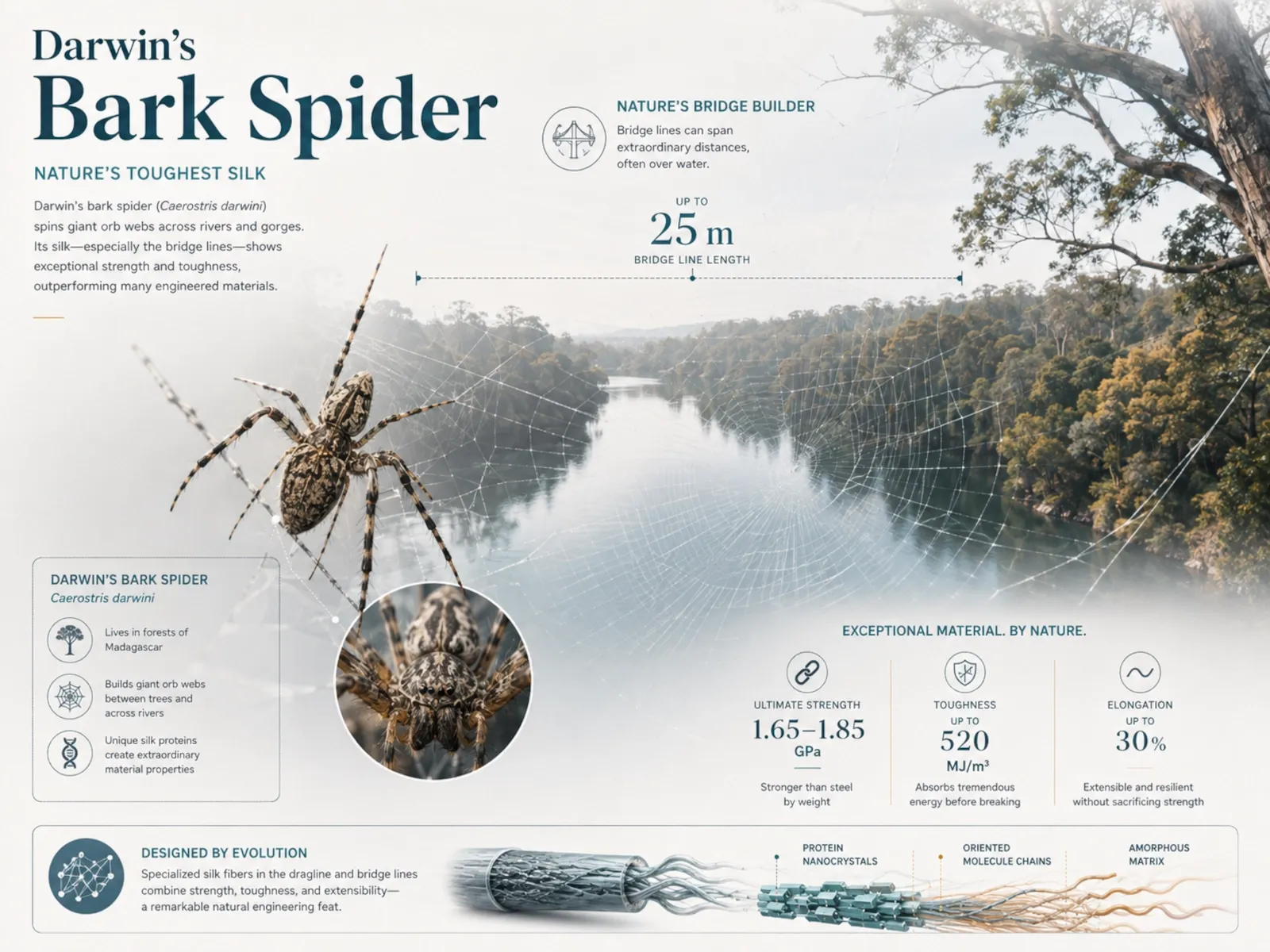
The Darwin’s bark spider is a particularly important case because its silk is extraordinary even by spider standards.
The species builds orb webs associated with rivers and other bodies of water. The 2010 study reported bridge lines reaching up to 25 meters, creating unusual mechanical demands.
For forcibly collected major ampullate silk, the researchers measured:
- 1,652 ± 208 MPa ultimate strength;
- 0.52 ± 0.22 true breaking strain;
- 11.5 ± 2.6 GPa initial stiffness;
- 354 ± 93 MJ/m³ toughness;
- and a measured toughness range of 233–520 MJ/m³.
The striking feature was not simply “more tensile strength.” The study described the tensile strength as high but not uniquely exceptional among spider silks.
The standout characteristic was extensibility combined with strength.
That is exactly why toughness is so important to this story.
How much weight can spider silk hold?
There is no single answer because the load capacity of a fiber is approximately:
failure load = tensile strength × cross-sectional area
That means a thicker bundle carries more load.
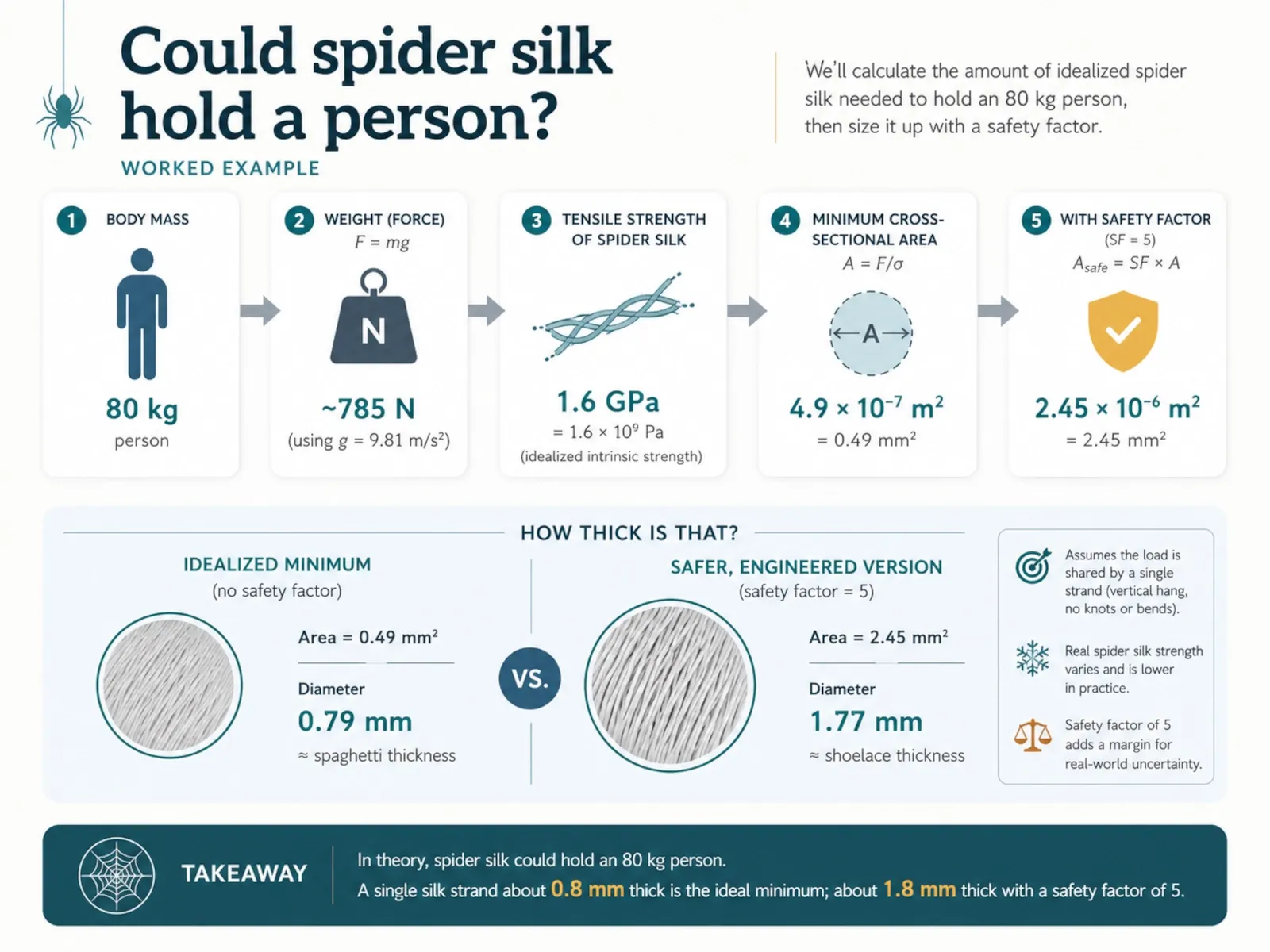
A worked example: an 80 kg person
Take an idealized dragline-silk strength of 1.6 GPa, close to the order of magnitude measured for Darwin’s bark spider silk.
An 80 kg person has a static weight of approximately:
80 kg × 9.81 m/s² ≈ 785 N
If the fiber were perfect and the load perfectly distributed:
required area = 785 N / 1.6 × 10^9 Pa
That gives approximately:
0.49 mm²
For an ideal circular rope, that corresponds to a diameter of only about:
0.79 mm
That number is deliberately surprising—and deliberately not a rope-design recommendation.
Apply a simple safety factor of 10 and the idealized required cross-sectional area becomes about 4.9 mm², corresponding to a circular diameter of roughly 2.5 mm.
Real engineering would also have to account for:
- dynamic loading;
- fiber-to-fiber load sharing;
- knots and terminations;
- abrasion;
- humidity;
- defects;
- aging;
- manufacturing consistency;
- and the reliability required for life-support equipment.
So the calculation demonstrates why high-strength fibers are impressive. It does not mean a 0.79 mm spider-silk cord is safe for human suspension.
Could spider silk hold a person?
A sufficiently large, well-made bundle could. One ordinary strand from a web should not be expected to.
This is a scaling problem. Tensile capacity increases with total load-bearing cross-sectional area.
Could spider silk hold a car?
In principle, enough fiber can support a car-scale static load—just as enough steel cable, aramid or polymer fiber can.
But that statement is less informative than it sounds. Once you allow arbitrary thickness, almost any structural material can be scaled to carry a large load.
The useful engineering question is how much mass, cross-section, cost and safety margin are required.
Could you swing from spider silk like Spider-Man?
The answer is more interesting than a simple yes or no.
A 2026 Veritasium demonstration used a bundle of transgenic spider-silk fiber to support and swing a person. The demonstration is valuable because it makes an important principle visible: enough load-bearing silk can support human-scale forces.
But it does not prove that Spider-Man-style web swinging is practical.
A real swing adds complications that static hanging does not:
- Dynamic force: acceleration can raise tension well above body weight.
- Shock loading: a sudden catch can create a much larger peak force than a gradual load.
- Anchor strength: the attachment point must survive the same forces.
- Rope construction: individual filaments must share the load reliably.
- Abrasion and bending: thin high-strength fibers can be damaged at contact points.
- Human comfort: a very thin cord can produce dangerously high pressure on skin or harness contact points.
- Safety factor: real climbing systems require generous margins rather than theoretical breaking strength.
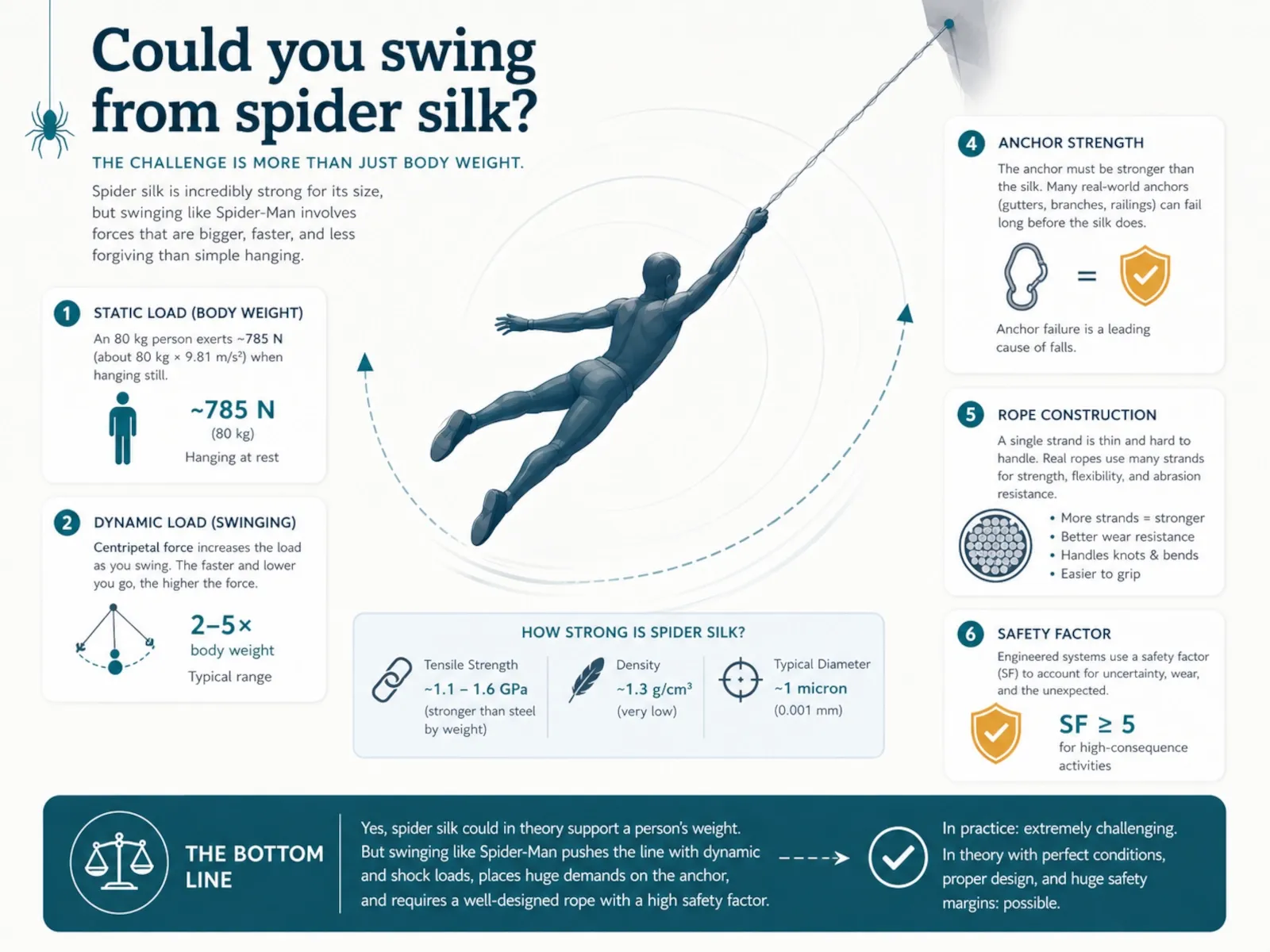
So: the material properties make human-scale suspension plausible; superhero-style deployment and swinging are a much harder systems-engineering problem.
Can spider silk stop a bullet?
A natural spider web is not bulletproof.
The confusion comes from toughness. Because some spider silks can absorb large amounts of energy before breaking, they are scientifically interesting for impact-resistant materials.
But ballistic protection depends on much more than the toughness of one filament:
- areal density;
- total thickness;
- number of layers;
- fiber orientation;
- weave or composite architecture;
- projectile mass and velocity;
- how load spreads across the panel;
- backing material;
- allowed deformation behind the armor.
A bullet-resistant vest is an engineered structure, not merely a collection of individually tough fibers.
So the correct statement is:
Spider silk has properties that make it interesting for impact-resistant material research, but an ordinary spider web cannot stop a bullet.
Spider silk vs. Kevlar
Kevlar is famous because aramid fibers combine high tensile strength with low mass and are useful in engineered protective structures.
Spider silk is different.
Some spider silks trade extreme stiffness for much greater extension before failure. That can generate very high tensile work-to-fracture toughness.
The Darwin’s bark spider paper reported an average toughness of 354 MJ/m³ and values up to 520 MJ/m³. In that paper, the authors compared these values with a Kevlar reference of roughly 33 MJ/m³, which is why statements such as “ten times tougher than Kevlar” appear in popular explanations.
That comparison needs two caveats:
- it refers to toughness, not universal superiority in every mechanical property;
- both biological fibers and commercial aramids come in multiple forms, and test conditions matter.
Kevlar can have higher tensile strength and stiffness than many spider silks. Spider silk’s striking advantage is the way some silks combine strength with large extension.
Why can’t we harvest spider silk?
Silkworm silk became an industry because silkworms can be domesticated and raised in huge numbers.
Spiders are much less cooperative production animals.
Large-scale farming is difficult because many spiders are:
- predatory;
- territorial;
- prone to cannibalism;
- difficult to house densely;
- and capable of producing only limited harvestable silk per animal.
Even collecting dragline silk from an individual spider is labor-intensive compared with unwinding a silkworm cocoon.
That is why modern spider-silk engineering focuses much more on recombinant production and bioengineered spinning systems than on building enormous spider farms.
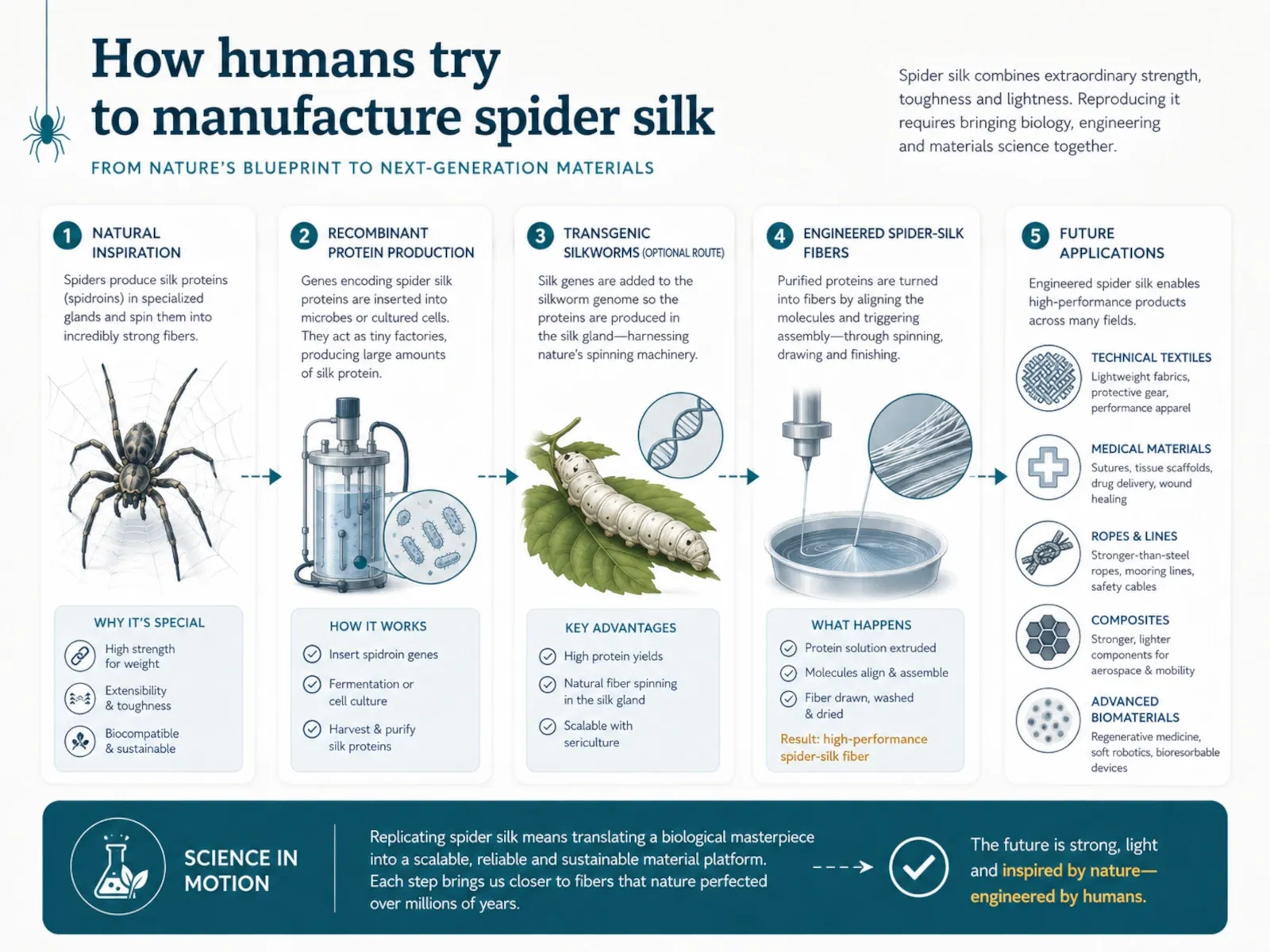
Can humans make spider silk?
Yes—but reproducing a spider’s entire manufacturing system is harder than simply producing the protein.
Researchers have expressed spider-silk proteins in organisms and cell systems including microbes and other hosts. The challenge is then converting those proteins into a fiber with the molecular alignment and hierarchical structure required for high mechanical performance.
One major strategy is to use silkworms, because they already possess a highly evolved silk-production and spinning system.
A 2023 study in Matter reported whole spider-silk fibers produced with transgenic silkworms that reached approximately:
- 1,299 MPa tensile strength;
- 319 MJ/m³ toughness.
That is important because it demonstrates that bioengineering can approach the combination of strength and toughness that makes natural spider silk so interesting.
It does not mean mass-market synthetic spider silk has already replaced steel, Kevlar or conventional textiles. Scaling production, controlling quality, lowering cost and matching natural-spider spinning remain engineering challenges.
What could artificial spider silk be used for?
Potential applications are broad because spider silk combines low density, mechanical performance and a protein-based chemistry.
Research and development areas include:
- lightweight high-performance fibers;
- technical textiles;
- ropes and cords where mass matters;
- impact-resistant composites;
- biomedical scaffolds;
- sutures and other medical materials;
- coatings and films;
- engineered materials inspired by spider-silk protein architecture.
The important word is potential.
A material can show outstanding laboratory properties without automatically becoming the best commercial choice. Manufacturing rate, cost, consistency, durability, moisture response, sterilization, regulatory requirements and end-of-life behavior all matter.
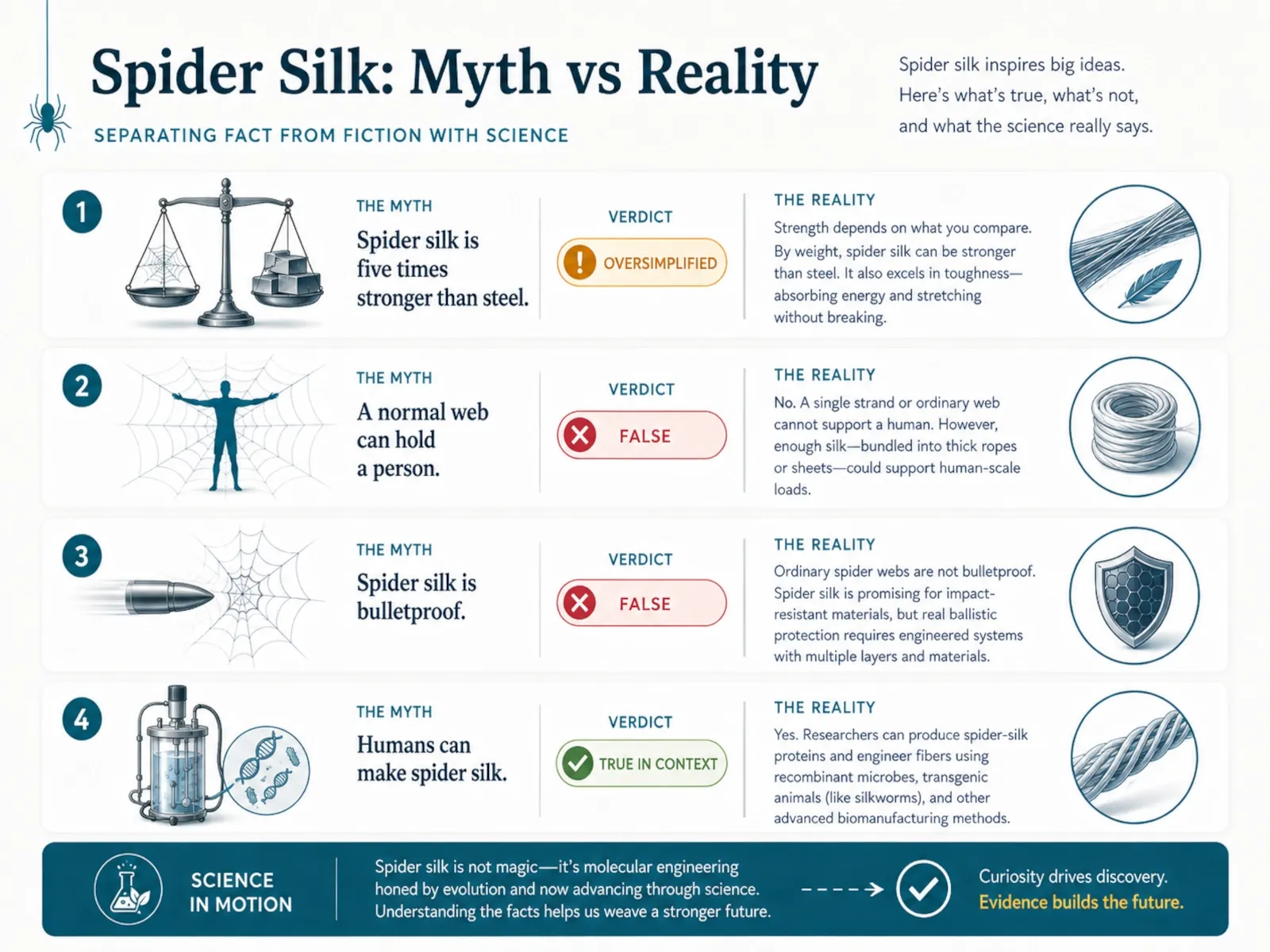
Claim vs. reality
| Claim | Verdict | Why |
|---|---|---|
| Spider silk is five times stronger than steel. | ⚠️ Oversimplified | The ratio depends on the property, silk, steel and whether weight is normalized. |
| Spider silk can beat steel by weight. | ✅ Often true in appropriate comparisons | Silk has high strength at roughly one-sixth the density of steel. |
| All spider silk is equally strong. | ❌ No | Mechanical performance varies by silk type, species, individual and conditions. |
| A normal web can hold a person. | ❌ No | Human loads require much more total load-bearing cross-section than ordinary web threads provide. |
| Enough spider silk can support a person. | ✅ In principle and in demonstrations | Load capacity scales with cross-sectional area and rope construction. |
| Spider silk is tougher than Kevlar. | ✅ Some measured silks under specific comparisons | Darwin’s bark spider silk has shown extremely high tensile work-to-fracture toughness. |
| A spider web can stop a bullet. | ❌ No | Ballistic protection requires a designed multilayer structure, not just a tough fiber. |
| Humans can make spider-like silk. | ✅ Yes | Recombinant and transgenic approaches have produced high-performance fibers. |
| Steel is weaker than spider silk. | ❌ Too broad | Some steels exceed spider silk in absolute tensile strength and are much stiffer. |
Common mistakes
Treating all steel as one material
Steel properties vary enormously with composition, heat treatment, microstructure and manufacturing.
A comparison using mild steel cannot be generalized to every steel.
Treating all spider silk as one fiber
Spiders can produce multiple silks, and even the same nominal silk type varies between species and test conditions.
Using “strength” when you mean “toughness”
This is the most common error.
Strength tells you about stress at failure. Toughness tells you about the total energy absorbed before failure.
Ignoring density
If you compare equal-diameter fibers, you are asking a different question from comparing equal-mass fibers.
Extrapolating from a laboratory fiber to a finished product
A fiber with exceptional material properties does not automatically become a safe rope, vest, bridge cable or aircraft component.
Turning one spectacular species into a universal rule
Darwin’s bark spider is useful precisely because it is exceptional. It should not be treated as the average spider.
Security, privacy and safety notes
This article explains material properties for educational purposes.
Do not use the worked calculations to design climbing, suspension, fall-arrest, lifting, ballistic or life-support equipment. Real engineering requires certified materials, controlled manufacturing, appropriate standards, dynamic testing, environmental testing and safety factors selected for the application.
Do not attempt to reproduce human-suspension or impact demonstrations with natural web silk, improvised fibers or unverified synthetic silk.
If collecting or observing spiders for educational work, avoid handling or restraining animals unless you are trained and following appropriate animal-care procedures.
Faster alternative: the 20-second comparison
If you only want the shortest accurate version, use this:
Spider silk is not universally stronger than steel. High-performance dragline silk can reach tensile strengths in the same broad range as strong steel while being much lighter. Some specialized steels exceed spider silk in absolute tensile strength, and steel is far stiffer. Spider silk’s standout advantage is its combination of low density, strength and extensibility, which can give it exceptional strength-to-weight performance and toughness.
That is the version worth remembering.
Final verdict
So, is spider silk stronger than steel?
Sometimes—depending on what you mean by stronger.
If you mean absolute tensile strength, there is no universal spider-silk victory. High-performing dragline silk can reach the same broad strength scale as strong steels, while specialized ultrahigh-strength steels can exceed it.
If you mean strength for a given mass, spider silk becomes much more competitive because it is dramatically lighter.
If you mean energy absorbed before breaking, some spider silks are exceptional because they combine high strength with very large extension.
If you mean stiffness, steel wins easily.
The scientifically interesting conclusion is therefore better than the myth:
Spider silk is remarkable not because it owns one unbeatable strength number, but because nature combines strength, lightness, flexibility and toughness in a single fiber produced under mild biological conditions.
FAQ
Is spider web stronger than steel?
A spider web is a structure, so the comparison should technically be between spider silk and steel. Some spider dragline silks can rival strong steels in tensile strength and outperform steel on a strength-to-weight basis, but steel is much stiffer and some specialized steels have higher absolute tensile strength.
How strong is spider silk?
It varies widely. High-performance dragline silks can reach tensile strengths in the gigapascal range. Darwin’s bark spider major ampullate silk was measured around 1.65–1.85 GPa in a well-known 2010 study.
Is spider silk five times stronger than steel?
Not as a universal rule. “Five times stronger” usually compresses a strength-to-weight comparison into a catchy phrase. The result changes depending on the spider silk, steel grade and property being compared.
Is spider silk the strongest material in the world?
No. There are materials with higher tensile strength, higher stiffness or other superior properties. Spider silk is notable for its combination of strength, low density and toughness.
Is spider silk stronger than titanium?
That depends on the titanium alloy and on whether you compare absolute tensile strength, specific strength or another property. “Titanium” is a family of materials just as “steel” is.
Is spider silk tougher than Kevlar?
Some measured spider silks have shown much higher tensile work-to-fracture toughness than the Kevlar reference used in the relevant studies. That does not mean spider silk exceeds Kevlar in every mechanical property or application.
Could spider silk hold a person?
A sufficiently thick and properly engineered bundle can support human-scale loads. A normal individual strand from an ordinary web should not be treated as a human-support rope.
Could spider silk hold a car?
Enough fiber could carry a car-scale static load in principle, but the useful question is how much material, structure and safety margin would be required. Real lifting systems must use certified engineering designs.
Can spider silk stop a bullet?
An ordinary spider web cannot. Spider silk’s toughness makes it interesting for impact-resistant material research, but ballistic protection requires engineered layers, sufficient areal density and controlled structure.
Why can’t we farm spiders for silk?
Many spiders are territorial, predatory and cannibalistic, which makes dense industrial farming difficult. Harvesting silk directly from spiders is also labor-intensive.
Can humans manufacture spider silk?
Yes. Researchers have produced spider-silk proteins through recombinant biology and have generated high-performance fibers using approaches including transgenic silkworms. Matching natural silk consistently and economically at industrial scale remains challenging.
What is the toughest spider silk known?
Darwin’s bark spider silk is one of the best-known exceptional cases. The 2010 study reported average toughness around 354 MJ/m³ for forcibly collected major ampullate silk, with measured values reaching 520 MJ/m³.
Last tested
Tested on:
- PLOS ONE mechanical data for Caerostris darwini
- Evolution 2024 comparative spider-silk analysis
- PNAS research on spider-web construction and mechanics
- Matter 2023 transgenic silkworm spider-silk results
- Published ultrahigh-strength steel research
- 2026 Veritasium spider-silk demonstration
Last tested: 2026-08-10
Related guides
Carefully selected guides to help you understand the topic and complete the next useful step.