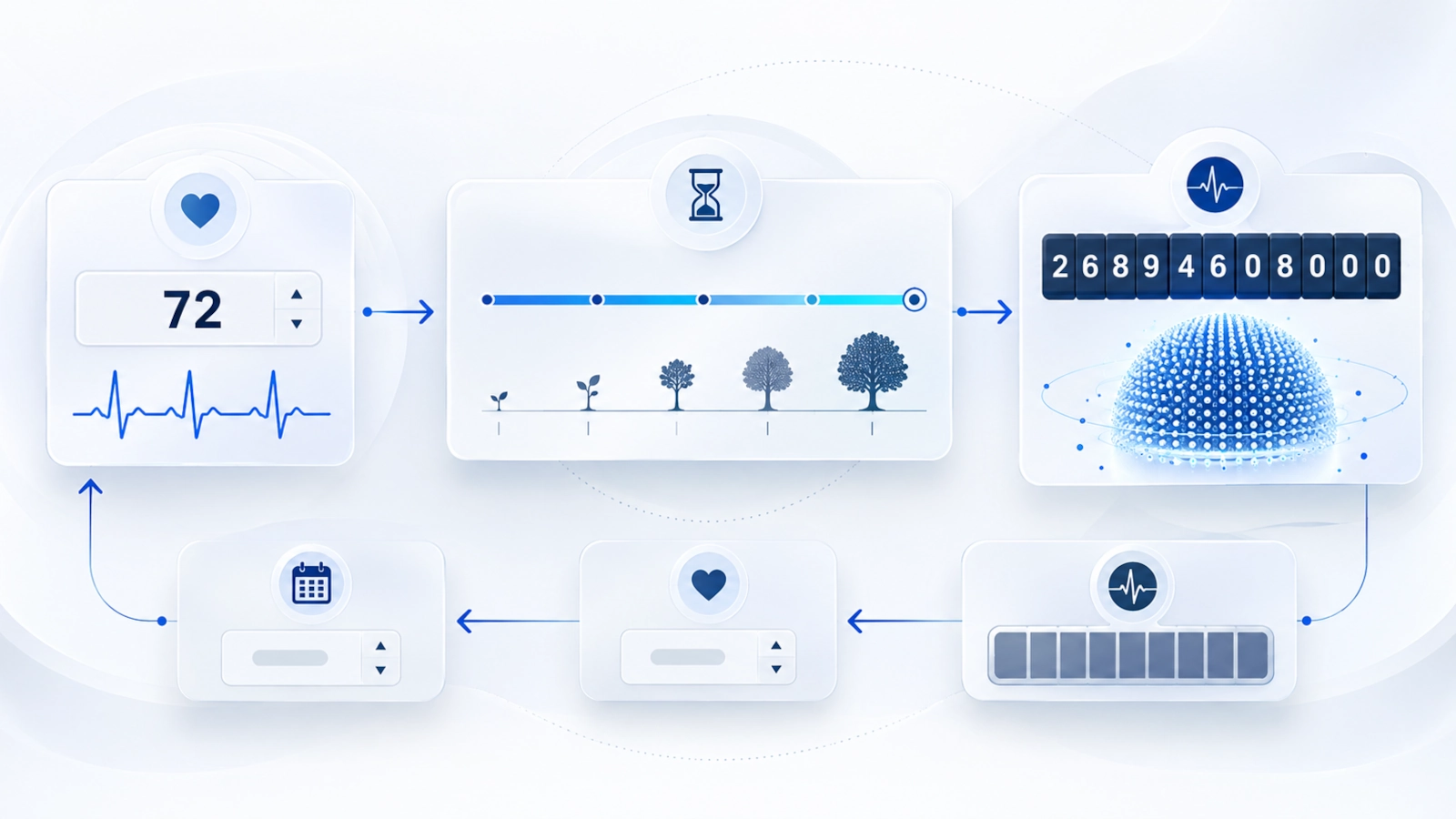
The “one billion heartbeats” idea becomes much easier to understand when you can change the numbers yourself. This calculator lets you experiment with heart rate, lifespan and total heartbeats using simple arithmetic.
Why do mammals seem to get about one billion heartbeats? Read the science behind the one-billion-heartbeats pattern, including its exceptions and why it is not a biological countdown clock.
Lifetime Heartbeats Calculator
Interactive science tool
Explore the math behind the one-billion-heartbeats idea
Estimate how many times a heart would beat over a given number of years, or convert a heartbeat total into an equivalent amount of time.
Try an illustrative example
Estimated lifetime heartbeats
≈ 2.95 billion heartbeats
At a constant 70 bpm over 80 years, the mathematical estimate is about 2.95 billion heartbeats.
Exact mathematical result: 2,945,376,000 heartbeats
Same lifespan, different constant heart rates.
The calculation assumes the same heart rate every minute of every day. Real mammalian heart rates change with activity, sleep, age, temperature, stress, diving, torpor and other physiological states.
Use this as a mathematical comparison, not as a prediction of lifespan.
Why the one-billion-heartbeats rule is only an approximation →How the calculator works
Estimate lifetime heartbeats
Lifetime heartbeats = heart rate × 60 × 24 × 365.25 × yearsConvert heartbeats to equivalent years
Equivalent years = total heartbeats ÷ heart rate ÷ 60 ÷ 24 ÷ 365.25The calculator uses 365.25 days per year and assumes a constant heart rate solely for mathematical comparison.
What this calculator can answer
Use the first mode to estimate the total number of heartbeats produced by a constant heart rate over a chosen number of years.
Use the second mode to answer questions such as:
- How long would 1 billion heartbeats take?
- How long would 3 billion heartbeats take?
- How many years are 2 billion heartbeats?
- How many heartbeats occur over 70 years at a given constant heart rate?
How the calculation works
For estimated lifetime heartbeats:
heart rate × 60 × 24 × 365.25 × years
For equivalent time:
total heartbeats ÷ heart rate ÷ 60 ÷ 24 ÷ 365.25
The use of 365.25 days per year accounts approximately for leap years.
How many years is 1 billion heartbeats?
There is no single conversion from 1 billion heartbeats to years because the answer depends on heart rate. At a lower constant BPM, one billion beats take longer; at a higher BPM, they take less time.
| Constant heart rate | Time to 1 billion heartbeats |
|---|---|
| 30 bpm | about 63.4 years |
| 40 bpm | about 47.5 years |
| 50 bpm | about 38.0 years |
| 60 bpm | about 31.7 years |
| 70 bpm | about 27.2 years |
| 80 bpm | about 23.8 years |
| 100 bpm | about 19.0 years |
| 120 bpm | about 15.8 years |
These values assume one constant heart rate for the entire period. They are mathematical conversions, not lifespan predictions.
How long is 1.5 billion heartbeats?
At a hypothetical constant heart rate:
| Constant heart rate | Time to 1.5 billion heartbeats |
|---|---|
| 60 bpm | about 47.5 years |
| 70 bpm | about 40.7 years |
For any other BPM, enter 1.5 billion as the heartbeat total in the calculator above.
How long is 2 billion heartbeats?
At a hypothetical constant heart rate:
| Constant heart rate | Time to 2 billion heartbeats |
|---|---|
| 60 bpm | about 63.4 years |
| 70 bpm | about 54.3 years |
The conversion changes proportionally with BPM, so the calculator is the simplest way to test another heart rate.
How long is 3 billion heartbeats?
At a hypothetical constant heart rate:
| Constant heart rate | Time to 3 billion heartbeats |
|---|---|
| 60 bpm | about 95.1 years |
| 70 bpm | about 81.5 years |
Again, these are arithmetic examples rather than biological limits.
How many heartbeats are there in a lifetime?
A lifetime heartbeat total depends on both heart rate (BPM) and time. Using a constant rate only for comparison, the calculation produces:
| Constant heart rate | 70 years | 80 years | 90 years |
|---|---|---|---|
| 50 bpm | about 1.84 billion | about 2.10 billion | about 2.37 billion |
| 60 bpm | about 2.21 billion | about 2.52 billion | about 2.84 billion |
| 70 bpm | about 2.58 billion | about 2.95 billion | about 3.31 billion |
| 80 bpm | about 2.95 billion | about 3.37 billion | about 3.79 billion |
| 100 bpm | about 3.68 billion | about 4.21 billion | about 4.73 billion |
This table is useful for quick comparisons. For a different age, lifespan or BPM, use the calculator instead of interpolating manually.
How heart rate (BPM) changes the result
When converting a fixed heartbeat total into years, time is inversely proportional to BPM. Doubling the constant heart rate cuts the calculated time roughly in half.
When estimating total heartbeats over a fixed number of years, the relationship goes the other way: a higher constant BPM produces a larger heartbeat total.
This is why the same number of heartbeats can correspond to very different lengths of time at different heart rates.
What the result does not mean
The result is a mathematical comparison. It does not predict lifespan.
Real heart rate varies with age, activity, sleep, stress, temperature, health, diving, torpor and many other physiological states. A constant heart rate entered into this calculator should therefore not be interpreted as a measured lifetime average.
Read the science behind the one-billion-heartbeats idea
For the full explanation of why many mammals can fall into a surprisingly similar range of estimated lifetime heartbeats—and why the rule has important exceptions—read:
Do Mammals Really Get 1 Billion Heartbeats? What the Science ShowsLast tested
Tested on:
- Client-side arithmetic using 365.25 days per year
- Astro production build
- Modern desktop and mobile browser interface
Last tested: 2026-09-17
Related guides
Carefully selected guides to help you understand the topic and complete the next useful step.