
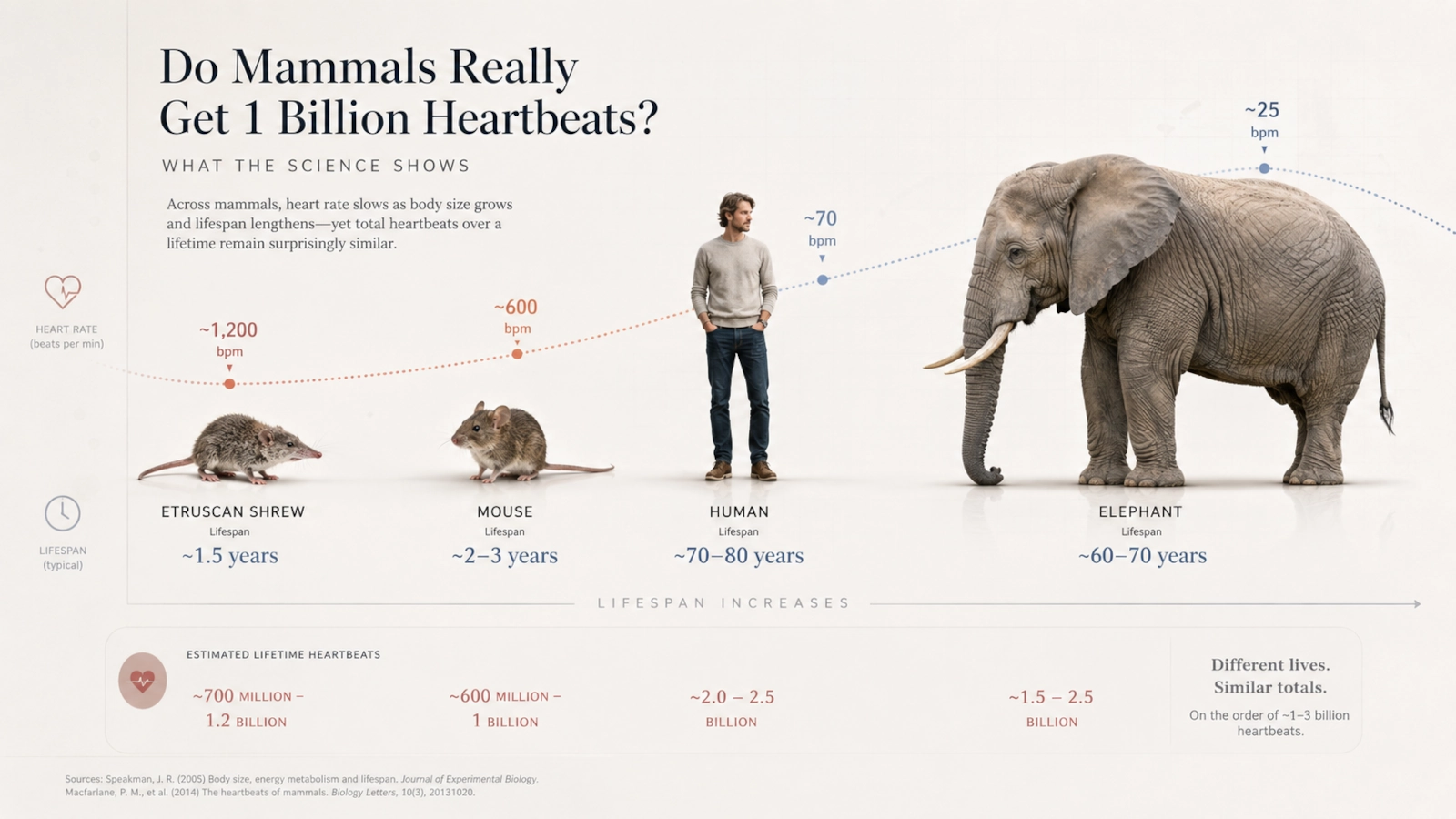
A tiny mammal can have a heart that races hundreds of times per minute and live only a few years. A much larger mammal may have a far slower pulse and live for decades. Multiply heart rate by lifespan and, surprisingly often, the totals land in the same broad neighborhood.
That observation is the source of the popular claim that every mammal gets about one billion heartbeats in its lifetime.
It is a memorable idea. It is also easy to misunderstand.
The most useful way to think about it is not as a countdown built into the heart, but as an allometric scaling pattern: body size is associated with systematic changes in metabolism, circulation and biological timing. Those relationships can make estimated lifetime heartbeat counts look roughly similar across many mammals—even though the number is not fixed, the exact scaling exponents are debated, and important species do not fit the pattern neatly.
Quick answer
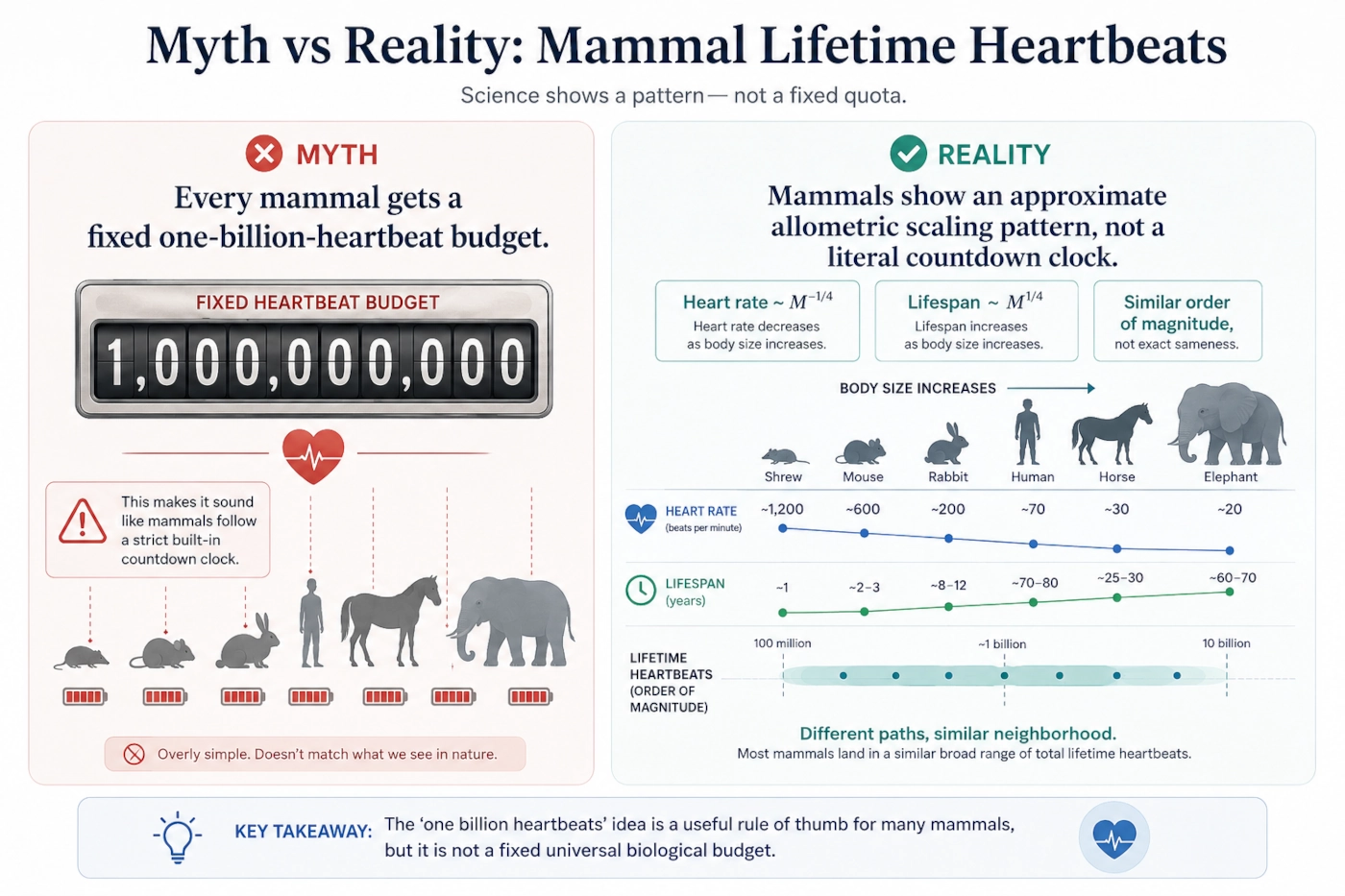
No, mammals do not literally receive a fixed allowance of one billion heartbeats. The “one billion heartbeats” idea is an approximate cross-species pattern.
Smaller mammals generally have faster heart rates and shorter lives, while larger mammals generally have slower heart rates and longer lives. In the classic quarter-power scaling framework, heart rate falls with body mass at roughly the inverse rate that characteristic lifespan rises. If those two trends are multiplied together, body mass largely cancels out, leaving a lifetime heartbeat count of roughly the same order of magnitude.
That is why values around a billion are often quoted.
But the rule is not exact. Published estimates differ substantially: a 1997 comparative analysis reported an average of about 7.3 × 10^8 heartbeats per lifetime, with very large variation, while a 2002 scaling paper described an approximate mammalian invariant of 1.5 × 10^9 heartbeats. Those are not the same number—and that difference is exactly why “one billion” should be treated as a useful approximation, not a biological constant.
The key idea: this is a statistical scaling pattern, not a biological countdown clock.
Curious what one billion heartbeats means at different heart rates?
Try the calculator in this article ↓, or open the full Lifetime Heartbeats Calculator to convert heartbeats into years and estimate lifetime totals with your own values.
When to use this explanation
This article is for you if you have seen claims such as:
- “Every mammal gets one billion heartbeats.”
- “A mouse and an elephant have the same number of heartbeats.”
- “Animals with slower hearts live longer.”
- “Humans get three billion heartbeats.”
- “Exercise uses up your lifetime heartbeats.”
- “Kleiber’s Law proves how long an animal will live.”
It is also useful if you want to understand why body size changes biological rates in non-linear ways.
This is not a guide to normal human heart rate, cardiovascular disease, exercise prescriptions or personal lifespan prediction. Those are medical questions and require a different evidence base.
Before you start
Three distinctions make the entire topic much easier to understand:
- Heart rate is not constant. It changes with activity, sleep, stress, age, temperature, diving, torpor and many other conditions.
- Lifespan is not one number. Maximum recorded lifespan, average lifespan, life expectancy, captive lifespan and wild lifespan are different measures.
- Correlation is not causation. If large mammals tend to have slower hearts and longer lives, that does not mean simply slowing a heart would automatically extend life.
There is one more important point: when scientists compare species, they usually work with broad statistical relationships across many animals. Individual species can sit well above or below the trend.
Main explanation
The one-billion-heartbeats idea sits at the intersection of four quantities:
body size → metabolic rate → heart rate → lifespan
Body mass can vary by many orders of magnitude across mammals, yet biological functions do not usually scale in direct proportion to mass.
A mammal that is 100 times heavier does not simply have 100 times the metabolic rate, 100 times the heart rate or 100 times the lifespan of the smaller animal. Instead, many traits follow power-law relationships.
That field is called allometry.
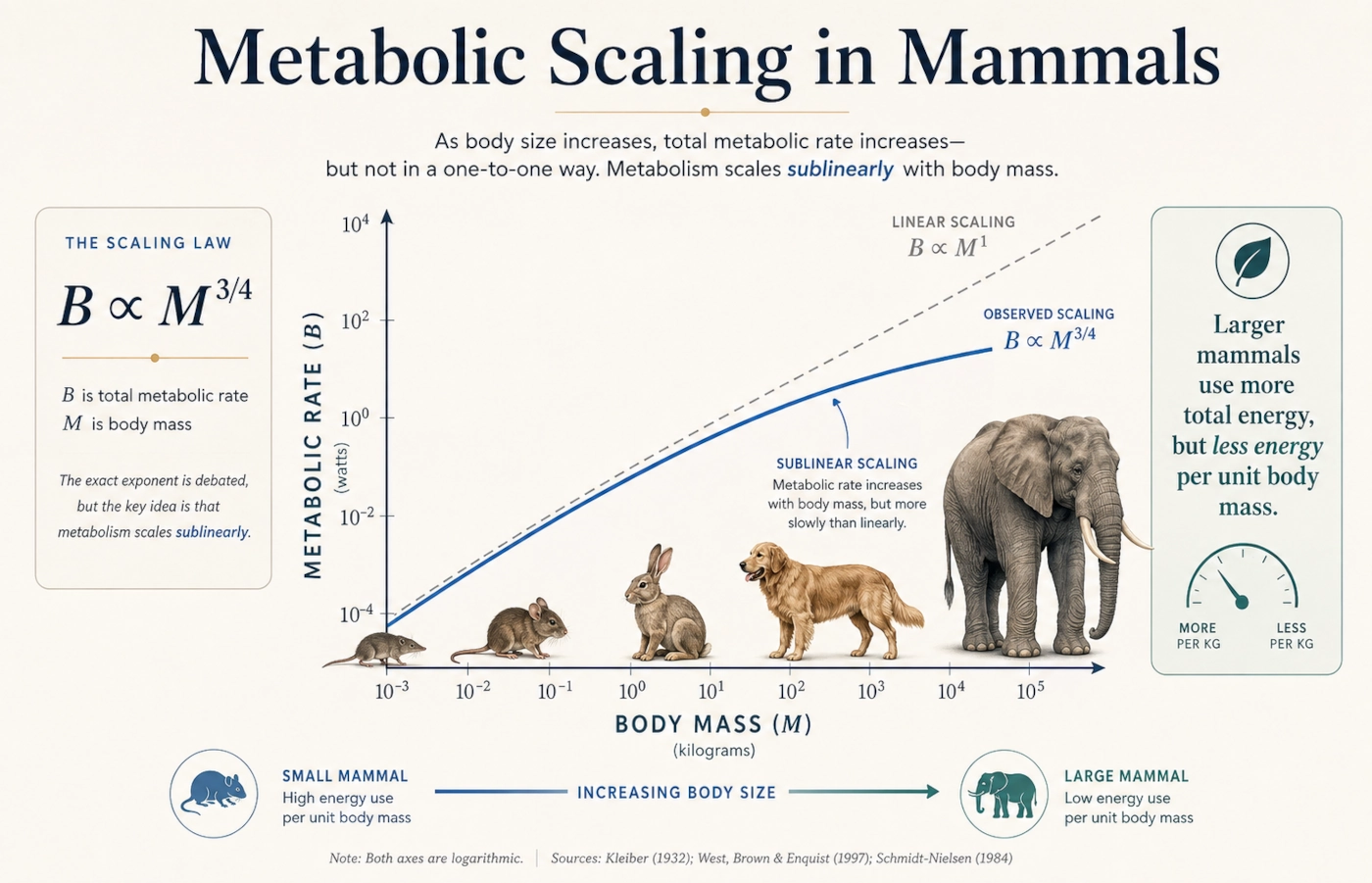
The most famous example is the relationship between body mass and metabolic rate. In the classic version of Kleiber’s Law, whole-organism metabolic rate is often approximated as scaling with body mass to the three-quarter power:
B ∝ M^3/4
where:
Bis metabolic rate;Mis body mass;∝means “is proportional to.”
Because the exponent is below 1, metabolic rate increases more slowly than body mass. A large mammal therefore uses more total energy than a small mammal, but less energy per unit of body mass.
That sublinear scaling is the starting point for understanding why biological time seems to run at different speeds in differently sized mammals.
Do mammals really get one billion heartbeats?
Not exactly.
There is a genuine comparative pattern behind the claim, but “one billion” is not a universal constant.
Herbert Levine’s 1997 analysis compared resting heart rate and life expectancy across mammals and reported a mean of about 7.3 ± 5.6 × 10^8 heartbeats per lifetime. The enormous spread around that average matters: it tells us immediately that species are not converging on one precise target.
A 2002 paper by Geoffrey West and colleagues, working within an allometric scaling framework, described the number of mammalian heartbeats per lifetime as an approximate invariant of about 1.5 × 10^9.
So even two influential treatments of the same broad idea give figures on opposite sides of one billion.
That is not a contradiction that destroys the pattern. It tells us what kind of pattern it is:
A broad biological scaling tendency, not an exact quota.
Where does the one-billion-heartbeats idea come from?
The modern version of the idea grew out of comparative physiology and the study of biological scaling.
In the early twentieth century, Max Kleiber measured metabolic rates across mammals of different sizes and found that metabolism did not rise linearly with body mass. The relationship later became widely known as Kleiber’s Law.
Decades later, Geoffrey West, James Brown and Brian Enquist proposed a general theoretical framework—often called WBE theory—that attempted to explain quarter-power scaling from the geometry and physics of biological resource-distribution networks such as blood vessels.
Once metabolic rate is linked to body size, other characteristic rates and times can be related to it. In the classic quarter-power picture:
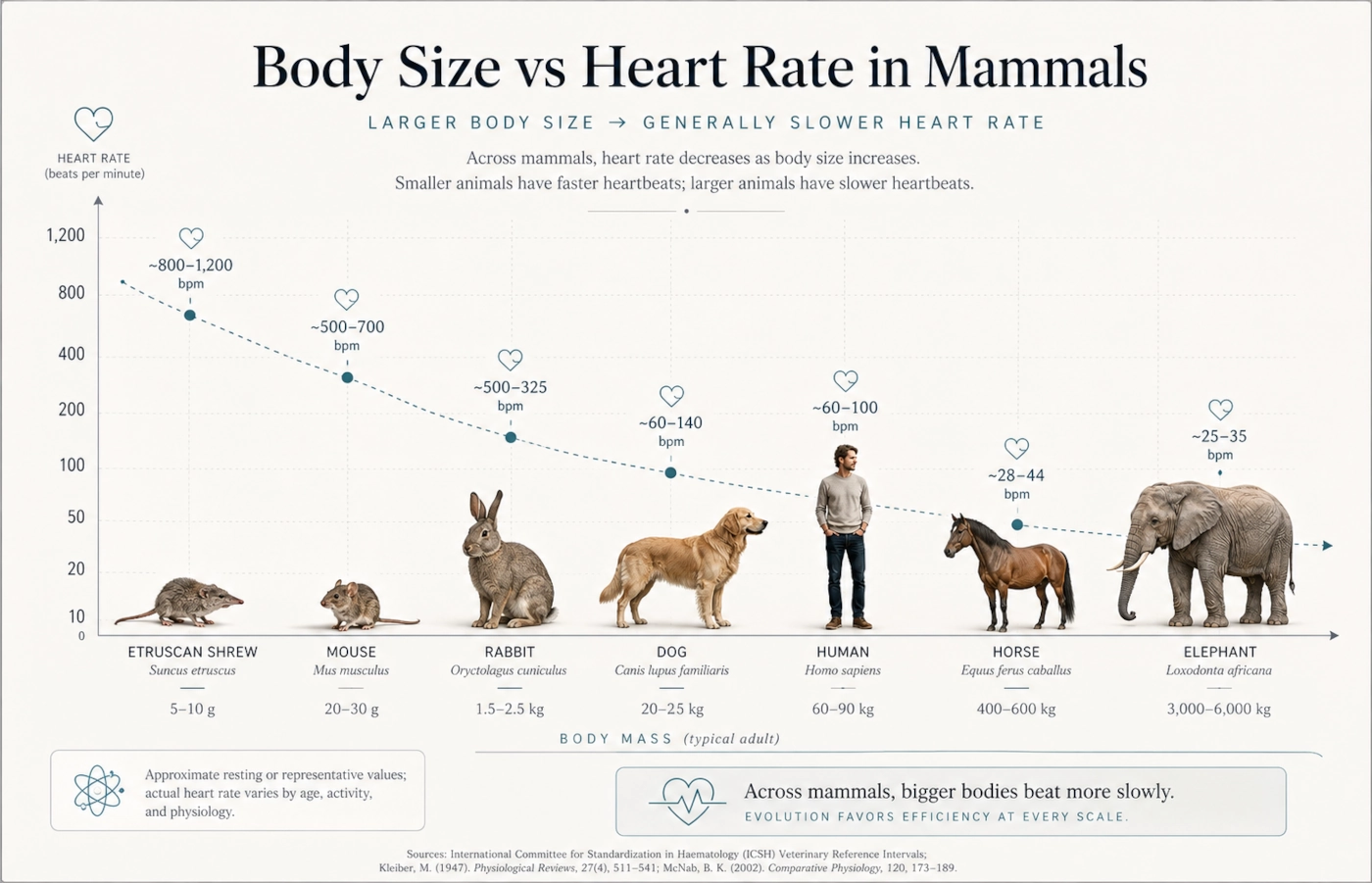
- heart rate tends to decrease with body size;
- biological times tend to increase with body size;
- lifespan often increases with size across broad mammalian comparisons.
If heart rate and lifespan change in approximately opposite ways, multiplying them can remove much of the effect of body mass.
That is the mathematical reason the lifetime total can appear surprisingly stable.
Why small mammals have faster heart rates
Small endothermic mammals lose heat quickly because they have a large surface area relative to their volume. Maintaining body temperature and supporting their tissues requires a high mass-specific metabolic rate.
Their circulation must deliver oxygen and nutrients at a correspondingly rapid pace.
This is why tiny mammals can have extraordinary heart rates.
A primary study of the Etruscan shrew, Suncus etruscus, measured heart rate rising from roughly 100 beats per minute during torpor to 800–1,200 beats per minute during rewarming.
That detail is important. The often-repeated “1,200 bpm shrew” figure is real in the study, but it was measured during a specific physiological transition. It should not be treated as one immutable heart rate that the animal maintains throughout its entire life.
This is one reason simple lifetime-heartbeat calculations are educational approximations rather than direct measurements.
Why large mammals have slower heart rates
Large mammals operate on a different physiological scale.
Their total metabolic rate is high because they have enormous bodies, but the energy used per unit of tissue is generally lower than in tiny mammals. Their characteristic heart rates are correspondingly slower.
At the extreme end, very large marine mammals show just how context-dependent heart rate can be.
In a 2019 study that recorded the heart rate of a free-ranging blue whale, heart rates during dives were typically around 4–8 beats per minute and could fall to about 2 beats per minute, then increase markedly near the surface.
That does not mean “a blue whale’s heart rate is 2 bpm.” It means heart rate changes with physiological state.
The same principle applies across mammals: a single resting or observed heart-rate value is never a perfect substitute for the integral of every heartbeat across an entire life.
What metabolism has to do with heart rate
Metabolism is the rate at which an organism uses energy.
Every organ depends on energy, and the cardiovascular system transports the oxygen and nutrients needed to support that energy use. Across species, metabolic demand and circulation are therefore closely connected.
In the quarter-power scaling framework, whole-body metabolic rate is written approximately as:
B ∝ M^3/4
If the amount of blood moved per beat scales roughly with body size, while total blood flow tracks metabolic demand, then characteristic heart rate scales approximately as:
Heart rate ∝ M^-1/4
The negative exponent means that heart rate tends to decline as body mass increases.
This is not a rule for predicting the pulse of an individual animal to the exact beat. It is a cross-species scaling relationship.
Kleiber’s Law, explained simply
Imagine two mammals where one is much larger than the other.
If biology scaled linearly, a mammal with 100 times the mass would use 100 times the energy. But real metabolic scaling is sublinear: the larger animal uses more energy overall, yet less energy for each unit of tissue.
Kleiber’s Law is commonly represented as:
B = B0 × M^b
where b is the scaling exponent.
The famous value is:
b ≈ 3/4
But this is where the story becomes more interesting than the popular version.
Researchers have spent decades debating whether 3/4 is truly universal. A 2003 PNAS analysis by Craig White and Roger Seymour found mammalian basal metabolic rate to be more consistent with an exponent near 2/3 under their treatment of the data. A 2010 phylogenetically informed analysis by Capellini, Venditti and Barton concluded that the scaling relationship varies among mammalian lineages and did not support a single universal 2/3 or 3/4 exponent for mammalian basal metabolic rate.
More recently, alternative models have continued to explain metabolic scaling through life-history optimization and other mechanisms.
So it is reasonable to teach the quarter-power framework because it is influential and mathematically revealing. It is not reasonable to present 3/4 as a perfectly settled constant of life.
The surprisingly simple math behind lifetime heartbeats
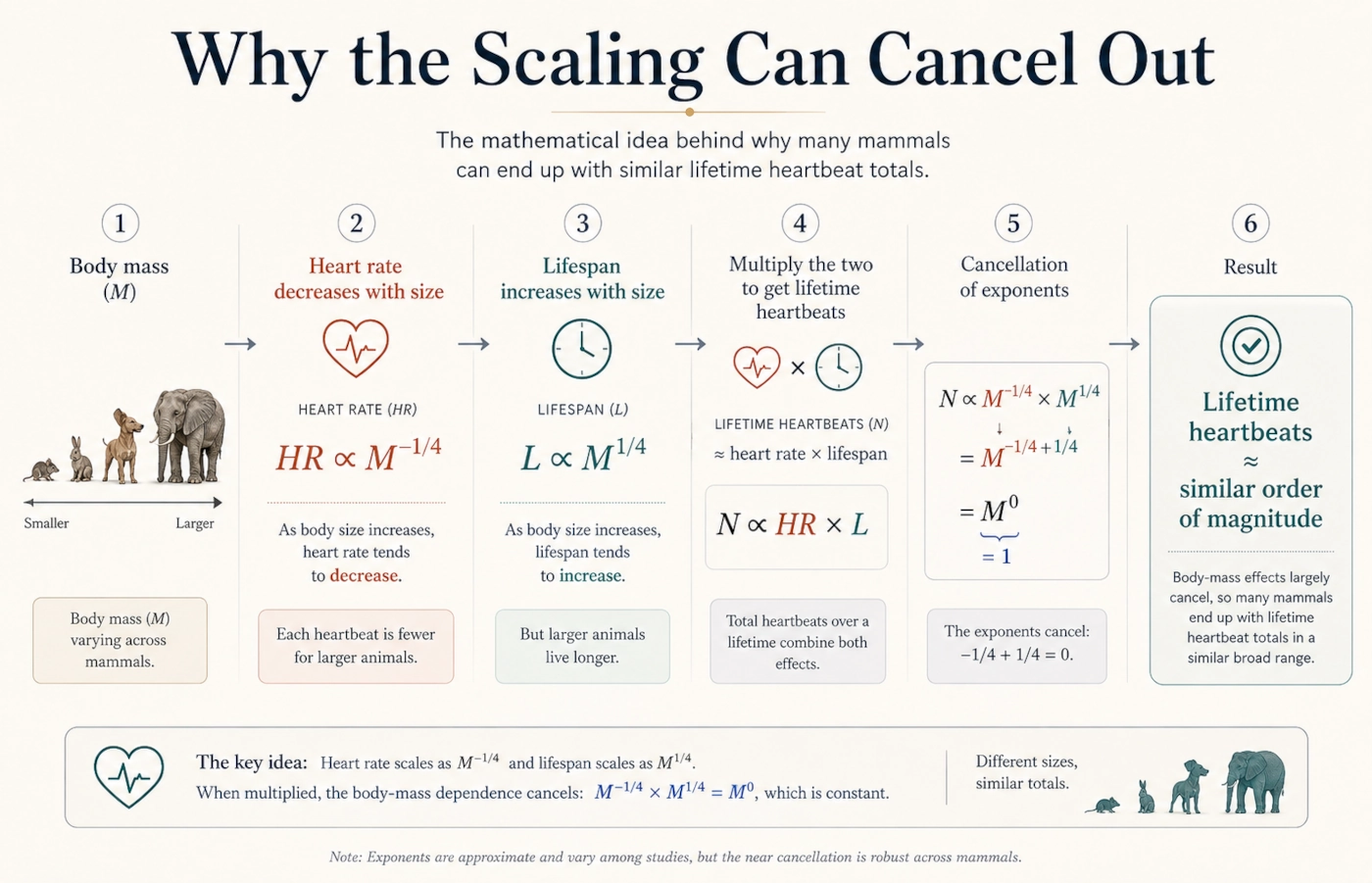
The classic explanation can be understood in five steps.
1. Start with body mass
Call mammal body mass M.
We want to know how two quantities change as M changes:
- heart rate;
- lifespan.
2. Let metabolic rate scale sublinearly
In the classic Kleiber/WBE framework:
Metabolic rate ∝ M^3/4
That means larger mammals use more total energy, but not in direct proportion to their extra mass.
3. Translate metabolic scaling into heart rate
The quarter-power framework predicts a characteristic heart-rate scaling close to:
Heart rate ∝ M^-1/4
So as body mass rises, heart rate falls.
4. Let characteristic lifespan rise with body size
In the same simplified framework, many biological times scale in the opposite direction:
Lifespan ∝ M^1/4
So larger mammals tend, on average, to operate on longer timescales.
5. Multiply heart rate by lifespan
A rough lifetime heartbeat count is:
Lifetime heartbeats ≈ heart rate × lifespan
Substitute the idealized scaling relationships:
Lifetime heartbeats ∝ M^-1/4 × M^1/4
The exponents cancel:
Lifetime heartbeats ∝ M^0
And because:
M^0 = 1
body mass disappears from the simplified expression.
That is the mathematical heart of the “one billion heartbeats” idea.
But remember what just happened: we multiplied idealized scaling relationships, not continuous lifetime measurements from every mammal species.
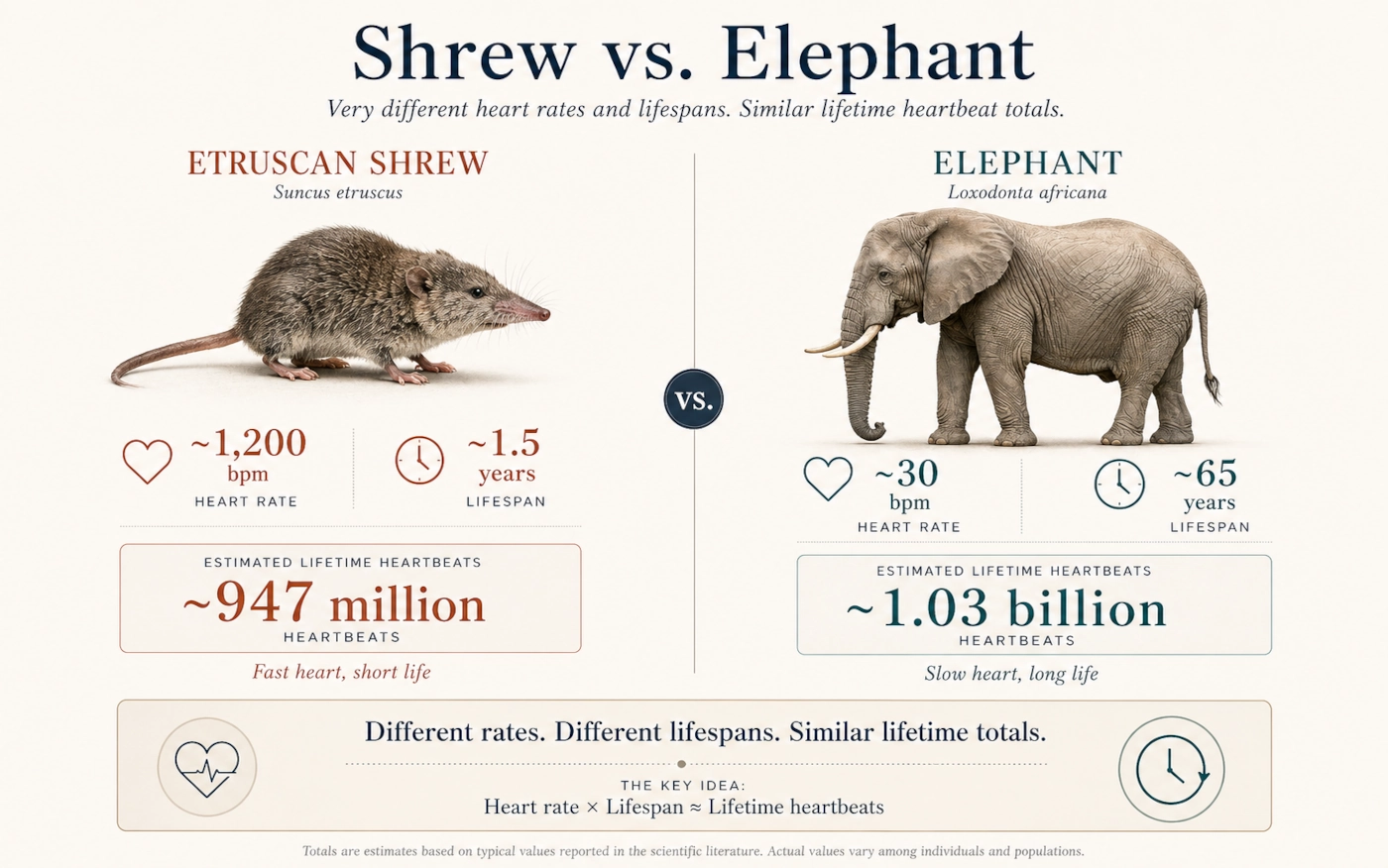
Shrew vs. elephant: a worked example
The shrew-versus-elephant comparison is powerful because the animals are at opposite ends of the land-mammal size range.
A commonly used illustrative calculation goes like this.
Etruscan shrew
Using:
1,200 beats/minute1.5 years
the calculation is:
1,200 × 60 × 24 × 365.25 × 1.5
which gives approximately:
947 million heartbeats
Large elephant
Using rounded teaching values of:
30 beats/minute65 years
the calculation is:
30 × 60 × 24 × 365.25 × 65
which gives approximately:
1.03 billion heartbeats
At first glance, the match is remarkable.
But it is important not to turn the arithmetic into stronger evidence than it is.
The 1,200 bpm shrew value has been measured during rewarming from torpor; it is not a demonstrated lifetime-average rate. The elephant values are also rounded representatives, while real heart rate changes with age, activity and physiology.
So the worked example demonstrates why the scaling argument is compelling. It does not prove that either animal literally experiences that exact number of beats.
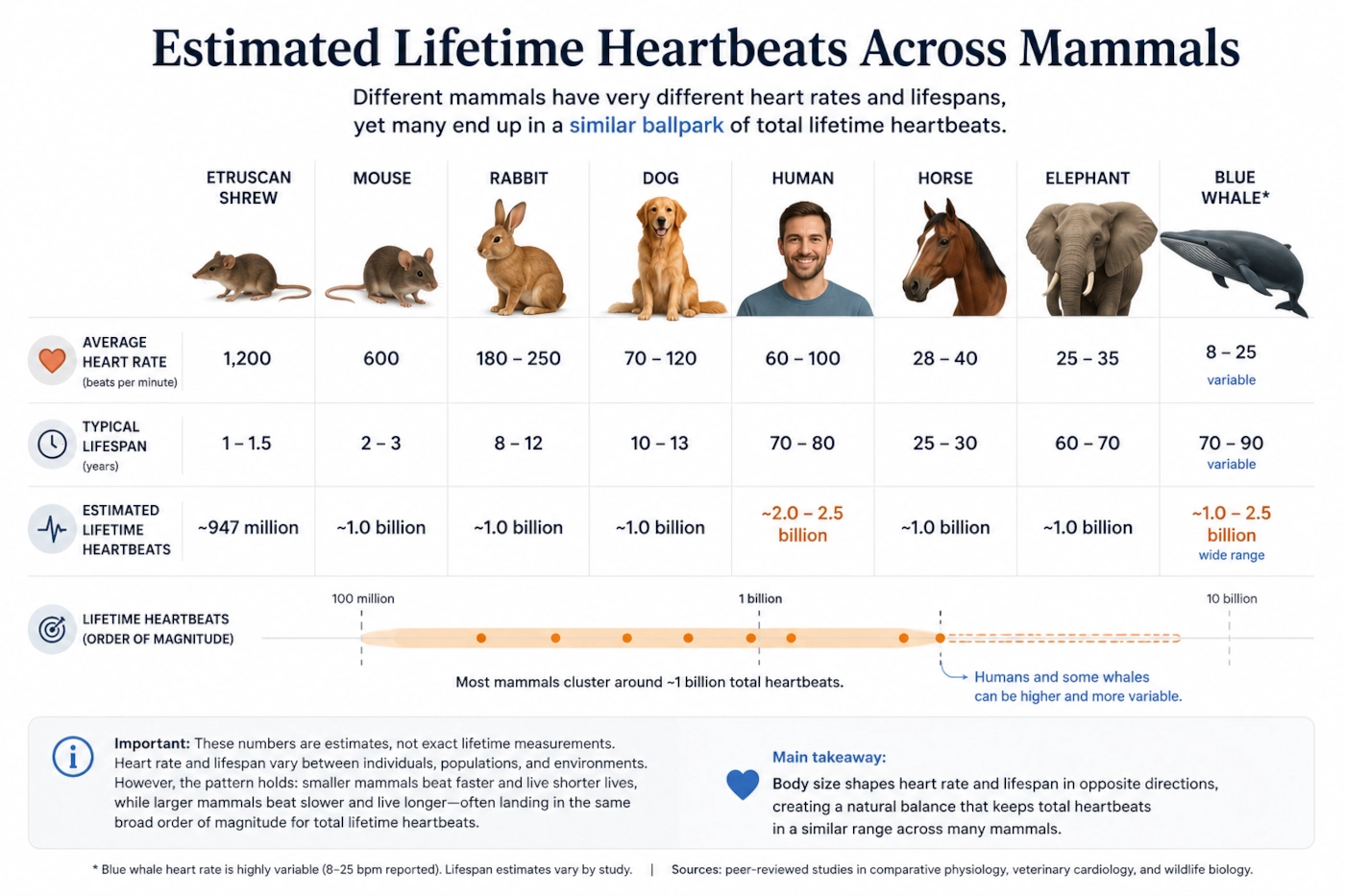
Heart rate, lifespan and lifetime heartbeats across mammals
A useful way to separate the idea from the myth is to compare what is actually being measured.
| Example | Heart-rate information | Time used | What the arithmetic tells us |
|---|---|---|---|
| Etruscan shrew | Up to 800–1,200 bpm during rewarming from torpor | Illustrative 1.5 years | Can produce a total near one billion, but the high rate is not a lifetime average |
| Large elephant | Rounded illustrative value around 30 bpm | Illustrative 65 years | Produces a total near one billion, but both inputs are approximations |
| Human example | Hypothetical constant 70 bpm | 80 years | About 2.95 billion beats, showing humans need not fit a strict one-billion rule |
| Blue whale | Typically 4–8 bpm during recorded dives; minimum about 2 bpm | Minutes of a dive | Shows how dramatically heart rate changes with physiological state; it cannot be extrapolated directly over a lifetime |
The scientifically correct lifetime quantity would be closer to:
Total beats = integral of heart rate over the entire lifespan
In plain English: you would have to count every beat while heart rate rises and falls across every activity, season, age and physiological state.
We do not have that kind of lifetime recording for thousands of mammal species.
Most “lifetime heartbeat” numbers are therefore estimates built from representative heart rates and lifespan statistics.
Does a slower heartbeat actually make an animal live longer?
Across mammal species, slower heart rates and longer lifespans are often associated.
That does not prove that a slower heart rate causes a longer life.
Body size, metabolic strategy, development, reproduction, ecology, predation, disease, genetics, immune function, oxidative stress, cellular maintenance and many other variables change together across species.
This distinction becomes especially important when researchers control for relatedness and body size.
A 2007 comparative analysis by de Magalhaes, Costa and Church found that after correcting for body mass and phylogeny, basal metabolic rate did not correlate with longevity in eutherian mammals or birds. The same study noted that groups such as bats and primates live longer than expected for their body size.
That result is hard to reconcile with the simplest “faster metabolism burns through life faster” story.
So the safer conclusion is:
Mammalian heart rate, body size and lifespan participate in broad scaling relationships, but heart rate is not a standalone lifespan timer.
Is there really a fixed “heartbeat budget”?
No evidence shows that mammals are born with a counter set to one billion and die when it reaches zero.
The fixed-budget interpretation fails for several reasons:
- Published mammalian lifetime-heartbeat estimates vary widely.
- Heart rate changes continuously within an animal.
- Species can live much longer or shorter than expected for their body size.
- Humans can accumulate far more than one billion beats.
- Bats and some other mammals are major longevity outliers.
- Different choices of resting heart rate, average lifespan or maximum lifespan produce different totals.
- The metabolic-scaling exponent itself is debated.
A better mental model is:
The same biological scaling that makes small mammals “fast” and large mammals “slow” can cause their estimated lifetime heartbeat totals to overlap surprisingly often.
Why humans break the one-billion-heartbeats rule
Humans make the problem with a literal heartbeat budget easy to see.
Take a purely illustrative calculation:
- constant heart rate:
70 bpm - lifespan:
80 years
Then:
70 × 60 × 24 × 365.25 × 80 ≈ 2.95 billion beats
That is nearly three times the popular one-billion figure.
The calculation is not meant to describe a real person’s lifetime heart-rate history. Human heart rate varies continuously, just as it does in other mammals.
The important point is that a long human lifespan is perfectly compatible with several billion heartbeats.
Humans are unusual among mammals in many ways, including exceptionally long life for our body size. Our survival is also shaped by factors that are not captured by a simple body-mass scaling equation: sanitation, medicine, nutrition, shelter, reduced exposure to some forms of predation and environmental risk, and social support systems.
Those factors do not “add beats” to a pre-existing budget. They change survival.
Other mammals that do not fit the rule neatly
Humans are not the only outliers.
Comparative biology contains many species whose lifespans are unusually long or short relative to body mass.
Examples include:
- bats;
- primates;
- subterranean mammals such as naked mole-rats;
- species with unusual ecological protection from predators;
- animals that use torpor or hibernation;
- long-lived marine mammals.
These exceptions are scientifically valuable because they help researchers ask a better question:
Instead of “How many beats does an animal get?”, ask “What combination of physiology, ecology and life history lets this species live longer or shorter than its size would predict?”
That question leads to much richer biology.
Bats, primates and unusually long-lived mammals
Bats are perhaps the clearest warning against a simplistic body-size-to-lifespan rule.
A 2019 phylogenetic analysis found that extreme longevity evolved repeatedly in bats. At least four bat lineages were estimated to have lifespans more than four times those of similar-sized placental mammals, and the ancestral bat was projected to have lived substantially longer than expected for its size.
Primates are another group that tends to live longer than body size alone would predict.
This matters because the one-billion-heartbeats claim implicitly assumes that body mass, heart rate and lifespan are coupled tightly enough to cancel one another.
Real evolution gives species many ways to move away from that average relationship.
Is Kleiber’s 3/4 law actually settled science?
No.
Kleiber’s 3/4 exponent is one of the most famous numbers in biological scaling, but the idea that a universal 3/4 law describes all mammals has been challenged repeatedly.
Two findings are particularly important:
- White & Seymour (2003): after reanalyzing mammalian basal metabolic-rate data, they argued for scaling closer to
M^2/3. - Capellini, Venditti & Barton (2010): after accounting for mammalian phylogeny, they found that metabolic scaling varies among lineages and that a single universal exponent was not supported.
Modern work continues to propose new mechanisms and optimization frameworks rather than treating the question as closed.
So when an explainer says:
metabolism ∝ M^3/4
the most accurate interpretation is:
This is a highly influential approximation and theoretical framework, not an uncontested numerical law that every mammal must obey.
What the WBE theory says—and why scientists still debate it
West, Brown and Enquist proposed a general explanation for quarter-power scaling based on resource-distribution networks.
In simplified form, the theory asks how biological networks such as vascular systems can:
- reach the entire volume of an organism;
- distribute resources efficiently;
- use terminal units such as capillaries that remain relatively similar in size;
- minimize energetic costs.
From those constraints, WBE theory derives a set of non-linear scaling relationships, including the famous 3/4 metabolic exponent and associated quarter-power biological times.
Its strength is that it does more than fit one line on a graph: it makes linked predictions for many physiological quantities.
Its weakness, as a universal explanation, is that real biological data do not always follow the same exponent across every lineage, body-size range or metabolic condition.
That is normal science.
A theory can be influential, predictive and useful without being the final word.
Lifetime Heartbeats Calculator
How many times would a heart beat over a lifetime? Or how long would a billion heartbeats take? Enter the numbers below and explore the arithmetic behind the one-billion-heartbeats idea.
Interactive science tool
Explore the math behind the one-billion-heartbeats idea
Estimate how many times a heart would beat over a given number of years, or convert a heartbeat total into an equivalent amount of time.
Try an illustrative example
Estimated lifetime heartbeats
≈ 2.95 billion heartbeats
At a constant 70 bpm over 80 years, the mathematical estimate is about 2.95 billion heartbeats.
Exact mathematical result: 2,945,376,000 heartbeats
Same lifespan, different constant heart rates.
The calculation assumes the same heart rate every minute of every day. Real mammalian heart rates change with activity, sleep, age, temperature, stress, diving, torpor and other physiological states.
Use this as a mathematical comparison, not as a prediction of lifespan.
Why the one-billion-heartbeats rule is only an approximation →How the calculator works
Estimate lifetime heartbeats
Lifetime heartbeats = heart rate × 60 × 24 × 365.25 × yearsConvert heartbeats to equivalent years
Equivalent years = total heartbeats ÷ heart rate ÷ 60 ÷ 24 ÷ 365.25The calculator uses 365.25 days per year and assumes a constant heart rate solely for mathematical comparison.
How long does one billion heartbeats take?
The answer depends entirely on heart rate.
Use:
Years = total heartbeats ÷ beats per minute ÷ 60 ÷ 24 ÷ 365.25
For one billion beats:
| Constant heart rate | Time to 1 billion beats |
|---|---|
| 30 bpm | about 63.4 years |
| 50 bpm | about 38.0 years |
| 60 bpm | about 31.7 years |
| 70 bpm | about 27.2 years |
| 100 bpm | about 19.0 years |
| 600 bpm | about 3.17 years |
| 1,200 bpm | about 1.58 years |
This table is arithmetic, not biology.
No mammal holds exactly one heart rate every minute of its life, and reaching one billion calculated beats does not predict death.
For conversions beyond the essential one-billion-beat example—such as 1.5, 2 or 3 billion heartbeats, or custom calculations using heart rate and lifespan—use the full Lifetime Heartbeats Calculator.
The article stays focused on the biological explanation; the standalone calculator is the utility for custom arithmetic.
Does exercise use up your lifetime heartbeats?
No fixed-heartbeat-budget model has been established, so you should not think of exercise as spending a limited supply of beats.
During exercise, heart rate rises temporarily because tissues need more oxygen and blood flow. At other times, heart rate is lower. The lifetime total is the result of an enormous, changing time series—not a prepaid counter.
Most importantly, the cross-species “one billion” observation is not a medical rule for individuals.
It should not be used to decide how much to exercise, whether to avoid activity, how to interpret a personal pulse or whether to change medication.
What animal has the fastest and slowest heart rate?
There is no single scientifically clean answer unless you define the conditions.
Heart rate changes with:
- rest versus activity;
- age;
- temperature;
- torpor;
- sleep;
- diving;
- stress;
- reproductive state;
- measurement method.
The Etruscan shrew provides an example at the fast end: during arousal from torpor, researchers measured 800–1,200 bpm.
At the slow end, a free-ranging blue whale showed heart rates typically around 4–8 bpm during dives, with a recorded minimum of about 2 bpm.
Those values should not be converted into claims that the shrew “always” beats at 1,200 bpm or the whale “has a 2 bpm heart rate.” They are measurements taken under particular physiological conditions.
That nuance is exactly why lifetime heartbeat totals should be treated cautiously.
Common mistakes
Mistake 1: Treating one billion as an exact number
Published estimates are not exact and can differ by hundreds of millions of beats.
Better: describe the value as an approximate order-of-magnitude pattern.
Mistake 2: Treating a measured heart rate as a lifetime-average heart rate
A peak, resting, diving or torpor heart rate is not the same as the average rate across an entire life.
Better: state the physiological condition in which a heart rate was measured.
Mistake 3: Mixing maximum lifespan with average lifespan
Maximum recorded lifespan and average survival answer different questions.
Better: compare like with like and label the lifespan statistic clearly.
Mistake 4: Assuming correlation proves causation
Large mammals often have slower hearts and longer lives, but those traits share many biological causes.
Better: say they are associated across species, not that one simple variable controls lifespan.
Mistake 5: Thinking exercise “uses up” heartbeats
The fixed heartbeat-budget premise is unsupported.
Better: separate cross-species scaling from personal cardiovascular physiology.
Mistake 6: Presenting the 3/4 exponent as settled for every mammal
The metabolic-scaling literature contains major empirical and theoretical disagreement.
Better: explain Kleiber/WBE as an influential framework and acknowledge alternatives.
Mistake 7: Forgetting the outliers
Bats, primates, humans and other unusually long-lived mammals show that body size alone cannot explain longevity.
Better: use the broad trend as a starting point, not a universal rule.
Security, privacy and safety notes
This article is a comparative biology explainer, not medical guidance.
Do not use the one-billion-heartbeats idea to:
- estimate how long you personally will live;
- decide whether your heart rate is healthy;
- avoid exercise because it raises your pulse;
- change medication;
- diagnose a cardiovascular condition;
- infer that a low heart rate is automatically better;
- compare a personal wearable reading with another species.
For scientific interpretation, also remember that different studies may use different definitions of resting metabolic rate, basal metabolic rate, heart rate and lifespan. Cross-species datasets can be affected by measurement conditions, sample size, phylogeny, captivity, ecology and body-size range.
Faster alternative
If you only need the 30-second explanation, use this:
- Small mammals generally run at faster biological rates.
- Their hearts tend to beat faster.
- They also tend to have shorter lifespans.
- Large mammals tend to show the opposite pattern.
- In a simplified quarter-power model, the body-mass effect on heart rate and lifespan cancels when the two are multiplied.
- That can put many species in the broad range of roughly a billion lifetime beats.
- The number is not exact, the exponent is not universally settled, and there is no fixed heartbeat budget.
That is the useful idea without the myth.
The final verdict
The statement “every mammal gets one billion heartbeats” is too strong.
A more accurate version is:
Many mammals fall within a surprisingly similar order of magnitude for estimated lifetime heartbeats because body size, metabolic rate, heart rate and lifespan scale together. In a classic quarter-power model, heart rate falls approximately as lifespan rises, so their product becomes roughly independent of body mass. But one billion is an approximation, not a biological allotment, and real species show substantial variation and important exceptions.
The claim survives because it captures something genuinely beautiful about biology: living systems do not scale linearly.
A shrew is not simply a miniature elephant running the same machinery at the same rate. Size changes the tempo of life.
The mistake is turning that scaling insight into a literal countdown.
FAQ
Do all mammals get exactly one billion heartbeats?
No. The figure is an approximation. Published comparative estimates vary, and individual species can fall well above or below one billion.
Why do bigger mammals generally have slower heart rates?
Larger mammals generally have lower mass-specific metabolic demands and operate on longer physiological timescales. In classic allometric models, characteristic heart rate declines as body mass increases.
Do animals with slower heartbeats live longer?
Across mammal species, slower heart rates and longer lifespans are often correlated. That does not prove that a slower heart rate by itself causes longer life.
Does a fast heart rate mean an animal burns through its life faster?
That is too simplistic. Heart rate, metabolic rate, lifespan, development, ecology and many other traits covary. After controlling for body mass and phylogeny, some comparative studies do not find a simple metabolic-rate-to-longevity relationship.
How long would one billion heartbeats take at 60 bpm?
At a constant 60 beats per minute, one billion beats take about 31.7 years.
How long would one billion heartbeats take at 70 bpm?
At a constant 70 beats per minute, one billion beats take about 27.2 years.
How many heartbeats are there in 70 years?
At a hypothetical constant 70 bpm, about 2.58 billion. At 60 bpm, about 2.21 billion.
Do humans get more than one billion heartbeats?
A simple example shows that they easily can. A constant 70 bpm over 80 years would equal about 2.95 billion beats. Real human heart rate is not constant, so this is only an illustration.
Which mammal has the fastest heartbeat?
It depends on the physiological condition being measured. Etruscan shrews have been measured at approximately 800–1,200 bpm during rewarming from torpor, placing them among the fastest measured mammalian heart rates.
Which mammal has the slowest heartbeat?
Again, the condition matters. A study of a free-ranging blue whale recorded heart rates as low as about 2 bpm during dives, with typical dive values around 4–8 bpm.
Is Kleiber’s Law proven?
The broad fact that metabolism scales non-linearly with body size is well established. The exact exponent and whether a universal 3/4 law applies across mammals remain debated.
Is the WBE theory accepted?
WBE theory is highly influential and makes important quantitative predictions, but it is not the only explanation for metabolic scaling and its assumptions and universality remain subjects of scientific debate.
Does exercise use up a fixed number of heartbeats?
No fixed lifetime-heartbeat allowance has been demonstrated. The cross-species pattern should not be used as an individual exercise or health rule.
Which mammal has the most lifetime heartbeats?
There is no defensible universal winner based on current comparative data. Lifetime totals are usually estimates, heart rate varies continuously, and exceptionally long-lived species can exceed simple allometric expectations.
Sources and further reading
- West GB, Brown JH, Enquist BJ. “A General Model for the Origin of Allometric Scaling Laws in Biology.” Science (1997).
-
West GB et al. “Allometric scaling of metabolic rate from molecules and mitochondria to cells and mammals.” Proceedings of the National Academy of Sciences (2002). This paper discusses an approximate mammalian lifetime-heartbeat invariant of
1.5 × 10^9. -
Levine HJ. “Rest heart rate and life expectancy.” Journal of the American College of Cardiology (1997). The comparative analysis reports an average of
7.3 ± 5.6 × 10^8heartbeats per lifetime across the mammals examined. - White CR, Seymour RS. “Mammalian basal metabolic rate is proportional to body mass 2/3.” Proceedings of the National Academy of Sciences (2003).
- Capellini I, Venditti C, Barton RA. “Phylogeny and metabolic scaling in mammals.” Ecology (2010).
- White CR et al. “Metabolic scaling is the product of life-history optimization.” Science (2022).
- de Magalhaes JP, Costa J, Church GM. “An Analysis of the Relationship Between Metabolism, Developmental Schedules, and Longevity Using Phylogenetic Independent Contrasts.” (2007).
- Fons R, Sender S, Peters T, Jürgens KD. “Rates of rewarming, heart and respiratory rates and their significance for oxygen transport during arousal from torpor in the smallest mammal, the Etruscan shrew Suncus etruscus.” Journal of Experimental Biology (1997).
- Goldbogen JA et al. “Extreme bradycardia and tachycardia in the world’s largest animal.” Proceedings of the National Academy of Sciences (2019).
- Wilkinson GS, Adams DM. “Recurrent evolution of extreme longevity in bats.” Biology Letters (2019).
Last tested
Tested on:
- Peer-reviewed mammalian metabolic-scaling literature
- Comparative heart-rate and longevity literature
- Primary Etruscan shrew heart-rate measurements
- Primary blue whale heart-rate measurements
- Lifetime-heartbeat arithmetic using 365.25 days per year
Last tested: 2026-08-11
Related guides
Carefully selected guides to help you understand the topic and complete the next useful step.